Science Explorer Back to mapMap
Discussion
University · Abeokuta · Nigeria

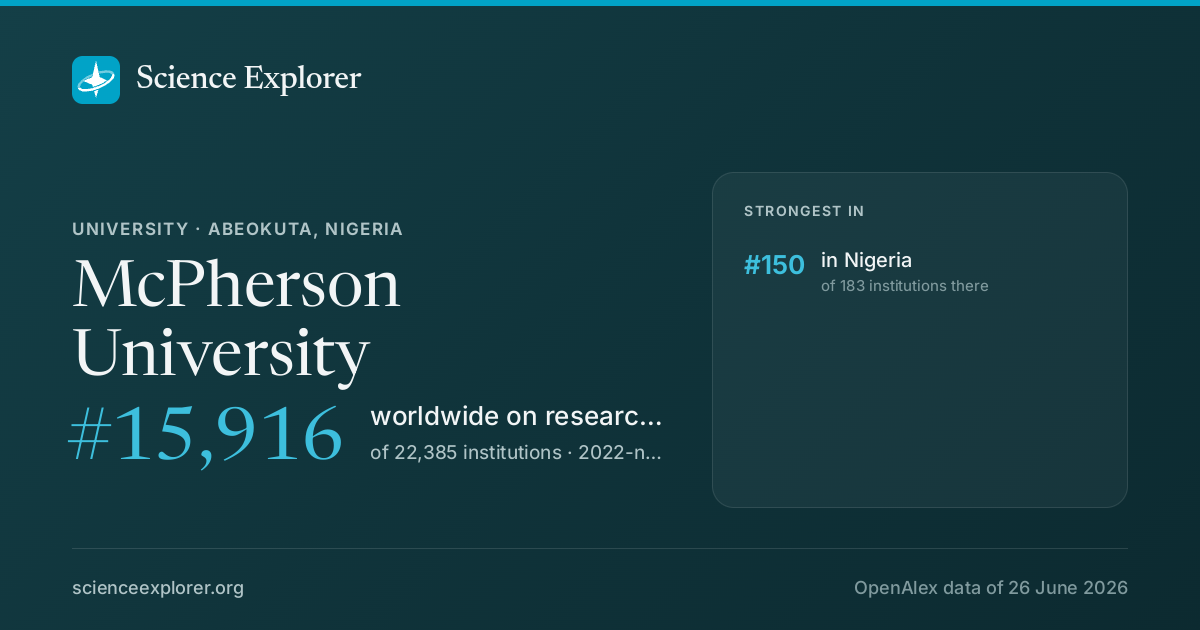
McPherson University

World rank, 2022-now
#15,916
of 22,385 · #20,835 all time
Rank in Nigeria
#150
of 183
Research works
256
▲ 19% vs 2018-21
Citations
1.7k
6.7 per fractional work
Top-10% rate
6.7%
all institutions 10.0%
vs its own fields
0.90×
1.00× is exactly expected
Open access
65%
world 40%
International
16%
world 18%

Which fields of science does McPherson University work in?

In 2022-now, 37% of research at McPherson University is in Social Sciences, 27% in Physical Sciences. Its largest fields are Social Sciences (20%), Medicine (15%), Computer Science (12%). It does 1.4× the world's share of Social Sciences.

Social Sciences: 46 fractional works · 36.6% of its workSocial Sciences: 25 fractional works · 20.3% of its workSociology and Political Science: 8 fractional works · 6.7% of its workCommunication: 3 fractional works · 2.6% of its workEducation: 3 fractional works · 2.3% of its workLaw: 2 fractional works · 1.6% of its workPolitical Science and International Relations: 2 fractional works · 1.4% of its workAnthropology: 1 fractional works · 1.1% of its workGeneral Social Sciences: 1 fractional works · 0.9% of its workUrban Studies: 1 fractional works · 0.8% of its workHuman Factors and Ergonomics: 1 fractional works · 0.7% of its workGender Studies: 1 fractional works · 0.6% of its workLife-span and Life-course Studies: 1 fractional works · 0.5% of its workSafety Research: 1 fractional works · 0.5% of its workSmaller subfields together: 1 fractional works · 0.5% of its workBusiness, Management and Accounting: 5 fractional works · 4.2% of its workAccounting: 3 fractional works · 2.4% of its workOrganizational Behavior and Human Resource Management: 1 fractional works · 0.8% of its workStrategy and Management: 1 fractional works · 0.8% of its workSmaller subfields together: 0 fractional works · 0.3% of its workArts and Humanities: 5 fractional works · 4.0% of its workPhilosophy: 2 fractional works · 1.4% of its workLiterature and Literary Theory: 2 fractional works · 1.3% of its workLanguage and Linguistics: 0 fractional works · 0.4% of its workMuseology: 0 fractional works · 0.4% of its workReligious studies: 0 fractional works · 0.4% of its workSmaller subfields together: 0 fractional works · 0.1% of its workEconomics, Econometrics and Finance: 4 fractional works · 3.6% of its workEconomics and Econometrics: 4 fractional works · 3.1% of its workFinance: 0 fractional works · 0.4% of its workSmaller subfields together: 0 fractional works · 0.1% of its workPsychology: 4 fractional works · 3.2% of its workSocial Psychology: 2 fractional works · 1.4% of its workClinical Psychology: 2 fractional works · 1.3% of its workExperimental and Cognitive Psychology: 0 fractional works · 0.3% of its workSmaller subfields together: 0 fractional works · 0.2% of its workDecision Sciences: 2 fractional works · 1.3% of its workManagement Science and Operations Research: 2 fractional works · 1.3% of its workPhysical Sciences: 34 fractional works · 27.0% of its workComputer Science: 15 fractional works · 12.3% of its workArtificial Intelligence: 5 fractional works · 4.1% of its workComputer Networks and Communications: 4 fractional works · 3.1% of its workInformation Systems: 4 fractional works · 2.9% of its workComputer Vision and Pattern Recognition: 1 fractional works · 0.9% of its workSignal Processing: 1 fractional works · 0.5% of its workComputational Theory and Mathematics: 1 fractional works · 0.4% of its workComputer Science Applications: 0 fractional works · 0.3% of its workSmaller subfields together: 0 fractional works · 0.1% of its workEngineering: 9 fractional works · 7.0% of its workElectrical and Electronic Engineering: 4 fractional works · 3.0% of its workBiomedical Engineering: 2 fractional works · 1.5% of its workBuilding and Construction: 1 fractional works · 1.1% of its workControl and Systems Engineering: 0 fractional works · 0.4% of its workIndustrial and Manufacturing Engineering: 0 fractional works · 0.3% of its workMechanics of Materials: 0 fractional works · 0.2% of its workSmaller subfields together: 1 fractional works · 0.5% of its workEnvironmental Science: 5 fractional works · 4.2% of its workPollution: 2 fractional works · 1.9% of its workHealth, Toxicology and Mutagenesis: 1 fractional works · 0.6% of its workWater Science and Technology: 1 fractional works · 0.5% of its workIndustrial and Manufacturing Engineering: 0 fractional works · 0.4% of its workManagement, Monitoring, Policy and Law: 0 fractional works · 0.4% of its workEnvironmental Engineering: 0 fractional works · 0.2% of its workSmaller subfields together: 0 fractional works · 0.2% of its workMaterials Science: 2 fractional works · 1.5% of its workMaterials Chemistry: 2 fractional works · 1.3% of its workSmaller subfields together: 0 fractional works · 0.2% of its workChemistry: 1 fractional works · 0.6% of its workSpectroscopy: 0 fractional works · 0.4% of its workSmaller subfields together: 0 fractional works · 0.2% of its workMathematics: 1 fractional works · 0.5% of its workModeling and Simulation: 0 fractional works · 0.4% of its workSmaller subfields together: 0 fractional works · 0.1% of its workPhysics and Astronomy: 0 fractional works · 0.4% of its workCondensed Matter Physics: 0 fractional works · 0.3% of its workSmaller subfields together: 0 fractional works · 0.1% of its workEarth and Planetary Sciences: 0 fractional works · 0.3% of its workEnergy: 0 fractional works · 0.1% of its workChemical Engineering: 0 fractional works · 0.1% of its workHealth Sciences: 26 fractional works · 20.8% of its workMedicine: 18 fractional works · 14.6% of its workPediatrics, Perinatology and Child Health: 2 fractional works · 1.9% of its workEpidemiology: 2 fractional works · 1.4% of its workPublic Health, Environmental and Occupational Health: 1 fractional works · 1.1% of its workEndocrinology, Diabetes and Metabolism: 1 fractional works · 1.0% of its workSurgery: 1 fractional works · 1.0% of its workBiochemistry: 1 fractional works · 1.0% of its workPharmacology: 1 fractional works · 0.8% of its workReproductive Medicine: 1 fractional works · 0.7% of its workGenetics: 1 fractional works · 0.6% of its workComplementary and alternative medicine: 1 fractional works · 0.6% of its workCardiology and Cardiovascular Medicine: 1 fractional works · 0.5% of its workPhysiology: 1 fractional works · 0.5% of its workOncology: 1 fractional works · 0.4% of its workPathology and Forensic Medicine: 1 fractional works · 0.4% of its workPulmonary and Respiratory Medicine: 1 fractional works · 0.4% of its workInfectious Diseases: 0 fractional works · 0.4% of its workRadiology, Nuclear Medicine and Imaging: 0 fractional works · 0.4% of its workHealth Informatics: 0 fractional works · 0.3% of its workCritical Care and Intensive Care Medicine: 0 fractional works · 0.3% of its workSmaller subfields together: 1 fractional works · 0.9% of its workHealth Professions: 6 fractional works · 4.9% of its workSpeech and Hearing: 2 fractional works · 1.9% of its workGeneral Health Professions: 2 fractional works · 1.5% of its workHealth Information Management: 2 fractional works · 1.3% of its workSmaller subfields together: 0 fractional works · 0.2% of its workNursing: 1 fractional works · 0.7% of its workNutrition and Dietetics: 1 fractional works · 0.7% of its workDentistry: 1 fractional works · 0.4% of its workPeriodontics: 1 fractional works · 0.4% of its workSmaller subfields together: 0 fractional works · 0.0% of its workVeterinary: 0 fractional works · 0.1% of its workLife Sciences: 19 fractional works · 15.6% of its workBiochemistry, Genetics and Molecular Biology: 11 fractional works · 8.7% of its workMolecular Biology: 6 fractional works · 4.9% of its workBiotechnology: 2 fractional works · 1.2% of its workGenetics: 1 fractional works · 0.9% of its workCancer Research: 1 fractional works · 0.5% of its workClinical Biochemistry: 1 fractional works · 0.5% of its workBiochemistry: 0 fractional works · 0.4% of its workCell Biology: 0 fractional works · 0.3% of its workSmaller subfields together: 0 fractional works · 0.2% of its workAgricultural and Biological Sciences: 6 fractional works · 5.2% of its workPlant Science: 3 fractional works · 2.5% of its workFood Science: 1 fractional works · 1.1% of its workGeneral Agricultural and Biological Sciences: 1 fractional works · 0.9% of its workAnimal Science and Zoology: 0 fractional works · 0.4% of its workSmaller subfields together: 0 fractional works · 0.3% of its workPharmacology, Toxicology and Pharmaceutics: 1 fractional works · 0.7% of its workPharmacology: 1 fractional works · 0.5% of its workSmaller subfields together: 0 fractional works · 0.1% of its workImmunology and Microbiology: 1 fractional works · 0.5% of its workImmunology: 0 fractional works · 0.2% of its workSmaller subfields together: 0 fractional works · 0.3% of its workNeuroscience: 1 fractional works · 0.5% of its workNeurology: 0 fractional works · 0.3% of its workSmaller subfields together: 0 fractional works · 0.2% of its workALL ITS WORKMcPhersonUniversity124fractional works, 2022-now
Life Sciences16%Physical Sciences27%Health Sciences21%Social Sciences37%

Each ring splits the one inside it: the four domains of science, their fields, their subfields. Size is fractional works in 2022-now. Every slice is a page; the interactive view zooms down to single topics and colours each by how much more of it this institution does than the world.

Its 4 domains and 26 fields, with their numbers
    1. Social Sciences2520.3%
    2. Business, Management and Accounting54.2%
    3. Arts and Humanities54.0%
    4. Economics, Econometrics and Finance43.6%
    5. Psychology43.2%
    6. Decision Sciences21.3%
    1. Computer Science1512.3%
    2. Engineering97.0%
    3. Environmental Science54.2%
    4. Materials Science21.5%
    5. Chemistry10.6%
    6. Mathematics10.5%
    7. Physics and Astronomy00.4%
    8. Earth and Planetary Sciences00.3%
    9. Energy00.1%
    10. Chemical Engineering00.1%
    1. Medicine1814.6%
    2. Health Professions64.9%
    3. Nursing10.7%
    4. Dentistry10.4%
    5. Veterinary00.1%
    1. Biochemistry, Genetics and Molecular Biology118.7%
    2. Agricultural and Biological Sciences65.2%
    3. Pharmacology, Toxicology and Pharmaceutics10.7%
    4. Immunology and Microbiology10.5%
    5. Neuroscience10.5%
All of science, and how each field's share has moved since 1950: the Science domain explorer

Field profile

Location quotient across every field it publishes in: outside the ring is more than an institution of this size would be expected to publish, inside it is less.

Agricultural and Biological Sciences: 1.10× its world share, 6 worksAgricultural and Bio…Biochemistry, Genetics and Molecular Biology: 1.64× its world share, 11 worksBiochemistry, Geneti…Immunology and Microbiology: 0.54× its world share, 1 worksImmunology and Micro…Neuroscience: 0.30× its world share, 1 worksNeurosciencePharmacology, Toxicology and Pharmaceutics: 1.84× its world share, 1 worksPharmacology, Toxico…Chemical Engineering: 0.19× its world share, 0 worksChemical EngineeringChemistry: 0.36× its world share, 1 worksChemistryComputer Science: 1.59× its world share, 15 worksComputer ScienceEarth and Planetary Sciences: 0.19× its world share, 0 worksEarth and Planetary …Energy: 0.16× its world share, 0 worksEnergyEngineering: 0.46× its world share, 9 worksEngineeringEnvironmental Science: 0.85× its world share, 5 worksEnvironmental ScienceMaterials Science: 0.43× its world share, 2 worksMaterials ScienceMathematics: 0.42× its world share, 1 worksMathematicsPhysics and Astronomy: 0.18× its world share, 0 worksPhysics and AstronomyDentistry: 0.92× its world share, 1 worksDentistryHealth Professions: 1.85× its world share, 6 worksHealth ProfessionsMedicine: 0.76× its world share, 18 worksMedicineNursing: 1.51× its world share, 1 worksNursingVeterinary: 0.63× its world share, 0 worksVeterinaryArts and Humanities: 1.40× its world share, 5 worksArts and HumanitiesBusiness, Management and Accounting: 1.31× its world share, 5 worksBusiness, Management…Decision Sciences: 1.34× its world share, 2 worksDecision SciencesEconomics, Econometrics and Finance: 1.66× its world share, 4 worksEconomics, Econometr…Psychology: 1.05× its world share, 4 worksPsychologySocial Sciences: 1.60× its world share, 25 worksSocial Sciences1×world share
more than its size predictsabout as predictedless

Rings at 0.5×, 1× and 2×. Widest outward: Health Professions, 1.9×. Every wedge is a field page.

All 26 fields, with their numbers
  1. Health Professions1.85×6 works
  2. Pharmacology, Toxicology and Pharmaceutics1.84×1 works
  3. Economics, Econometrics and Finance1.66×4 works
  4. Biochemistry, Genetics and Molecular Biology1.64×11 works
  5. Social Sciences1.60×25 works
  6. Computer Science1.59×15 works
  7. Nursing1.51×1 works
  8. Arts and Humanities1.40×5 works
  9. Decision Sciences1.34×2 works
  10. Business, Management and Accounting1.31×5 works
  11. Agricultural and Biological Sciences1.10×6 works
  12. Psychology1.05×4 works
  13. Dentistry0.92×1 works
  14. Environmental Science0.85×5 works
  15. Medicine0.76×18 works
  16. Veterinary0.63×0 works
  17. Immunology and Microbiology0.54×1 works
  18. Engineering0.46×9 works
  19. Materials Science0.43×2 works
  20. Mathematics0.42×1 works
  21. Chemistry0.36×1 works
  22. Neuroscience0.30×1 works
  23. Chemical Engineering0.19×0 works
  24. Earth and Planetary Sciences0.19×0 works
  25. Physics and Astronomy0.18×0 works
  26. Energy0.16×0 works

Who are the top researchers at McPherson University?

Ranked on the quality score, Olusegun Atanda, Temidayo Akinrinlola and Lawal Babatunde Akeem lead among researchers whose main affiliation is McPherson University.

  1. 1 Olusegun Atanda Nigeria · #1,698,035 worldwide 1.7k citations · 59 works
  2. 2 Temidayo Akinrinlola Nigeria · #2,740,028 worldwide 67 citations · 29 works
  3. 3 Lawal Babatunde Akeem Nigeria · #2,864,172 worldwide 172 citations · 18 works
  4. 4 Ige Francis Olaoye Nigeria · #3,662,452 worldwide 233 citations · 22 works
  5. 5 Kayode Abiodun Oladapo Nigeria · #3,787,622 worldwide 54 citations · 19 works
  6. 6 Kenneth Chukwuemeka Nwoko Nigeria · #4,113,220 worldwide 75 citations · 16 works
  7. 7 Michael Bamitale Osho Nigeria · #4,490,806 worldwide 153 citations · 27 works
  8. 8 Anthony Ilegbinosa Imoisi Nigeria · #4,705,055 worldwide 121 citations · 18 works
  9. 9 Godswill Ehimengbale Akhigbe Nigeria · #4,909,744 worldwide 97 citations · 18 works
  10. 10 Kayode Oladele Olumurewa Nigeria · #5,025,046 worldwide 181 citations · 23 works
All ranked researchers at McPherson University

What are the most cited papers from McPherson University?

The most cited paper from McPherson University is "Evaluation of surface water quality indices and ecological risk assessment for heavy metals in scrap yard neighbourhood" (Olusheyi Z. Ojekunle, Olurotimi V. Ojekunle, Olurotimi V. Ojekunle et al., 2016), with 141 citations. Next come "The Status of Fusarium Mycotoxins in Sub-Saharan Africa: A Review of Emerging Trends and Post-Harvest Mitigation Strategies towards Food Control" (127) and "Machine learning techniques for hate speech classification of twitter data: State-of-the-art, future challenges and research directions" (117).

Most cited papers
#PaperReleasedCitations
1 Evaluation of surface water quality indices and ecological risk assessment for heavy metals in scrap yard neighbourhood Olusheyi Z. Ojekunle, Olurotimi V. Ojekunle, Olurotimi V. Ojekunle et al. · SpringerPlus Open access 3 May 2016 141
2 The Status of Fusarium Mycotoxins in Sub-Saharan Africa: A Review of Emerging Trends and Post-Harvest Mitigation Strategies towards Food Control Cynthia Adaku Chilaka, Marthe De Boevre, Olusegun Atanda et al. · Toxins Open access 5 Jan 2017 127
3 Machine learning techniques for hate speech classification of twitter data: State-of-the-art, future challenges and research directions Femi Emmanuel Ayo, Olusegun O. Folorunso, Friday Thomas Ibharalu et al. · Computer Science Review 13 Oct 2020 117
4 Synthesis of organic derived hydroxyapatite scaffold from pig bone waste for tissue engineering applications Edwin Andrew Ofudje, Archana Rajendran, Abideen Idowu Adeogun et al. · Advanced Powder Technology 21 Sep 2017 117
5 Adsorption of methylene blue onto activated carbon derived from periwinkle shells: kinetics and equilibrium studies Olugbenga Solomon Bello, Idowu Abideen Adeogun, John Chijioke Ajaelu et al. · Chemistry and Ecology Aug 2008 115
All 60 most cited papers, with filters and sorting

Which keywords describe research at McPherson University?

By fractional works in 2022-now, weighted toward what it does more of than the world: Social Media, Oxidative Stress, Globalization, Machine Learning, Flavonoids, Deep Learning, Education and Nutritional Significance.

▲ more of its work than of the world's◆ about the world's share▼ less than the world's

Size is fractional works in 2022-now in the topics tagged with each word; colour is the word's share of this institution's work against its share of the world's. The 40 words are chosen for being large and distinctive. Each links to the topic it comes from most.

All 40 words, with their numbers
  1. Machine Learning7▲ 1.63×24 topics
  2. Deep Learning6▲ 1.38×20 topics
  3. Social Media6▲ 3.4×14 topics
  4. Globalization6▲ 2.3×12 topics
  5. Oxidative Stress5▲ 2.6×25 topics
  6. Education4▲ 2.1×9 topics
  7. Neural Networks4▲ 2.0×11 topics
  8. Cancer3▲ 2.0×12 topics
  9. Human Rights3▲ 2.5×7 topics
  10. Antioxidant3▲ 3.6×14 topics
  11. Security3▲ 3.1×9 topics
  12. Antioxidants2▲ 4.6×7 topics
  13. Flavonoids2▲ 8.0×4 topics
  14. Risk Management2▲ 4.0×5 topics
  15. Social Support2▲ 3.4×7 topics
  16. Information Technology2▲ 3.7×3 topics
  17. Nutritional Significance2▲ 11×3 topics
  18. Community Health Workers2▲ 19×2 topics
  19. Anti-inflammatory2▲ 5.6×8 topics
  20. Fiscal Policy2▲ 8.0×2 topics
  21. Anomaly Detection2▲ 5.5×3 topics
  22. Apoptosis2▲ 4.8×5 topics
  23. Cancer Prevention2▲ 5.9×3 topics
  24. Child Mortality2▲ 21×1 topic
  25. Health Systems2▲ 21×1 topic
  26. Maternal Mortality2▲ 6.8×2 topics
  27. Self-Efficacy2▲ 5.8×2 topics
  28. Alzheimer's Disease2▲ 5.3×4 topics
  29. Food Safety2▲ 5.2×5 topics
  30. Income Tax2▲ 19×2 topics
  31. Non-Communicable Diseases2▲ 5.2×3 topics
  32. Bioavailability2▲ 7.0×3 topics
  33. Cybersecurity2▲ 5.6×2 topics
  34. Employee Engagement2▲ 7.5×2 topics
  35. Capacity Building2▲ 20×2 topics
  36. Earnings Management2▲ 12×2 topics
  37. Leadership Style2▲ 8.8×2 topics
  38. Mediatization2▲ 24×2 topics
  39. Wireless Networks2▲ 8.1×3 topics
  40. Psychological1▲ 18×2 topics

Which research topics does McPherson University publish most on?

By volume in 2022-now: Global Maternal and Child Health, Terrorism, Counterterrorism, and Political Violence, Fiscal Policy and Economic Growth and Global Health and Epidemiology.

  1. 1 Global Maternal and Child Health Pediatrics, Perinatology and Child Health 2 works
  2. 2 Terrorism, Counterterrorism, and Political Violence Sociology and Political Science 1 works
  3. 3 Fiscal Policy and Economic Growth Economics and Econometrics 1 works
  4. 4 Global Health and Epidemiology Health Information Management 1 works
  5. 5 School Health and Nursing Education Speech and Hearing 1 works
  6. 6 Biological Research and Disease Studies Molecular Biology 1 works
  7. 7 Religion and Sociopolitical Dynamics in Nigeria General Social Sciences 1 works
  8. 8 Phytochemicals and Antioxidant Activities Biochemistry 1 works
  9. 9 Network Security and Intrusion Detection Computer Networks and Communications 1 works
  10. 10 African Education and Politics Education 1 works

How open and international is its research?

Against the world's own shares: the tick on each track. Both are shares of its output, so they sit on one scale and can be read against each other as well as against the world.

openly available65.3%not open34.7%

World: 40% of research is openly available.

with international co-authors15.8%domestic only84.2%

World: 18% is written across borders.

How has McPherson University's research output changed?

Output in 2022-2025 was 19% higher than in 2018-2021.

still counting1990200020102020
grewheldshrank

The same series as a ribbon: one cell per year, darker for more. The line above answers how much; this answers when.

Its share of all research

Growing output can still be a shrinking share: all of science grows. This is McPherson University as a percentage of every work published that year, 0.00027% in 2024.

still counting0.00025%0.00050%0.00075%McPherson University0.00068% in 202519801990200020102020

Fractional works of McPherson University over all fractional works that year. How the balance of science has shifted.

Other research institutions in Abeokuta

All research institutions in Abeokuta

Share McPherson University's ranking

McPherson University on Science Explorer

A card with McPherson University's standing and the fields it leads in, for a post or a slide. A link to this page previews as the same card.

Download the card

1200 × 630 PNG, sized for social posts, drawn from the latest snapshot.

Badges for a website1Each links back here and updates with every snapshot

Research measures only: rankings here say nothing about teaching, admissions or student experience. Comparable institutions and collaboration partners have tabs of their own, above.

Discussion

Ask a question or share a note about McPherson University. Posts are plain text and can be reported.