Science Explorer Back to mapMap
Discussion
University · Dallas · United States

Misericordia University

In research, Misericordia University stands highest in Medicine (#5,346 of 8,541 worldwide) and Health Sciences (#6,321 of 9,902 worldwide), 2022-now.

World rank, 2022-now
#14,478
of 22,385 · #13,488 all time
Rank in United States
#2,045
of 3,332
Research works
863
▼ 21% vs 2018-21
Citations
9.6k
11.1 per fractional work
Top-10% rate
10.0%
all institutions 10.0%
vs its own fields
0.92×
1.00× is exactly expected
Open access
29%
world 40%
International
36%
world 18%

What is Misericordia University known for in research?

The fields where it stands highest, 2022-now, ranked among every institution above the floor in each field.

FieldWorld rankWhere that sitsTop-10% rateWorksAll time
MedicineField #5,346 of 8,541 8.5%66 #5574
Health SciencesDomain #6,321 of 9,902 8.8%75 #6394

Each strip is that field's whole ranked pool, with the notch where Misericordia University sits in it, in the colour of the band that rank falls in. The track under the rate is the rate itself: it carries no average mark, because the average differs by field (from about 6% in Dentistry to 21% in Economics).

Which fields of science does Misericordia University work in?

In 2022-now, 60% of research at Misericordia University is in Health Sciences, 26% in Social Sciences. Its largest fields are Medicine (54%), Social Sciences (12%), Arts and Humanities (5%). It does 2.5× the world's share of Health Sciences.

Health Sciences: 97 fractional works · 59.8% of its workMedicine: 88 fractional works · 53.9% of its workCardiology and Cardiovascular Medicine: 12 fractional works · 7.4% of its workSurgery: 12 fractional works · 7.4% of its workPulmonary and Respiratory Medicine: 10 fractional works · 6.3% of its workEpidemiology: 6 fractional works · 3.9% of its workPhysiology: 5 fractional works · 3.0% of its workPublic Health, Environmental and Occupational Health: 4 fractional works · 2.5% of its workNeurology: 4 fractional works · 2.4% of its workOncology: 4 fractional works · 2.3% of its workPathology and Forensic Medicine: 3 fractional works · 1.6% of its workInfectious Diseases: 2 fractional works · 1.4% of its workRheumatology: 2 fractional works · 1.3% of its workRadiology, Nuclear Medicine and Imaging: 2 fractional works · 1.3% of its workPsychiatry and Mental health: 2 fractional works · 1.1% of its workCritical Care and Intensive Care Medicine: 2 fractional works · 1.0% of its workGenetics: 1 fractional works · 0.9% of its workEmergency Medicine: 1 fractional works · 0.8% of its workEndocrinology, Diabetes and Metabolism: 1 fractional works · 0.8% of its workPharmacology: 1 fractional works · 0.8% of its workHematology: 1 fractional works · 0.8% of its workOrthopedics and Sports Medicine: 1 fractional works · 0.7% of its workRehabilitation: 1 fractional works · 0.7% of its workReproductive Medicine: 1 fractional works · 0.6% of its workNephrology: 1 fractional works · 0.6% of its workObstetrics and Gynecology: 1 fractional works · 0.5% of its workDermatology: 1 fractional works · 0.5% of its workPediatrics, Perinatology and Child Health: 1 fractional works · 0.5% of its workOphthalmology: 1 fractional works · 0.5% of its workAnesthesiology and Pain Medicine: 1 fractional works · 0.4% of its workGastroenterology: 0 fractional works · 0.3% of its workHealth Informatics: 0 fractional works · 0.3% of its workInternal Medicine: 0 fractional works · 0.3% of its workFamily Practice: 0 fractional works · 0.2% of its workHepatology: 0 fractional works · 0.2% of its workUrology: 0 fractional works · 0.2% of its workTransplantation: 0 fractional works · 0.2% of its workHealth Professions: 8 fractional works · 4.9% of its workGeneral Health Professions: 3 fractional works · 1.9% of its workOccupational Therapy: 2 fractional works · 1.1% of its workSpeech and Hearing: 1 fractional works · 0.8% of its workPharmacy: 0 fractional works · 0.2% of its workPhysical Therapy, Sports Therapy and Rehabilitation: 0 fractional works · 0.2% of its workRadiological and Ultrasound Technology: 0 fractional works · 0.2% of its workSmaller subfields together: 1 fractional works · 0.4% of its workNursing: 1 fractional works · 0.6% of its workNutrition and Dietetics: 1 fractional works · 0.4% of its workLeadership and Management: 0 fractional works · 0.2% of its workDentistry: 1 fractional works · 0.5% of its workOral Surgery: 0 fractional works · 0.2% of its workSmaller subfields together: 0 fractional works · 0.2% of its workSocial Sciences: 43 fractional works · 26.2% of its workSocial Sciences: 19 fractional works · 11.7% of its workEducation: 6 fractional works · 3.5% of its workSociology and Political Science: 5 fractional works · 3.2% of its workCultural Studies: 2 fractional works · 1.1% of its workAnthropology: 1 fractional works · 0.8% of its workGender Studies: 1 fractional works · 0.7% of its workPolitical Science and International Relations: 1 fractional works · 0.7% of its workHealth: 1 fractional works · 0.5% of its workGeneral Social Sciences: 0 fractional works · 0.3% of its workSafety Research: 0 fractional works · 0.3% of its workGeography, Planning and Development: 0 fractional works · 0.2% of its workLife-span and Life-course Studies: 0 fractional works · 0.2% of its workSmaller subfields together: 0 fractional works · 0.2% of its workArts and Humanities: 9 fractional works · 5.2% of its workHistory: 3 fractional works · 2.0% of its workPhilosophy: 2 fractional works · 1.1% of its workHistory and Philosophy of Science: 1 fractional works · 0.7% of its workLiterature and Literary Theory: 1 fractional works · 0.5% of its workVisual Arts and Performing Arts: 1 fractional works · 0.4% of its workClassics: 0 fractional works · 0.3% of its workMuseology: 0 fractional works · 0.2% of its workSmaller subfields together: 0 fractional works · 0.1% of its workPsychology: 8 fractional works · 4.9% of its workClinical Psychology: 4 fractional works · 2.4% of its workExperimental and Cognitive Psychology: 2 fractional works · 1.3% of its workSocial Psychology: 1 fractional works · 0.7% of its workDevelopmental and Educational Psychology: 1 fractional works · 0.4% of its workSmaller subfields together: 0 fractional works · 0.1% of its workBusiness, Management and Accounting: 4 fractional works · 2.2% of its workAccounting: 1 fractional works · 0.7% of its workMarketing: 1 fractional works · 0.6% of its workOrganizational Behavior and Human Resource Management: 1 fractional works · 0.5% of its workStrategy and Management: 1 fractional works · 0.4% of its workEconomics, Econometrics and Finance: 3 fractional works · 1.7% of its workEconomics and Econometrics: 3 fractional works · 1.7% of its workDecision Sciences: 1 fractional works · 0.5% of its workInformation Systems and Management: 0 fractional works · 0.3% of its workSmaller subfields together: 0 fractional works · 0.2% of its workLife Sciences: 13 fractional works · 8.0% of its workBiochemistry, Genetics and Molecular Biology: 5 fractional works · 2.9% of its workMolecular Biology: 3 fractional works · 1.7% of its workGenetics: 1 fractional works · 0.5% of its workCell Biology: 0 fractional works · 0.3% of its workCancer Research: 0 fractional works · 0.2% of its workSmaller subfields together: 0 fractional works · 0.2% of its workNeuroscience: 5 fractional works · 2.9% of its workCognitive Neuroscience: 2 fractional works · 1.3% of its workNeurology: 1 fractional works · 0.9% of its workCellular and Molecular Neuroscience: 1 fractional works · 0.4% of its workSmaller subfields together: 0 fractional works · 0.3% of its workImmunology and Microbiology: 2 fractional works · 1.1% of its workMicrobiology: 1 fractional works · 0.4% of its workImmunology: 1 fractional works · 0.4% of its workSmaller subfields together: 1 fractional works · 0.3% of its workAgricultural and Biological Sciences: 1 fractional works · 0.7% of its workGeneral Agricultural and Biological Sciences: 1 fractional works · 0.4% of its workPlant Science: 1 fractional works · 0.3% of its workPharmacology, Toxicology and Pharmaceutics: 1 fractional works · 0.4% of its workPharmacology: 1 fractional works · 0.4% of its workPhysical Sciences: 10 fractional works · 6.0% of its workEngineering: 3 fractional works · 1.9% of its workBiomedical Engineering: 1 fractional works · 0.7% of its workControl and Systems Engineering: 1 fractional works · 0.4% of its workAerospace Engineering: 0 fractional works · 0.2% of its workOcean Engineering: 0 fractional works · 0.2% of its workSafety, Risk, Reliability and Quality: 0 fractional works · 0.2% of its workSmaller subfields together: 0 fractional works · 0.1% of its workMathematics: 2 fractional works · 1.0% of its workStatistics and Probability: 1 fractional works · 0.8% of its workSmaller subfields together: 0 fractional works · 0.2% of its workComputer Science: 2 fractional works · 1.0% of its workArtificial Intelligence: 1 fractional works · 0.7% of its workComputer Science Applications: 0 fractional works · 0.2% of its workSmaller subfields together: 0 fractional works · 0.1% of its workEnvironmental Science: 1 fractional works · 0.8% of its workHealth, Toxicology and Mutagenesis: 1 fractional works · 0.4% of its workGlobal and Planetary Change: 0 fractional works · 0.2% of its workSmaller subfields together: 0 fractional works · 0.2% of its workChemistry: 1 fractional works · 0.7% of its workOrganic Chemistry: 1 fractional works · 0.7% of its workEarth and Planetary Sciences: 1 fractional works · 0.3% of its workOceanography: 0 fractional works · 0.2% of its workSmaller subfields together: 0 fractional works · 0.1% of its workMaterials Science: 0 fractional works · 0.1% of its workPhysics and Astronomy: 0 fractional works · 0.1% of its workALL ITS WORKMisericordiaUniversity163fractional works, 2022-now
Life Sciences8%Physical Sciences6%Health Sciences60%Social Sciences26%

Each ring splits the one inside it: the four domains of science, their fields, their subfields. Size is fractional works in 2022-now. Every slice is a page; the interactive view zooms down to single topics and colours each by how much more of it this institution does than the world.

Its 4 domains and 23 fields, with their numbers
    1. Medicine8853.9%
    2. Health Professions84.9%
    3. Nursing10.6%
    4. Dentistry10.5%
    1. Social Sciences1911.7%
    2. Arts and Humanities95.2%
    3. Psychology84.9%
    4. Business, Management and Accounting42.2%
    5. Economics, Econometrics and Finance31.7%
    6. Decision Sciences10.5%
    1. Biochemistry, Genetics and Molecular Biology52.9%
    2. Neuroscience52.9%
    3. Immunology and Microbiology21.1%
    4. Agricultural and Biological Sciences10.7%
    5. Pharmacology, Toxicology and Pharmaceutics10.4%
    1. Engineering31.9%
    2. Mathematics21.0%
    3. Computer Science21.0%
    4. Environmental Science10.8%
    5. Chemistry10.7%
    6. Earth and Planetary Sciences10.3%
    7. Materials Science00.1%
    8. Physics and Astronomy00.1%
All of science, and how each field's share has moved since 1950: the Science domain explorer

Field profile

Location quotient across every field it publishes in: outside the ring is more than an institution of this size would be expected to publish, inside it is less.

Agricultural and Biological Sciences: 0.16× its world share, 1 worksAgricultural and Bio…Biochemistry, Genetics and Molecular Biology: 0.55× its world share, 5 worksBiochemistry, Geneti…Immunology and Microbiology: 1.11× its world share, 2 worksImmunology and Micro…Neuroscience: 1.78× its world share, 5 worksNeurosciencePharmacology, Toxicology and Pharmaceutics: 1.07× its world share, 1 worksPharmacology, Toxico…Chemistry: 0.43× its world share, 1 worksChemistryComputer Science: 0.13× its world share, 2 worksComputer ScienceEarth and Planetary Sciences: 0.22× its world share, 1 worksEarth and Planetary …Engineering: 0.12× its world share, 3 worksEngineeringEnvironmental Science: 0.16× its world share, 1 worksEnvironmental ScienceMaterials Science: 0.03× its world share, 0 worksMaterials ScienceMathematics: 0.88× its world share, 2 worksMathematicsPhysics and Astronomy: 0.05× its world share, 0 worksPhysics and AstronomyDentistry: 0.94× its world share, 1 worksDentistryHealth Professions: 1.86× its world share, 8 worksHealth ProfessionsMedicine: 2.80× its world share, 88 worksMedicineNursing: 1.14× its world share, 1 worksNursingArts and Humanities: 1.81× its world share, 8 worksArts and HumanitiesBusiness, Management and Accounting: 0.68× its world share, 4 worksBusiness, Management…Decision Sciences: 0.50× its world share, 1 worksDecision SciencesEconomics, Econometrics and Finance: 0.78× its world share, 3 worksEconomics, Econometr…Psychology: 1.60× its world share, 8 worksPsychologySocial Sciences: 0.93× its world share, 19 worksSocial Sciences1×world share
more than its size predictsabout as predictedless

Rings at 0.5×, 1× and 2×. Widest outward: Medicine, 2.8×. Every wedge is a field page.

All 23 fields, with their numbers
  1. Medicine2.80×88 works
  2. Health Professions1.86×8 works
  3. Arts and Humanities1.81×8 works
  4. Neuroscience1.78×5 works
  5. Psychology1.60×8 works
  6. Nursing1.14×1 works
  7. Immunology and Microbiology1.11×2 works
  8. Pharmacology, Toxicology and Pharmaceutics1.07×1 works
  9. Dentistry0.94×1 works
  10. Social Sciences0.93×19 works
  11. Mathematics0.88×2 works
  12. Economics, Econometrics and Finance0.78×3 works
  13. Business, Management and Accounting0.68×4 works
  14. Biochemistry, Genetics and Molecular Biology0.55×5 works
  15. Decision Sciences0.50×1 works
  16. Chemistry0.43×1 works
  17. Earth and Planetary Sciences0.22×1 works
  18. Agricultural and Biological Sciences0.16×1 works
  19. Environmental Science0.16×1 works
  20. Computer Science0.13×2 works
  21. Engineering0.12×3 works
  22. Physics and Astronomy0.05×0 works
  23. Materials Science0.03×0 works

Who are the top researchers at Misericordia University?

Ranked on the quality score, Alicia H. Nordstrom, Stevan L. Davies and Thomas Hajkowski lead among researchers whose main affiliation is Misericordia University.

  1. 1 Alicia H. Nordstrom United States · #1,572,910 worldwide 928 citations · 20 works
  2. 2 Stevan L. Davies United States · #2,075,705 worldwide 313 citations · 18 works
  3. 3 Thomas Hajkowski United States · #2,871,691 worldwide 182 citations · 42 works
  4. 4 Glen M. Tellis United States · #2,984,425 worldwide 706 citations · 24 works
  5. 5 Ryan Watson United States · #3,117,613 worldwide 44 citations · 16 works
  6. 6 Gail S. Fidler United States · #3,156,325 worldwide 490 citations · 25 works
  7. 7 Hans Ulrich Steymans United States · #3,175,274 worldwide 80 citations · 33 works
  8. 8 Paul J. Donahue United States · #3,371,711 worldwide 172 citations · 17 works
  9. 9 Roberta H. Mawdsley United States · #3,659,679 worldwide 639 citations · 23 works
  10. 10 BENEDICT M. REYNOLDS United States · #3,713,618 worldwide 1.1k citations · 27 works
All ranked researchers at Misericordia University

What are the most cited papers from Misericordia University?

The most cited paper from Misericordia University is "A Psychometric Toolbox for Testing Validity and Reliability" (Holli A. DeVon, Michelle E. Block, Patricia Moyle‐Wright et al., 2007), with 1,928 citations. Next come "EULAR recommendations for the management of Sjögren's syndrome with topical and systemic therapies" (736) and "Clinical Phenotypes and Outcome of Patients Hospitalized for Acute Heart Failure: The ESC Heart Failure Long-Term Registry" (576).

Most cited papers
#PaperReleasedCitations
1 A Psychometric Toolbox for Testing Validity and Reliability Holli A. DeVon, Michelle E. Block, Patricia Moyle‐Wright et al. · Journal of Nursing Scholarship 23 May 2007 1,928
2 EULAR recommendations for the management of Sjögren's syndrome with topical and systemic therapies Manuel Ramos‐Casals et al. · Annals of the Rheumatic Diseases Open access 31 Oct 2019 736
3 Clinical Phenotypes and Outcome of Patients Hospitalized for Acute Heart Failure: The ESC Heart Failure Long-Term Registry Ovidiu Chioncel, Alexandre Mebazaa, Veli‐Pekka Harjola et al. · European Journal of Heart Failure Open access 30 Apr 2017 576
4 GD2-CART01 for Relapsed or Refractory High-Risk Neuroblastoma Francesca Del Bufalo et al. · New England Journal of Medicine 5 Apr 2023 567
5 Usual versus tight control of systolic blood pressure in non-diabetic patients with hypertension (Cardio-Sis): an open-label randomised trial Paolo Verdecchia, Jan A. Staessen, Fabio Angeli et al. · The Lancet Open access Aug 2009 437
All 60 most cited papers, with filters and sorting

Which keywords describe research at Misericordia University?

By fractional works in 2022-now, weighted toward what it does more of than the world: Epidemiology, Echocardiography, Heart Failure, Quality of Life, Diagnosis, Treatment, Colonialism and History.

▲ more of its work than of the world's◆ about the world's share▼ less than the world's

Size is fractional works in 2022-now in the topics tagged with each word; colour is the word's share of this institution's work against its share of the world's. The 40 words are chosen for being large and distinctive. Each links to the topic it comes from most.

All 40 words, with their numbers
  1. Epidemiology19▲ 3.0×80 topics
  2. Quality of Life7▲ 3.1×32 topics
  3. Echocardiography7▲ 15×7 topics
  4. Treatment6▲ 3.3×30 topics
  5. Diagnosis6▲ 4.1×25 topics
  6. Inflammation5▲ 1.53×37 topics
  7. Heart Failure5▲ 7.2×10 topics
  8. Public Health4▲ 1.89×21 topics
  9. Risk Factors4▲ 2.5×22 topics
  10. Colonialism4▲ 5.4×6 topics
  11. History4▲ 3.8×8 topics
  12. Cardiovascular Disease4▲ 2.1×19 topics
  13. Mental Health4▲ 1.72×12 topics
  14. Literature4▲ 4.4×7 topics
  15. Global Burden3▲ 3.8×9 topics
  16. Clinical Trials3▲ 3.0×12 topics
  17. Identity3▲ 2.8×4 topics
  18. Religion3▲ 4.4×6 topics
  19. Management3▲ 2.5×19 topics
  20. Clinical Practice Guidelines3▲ 3.4×12 topics
  21. Nationalism3▲ 4.1×4 topics
  22. Complications3▲ 3.5×14 topics
  23. Immunotherapy3▲ 2.4×12 topics
  24. Prognosis3▲ 5.3×8 topics
  25. Guidelines3▲ 3.6×11 topics
  26. Sudden Cardiac Death3▲ 20×2 topics
  27. Rehabilitation3▲ 4.1×8 topics
  28. Cardiac Resynchronization Therapy2▲ 38×1 topic
  29. Implantable Cardioverter-Defibrillator2▲ 38×1 topic
  30. Genetic Mutations2▲ 3.4×14 topics
  31. Prognostic Factors2▲ 3.5×9 topics
  32. Student Engagement2▲ 3.6×4 topics
  33. Neuroimaging2▲ 5.0×8 topics
  34. Autoantibodies2▲ 5.3×7 topics
  35. Stroke Prevention2▲ 9.7×2 topics
  36. Catheter Ablation2▲ 9.2×2 topics
  37. Blended Learning2▲ 7.5×1 topic
  38. Empire2▲ 12×2 topics
  39. Evidence-Based Practice2▲ 8.0×2 topics
  40. Mechanical Ventilation2▲ 8.8×2 topics

Which research topics does Misericordia University publish most on?

By volume in 2022-now: Cardiac pacing and defibrillation studies, Online and Blended Learning, Occupational Therapy Practice and Research and Cardiovascular Function and Risk Factors.

  1. 1 Cardiac pacing and defibrillation studies Cardiology and Cardiovascular Medicine 2 works
  2. 2 Online and Blended Learning Education 2 works
  3. 3 Occupational Therapy Practice and Research Occupational Therapy 1 works
  4. 4 Cardiovascular Function and Risk Factors Cardiology and Cardiovascular Medicine 1 works
  5. 5 Asian American and Pacific Histories Cultural Studies 1 works
  6. 6 Innovative Teaching Methods Education 1 works
  7. 7 Italian Fascism and Post-war Society Sociology and Political Science 1 works
  8. 8 Noise Effects and Management Speech and Hearing 1 works
  9. 9 Historical Studies and Socio-cultural Analysis History and Philosophy of Science 1 works
  10. 10 Respiratory Support and Mechanisms Pulmonary and Respiratory Medicine 1 works

How open and international is its research?

Against the world's own shares: the tick on each track. Both are shares of its output, so they sit on one scale and can be read against each other as well as against the world.

openly available28.6%not open71.4%

World: 40% of research is openly available.

with international co-authors35.6%domestic only64.4%

World: 18% is written across borders.

How has Misericordia University's research output changed?

Output in 2022-2025 was 21% lower than in 2018-2021.

still counting1990200020102020
grewheldshrank

The same series as a ribbon: one cell per year, darker for more. The line above answers how much; this answers when.

Its share of all research

Growing output can still be a shrinking share: all of science grows. This is Misericordia University as a percentage of every work published that year, 0.00056% in 2024.

still counting0.0010%0.0020%0.0030%Misericordia University0.00079% in 202519801990200020102020

Fractional works of Misericordia University over all fractional works that year. How the balance of science has shifted.

How much of it reaches the world top 10%

Year by year, against all institutions in the same year.

still counting5%10%15%all institutions10.0% in 2025Misericordia University7.6% in 202520102020

Of each year's output, the share that reached the world's 10% most cited for its field and year. Peak 11.0% in 2022.

Share Misericordia University's ranking
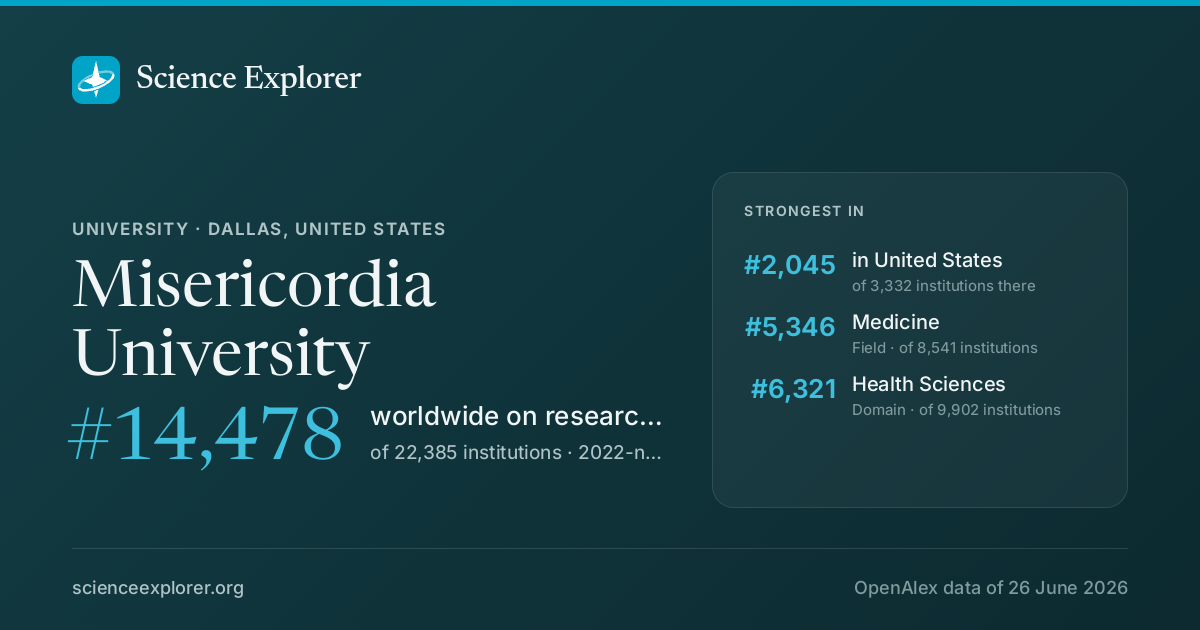
Misericordia University on Science Explorer

A card with Misericordia University's standing and the fields it leads in, for a post or a slide. A link to this page previews as the same card.

Download the card

1200 × 630 PNG, sized for social posts, drawn from the latest snapshot.

Badges for a website1Each links back here and updates with every snapshot

Research measures only: rankings here say nothing about teaching, admissions or student experience. Comparable institutions and collaboration partners have tabs of their own, above.

Discussion

Ask a question or share a note about Misericordia University. Keep it to the research: no personal attacks, advertising or links. Any reader can report a post, which collapses it for everyone until it is opened.
