Murata (Japan)
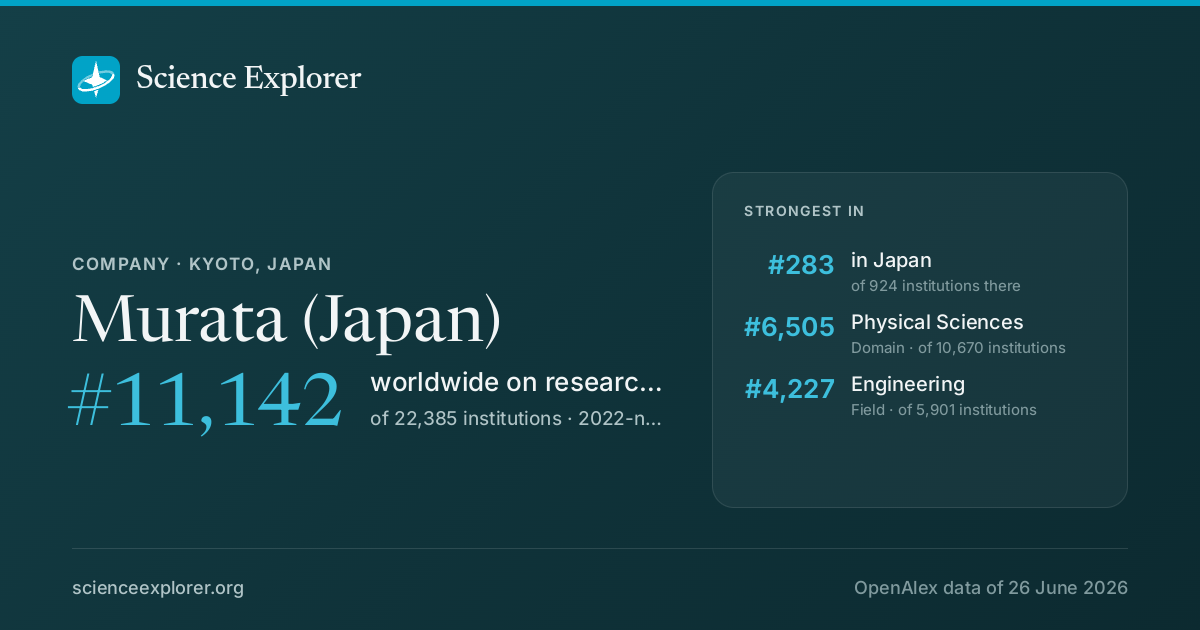
In research, Murata (Japan) stands highest in Physical Sciences (#6,505 of 10,670 worldwide) and Engineering (#4,227 of 5,901 worldwide), 2022-now. Relative to its size it is most specialised in Electrical and Electronic Engineering, Materials Chemistry and Materials Science (Electrical and Electronic Engineering is 6.8× its share of world research).
- World rank, 2022-now
- #11,142 of 22,385 · #8,632 all time
- Rank in Japan
- #283 of 924
- Research works
- 1.8k ▲ 18% vs 2018-21
- Citations
- 25k 14.1 per fractional work
- Top-10% rate
- 6.1% all institutions 10.0%
- vs its own fields
- 0.88× 1.00× is exactly expected
- Open access
- 32% world 40%
- International
- 17% world 18%
What is Murata (Japan) known for in research?
The fields where it stands highest, 2022-now, ranked among every institution above the floor in each field.
| Field | World rank | Where that sits | Top-10% rate | Works | All time |
|---|---|---|---|---|---|
| Physical SciencesDomain | #6,505 of 10,670 | 6.2% | 169 | #3499 | |
| EngineeringField | #4,227 of 5,901 | 5.9% | 109 | #3310 |
Each strip is that field's whole ranked pool, with the notch where Murata (Japan) sits in it, in the colour of the band that rank falls in. The track under the rate is the rate itself: it carries no average mark, because the average differs by field (from about 6% in Dentistry to 21% in Economics).
Which fields of science does Murata (Japan) work in?
In 2022-now, 69% of research at Murata (Japan) is in Physical Sciences, 14% in Health Sciences. Its largest fields are Engineering (44%), Medicine (13%), Materials Science (12%). It does 1.8× the world's share of Physical Sciences.
Each ring splits the one inside it: the four domains of science, their fields, their subfields. Size is fractional works in 2022-now. Every slice is a page; the interactive view zooms down to single topics and colours each by how much more of it this institution does than the world.
Its 4 domains and 25 fields, with their numbers
- Physical Sciences19469.4%
- Engineering12444.4%
- Materials Science3211.5%
- Computer Science155.4%
- Physics and Astronomy93.1%
- Environmental Science51.8%
- Earth and Planetary Sciences41.4%
- Energy20.7%
- Chemistry20.6%
- Chemical Engineering10.4%
- Mathematics00.2%
- Health Sciences4114.5%
- Medicine3612.8%
- Health Professions31.2%
- Dentistry10.4%
- Nursing00.1%
- Social Sciences269.3%
- Life Sciences196.9%
What does Murata (Japan) specialise in?
Where its research is concentrated relative to its size: Electrical and Electronic Engineering takes 6.8× the share of its output that it takes of world research.
- Electrical and Electronic EngineeringSubfield · 68.1 works6.8×
- Materials ChemistrySubfield · 22.9 works4.2×
- Materials ScienceField · 32.2 works3.3×
- EngineeringField · 124.4 works3.0×
Location quotient, a volume reading rather than an impact one. It surfaces small, lopsided specialities.
Field profile
Location quotient across every field it publishes in: outside the ring is more than an institution of this size would be expected to publish, inside it is less.
Rings at 0.5×, 1× and 2×. Widest outward: Materials Science, 3.3×. Every wedge is a field page.
All 25 fields, with their numbers
- Materials Science3.30×32 works
- Engineering2.96×124 works
- Physics and Astronomy1.39×9 works
- Chemical Engineering1.22×1 works
- Earth and Planetary Sciences0.87×4 works
- Dentistry0.86×1 works
- Energy0.75×2 works
- Pharmacology, Toxicology and Pharmaceutics0.74×1 works
- Neuroscience0.73×3 works
- Computer Science0.69×15 works
- Medicine0.67×36 works
- Agricultural and Biological Sciences0.56×7 works
- Economics, Econometrics and Finance0.51×3 works
- Biochemistry, Genetics and Molecular Biology0.47×7 works
- Social Sciences0.47×17 works
- Health Professions0.44×3 works
- Decision Sciences0.37×1 works
- Environmental Science0.36×5 works
- Chemistry0.35×2 works
- Immunology and Microbiology0.27×1 works
- Nursing0.26×0 works
- Arts and Humanities0.23×2 works
- Business, Management and Accounting0.22×2 works
- Psychology0.16×1 works
- Mathematics0.15×0 works
- Materials Science 3.3×
- Engineering 3.0×
- Physics and Astronomy 1.4×
- Chemical Engineering 1.2×
- Earth and Planetary Sciences 0.9×
- Dentistry 0.9×
- Energy 0.8×
- Pharmacology, Toxicology and Pharmaceutics 0.7×
- Neuroscience 0.7×
- Computer Science 0.7×
- Medicine 0.7×
- Agricultural and Biological Sciences 0.6×
- Economics, Econometrics and Finance 0.5×
- Biochemistry, Genetics and Molecular Biology 0.5×
- Social Sciences 0.5×
- Health Professions 0.4×
- Decision Sciences 0.4×
- Environmental Science 0.4×
- Chemistry 0.3×
- Immunology and Microbiology 0.3×
- Nursing 0.3×
- Arts and Humanities 0.2×
- Business, Management and Accounting 0.2×
- Psychology 0.2×
- Mathematics 0.1×
Who are the top researchers at Murata (Japan)?
Ranked on the quality score, Yusuke Morino, Tomoyasu Usui and Takeshi Nakao lead among researchers whose main affiliation is Murata (Japan).
- 1
Yusuke Morino
 Japan · #925,183 worldwide
1.2k citations · 76 works
- 2
Tomoyasu Usui
Japan · #1,132,957 worldwide
1.4k citations · 29 works
- 3
Takeshi Nakao
Japan · #1,418,775 worldwide
2.2k citations · 92 works
- 4
Shuichi Funahashi
Japan · #1,712,444 worldwide
697 citations · 13 works
- 5
Tsutomu Takai
Japan · #1,725,411 worldwide
959 citations · 17 works
- 6
Hideki Iwamoto
Japan · #2,046,609 worldwide
1k citations · 19 works
- 7
Naoki Koshitani
Japan · #2,080,232 worldwide
296 citations · 15 works
- 8
Osamu Nakagawara
Japan · #2,359,424 worldwide
661 citations · 32 works
- 9
Yukio Hamaji
Japan · #2,360,761 worldwide
615 citations · 16 works
- 10
Kikuo Wakino
Japan · #2,470,073 worldwide
3.5k citations · 136 works
Which keywords describe research at Murata (Japan)?
By fractional works in 2022-now, weighted toward what it does more of than the world: Cathode Materials, Lithium-ion Batteries, Energy Storage, Rechargeable Batteries, Thermal Management, Battery Technology, Battery Materials and Nanostructured Anodes.
- Resonators
- Thermal Behavior
- Materials
- CMOS Design
- Low-Noise Amplifiers
- Two-Dimensional Materials
- Electronic Structure
- Frequency Synthesizer
- Thermal Runaway
- Thin Film Resonators
- High-Frequency Applications
- Biosensors
- Power Electronics
- Ferroelectric Materials
- Thin Films
- Lithium-Sulfur Batteries
- Nanostructured Anodes
- Battery Technology
- Rechargeable Batteries
- Lithium-ion Batteries
- Cathode Materials
- Energy Storage
- Thermal Management
- Battery Materials
- Nanoparticles
- Solid-State Electrolytes
- Electric Vehicles
- Lead-free Piezoceramics
- Biological Detection
- Biosensor Applications
- Acoustic Wave Biosensors
- Battery Management Systems
- Integrated Circuits
- Millimeter-Wave
- Sintering
- CMOS
- Oscillators
- Electric Vehicle Charging
- Superconductivity
- Ceramics
Size is fractional works in 2022-now in the topics tagged with each word; colour is the word's share of this institution's work against its share of the world's. The 40 words are chosen for being large and distinctive. Each links to the topic it comes from most.
All 40 words, with their numbers
- Cathode Materials16▲ 15×3 topics
- Lithium-ion Batteries13▲ 11×2 topics
- Energy Storage12▲ 6.9×6 topics
- Rechargeable Batteries9▲ 12×2 topics
- Thermal Management9▲ 9.7×4 topics
- Battery Technology8▲ 11×2 topics
- Battery Materials8▲ 18×1 topic
- Nanostructured Anodes8▲ 18×1 topic
- Nanoparticles8▲ 2.2×17 topics
- Lithium-Sulfur Batteries7▲ 18×1 topic
- Solid-State Electrolytes7▲ 21×1 topic
- Thin Films7▲ 12×8 topics
- Electric Vehicles6▲ 7.8×3 topics
- Ferroelectric Materials6▲ 58×1 topic
- Lead-free Piezoceramics6▲ 58×1 topic
- Power Electronics6▲ 6.8×6 topics
- Biological Detection6▲ 24×2 topics
- Biosensors6▲ 4.2×8 topics
- Biosensor Applications5▲ 18×3 topics
- High-Frequency Applications5▲ 42×2 topics
- Acoustic Wave Biosensors5▲ 64×1 topic
- Thin Film Resonators5▲ 64×1 topic
- Battery Management Systems5▲ 12×1 topic
- Thermal Runaway5▲ 12×1 topic
- Integrated Circuits5▲ 12×3 topics
- Frequency Synthesizer5▲ 41×2 topics
- Millimeter-Wave4▲ 43×2 topics
- Electronic Structure4▲ 8.7×5 topics
- Sintering4▲ 12×4 topics
- Two-Dimensional Materials4▲ 6.7×3 topics
- CMOS4▲ 30×2 topics
- Low-Noise Amplifiers4▲ 53×1 topic
- Oscillators4▲ 53×1 topic
- CMOS Design4▲ 68×2 topics
- Electric Vehicle Charging4▲ 17×2 topics
- Materials4▲ 6.1×4 topics
- Superconductivity4▲ 7.9×5 topics
- Thermal Behavior4▲ 33×2 topics
- Ceramics4▲ 8.8×4 topics
- Resonators4▲ 28×2 topics
Which research topics does Murata (Japan) publish most on?
By volume in 2022-now: Advancements in Battery Materials, Advanced Battery Materials and Technologies, Ferroelectric and Piezoelectric Materials and Acoustic Wave Resonator Technologies.
Area is fractional works; colour is the subfield each topic belongs to.
- 1 Advancements in Battery Materials Electrical and Electronic Engineering 8 works
- 2 Advanced Battery Materials and Technologies Electrical and Electronic Engineering 7 works
- 3 Ferroelectric and Piezoelectric Materials Materials Chemistry 6 works
- 4 Acoustic Wave Resonator Technologies Biomedical Engineering 5 works
- 5 Advanced Battery Technologies Research Automotive Engineering 5 works
- 6 Radio Frequency Integrated Circuit Design Electrical and Electronic Engineering 4 works
- 7 Advanced Power Amplifier Design Electrical and Electronic Engineering 3 works
- 8 Semiconductor materials and devices Electrical and Electronic Engineering 3 works
- 9 3D IC and TSV technologies Electrical and Electronic Engineering 3 works
- 10 Microwave Engineering and Waveguides Electrical and Electronic Engineering 3 works
How open and international is its research?
Against the world's own shares: the tick on each track. Both are shares of its output, so they sit on one scale and can be read against each other as well as against the world.
World: 40% of research is openly available.
World: 18% is written across borders.
How has Murata (Japan)'s research output changed?
Output in 2022-2025 was 18% higher than in 2018-2021.
The same series as a ribbon: one cell per year, darker for more. The line above answers how much; this answers when.
Its share of all research
Growing output can still be a shrinking share: all of science grows. This is Murata (Japan) as a percentage of every work published that year, 0.0013% in 2024.
Fractional works of Murata (Japan) over all fractional works that year. How the balance of science has shifted.
How much of it reaches the world top 10%
Year by year, against all institutions in the same year.
Of each year's output, the share that reached the world's 10% most cited for its field and year. Peak 15.1% in 1991.
Other research institutions in Kyoto
- Kyoto University
- Ritsumeikan University
- Kyoto Prefectural University of Medicine
- Kyoto Institute of Technology
- Doshisha University
- Kyoto Pharmaceutical University
- Ryukoku University
- Ōtani University

Share Murata (Japan)'s ranking
Badges for a website1Each links back here and updates with every snapshot

Research measures only: rankings here say nothing about teaching, admissions or student experience. Comparable institutions and collaboration partners have tabs of their own, above.
Discussion
Ask a question or share a note about Murata (Japan). Posts are plain text and can be reported.