Netaji Subhas Open University

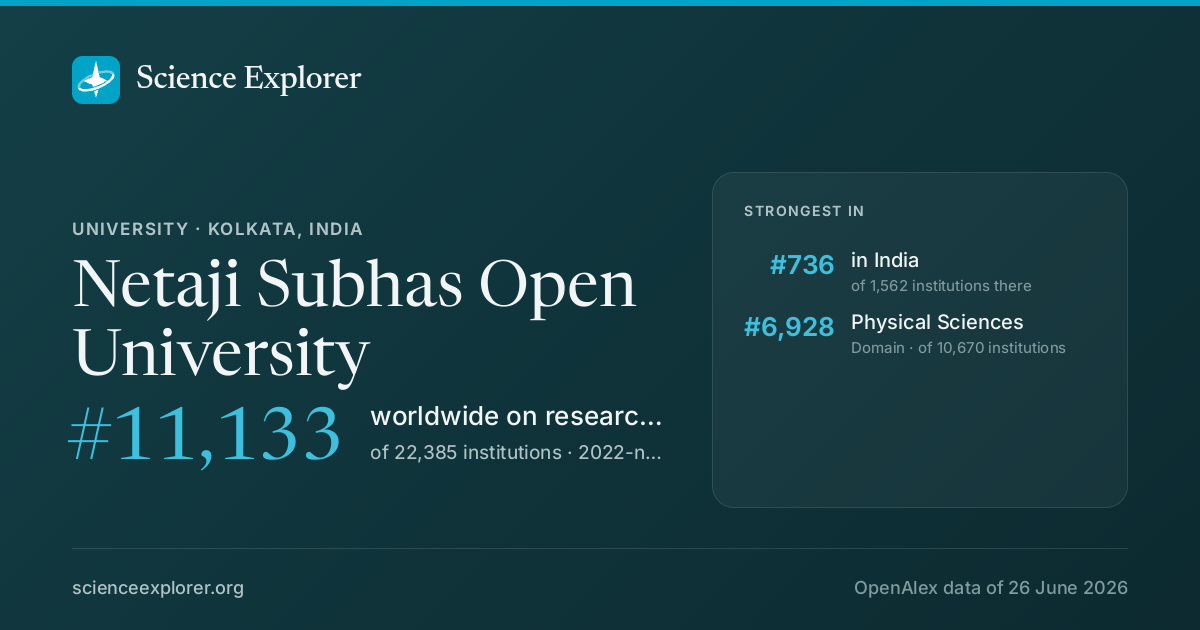
In research, Netaji Subhas Open University stands highest in Physical Sciences (#6,928 of 10,670 worldwide), 2022-now.
- World rank, 2022-now
- #11,133 of 22,385 · #20,112 all time
- Rank in India
- #736 of 1,562
- Research works
- 270 ▲ 206% vs 2018-21
- Citations
- 883 3.3 per fractional work
- Top-10% rate
- 4.2% all institutions 10.0%
- vs its own fields
- 0.97× 1.00× is exactly expected
- Open access
- 48% world 40%
- International
- 11% world 18%
What is Netaji Subhas Open University known for in research?
The fields where it stands highest, 2022-now, ranked among every institution above the floor in each field.
| Field | World rank | Where that sits | Top-10% rate | Works | All time |
|---|---|---|---|---|---|
| Physical SciencesDomain | #6,928 of 10,670 | 4.6% | 82 | #11466 |
Each strip is that field's whole ranked pool, with the notch where Netaji Subhas Open University sits in it, in the colour of the band that rank falls in. The track under the rate is the rate itself: it carries no average mark, because the average differs by field (from about 6% in Dentistry to 21% in Economics).
Which fields of science does Netaji Subhas Open University work in?
In 2022-now, 53% of research at Netaji Subhas Open University is in Physical Sciences, 29% in Social Sciences. Its largest fields are Computer Science (15%), Social Sciences (14%), Engineering (10%). It does 1.3× the world's share of Physical Sciences.
Each ring splits the one inside it: the four domains of science, their fields, their subfields. Size is fractional works in 2022-now. Every slice is a page; the interactive view zooms down to single topics and colours each by how much more of it this institution does than the world.
Its 4 domains and 24 fields, with their numbers
- Physical Sciences9652.8%
- Computer Science2714.7%
- Engineering1910.4%
- Environmental Science1810.1%
- Materials Science73.8%
- Physics and Astronomy63.4%
- Chemical Engineering63.4%
- Chemistry63.1%
- Mathematics52.5%
- Earth and Planetary Sciences21.0%
- Energy10.4%
- Social Sciences5228.8%
- Life Sciences2011.1%
- Health Sciences137.3%
- Medicine105.5%
- Health Professions21.1%
- Nursing10.7%
Field profile
Location quotient across every field it publishes in: outside the ring is more than an institution of this size would be expected to publish, inside it is less.
Rings at 0.5×, 1× and 2×. Widest outward: Chemical Engineering, 9.7×. Every wedge is a field page.
All 24 fields, with their numbers
- Chemical Engineering9.66×6 works
- Mathematics2.16×5 works
- Environmental Science2.04×18 works
- Chemistry1.95×6 works
- Computer Science1.89×27 works
- Arts and Humanities1.75×9 works
- Physics and Astronomy1.54×6 works
- Economics, Econometrics and Finance1.49×6 works
- Decision Sciences1.43×2 works
- Nursing1.36×1 works
- Pharmacology, Toxicology and Pharmaceutics1.24×1 works
- Social Sciences1.13×26 works
- Materials Science1.09×7 works
- Business, Management and Accounting1.05×6 works
- Agricultural and Biological Sciences0.99×9 works
- Biochemistry, Genetics and Molecular Biology0.83×8 works
- Engineering0.69×19 works
- Neuroscience0.63×2 works
- Earth and Planetary Sciences0.63×2 works
- Psychology0.52×3 works
- Energy0.47×1 works
- Immunology and Microbiology0.46×1 works
- Health Professions0.40×2 works
- Medicine0.29×10 works
- Chemical Engineering 9.7×
- Mathematics 2.2×
- Environmental Science 2.0×
- Chemistry 1.9×
- Computer Science 1.9×
- Arts and Humanities 1.8×
- Physics and Astronomy 1.5×
- Economics, Econometrics and Finance 1.5×
- Decision Sciences 1.4×
- Nursing 1.4×
- Pharmacology, Toxicology and Pharmaceutics 1.2×
- Social Sciences 1.1×
- Materials Science 1.1×
- Business, Management and Accounting 1.1×
- Agricultural and Biological Sciences 1.0×
- Biochemistry, Genetics and Molecular Biology 0.8×
- Engineering 0.7×
- Neuroscience 0.6×
- Earth and Planetary Sciences 0.6×
- Psychology 0.5×
- Energy 0.5×
- Immunology and Microbiology 0.5×
- Health Professions 0.4×
- Medicine 0.3×
Who are the top researchers at Netaji Subhas Open University?
Ranked on the quality score, Biraj Kanti Mondal, Avishek Saha and Santanu Saha lead among researchers whose main affiliation is Netaji Subhas Open University.
- 1
Biraj Kanti Mondal
 India · #1,538,958 worldwide
442 citations · 51 works
- 2
Avishek Saha
India · #1,935,333 worldwide
1.2k citations · 60 works
- 3
Santanu Saha
India · #3,188,279 worldwide
170 citations · 15 works
- 4
Rima Das
India · #3,477,831 worldwide
142 citations · 24 works
- 5
Premananda Jana
India · #3,715,973 worldwide
127 citations · 22 works
- 6
Tanmoy Basu
India · #3,757,310 worldwide
46 citations · 22 works
- 7
Himadri Lahiri
India · #4,247,689 worldwide
3 citations · 20 works
- 8
Ashif Ahamed
India · #4,462,110 worldwide
103 citations · 20 works
- 9
Kajal De
India · #4,698,200 worldwide
491 citations · 58 works
- 10
Bibhas Guha
India · #5,312,223 worldwide
259 citations · 30 works
Which keywords describe research at Netaji Subhas Open University?
By fractional works in 2022-now, weighted toward what it does more of than the world: Climate Change, Sustainability, Poverty Reduction, Deep Learning, Machine Learning, Hydrogen Bonding, Land Use Change and Crystal Engineering.
- Metric Dimension
- Teacher Education
- School Subsidies
- Flood Risk
- Approximation Algorithms
- Viscosity
- Conflict
- Thermodynamic Properties
- Gender Inequality
- Extraction
- Nucleation
- Crystallization
- Crystal Growth
- Knowledge Management
- Land Use Change
- Internet of Things
- Artificial Intelligence
- Poverty Reduction
- Machine Learning
- Sustainability
- Climate Change
- Deep Learning
- Remote Sensing
- Renewable Energy
- Human Rights
- Social Capital
- Hydrogen Bonding
- Crystal Engineering
- Ionic Liquids
- Food Security
- Hydrological Modeling
- Aqueous Two-Phase Systems
- Protein Separation
- Vocational Education
- Density
- Disaster Management
- Conditional Cash Transfers
- Food Supply Chain
- Surface Water Mapping
- Graph Labeling
Size is fractional works in 2022-now in the topics tagged with each word; colour is the word's share of this institution's work against its share of the world's. The 40 words are chosen for being large and distinctive. Each links to the topic it comes from most.
All 40 words, with their numbers
- Climate Change10▲ 2.1×24 topics
- Sustainability10▲ 2.2×19 topics
- Deep Learning9▲ 1.50×31 topics
- Machine Learning9▲ 1.48×36 topics
- Remote Sensing5▲ 2.4×13 topics
- Poverty Reduction5▲ 21×4 topics
- Renewable Energy5▲ 1.86×13 topics
- Artificial Intelligence5▲ 1.83×11 topics
- Human Rights4▲ 2.5×7 topics
- Internet of Things4▲ 2.9×9 topics
- Social Capital4▲ 3.8×7 topics
- Land Use Change4▲ 6.4×6 topics
- Hydrogen Bonding3▲ 22×4 topics
- Knowledge Management3▲ 3.3×4 topics
- Crystal Engineering3▲ 15×3 topics
- Crystal Growth3▲ 6.3×3 topics
- Ionic Liquids3▲ 6.2×6 topics
- Crystallization3▲ 30×1 topic
- Food Security3▲ 3.0×6 topics
- Nucleation3▲ 104×1 topic
- Hydrological Modeling3▲ 6.4×3 topics
- Extraction3▲ 11×3 topics
- Aqueous Two-Phase Systems2▲ 118×1 topic
- Gender Inequality2▲ 9.3×3 topics
- Protein Separation2▲ 118×1 topic
- Thermodynamic Properties2▲ 26×2 topics
- Vocational Education2▲ 15×2 topics
- Conflict2▲ 7.4×2 topics
- Density2▲ 109×1 topic
- Viscosity2▲ 17×1 topic
- Disaster Management2▲ 7.4×2 topics
- Approximation Algorithms2▲ 15×2 topics
- Conditional Cash Transfers2▲ 31×1 topic
- Flood Risk2▲ 13×1 topic
- Food Supply Chain2▲ 9.8×2 topics
- School Subsidies2▲ 31×1 topic
- Surface Water Mapping2▲ 14×1 topic
- Teacher Education2▲ 8.6×2 topics
- Graph Labeling2▲ 80×1 topic
- Metric Dimension2▲ 80×1 topic
Which research topics does Netaji Subhas Open University publish most on?
By volume in 2022-now: Crystallization and Solubility Studies, Chemical and Physical Properties in Aqueous Solutions, Thermodynamic properties of mixtures and Flood Risk Assessment and Management.
Area is fractional works; colour is the subfield each topic belongs to.
- 1 Crystallization and Solubility Studies Materials Chemistry 3 works
- 2 Chemical and Physical Properties in Aqueous Solutions Filtration and Separation 2 works
- 3 Thermodynamic properties of mixtures Fluid Flow and Transfer Processes 2 works
- 4 Flood Risk Assessment and Management Global and Planetary Change 2 works
- 5 Poverty, Education, and Child Welfare Safety Research 2 works
- 6 Graph Labeling and Dimension Problems Computational Theory and Mathematics 2 works
- 7 Microfinance and Financial Inclusion Economics and Econometrics 2 works
- 8 COVID-19 Pandemic Impacts Economics and Econometrics 2 works
- 9 Indian History and Philosophy Philosophy 2 works
- 10 South Asian Studies and Conflicts Political Science and International Relations 2 works
How open and international is its research?
Against the world's own shares: the tick on each track. Both are shares of its output, so they sit on one scale and can be read against each other as well as against the world.
World: 40% of research is openly available.
World: 18% is written across borders.
How has Netaji Subhas Open University's research output changed?
Output in 2022-2025 was 206% higher than in 2018-2021.
The same series as a ribbon: one cell per year, darker for more. The line above answers how much; this answers when.
Its share of all research
Growing output can still be a shrinking share: all of science grows. This is Netaji Subhas Open University as a percentage of every work published that year, 0.00066% in 2024.
Fractional works of Netaji Subhas Open University over all fractional works that year. How the balance of science has shifted.
Other research institutions in Kolkata
- Jadavpur University
- University of Calcutta
- Indian Statistical Institute
- Indian Association for the Cultivation of Science
- Presidency University
- Saha Institute of Nuclear Physics
- Maulana Abul Kalam Azad University of Technology, West Bengal
- Botanical Survey of India

Share Netaji Subhas Open University's ranking
Badges for a website1Each links back here and updates with every snapshot

Research measures only: rankings here say nothing about teaching, admissions or student experience. Comparable institutions and collaboration partners have tabs of their own, above.
Discussion
Ask a question or share a note about Netaji Subhas Open University. Keep it to the research: no personal attacks, advertising or links. Any reader can report a post, which collapses it for everyone until it is opened.