Science Explorer Back to mapMap
Discussion
Nonprofit · Nijmegen · Netherlands

Netherlands Bioinformatics Centre

World rank, all time
#28,008
of 34,923
Rank in Netherlands
#358
of 407
Research works
151
▼ 30% vs 2018-21
Citations
7.2k
47.6 per fractional work
Top-10% rate
9.8%
all institutions 10.0%
vs its own fields
1.05×
1.00× is exactly expected
Open access
57%
world 40%
International
27%
world 18%

Which fields of science does Netherlands Bioinformatics Centre work in?

In all years, 53% of research at Netherlands Bioinformatics Centre is in Life Sciences, 20% in Health Sciences. Its largest fields are Biochemistry, Genetics and Molecular Biology (40%), Medicine (18%), Agricultural and Biological Sciences (6%). It does 3.2× the world's share of Life Sciences.

Life Sciences: 81 fractional works · 53.3% of its workBiochemistry, Genetics and Molecular Biology: 61 fractional works · 40.4% of its workMolecular Biology: 47 fractional works · 30.9% of its workGenetics: 8 fractional works · 5.5% of its workCell Biology: 2 fractional works · 1.1% of its workCancer Research: 2 fractional works · 1.0% of its workBiophysics: 1 fractional works · 0.7% of its workBiotechnology: 1 fractional works · 0.6% of its workSmaller subfields together: 1 fractional works · 0.6% of its workAgricultural and Biological Sciences: 9 fractional works · 6.2% of its workPlant Science: 4 fractional works · 2.9% of its workFood Science: 2 fractional works · 1.6% of its workEcology, Evolution, Behavior and Systematics: 2 fractional works · 1.0% of its workAnimal Science and Zoology: 1 fractional works · 0.5% of its workSmaller subfields together: 0 fractional works · 0.2% of its workImmunology and Microbiology: 8 fractional works · 5.4% of its workImmunology: 7 fractional works · 4.6% of its workVirology: 0 fractional works · 0.3% of its workMicrobiology: 0 fractional works · 0.3% of its workSmaller subfields together: 0 fractional works · 0.2% of its workNeuroscience: 2 fractional works · 1.1% of its workCognitive Neuroscience: 1 fractional works · 0.7% of its workSmaller subfields together: 1 fractional works · 0.4% of its workPharmacology, Toxicology and Pharmaceutics: 0 fractional works · 0.2% of its workHealth Sciences: 31 fractional works · 20.4% of its workMedicine: 28 fractional works · 18.2% of its workSurgery: 3 fractional works · 1.8% of its workPublic Health, Environmental and Occupational Health: 3 fractional works · 1.8% of its workEpidemiology: 3 fractional works · 1.8% of its workRadiology, Nuclear Medicine and Imaging: 2 fractional works · 1.6% of its workOncology: 2 fractional works · 1.3% of its workInfectious Diseases: 2 fractional works · 1.3% of its workPediatrics, Perinatology and Child Health: 1 fractional works · 1.0% of its workPulmonary and Respiratory Medicine: 1 fractional works · 0.9% of its workHematology: 1 fractional works · 0.8% of its workCardiology and Cardiovascular Medicine: 1 fractional works · 0.6% of its workGenetics: 1 fractional works · 0.5% of its workReproductive Medicine: 1 fractional works · 0.4% of its workPhysiology: 1 fractional works · 0.4% of its workPathology and Forensic Medicine: 1 fractional works · 0.4% of its workCritical Care and Intensive Care Medicine: 1 fractional works · 0.4% of its workGastroenterology: 0 fractional works · 0.3% of its workEndocrinology, Diabetes and Metabolism: 0 fractional works · 0.3% of its workObstetrics and Gynecology: 0 fractional works · 0.3% of its workImmunology and Allergy: 0 fractional works · 0.3% of its workPharmacology: 0 fractional works · 0.3% of its workDermatology: 0 fractional works · 0.2% of its workUrology: 0 fractional works · 0.2% of its workPsychiatry and Mental health: 0 fractional works · 0.2% of its workSmaller subfields together: 2 fractional works · 1.1% of its workNursing: 2 fractional works · 1.0% of its workNutrition and Dietetics: 2 fractional works · 1.0% of its workHealth Professions: 1 fractional works · 0.7% of its workPhysical Therapy, Sports Therapy and Rehabilitation: 0 fractional works · 0.3% of its workSmaller subfields together: 1 fractional works · 0.4% of its workDentistry: 1 fractional works · 0.4% of its workOral Surgery: 0 fractional works · 0.2% of its workPeriodontics: 0 fractional works · 0.2% of its workVeterinary: 0 fractional works · 0.1% of its workPhysical Sciences: 29 fractional works · 19.3% of its workComputer Science: 8 fractional works · 5.3% of its workComputer Networks and Communications: 2 fractional works · 1.6% of its workComputational Theory and Mathematics: 2 fractional works · 1.4% of its workArtificial Intelligence: 1 fractional works · 0.8% of its workInformation Systems: 1 fractional works · 0.8% of its workComputer Vision and Pattern Recognition: 1 fractional works · 0.4% of its workComputer Science Applications: 0 fractional works · 0.2% of its workSmaller subfields together: 0 fractional works · 0.1% of its workEngineering: 8 fractional works · 5.2% of its workBiomedical Engineering: 4 fractional works · 2.8% of its workIndustrial and Manufacturing Engineering: 2 fractional works · 1.1% of its workElectrical and Electronic Engineering: 1 fractional works · 0.5% of its workMechanical Engineering: 0 fractional works · 0.2% of its workSmaller subfields together: 1 fractional works · 0.6% of its workChemistry: 5 fractional works · 3.5% of its workSpectroscopy: 5 fractional works · 3.1% of its workSmaller subfields together: 1 fractional works · 0.4% of its workEnvironmental Science: 4 fractional works · 2.5% of its workEcology: 2 fractional works · 1.4% of its workHealth, Toxicology and Mutagenesis: 0 fractional works · 0.3% of its workEcological Modeling: 0 fractional works · 0.2% of its workWater Science and Technology: 0 fractional works · 0.2% of its workSmaller subfields together: 1 fractional works · 0.3% of its workMaterials Science: 1 fractional works · 0.9% of its workMaterials Chemistry: 1 fractional works · 0.8% of its workSmaller subfields together: 0 fractional works · 0.1% of its workEarth and Planetary Sciences: 1 fractional works · 0.8% of its workPaleontology: 0 fractional works · 0.3% of its workOceanography: 0 fractional works · 0.2% of its workSmaller subfields together: 0 fractional works · 0.3% of its workPhysics and Astronomy: 1 fractional works · 0.5% of its workAstronomy and Astrophysics: 0 fractional works · 0.2% of its workSmaller subfields together: 0 fractional works · 0.3% of its workMathematics: 1 fractional works · 0.4% of its workStatistics and Probability: 1 fractional works · 0.4% of its workChemical Engineering: 0 fractional works · 0.2% of its workEnergy: 0 fractional works · 0.1% of its workSocial Sciences: 11 fractional works · 7.0% of its workSocial Sciences: 4 fractional works · 2.9% of its workSociology and Political Science: 2 fractional works · 1.2% of its workHealth: 1 fractional works · 0.7% of its workDemography: 0 fractional works · 0.3% of its workGeography, Planning and Development: 0 fractional works · 0.3% of its workEducation: 0 fractional works · 0.2% of its workSmaller subfields together: 0 fractional works · 0.2% of its workDecision Sciences: 4 fractional works · 2.6% of its workInformation Systems and Management: 3 fractional works · 1.8% of its workStatistics, Probability and Uncertainty: 1 fractional works · 0.4% of its workManagement Science and Operations Research: 1 fractional works · 0.4% of its workPsychology: 2 fractional works · 1.1% of its workDevelopmental and Educational Psychology: 1 fractional works · 0.8% of its workSmaller subfields together: 0 fractional works · 0.2% of its workArts and Humanities: 1 fractional works · 0.4% of its workLanguage and Linguistics: 0 fractional works · 0.2% of its workLiterature and Literary Theory: 0 fractional works · 0.2% of its workALL ITS WORKNetherlandsBioinformatics…151fractional works, all years
Life Sciences53%Physical Sciences19%Health Sciences20%Social Sciences7%

Each ring splits the one inside it: the four domains of science, their fields, their subfields. Size is fractional works in all years. Every slice is a page; the interactive view zooms down to single topics and colours each by how much more of it this institution does than the world.

Its 4 domains and 25 fields, with their numbers
    1. Biochemistry, Genetics and Molecular Biology6140.4%
    2. Agricultural and Biological Sciences96.2%
    3. Immunology and Microbiology85.4%
    4. Neuroscience21.1%
    5. Pharmacology, Toxicology and Pharmaceutics00.2%
    1. Medicine2818.2%
    2. Nursing21.0%
    3. Health Professions10.7%
    4. Dentistry10.4%
    5. Veterinary00.1%
    1. Computer Science85.3%
    2. Engineering85.2%
    3. Chemistry53.5%
    4. Environmental Science42.5%
    5. Materials Science10.9%
    6. Earth and Planetary Sciences10.8%
    7. Physics and Astronomy10.5%
    8. Mathematics10.4%
    9. Chemical Engineering00.2%
    10. Energy00.1%
    1. Social Sciences42.9%
    2. Decision Sciences42.6%
    3. Psychology21.1%
    4. Arts and Humanities10.4%
    5. Business, Management and Accounting00.0%
All of science, and how each field's share has moved since 1950: the Science domain explorer

Field profile

Location quotient across every field it publishes in: outside the ring is more than an institution of this size would be expected to publish, inside it is less.

Agricultural and Biological Sciences: 1.91× its world share, 1 worksAgricultural and Bio…Biochemistry, Genetics and Molecular Biology: 2.53× its world share, 1 worksBiochemistry, Geneti…Immunology and Microbiology: 3.20× its world share, 0 worksImmunology and Micro…Neuroscience: 0.37× its world share, 0 worksNeuroscienceChemistry: 0.84× its world share, 0 worksChemistryComputer Science: 0.13× its world share, 0 worksComputer ScienceEngineering: 2.13× its world share, 3 worksEngineeringEnvironmental Science: 0.23× its world share, 0 worksEnvironmental ScienceMaterials Science: 0.68× its world share, 0 worksMaterials ScienceMedicine: 0.86× its world share, 2 worksMedicineNursing: 5.21× its world share, 0 worksNursingVeterinary: 1.79× its world share, 0 worksVeterinaryArts and Humanities: 2.36× its world share, 1 worksArts and HumanitiesDecision Sciences: 1.17× its world share, 0 worksDecision SciencesPsychology: 2.23× its world share, 1 worksPsychologySocial Sciences: 0.13× its world share, 0 worksSocial Sciences1×world share
more than its size predictsabout as predictedless

Rings at 0.5×, 1× and 2×. Widest outward: Nursing, 5.2×. Every wedge is a field page.

All 16 fields, with their numbers
  1. Nursing5.21×0 works
  2. Immunology and Microbiology3.20×0 works
  3. Biochemistry, Genetics and Molecular Biology2.53×1 works
  4. Arts and Humanities2.36×1 works
  5. Psychology2.23×1 works
  6. Engineering2.13×3 works
  7. Agricultural and Biological Sciences1.91×1 works
  8. Veterinary1.79×0 works
  9. Decision Sciences1.17×0 works
  10. Medicine0.86×2 works
  11. Chemistry0.84×0 works
  12. Materials Science0.68×0 works
  13. Neuroscience0.37×0 works
  14. Environmental Science0.23×0 works
  15. Computer Science0.13×0 works
  16. Social Sciences0.13×0 works

Who are the top researchers at Netherlands Bioinformatics Centre?

Ranked on the quality score, B. Hesper lead among researchers whose main affiliation is Netherlands Bioinformatics Centre.

  1. 1 B. Hesper Netherlands · #1,124,695 worldwide 999 citations · 23 works
All ranked researchers at Netherlands Bioinformatics Centre

What are the most cited papers from Netherlands Bioinformatics Centre?

The most cited paper from Netherlands Bioinformatics Centre is "Human gut microbes impact host serum metabolome and insulin sensitivity" (Helle Pedersen et al., 2016), with 2,204 citations. Next come "A series of PDB related databases for everyday needs" (1,386) and "Protein structure analysis of mutations causing inheritable diseases. An e-Science approach with life scientist friendly interfaces" (1,205).

Most cited papers
#PaperReleasedCitations
1 Human gut microbes impact host serum metabolome and insulin sensitivity Helle Pedersen et al. · Nature Open access Jul 2016 2,204
2 A series of PDB related databases for everyday needs Robbie P. Joosten, Tim A. H. te Beek, Elmar Krieger et al. · Nucleic Acids Research Open access 11 Nov 2010 1,386
3 Protein structure analysis of mutations causing inheritable diseases. An e-Science approach with life scientist friendly interfaces Hanka Venselaar, Tim AH te Beek, Remko K. P. Kuipers et al. · BMC Bioinformatics Open access 8 Nov 2010 1,205
4 A community-driven global reconstruction of human metabolism Ines Thiele et al. · Nature Biotechnology Open access 3 Mar 2013 1,087
5 Marine DNA Viral Macro- and Microdiversity from Pole to Pole Ann Gregory et al. · Cell Open access 25 Apr 2019 923
All 61 most cited papers, with filters and sorting

Which keywords describe research at Netherlands Bioinformatics Centre?

By fractional works in all years, weighted toward what it does more of than the world: Bioinformatics, Phylogenetic Analysis, Quality Assessment, RNA-Seq, Gene Expression, genome annotation, sequence alignment and Mass Spectrometry.

▲ more of its work than of the world's◆ about the world's share▼ less than the world's

Size is fractional works in all years in the topics tagged with each word; colour is the word's share of this institution's work against its share of the world's. The 40 words are chosen for being large and distinctive. Each links to the topic it comes from most.

All 40 words, with their numbers
  1. Bioinformatics10▲ 56×4 topics
  2. Phylogenetic Analysis8▲ 15×5 topics
  3. Quality Assessment8▲ 27×3 topics
  4. Machine Learning8▲ 2.3×6 topics
  5. RNA-Seq8▲ 54×2 topics
  6. Gene Expression8▲ 8.2×12 topics
  7. genome annotation7▲ 66×1 topic
  8. sequence alignment7▲ 66×1 topic
  9. Mass Spectrometry6▲ 20×3 topics
  10. Genomics6▲ 12×7 topics
  11. Data Analysis6▲ 12×3 topics
  12. Cancer5▲ 2.3×21 topics
  13. Gene Set Enrichment Analysis5▲ 93×1 topic
  14. Protein-Protein Interaction Networks5▲ 93×1 topic
  15. Proteomics4▲ 25×2 topics
  16. Normalization4▲ 38×2 topics
  17. Clustering4▲ 24×2 topics
  18. Workflow Management4▲ 25×2 topics
  19. Differential Expression4▲ 81×1 topic
  20. Microarray4▲ 81×1 topic
  21. TGF-ß3▲ 13×3 topics
  22. Autoimmunity3▲ 10×3 topics
  23. CD4+CD25+3▲ 28×1 topic
  24. Foxp33▲ 28×1 topic
  25. Data Integration3▲ 8.7×3 topics
  26. Semantic Web Services3▲ 22×2 topics
  27. Translation3▲ 10.0×2 topics
  28. Population Genetics3▲ 12×4 topics
  29. Prediction3▲ 20×2 topics
  30. Protein3▲ 13×2 topics
  31. RNA Structure3▲ 20×1 topic
  32. Ribosome3▲ 20×1 topic
  33. Tandem Mass Spectrometry3▲ 19×2 topics
  34. Protein Identification3▲ 81×1 topic
  35. Quantitative Analysis3▲ 12×1 topic
  36. Gene Regulation3▲ 12×4 topics
  37. Semantic Web3▲ 13×2 topics
  38. Reproducibility3▲ 55×1 topic
  39. Scientific Workflows3▲ 55×1 topic
  40. Microbiota3▲ 7.7×4 topics

Which research topics does Netherlands Bioinformatics Centre publish most on?

By volume in 2022-now: Industrial Vision Systems and Defect Detection, Scheduling and Optimization Algorithms, Probiotics and Fermented Foods and Advanced Manufacturing and Logistics Optimization.

  1. 1 Industrial Vision Systems and Defect Detection Industrial and Manufacturing Engineering 0 works
  2. 2 Scheduling and Optimization Algorithms Industrial and Manufacturing Engineering 0 works
  3. 3 Probiotics and Fermented Foods Food Science 0 works
  4. 4 Advanced Manufacturing and Logistics Optimization Industrial and Manufacturing Engineering 0 works
  5. 5 Second Language Acquisition and Learning Developmental and Educational Psychology 0 works
  6. 6 Second Language Learning and Teaching Literature and Literary Theory 0 works
  7. 7 EFL/ESL Teaching and Learning Language and Linguistics 0 works
  8. 8 Assembly Line Balancing Optimization Industrial and Manufacturing Engineering 0 works
  9. 9 Silicon Carbide Semiconductor Technologies Electrical and Electronic Engineering 0 works
  10. 10 Leptospirosis research and findings Parasitology 0 works

How open and international is its research?

Against the world's own shares: the tick on each track. Both are shares of its output, so they sit on one scale and can be read against each other as well as against the world.

openly available56.8%not open43.2%

World: 40% of research is openly available.

with international co-authors27.2%domestic only72.8%

World: 18% is written across borders.

How has Netherlands Bioinformatics Centre's research output changed?

Output in 2022-2025 was 30% lower than in 2018-2021.

still counting1990200020102020
grewheldshrank

The same series as a ribbon: one cell per year, darker for more. The line above answers how much; this answers when.

Its share of all research

Growing output can still be a shrinking share: all of science grows. This is Netherlands Bioinformatics Centre as a percentage of every work published that year, 0.000035% in 2024.

still counting0.00050%0.0010%Netherlands Bioinformatics Centre0.000023% in 202519801990200020102020

Fractional works of Netherlands Bioinformatics Centre over all fractional works that year. How the balance of science has shifted.

Other research institutions in Nijmegen

All research institutions in Nijmegen

Share Netherlands Bioinformatics Centre's ranking
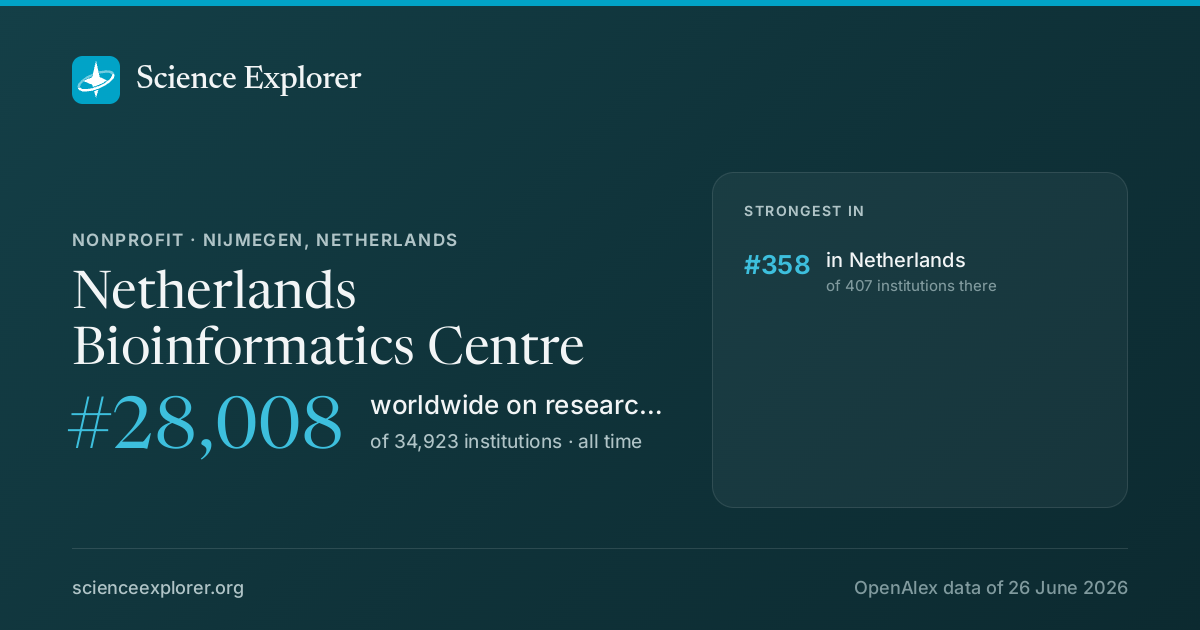
Netherlands Bioinformatics Centre on Science Explorer

A card with Netherlands Bioinformatics Centre's standing and the fields it leads in, for a post or a slide. A link to this page previews as the same card.

Download the card

1200 × 630 PNG, sized for social posts, drawn from the latest snapshot.

Badges for a website1Each links back here and updates with every snapshot

Research measures only: rankings here say nothing about teaching, admissions or student experience. Comparable institutions and collaboration partners have tabs of their own, above.

Discussion

Ask a question or share a note about Netherlands Bioinformatics Centre. Posts are plain text and can be reported.