Science Explorer Back to mapMap
Discussion
Company · Wageningen · Netherlands

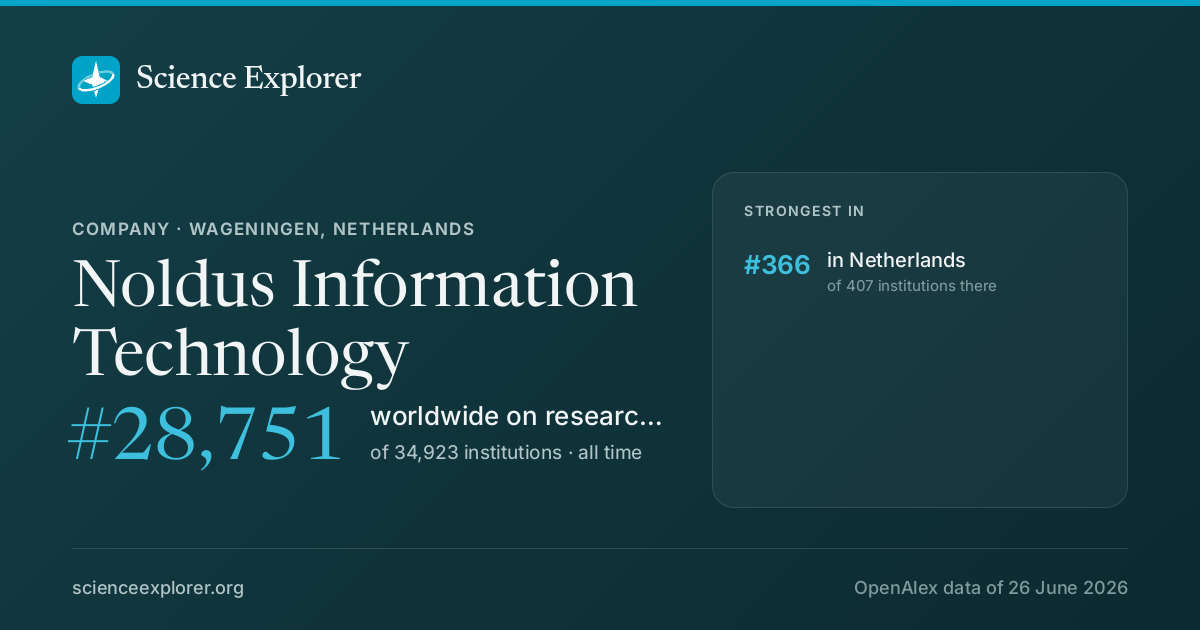
Noldus Information Technology

World rank, all time
#28,751
of 34,923
Rank in Netherlands
#366
of 407
Research works
124
▼ 58% vs 2018-21
Citations
5.2k
41.8 per fractional work
Top-10% rate
11.5%
all institutions 10.0%
vs its own fields
1.03×
1.00× is exactly expected
Open access
47%
world 40%
International
21%
world 18%

Which fields of science does Noldus Information Technology work in?

In all years, 54% of research at Noldus Information Technology is in Physical Sciences, 24% in Social Sciences. Its largest fields are Computer Science (31%), Engineering (16%), Social Sciences (10%). It does 1.3× the world's share of Physical Sciences.

Physical Sciences: 67 fractional works · 53.9% of its workComputer Science: 38 fractional works · 30.7% of its workComputer Networks and Communications: 14 fractional works · 11.0% of its workArtificial Intelligence: 7 fractional works · 5.7% of its workComputer Vision and Pattern Recognition: 6 fractional works · 5.2% of its workInformation Systems: 4 fractional works · 3.2% of its workHuman-Computer Interaction: 3 fractional works · 2.1% of its workSoftware: 2 fractional works · 2.0% of its workComputational Theory and Mathematics: 1 fractional works · 1.0% of its workSignal Processing: 1 fractional works · 0.5% of its workSmaller subfields together: 0 fractional works · 0.2% of its workEngineering: 20 fractional works · 16.0% of its workElectrical and Electronic Engineering: 10 fractional works · 7.9% of its workMechanical Engineering: 3 fractional works · 2.1% of its workAerospace Engineering: 1 fractional works · 1.1% of its workBiomedical Engineering: 1 fractional works · 1.1% of its workMedia Technology: 1 fractional works · 1.0% of its workAutomotive Engineering: 1 fractional works · 0.9% of its workSafety, Risk, Reliability and Quality: 1 fractional works · 0.6% of its workMechanics of Materials: 1 fractional works · 0.5% of its workControl and Systems Engineering: 0 fractional works · 0.4% of its workOcean Engineering: 0 fractional works · 0.2% of its workComputational Mechanics: 0 fractional works · 0.2% of its workIndustrial and Manufacturing Engineering: 0 fractional works · 0.2% of its workSmaller subfields together: 0 fractional works · 0.1% of its workEnvironmental Science: 3 fractional works · 2.5% of its workEcology: 1 fractional works · 0.6% of its workEnvironmental Engineering: 1 fractional works · 0.5% of its workNature and Landscape Conservation: 0 fractional works · 0.4% of its workEcological Modeling: 0 fractional works · 0.3% of its workManagement, Monitoring, Policy and Law: 0 fractional works · 0.2% of its workSmaller subfields together: 1 fractional works · 0.4% of its workMathematics: 2 fractional works · 1.9% of its workGeometry and Topology: 1 fractional works · 0.8% of its workDiscrete Mathematics and Combinatorics: 0 fractional works · 0.4% of its workStatistics and Probability: 0 fractional works · 0.4% of its workApplied Mathematics: 0 fractional works · 0.3% of its workSmaller subfields together: 0 fractional works · 0.1% of its workPhysics and Astronomy: 1 fractional works · 0.9% of its workStatistical and Nonlinear Physics: 1 fractional works · 0.8% of its workSmaller subfields together: 0 fractional works · 0.1% of its workChemical Engineering: 1 fractional works · 0.6% of its workCatalysis: 0 fractional works · 0.3% of its workProcess Chemistry and Technology: 0 fractional works · 0.2% of its workSmaller subfields together: 0 fractional works · 0.1% of its workEnergy: 0 fractional works · 0.4% of its workGeneral Energy: 0 fractional works · 0.2% of its workSmaller subfields together: 0 fractional works · 0.2% of its workMaterials Science: 0 fractional works · 0.4% of its workMaterials Chemistry: 0 fractional works · 0.3% of its workSmaller subfields together: 0 fractional works · 0.1% of its workChemistry: 0 fractional works · 0.3% of its workOrganic Chemistry: 0 fractional works · 0.2% of its workSmaller subfields together: 0 fractional works · 0.1% of its workEarth and Planetary Sciences: 0 fractional works · 0.1% of its workSocial Sciences: 29 fractional works · 23.6% of its workSocial Sciences: 12 fractional works · 9.7% of its workSociology and Political Science: 5 fractional works · 3.7% of its workGender Studies: 2 fractional works · 1.4% of its workPolitical Science and International Relations: 2 fractional works · 1.3% of its workCultural Studies: 1 fractional works · 0.8% of its workCommunication: 1 fractional works · 0.7% of its workEducation: 1 fractional works · 0.6% of its workUrban Studies: 1 fractional works · 0.5% of its workTransportation: 0 fractional works · 0.3% of its workLaw: 0 fractional works · 0.3% of its workSmaller subfields together: 0 fractional works · 0.1% of its workBusiness, Management and Accounting: 7 fractional works · 5.7% of its workStrategy and Management: 2 fractional works · 1.7% of its workMarketing: 2 fractional works · 1.4% of its workManagement of Technology and Innovation: 2 fractional works · 1.2% of its workManagement Information Systems: 1 fractional works · 1.2% of its workSmaller subfields together: 0 fractional works · 0.1% of its workPsychology: 5 fractional works · 3.7% of its workSocial Psychology: 3 fractional works · 2.2% of its workExperimental and Cognitive Psychology: 1 fractional works · 1.0% of its workClinical Psychology: 0 fractional works · 0.3% of its workSmaller subfields together: 0 fractional works · 0.2% of its workDecision Sciences: 2 fractional works · 2.0% of its workInformation Systems and Management: 2 fractional works · 1.4% of its workManagement Science and Operations Research: 0 fractional works · 0.3% of its workStatistics, Probability and Uncertainty: 0 fractional works · 0.3% of its workEconomics, Econometrics and Finance: 2 fractional works · 1.4% of its workFinance: 1 fractional works · 0.8% of its workEconomics and Econometrics: 1 fractional works · 0.6% of its workArts and Humanities: 2 fractional works · 1.2% of its workLiterature and Literary Theory: 0 fractional works · 0.4% of its workMuseology: 0 fractional works · 0.4% of its workMusic: 0 fractional works · 0.3% of its workSmaller subfields together: 0 fractional works · 0.1% of its workLife Sciences: 20 fractional works · 16.0% of its workAgricultural and Biological Sciences: 7 fractional works · 6.0% of its workEcology, Evolution, Behavior and Systematics: 2 fractional works · 1.6% of its workInsect Science: 2 fractional works · 1.4% of its workAnimal Science and Zoology: 1 fractional works · 1.2% of its workPlant Science: 1 fractional works · 0.8% of its workFood Science: 1 fractional works · 0.5% of its workAgronomy and Crop Science: 0 fractional works · 0.2% of its workSmaller subfields together: 0 fractional works · 0.3% of its workBiochemistry, Genetics and Molecular Biology: 6 fractional works · 5.0% of its workMolecular Biology: 2 fractional works · 1.5% of its workCell Biology: 2 fractional works · 1.3% of its workGenetics: 1 fractional works · 1.0% of its workDevelopmental Biology: 1 fractional works · 1.0% of its workSmaller subfields together: 0 fractional works · 0.2% of its workNeuroscience: 5 fractional works · 4.4% of its workCognitive Neuroscience: 3 fractional works · 2.2% of its workSensory Systems: 1 fractional works · 1.0% of its workCellular and Molecular Neuroscience: 1 fractional works · 1.0% of its workSmaller subfields together: 0 fractional works · 0.2% of its workImmunology and Microbiology: 1 fractional works · 0.5% of its workMicrobiology: 1 fractional works · 0.5% of its workPharmacology, Toxicology and Pharmaceutics: 0 fractional works · 0.1% of its workHealth Sciences: 8 fractional works · 6.5% of its workMedicine: 5 fractional works · 4.1% of its workRadiology, Nuclear Medicine and Imaging: 1 fractional works · 0.9% of its workNeurology: 1 fractional works · 0.5% of its workAnesthesiology and Pain Medicine: 1 fractional works · 0.4% of its workPublic Health, Environmental and Occupational Health: 0 fractional works · 0.4% of its workCardiology and Cardiovascular Medicine: 0 fractional works · 0.3% of its workEpidemiology: 0 fractional works · 0.3% of its workRehabilitation: 0 fractional works · 0.3% of its workPhysiology: 0 fractional works · 0.2% of its workPulmonary and Respiratory Medicine: 0 fractional works · 0.2% of its workSmaller subfields together: 1 fractional works · 0.5% of its workVeterinary: 2 fractional works · 1.8% of its workSmall Animals: 2 fractional works · 1.8% of its workHealth Professions: 1 fractional works · 0.5% of its workGeneral Health Professions: 0 fractional works · 0.4% of its workSmaller subfields together: 0 fractional works · 0.1% of its workNursing: 0 fractional works · 0.1% of its workALL ITS WORKNoldusInformation…124fractional works, all years
Life Sciences16%Physical Sciences54%Health Sciences6%Social Sciences24%

Each ring splits the one inside it: the four domains of science, their fields, their subfields. Size is fractional works in all years. Every slice is a page; the interactive view zooms down to single topics and colours each by how much more of it this institution does than the world.

Its 4 domains and 25 fields, with their numbers
    1. Computer Science3830.7%
    2. Engineering2016.0%
    3. Environmental Science32.5%
    4. Mathematics21.9%
    5. Physics and Astronomy10.9%
    6. Chemical Engineering10.6%
    7. Energy00.4%
    8. Materials Science00.4%
    9. Chemistry00.3%
    10. Earth and Planetary Sciences00.1%
    1. Social Sciences129.7%
    2. Business, Management and Accounting75.7%
    3. Psychology53.7%
    4. Decision Sciences22.0%
    5. Economics, Econometrics and Finance21.4%
    6. Arts and Humanities21.2%
    1. Agricultural and Biological Sciences76.0%
    2. Biochemistry, Genetics and Molecular Biology65.0%
    3. Neuroscience54.4%
    4. Immunology and Microbiology10.5%
    5. Pharmacology, Toxicology and Pharmaceutics00.1%
    1. Medicine54.1%
    2. Veterinary21.8%
    3. Health Professions10.5%
    4. Nursing00.1%
All of science, and how each field's share has moved since 1950: the Science domain explorer

Field profile

Location quotient across every field it publishes in: outside the ring is more than an institution of this size would be expected to publish, inside it is less.

Agricultural and Biological Sciences: 2.31× its world share, 1 worksAgricultural and Bio…Biochemistry, Genetics and Molecular Biology: 1.08× its world share, 0 worksBiochemistry, Geneti…Neuroscience: 1.81× its world share, 0 worksNeuroscienceChemical Engineering: 5.61× its world share, 0 worksChemical EngineeringComputer Science: 0.73× its world share, 0 worksComputer ScienceEnergy: 5.34× its world share, 0 worksEnergyEngineering: 0.22× its world share, 0 worksEngineeringEnvironmental Science: 0.22× its world share, 0 worksEnvironmental SciencePhysics and Astronomy: 0.88× its world share, 0 worksPhysics and AstronomyMedicine: 0.42× its world share, 1 worksMedicineVeterinary: 8.00× its world share, 0 worksVeterinaryArts and Humanities: 4.76× its world share, 1 worksArts and HumanitiesBusiness, Management and Accounting: 0.61× its world share, 0 worksBusiness, Management…Psychology: 1.87× its world share, 0 worksPsychologySocial Sciences: 2.44× its world share, 3 worksSocial Sciences1×world share
more than its size predictsabout as predictedless

Rings at 0.5×, 1× and 2×. Widest outward: Veterinary, 8.0×. Every wedge is a field page.

All 15 fields, with their numbers
  1. Veterinary8.00×0 works
  2. Chemical Engineering5.61×0 works
  3. Energy5.34×0 works
  4. Arts and Humanities4.76×1 works
  5. Social Sciences2.44×3 works
  6. Agricultural and Biological Sciences2.31×1 works
  7. Psychology1.87×0 works
  8. Neuroscience1.81×0 works
  9. Biochemistry, Genetics and Molecular Biology1.08×0 works
  10. Physics and Astronomy0.88×0 works
  11. Computer Science0.73×0 works
  12. Business, Management and Accounting0.61×0 works
  13. Medicine0.42×1 works
  14. Engineering0.22×0 works
  15. Environmental Science0.22×0 works

Who are the top researchers at Noldus Information Technology?

Ranked on the quality score, Lucas P. J. J. Noldus, Andrew Spink and Elsbeth van Dam lead among researchers whose main affiliation is Noldus Information Technology.

  1. 1 Lucas P. J. J. Noldus Netherlands · #223,160 worldwide 5.7k citations · 126 works
  2. 2 Andrew Spink Netherlands · #3,698,428 worldwide 689 citations · 30 works
  3. 3 Elsbeth van Dam Netherlands · #4,159,770 worldwide 135 citations · 16 works
All ranked researchers at Noldus Information Technology

What are the most cited papers from Noldus Information Technology?

The most cited paper from Noldus Information Technology is "Evaluation campaigns and TRECVid" (Alan F. Smeaton, Paul Over, Wessel Kraaij, 2006), with 1,228 citations. Next come "Virus Spread in Networks" (1,073) and "EthoVision: A versatile video tracking system for automation of behavioral experiments" (742).

Most cited papers
#PaperReleasedCitations
1 Evaluation campaigns and TRECVid Alan F. Smeaton, Paul Over, Wessel Kraaij Conference paperOpen access 26 Oct 2006 1,228
2 Virus Spread in Networks Piet Van Mieghem, Jasmina Omić, Robert E. Kooij · IEEE/ACM Transactions on Networking Open access 4 Aug 2008 1,073
3 EthoVision: A versatile video tracking system for automation of behavioral experiments Lucas P. J. J. Noldus, Andrew J. Spink, Ruud A.J. Tegelenbosch · Behavior Research Methods, Instruments, & Computers Open access Aug 2001 742
4 Automated image-based tracking and its application in ecology Anthony I. Dell, John A. Bender, Kristin M. Branson et al. · Trends in Ecology & Evolution ReviewOpen access 5 Jun 2014 542
5 The Observer: A software system for collection and analysis of observational data Lucas P. J. J. Noldus · Behavior Research Methods, Instruments, & Computers Open access Sep 1991 476
All 60 most cited papers, with filters and sorting

Which keywords describe research at Noldus Information Technology?

By fractional works in all years, weighted toward what it does more of than the world: Power Control, Wireless Networks, Deep Learning, Resource Allocation, Channel Assignment, User Interaction, Mobile Ad Hoc Networks and Mobility Models.

▲ more of its work than of the world's◆ about the world's share▼ less than the world's

Size is fractional works in all years in the topics tagged with each word; colour is the word's share of this institution's work against its share of the world's. The 40 words are chosen for being large and distinctive. Each links to the topic it comes from most.

All 40 words, with their numbers
  1. Deep Learning8▲ 2.9×18 topics
  2. Power Control5▲ 34×3 topics
  3. Wireless Networks5▲ 17×6 topics
  4. Resource Allocation5▲ 16×3 topics
  5. Climate Change4▲ 1.35×12 topics
  6. Channel Assignment4▲ 28×3 topics
  7. Social Media4▲ 3.7×6 topics
  8. Mobile Ad Hoc Networks3▲ 37×2 topics
  9. Mobility Models3▲ 37×2 topics
  10. User Interaction3▲ 51×2 topics
  11. Routing Protocols3▲ 27×2 topics
  12. Energy Efficiency3▲ 2.9×6 topics
  13. Trust3▲ 8.8×5 topics
  14. Mobile Networks3▲ 32×2 topics
  15. Performance Analysis3▲ 12×3 topics
  16. Wireless Sensor Networks3▲ 5.5×5 topics
  17. Animal Welfare2▲ 18×2 topics
  18. Distributed Systems2▲ 8.4×4 topics
  19. OFDM Systems2▲ 35×2 topics
  20. Participatory Design2▲ 49×2 topics
  21. Massive MIMO2▲ 25×2 topics
  22. User Experience2▲ 30×2 topics
  23. Cross-Layer Optimization2▲ 58×1 topic
  24. Emotional State2▲ 51×1 topic
  25. IEEE 802.112▲ 41×2 topics
  26. Stress Indicators2▲ 51×1 topic
  27. Wireless Communication2▲ 12×1 topic
  28. End-User Software Engineering2▲ 407×1 topic
  29. Interactive Television2▲ 59×1 topic
  30. Meta-design2▲ 407×1 topic
  31. Social TV2▲ 59×1 topic
  32. Content Delivery2▲ 23×2 topics
  33. Information Systems2▲ 10×3 topics
  34. Interference Mitigation2▲ 42×2 topics
  35. Design Research2▲ 74×1 topic
  36. Interaction Design2▲ 74×1 topic
  37. Spectral Efficiency2▲ 21×2 topics
  38. Value Creation2▲ 31×2 topics
  39. Co-Creation2▲ 44×2 topics
  40. Pheromones2▲ 20×2 topics

Which research topics does Noldus Information Technology publish most on?

By volume in 2022-now: Gender Diversity and Inequality, Gender Politics and Representation, Educational Methods and Analysis and Cultural and Sociopolitical Studies.

  1. 1 Gender Diversity and Inequality Gender Studies 1 works
  2. 2 Gender Politics and Representation Gender Studies 0 works
  3. 3 Educational Methods and Analysis Education 0 works
  4. 4 Cultural and Sociopolitical Studies Museology 0 works
  5. 5 Turkish Literature and Culture Literature and Literary Theory 0 works
  6. 6 Global Energy Security and Policy General Energy 0 works
  7. 7 Turkey's Politics and Society Political Science and International Relations 0 works
  8. 8 Families in Therapy and Culture Social Psychology 0 works
  9. 9 Photosynthetic Processes and Mechanisms Molecular Biology 0 works
  10. 10 Human Pose and Action Recognition Computer Vision and Pattern Recognition 0 works

How open and international is its research?

Against the world's own shares: the tick on each track. Both are shares of its output, so they sit on one scale and can be read against each other as well as against the world.

openly available47.3%not open52.7%

World: 40% of research is openly available.

with international co-authors21.4%domestic only78.6%

World: 18% is written across borders.

How has Noldus Information Technology's research output changed?

Output in 2022-2025 was 58% lower than in 2018-2021.

still counting200020102020
grewheldshrank

The same series as a ribbon: one cell per year, darker for more. The line above answers how much; this answers when.

Its share of all research

Growing output can still be a shrinking share: all of science grows. This is Noldus Information Technology as a percentage of every work published that year, 0.000021% in 2024.

still counting0.00020%0.00040%0.00060%Noldus Information Technology0.000047% in 2025200020102020

Fractional works of Noldus Information Technology over all fractional works that year. How the balance of science has shifted.

Other research institutions in Wageningen

All research institutions in Wageningen

Share Noldus Information Technology's ranking

Noldus Information Technology on Science Explorer

A card with Noldus Information Technology's standing and the fields it leads in, for a post or a slide. A link to this page previews as the same card.

Download the card

1200 × 630 PNG, sized for social posts, drawn from the latest snapshot.

Badges for a website1Each links back here and updates with every snapshot

Research measures only: rankings here say nothing about teaching, admissions or student experience. Comparable institutions and collaboration partners have tabs of their own, above.

Discussion

Ask a question or share a note about Noldus Information Technology. Posts are plain text and can be reported.

