Science Explorer Back to mapMap
Discussion
Company · Oshkosh · United States

Oshkosh (United States)

World rank, all time
#24,477
of 34,923
Rank in United States
#5,090
of 7,310
Research works
153
▼ 28% vs 2018-21
Citations
1.9k
12.5 per fractional work
Top-10% rate
7.4%
all institutions 10.0%
vs its own fields
0.96×
1.00× is exactly expected
Open access
22%
world 40%
International
15%
world 18%

Which fields of science does Oshkosh (United States) work in?

In all years, 44% of research at Oshkosh (United States) is in Physical Sciences, 25% in Social Sciences. Its largest fields are Engineering (26%), Medicine (15%), Social Sciences (11%).

Physical Sciences: 67 fractional works · 43.9% of its workEngineering: 40 fractional works · 26.5% of its workAutomotive Engineering: 12 fractional works · 7.7% of its workMechanical Engineering: 11 fractional works · 7.3% of its workCivil and Structural Engineering: 4 fractional works · 2.6% of its workIndustrial and Manufacturing Engineering: 3 fractional works · 2.1% of its workControl and Systems Engineering: 3 fractional works · 2.1% of its workMedia Technology: 2 fractional works · 1.4% of its workAerospace Engineering: 2 fractional works · 1.3% of its workSafety, Risk, Reliability and Quality: 1 fractional works · 0.6% of its workElectrical and Electronic Engineering: 1 fractional works · 0.5% of its workComputational Mechanics: 1 fractional works · 0.3% of its workBiomedical Engineering: 0 fractional works · 0.3% of its workBuilding and Construction: 0 fractional works · 0.2% of its workSmaller subfields together: 0 fractional works · 0.2% of its workEnvironmental Science: 16 fractional works · 10.8% of its workNature and Landscape Conservation: 6 fractional works · 4.2% of its workEcology: 5 fractional works · 3.1% of its workGlobal and Planetary Change: 2 fractional works · 1.6% of its workWater Science and Technology: 2 fractional works · 1.0% of its workEnvironmental Engineering: 0 fractional works · 0.3% of its workEnvironmental Chemistry: 0 fractional works · 0.2% of its workSmaller subfields together: 0 fractional works · 0.3% of its workPhysics and Astronomy: 4 fractional works · 2.3% of its workAtomic and Molecular Physics, and Optics: 1 fractional works · 0.9% of its workAstronomy and Astrophysics: 1 fractional works · 0.8% of its workStatistical and Nonlinear Physics: 1 fractional works · 0.5% of its workSmaller subfields together: 0 fractional works · 0.1% of its workComputer Science: 3 fractional works · 2.0% of its workArtificial Intelligence: 1 fractional works · 0.5% of its workComputer Vision and Pattern Recognition: 1 fractional works · 0.5% of its workHardware and Architecture: 0 fractional works · 0.3% of its workInformation Systems: 0 fractional works · 0.2% of its workSmaller subfields together: 1 fractional works · 0.5% of its workEarth and Planetary Sciences: 2 fractional works · 1.2% of its workPaleontology: 1 fractional works · 0.9% of its workSpace and Planetary Science: 0 fractional works · 0.2% of its workSmaller subfields together: 0 fractional works · 0.1% of its workMaterials Science: 1 fractional works · 0.4% of its workChemical Engineering: 0 fractional works · 0.3% of its workFluid Flow and Transfer Processes: 0 fractional works · 0.2% of its workSmaller subfields together: 0 fractional works · 0.1% of its workMathematics: 0 fractional works · 0.2% of its workGeometry and Topology: 0 fractional works · 0.2% of its workChemistry: 0 fractional works · 0.2% of its workPhysical and Theoretical Chemistry: 0 fractional works · 0.2% of its workSocial Sciences: 39 fractional works · 25.3% of its workSocial Sciences: 18 fractional works · 11.5% of its workEducation: 6 fractional works · 3.7% of its workSociology and Political Science: 5 fractional works · 3.4% of its workSafety Research: 2 fractional works · 1.5% of its workCultural Studies: 1 fractional works · 0.5% of its workLinguistics and Language: 1 fractional works · 0.4% of its workPolitical Science and International Relations: 1 fractional works · 0.4% of its workGender Studies: 1 fractional works · 0.4% of its workHealth: 0 fractional works · 0.3% of its workAnthropology: 0 fractional works · 0.2% of its workDemography: 0 fractional works · 0.2% of its workUrban Studies: 0 fractional works · 0.2% of its workSmaller subfields together: 0 fractional works · 0.2% of its workArts and Humanities: 7 fractional works · 4.4% of its workHistory: 2 fractional works · 1.1% of its workHistory and Philosophy of Science: 2 fractional works · 1.0% of its workLanguage and Linguistics: 1 fractional works · 0.9% of its workReligious studies: 1 fractional works · 0.9% of its workPhilosophy: 0 fractional works · 0.2% of its workLiterature and Literary Theory: 0 fractional works · 0.2% of its workSmaller subfields together: 0 fractional works · 0.1% of its workPsychology: 6 fractional works · 4.1% of its workClinical Psychology: 3 fractional works · 1.9% of its workSocial Psychology: 2 fractional works · 1.0% of its workDevelopmental and Educational Psychology: 1 fractional works · 0.7% of its workExperimental and Cognitive Psychology: 0 fractional works · 0.3% of its workSmaller subfields together: 0 fractional works · 0.1% of its workBusiness, Management and Accounting: 3 fractional works · 2.1% of its workOrganizational Behavior and Human Resource Management: 1 fractional works · 0.8% of its workStrategy and Management: 1 fractional works · 0.5% of its workManagement Information Systems: 0 fractional works · 0.3% of its workManagement of Technology and Innovation: 0 fractional works · 0.3% of its workSmaller subfields together: 0 fractional works · 0.1% of its workDecision Sciences: 3 fractional works · 1.9% of its workManagement Science and Operations Research: 2 fractional works · 1.0% of its workStatistics, Probability and Uncertainty: 1 fractional works · 0.9% of its workEconomics, Econometrics and Finance: 2 fractional works · 1.4% of its workEconomics and Econometrics: 2 fractional works · 1.3% of its workSmaller subfields together: 0 fractional works · 0.1% of its workHealth Sciences: 29 fractional works · 18.8% of its workMedicine: 23 fractional works · 15.2% of its workSurgery: 5 fractional works · 3.4% of its workEpidemiology: 3 fractional works · 1.7% of its workPulmonary and Respiratory Medicine: 3 fractional works · 1.7% of its workPhysiology: 3 fractional works · 1.6% of its workInfectious Diseases: 2 fractional works · 1.5% of its workEmergency Medicine: 1 fractional works · 0.7% of its workAnesthesiology and Pain Medicine: 1 fractional works · 0.6% of its workGastroenterology: 1 fractional works · 0.5% of its workPathology and Forensic Medicine: 1 fractional works · 0.5% of its workHepatology: 1 fractional works · 0.4% of its workOphthalmology: 0 fractional works · 0.3% of its workPsychiatry and Mental health: 0 fractional works · 0.3% of its workCardiology and Cardiovascular Medicine: 0 fractional works · 0.3% of its workOrthopedics and Sports Medicine: 0 fractional works · 0.2% of its workRheumatology: 0 fractional works · 0.2% of its workSmaller subfields together: 2 fractional works · 1.3% of its workHealth Professions: 4 fractional works · 2.7% of its workGeneral Health Professions: 2 fractional works · 1.4% of its workSpeech and Hearing: 1 fractional works · 0.9% of its workPhysical Therapy, Sports Therapy and Rehabilitation: 0 fractional works · 0.2% of its workSmaller subfields together: 0 fractional works · 0.2% of its workNursing: 1 fractional works · 0.4% of its workIssues, ethics and legal aspects: 0 fractional works · 0.3% of its workSmaller subfields together: 0 fractional works · 0.1% of its workDentistry: 0 fractional works · 0.3% of its workOral Surgery: 0 fractional works · 0.3% of its workVeterinary: 0 fractional works · 0.2% of its workSmall Animals: 0 fractional works · 0.2% of its workLife Sciences: 18 fractional works · 11.9% of its workBiochemistry, Genetics and Molecular Biology: 9 fractional works · 5.8% of its workMolecular Biology: 4 fractional works · 2.8% of its workGenetics: 3 fractional works · 2.2% of its workCancer Research: 0 fractional works · 0.3% of its workDevelopmental Biology: 0 fractional works · 0.2% of its workSmaller subfields together: 0 fractional works · 0.3% of its workAgricultural and Biological Sciences: 5 fractional works · 3.3% of its workAquatic Science: 2 fractional works · 1.3% of its workAnimal Science and Zoology: 1 fractional works · 0.9% of its workPlant Science: 1 fractional works · 0.5% of its workAgronomy and Crop Science: 0 fractional works · 0.3% of its workSmaller subfields together: 1 fractional works · 0.3% of its workImmunology and Microbiology: 3 fractional works · 2.1% of its workVirology: 1 fractional works · 0.8% of its workImmunology: 1 fractional works · 0.7% of its workMicrobiology: 1 fractional works · 0.3% of its workApplied Microbiology and Biotechnology: 0 fractional works · 0.2% of its workSmaller subfields together: 0 fractional works · 0.1% of its workNeuroscience: 1 fractional works · 0.8% of its workCognitive Neuroscience: 1 fractional works · 0.7% of its workSmaller subfields together: 0 fractional works · 0.0% of its workALL ITS WORKOshkosh (UnitedStates)153fractional works, all years
Life Sciences12%Physical Sciences44%Health Sciences19%Social Sciences25%

Each ring splits the one inside it: the four domains of science, their fields, their subfields. Size is fractional works in all years. Every slice is a page; the interactive view zooms down to single topics and colours each by how much more of it this institution does than the world.

Its 4 domains and 24 fields, with their numbers
    1. Engineering4026.5%
    2. Environmental Science1610.8%
    3. Physics and Astronomy42.3%
    4. Computer Science32.0%
    5. Earth and Planetary Sciences21.2%
    6. Materials Science10.4%
    7. Chemical Engineering00.3%
    8. Mathematics00.2%
    9. Chemistry00.2%
    1. Social Sciences1811.5%
    2. Arts and Humanities74.4%
    3. Psychology64.1%
    4. Business, Management and Accounting32.1%
    5. Decision Sciences31.9%
    6. Economics, Econometrics and Finance21.4%
    1. Medicine2315.2%
    2. Health Professions42.7%
    3. Nursing10.4%
    4. Dentistry00.3%
    5. Veterinary00.2%
    1. Biochemistry, Genetics and Molecular Biology95.8%
    2. Agricultural and Biological Sciences53.3%
    3. Immunology and Microbiology32.1%
    4. Neuroscience10.8%
All of science, and how each field's share has moved since 1950: the Science domain explorer

Field profile

Location quotient across every field it publishes in: outside the ring is more than an institution of this size would be expected to publish, inside it is less.

Agricultural and Biological Sciences: 0.97× its world share, 1 worksAgricultural and Bio…Biochemistry, Genetics and Molecular Biology: 1.75× its world share, 2 worksBiochemistry, Geneti…Immunology and Microbiology: 5.15× its world share, 1 worksImmunology and Micro…Neuroscience: 0.52× its world share, 0 worksNeuroscienceEarth and Planetary Sciences: 0.05× its world share, 0 worksEarth and Planetary …Engineering: 1.06× its world share, 3 worksEngineeringEnvironmental Science: 1.60× its world share, 1 worksEnvironmental ScienceMathematics: 1.64× its world share, 0 worksMathematicsHealth Professions: 0.75× its world share, 0 worksHealth ProfessionsMedicine: 1.67× its world share, 6 worksMedicineNursing: 1.54× its world share, 0 worksNursingVeterinary: 4.63× its world share, 0 worksVeterinaryArts and Humanities: 1.47× its world share, 1 worksArts and HumanitiesDecision Sciences: 0.39× its world share, 0 worksDecision SciencesEconomics, Econometrics and Finance: 0.58× its world share, 0 worksEconomics, Econometr…Psychology: 0.41× its world share, 0 worksPsychologySocial Sciences: 0.91× its world share, 2 worksSocial Sciences1×world share
more than its size predictsabout as predictedless

Rings at 0.5×, 1× and 2×. Widest outward: Immunology and Microbiology, 5.2×. Every wedge is a field page.

All 17 fields, with their numbers
  1. Immunology and Microbiology5.15×1 works
  2. Veterinary4.63×0 works
  3. Biochemistry, Genetics and Molecular Biology1.75×2 works
  4. Medicine1.67×6 works
  5. Mathematics1.64×0 works
  6. Environmental Science1.60×1 works
  7. Nursing1.54×0 works
  8. Arts and Humanities1.47×1 works
  9. Engineering1.06×3 works
  10. Agricultural and Biological Sciences0.97×1 works
  11. Social Sciences0.91×2 works
  12. Health Professions0.75×0 works
  13. Economics, Econometrics and Finance0.58×0 works
  14. Neuroscience0.52×0 works
  15. Psychology0.41×0 works
  16. Decision Sciences0.39×0 works
  17. Earth and Planetary Sciences0.05×0 works

Who are the top researchers at Oshkosh (United States)?

Ranked on the quality score, Olachi J. Egbo, Frederick R. Clow and J. O. Frank lead among researchers whose main affiliation is Oshkosh (United States).

  1. 1 Olachi J. Egbo United States · #2,019,714 worldwide 36 citations · 24 works
  2. 2 Frederick R. Clow United States · #2,541,251 worldwide 64 citations · 29 works
  3. 3 J. O. Frank United States · #2,921,453 worldwide 27 citations · 30 works
  4. 4 F. GREGORY CONNELL United States · #3,159,950 worldwide 105 citations · 28 works
  5. 5 Nathaniel Frank United States · #3,190,199 worldwide 474 citations · 15 works
  6. 6 H. A. Brown United States · #3,350,505 worldwide 18 citations · 29 works
  7. 7 Hilary Goddard United States · #3,758,283 worldwide 16 citations · 17 works
  8. 8 Gladys V. Veidemanis United States · #3,872,335 worldwide 26 citations · 25 works
  9. 9 Nathaniel Frank United States · #4,319,206 worldwide 265 citations · 24 works
  10. 10 Xiaobo Yang United States · #4,359,857 worldwide 1.2k citations · 83 works
All ranked researchers at Oshkosh (United States)

What are the most cited papers from Oshkosh (United States)?

The most cited paper from Oshkosh (United States) is "Spawning behavior of lake sturgeon (Acipenser fulvescens)" (Ronald M. Bruch, Fred P. Binkowski, 2002), with 243 citations. Next come "Sexual Offender Treatment Efficacy Revisited" (219) and "Total Hip Arthroplasty with an Uncemented Tapered Femoral Component" (127).

Most cited papers
#PaperReleasedCitations
1 Spawning behavior of lake sturgeon (Acipenser fulvescens) Ronald M. Bruch, Fred P. Binkowski · Journal of Applied Ichthyology Open access Dec 2002 243
2 Sexual Offender Treatment Efficacy Revisited Margaret A. Alexander · Sexual Abuse Apr 1999 219
3 Total Hip Arthroplasty with an Uncemented Tapered Femoral Component Jeffrey R. McLaughlin, Kyla R. Lee · Journal of Bone and Joint Surgery Jun 2008 127
4 The American Society of Pain and Neuroscience (ASPN) Best Practices and Guidelines for the Interventional Management of Cancer-Associated Pain Mansoor M. Aman et al. · Journal of Pain Research Open access Jul 2021 113
5 Lake Sturgeon Age Validation using Bomb Radiocarbon and Known‐Age Fish Ronald M. Bruch, Steven E. Campana, Shannon L. Davis‐Foust et al. · Transactions of the American Fisheries Society Mar 2009 107
All 59 most cited papers, with filters and sorting

Which keywords describe research at Oshkosh (United States)?

By fractional works in all years, weighted toward what it does more of than the world: Autonomous Vehicles, Control Systems, Model Predictive Control, Electric Vehicles, Invasive Species, Fisheries Sustainability, Vehicle Dynamics and Active Steering.

▲ more of its work than of the world's◆ about the world's share▼ less than the world's

Size is fractional works in all years in the topics tagged with each word; colour is the word's share of this institution's work against its share of the world's. The 40 words are chosen for being large and distinctive. Each links to the topic it comes from most.

All 40 words, with their numbers
  1. Climate Change10▲ 2.5×16 topics
  2. Epidemiology10▲ 1.62×31 topics
  3. Autonomous Vehicles9▲ 40×3 topics
  4. Control Systems9▲ 21×2 topics
  5. Model Predictive Control8▲ 24×4 topics
  6. Electric Vehicles8▲ 33×3 topics
  7. Invasive Species8▲ 9.4×5 topics
  8. Fisheries Sustainability8▲ 40×2 topics
  9. Vehicle Dynamics8▲ 100×2 topics
  10. Active Steering7▲ 191×1 topic
  11. Tire-Road Friction Estimation7▲ 191×1 topic
  12. Habitat Fragmentation7▲ 15×2 topics
  13. Conservation Challenges6▲ 60×1 topic
  14. Freshwater Biodiversity6▲ 49×1 topic
  15. Optimization6▲ 7.5×4 topics
  16. Finite Element Analysis5▲ 15×3 topics
  17. Composite Springs5▲ 107×1 topic
  18. Vehicle Suspension5▲ 88×1 topic
  19. Pathogenesis4▲ 5.0×8 topics
  20. Vaccine4▲ 6.0×7 topics
  21. STEM Education4▲ 8.2×3 topics
  22. Toxins3▲ 19×3 topics
  23. Phylogenetic Analysis3▲ 5.6×5 topics
  24. Evolution3▲ 6.8×4 topics
  25. Genetic Diversity3▲ 4.0×4 topics
  26. Failure Analysis2▲ 12×3 topics
  27. Hemostasis2▲ 10×2 topics
  28. Distance Learning2▲ 6.7×2 topics
  29. Envenoming2▲ 87×1 topic
  30. Snake Venom2▲ 87×1 topic
  31. Collision Avoidance2▲ 12×3 topics
  32. Control2▲ 11×4 topics
  33. Dynamic Scheduling2▲ 25×2 topics
  34. Finite Element Model2▲ 44×2 topics
  35. Soil Mechanics2▲ 69×1 topic
  36. Terrain Interaction2▲ 69×1 topic
  37. Trophic Cascades2▲ 12×2 topics
  38. Brain Injury2▲ 41×1 topic
  39. Eco-Driving2▲ 29×1 topic
  40. Engineering Education2▲ 13×1 topic

Which research topics does Oshkosh (United States) publish most on?

By volume in 2022-now: Religious, Philosophical, and Educational Studies, Liver Disease and Transplantation, Viral gastroenteritis research and epidemiology and Animal Virus Infections Studies.

  1. 1 Religious, Philosophical, and Educational Studies Sociology and Political Science 1 works
  2. 2 Liver Disease and Transplantation Hepatology 1 works
  3. 3 Viral gastroenteritis research and epidemiology Infectious Diseases 1 works
  4. 4 Animal Virus Infections Studies Animal Science and Zoology 0 works
  5. 5 Microbial infections and disease research Microbiology 0 works
  6. 6 Bacteriophages and microbial interactions Ecology 0 works
  7. 7 Genomics and Phylogenetic Studies Molecular Biology 0 works
  8. 8 Engineering Applied Research Civil and Structural Engineering 0 works
  9. 9 Refrigeration and Air Conditioning Technologies Mechanical Engineering 0 works
  10. 10 Animal Vocal Communication and Behavior Developmental Biology 0 works

How open and international is its research?

Against the world's own shares: the tick on each track. Both are shares of its output, so they sit on one scale and can be read against each other as well as against the world.

openly available22.4%not open77.6%

World: 40% of research is openly available.

with international co-authors14.6%domestic only85.4%

World: 18% is written across borders.

How has Oshkosh (United States)'s research output changed?

Output in 2022-2025 was 28% lower than in 2018-2021.

still counting1990200020102020
grewheldshrank

The same series as a ribbon: one cell per year, darker for more. The line above answers how much; this answers when.

Its share of all research

Growing output can still be a shrinking share: all of science grows. This is Oshkosh (United States) as a percentage of every work published that year, 0.000052% in 2024.

still counting0.00020%0.00040%0.00060%Oshkosh (United States)0.00010% in 202519801990200020102020

Fractional works of Oshkosh (United States) over all fractional works that year. How the balance of science has shifted.

Other research institutions in Oshkosh

All research institutions in Oshkosh

Share Oshkosh (United States)'s ranking
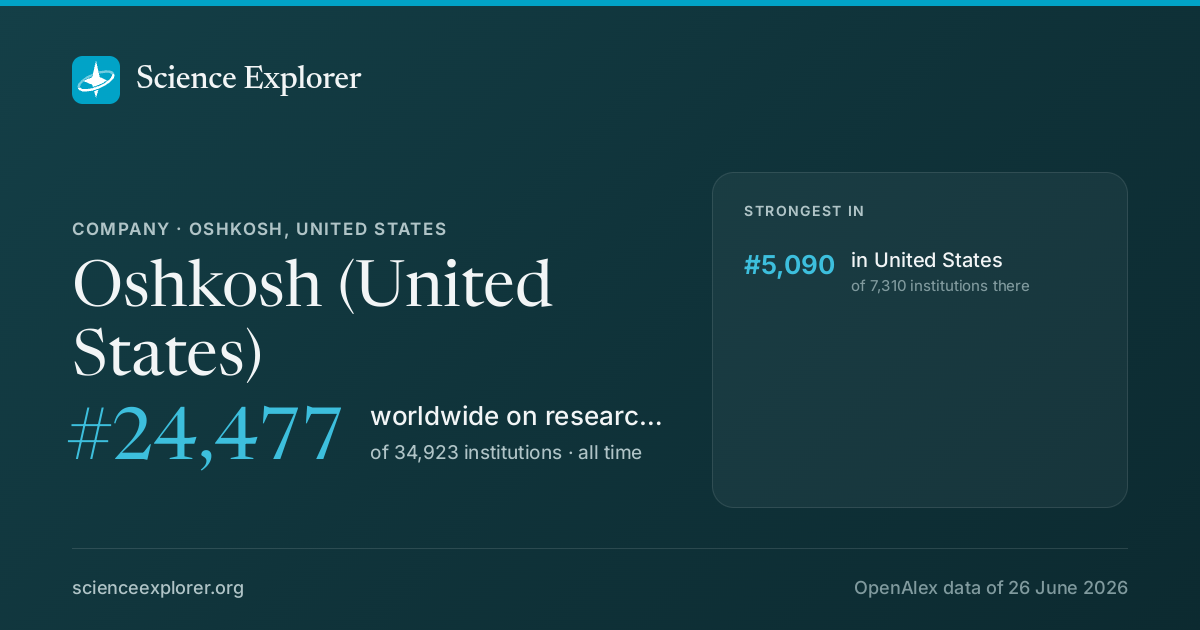
Oshkosh (United States) on Science Explorer

A card with Oshkosh (United States)'s standing and the fields it leads in, for a post or a slide. A link to this page previews as the same card.

Download the card

1200 × 630 PNG, sized for social posts, drawn from the latest snapshot.

Badges for a website1Each links back here and updates with every snapshot

Research measures only: rankings here say nothing about teaching, admissions or student experience. Comparable institutions and collaboration partners have tabs of their own, above.

Discussion

Ask a question or share a note about Oshkosh (United States). Keep it to the research: no personal attacks, advertising or links. Any reader can report a post, which collapses it for everyone until it is opened.