Pakuan University
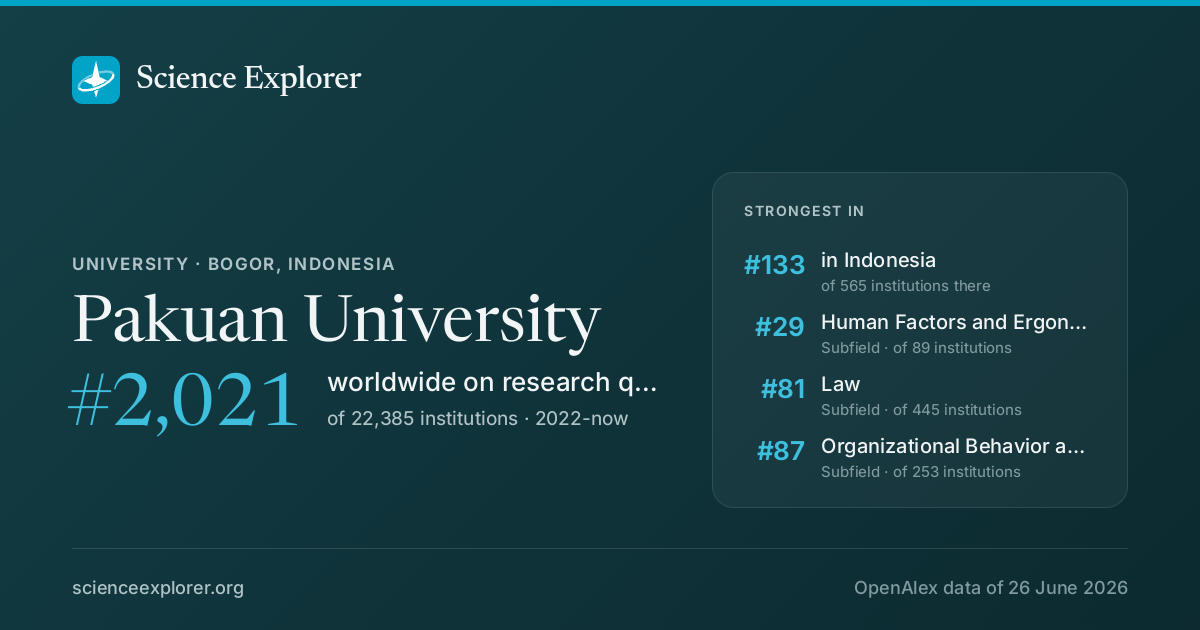
In research, Pakuan University stands highest in Social Sciences (#667 of 9,585 worldwide), Social Sciences (#430 of 5,988 worldwide) and Education (#153 of 1,930 worldwide), 2022-now. Relative to its size it is most specialised in Human Factors and Ergonomics, Law and Education (Human Factors and Ergonomics is 22.5× its share of world research).
- World rank, 2022-now
- #2,021 of 22,385 · #4,942 all time
- Rank in Indonesia
- #133 of 565
- Research works
- 4.7k ▲ 86% vs 2018-21
- Citations
- 11k 2.4 per fractional work
- Top-10% rate
- 8.9% all institutions 10.0%
- vs its own fields
- 0.69× 1.00× is exactly expected
- Open access
- 94% world 40%
- International
- 3% world 18%
What is Pakuan University known for in research?
The fields where it stands highest, 2022-now, ranked among every institution above the floor in each field.
| Field | World rank | Where that sits | Top-10% rate | Works | All time |
|---|---|---|---|---|---|
| Social SciencesDomain | #667 of 9,585 | 10.1% | 1,754 | #1241 | |
| Social SciencesField | #430 of 5,988 | 10.8% | 1,273 | #882 | |
| EducationSubfield | #153 of 1,930 | 11.1% | 617 | #253 | |
| LawSubfield | #81 of 445 | 16.1% | 171 | #337 | |
| Information SystemsSubfield | #286 of 1,321 | 10.4% | 261 | #625 | |
| Computer ScienceField | #1,124 of 4,417 | 10.0% | 331 | #2158 | |
| Physical SciencesDomain | #3,463 of 10,670 | 7.6% | 579 | #8575 | |
| Human Factors and ErgonomicsSubfield | #29 of 89 | 15.2% | 64 | - | |
| Business, Management and AccountingField | #842 of 2,581 | 9.6% | 323 | #1293 | |
| Organizational Behavior and Human Resource ManagementSubfield | #87 of 253 | 13.2% | 86 | #462 |
Each strip is that field's whole ranked pool, with the notch where Pakuan University sits in it, in the colour of the band that rank falls in. The track under the rate is the rate itself: it carries no average mark, because the average differs by field (from about 6% in Dentistry to 21% in Economics).
Which of those standings moved
The same fields on both windows: where it stood over the whole record, and where it stands in 2022-now. The distance is the story, and it is the one thing the two rank columns above cannot show.
- Social Sciences#1,241 #667
- Social Sciences#882 #430
- Education#253 #153
- Law#337 #81
- Information Systems#625 #286
- Computer Science#2,158 #1,124
- Physical Sciences#8,575 #3,463
- Business, Management and Accounting#1,293 #842
- Organizational Behavior and Human Resource Management#462 #87
A dot further right is a better standing. Fields it was not ranked in over the whole record are left out.
Which fields of science does Pakuan University work in?
In 2022-now, 66% of research at Pakuan University is in Social Sciences, 21% in Physical Sciences. Its largest fields are Social Sciences (48%), Business, Management and Accounting (12%), Computer Science (12%). It does 2.7× the world's share of Social Sciences.
Each ring splits the one inside it: the four domains of science, their fields, their subfields. Size is fractional works in 2022-now. Every slice is a page; the interactive view zooms down to single topics and colours each by how much more of it this institution does than the world.
Its 4 domains and 26 fields, with their numbers
- Social Sciences1,92366.4%
- Social Sciences1,38047.7%
- Business, Management and Accounting36012.4%
- Arts and Humanities561.9%
- Economics, Econometrics and Finance521.8%
- Psychology481.6%
- Decision Sciences260.9%
- Physical Sciences61521.2%
- Computer Science34411.9%
- Environmental Science1103.8%
- Engineering933.2%
- Mathematics321.1%
- Earth and Planetary Sciences120.4%
- Chemistry110.4%
- Materials Science70.3%
- Energy50.2%
- Physics and Astronomy10.0%
- Chemical Engineering00.0%
- Life Sciences2418.3%
- Health Sciences1174.1%
- Medicine582.0%
- Health Professions491.7%
- Nursing100.3%
- Dentistry00.0%
- Veterinary00.0%
What does Pakuan University specialise in?
Where its research is concentrated relative to its size: Human Factors and Ergonomics takes 22.5× the share of its output that it takes of world research.
- Human Factors and ErgonomicsSubfield · 72.5 works22×
- LawSubfield · 181.7 works11×
- EducationSubfield · 667.7 works7.5×
- Organizational Behavior and Human Resource ManagementSubfield · 100.4 works7.2×
- DemographySubfield · 110.9 works5.6×
- General Agricultural and Biological SciencesSubfield · 67.9 works5.3×
Location quotient, a volume reading rather than an impact one. It surfaces small, lopsided specialities.
Field profile
Location quotient across every field it publishes in: outside the ring is more than an institution of this size would be expected to publish, inside it is less.
Rings at 0.5×, 1× and 2×. Widest outward: Business, Management and Accounting, 3.9×. Every wedge is a field page.
All 26 fields, with their numbers
- Business, Management and Accounting3.86×360 works
- Social Sciences3.77×1,380 works
- Pharmacology, Toxicology and Pharmaceutics1.67×17 works
- Computer Science1.53×344 works
- Agricultural and Biological Sciences1.43×196 works
- Decision Sciences0.95×26 works
- Mathematics0.94×32 works
- Economics, Econometrics and Finance0.84×52 works
- Environmental Science0.76×110 works
- Nursing0.68×10 works
- Arts and Humanities0.67×56 works
- Health Professions0.64×49 works
- Psychology0.54×48 works
- Earth and Planetary Sciences0.25×12 works
- Chemistry0.24×11 works
- Engineering0.21×93 works
- Energy0.19×5 works
- Biochemistry, Genetics and Molecular Biology0.15×23 works
- Immunology and Microbiology0.13×4 works
- Medicine0.10×58 works
- Materials Science0.07×7 works
- Veterinary0.04×0 works
- Neuroscience0.03×1 works
- Chemical Engineering0.02×0 works
- Physics and Astronomy0.01×1 works
- Dentistry0.01×0 works
- Business, Management and Accounting 3.9×
- Social Sciences 3.8×
- Pharmacology, Toxicology and Pharmaceutics 1.7×
- Computer Science 1.5×
- Agricultural and Biological Sciences 1.4×
- Decision Sciences 0.9×
- Mathematics 0.9×
- Economics, Econometrics and Finance 0.8×
- Environmental Science 0.8×
- Nursing 0.7×
- Arts and Humanities 0.7×
- Health Professions 0.6×
- Psychology 0.5×
- Earth and Planetary Sciences 0.2×
- Chemistry 0.2×
- Engineering 0.2×
- Energy 0.2×
- Biochemistry, Genetics and Molecular Biology 0.1×
- Immunology and Microbiology 0.1×
- Medicine 0.1×
- Materials Science 0.1×
- Veterinary 0.0×
- Neuroscience 0.0×
- Chemical Engineering 0.0×
- Physics and Astronomy 0.0×
- Dentistry 0.0×
Who are the top researchers at Pakuan University?
Ranked on the quality score, Yudhie Suchyadi, Bibin Rubini and Nita Karmila lead among researchers whose main affiliation is Pakuan University.
- 1
Yudhie Suchyadi
 Indonesia · #467,823 worldwide
854 citations · 62 works
- 2
Bibin Rubini
Indonesia · #1,306,553 worldwide
727 citations · 91 works
- 3
Nita Karmila
Indonesia · #1,409,253 worldwide
259 citations · 40 works
- 4
Prasetyono Hendriarto
Indonesia · #1,667,056 worldwide
271 citations · 20 works
- 5
Indarini Dwi Pursitasari
Indonesia · #1,684,198 worldwide
853 citations · 95 works
- 6
Leny Heliawati
Indonesia · #1,731,848 worldwide
402 citations · 53 works
- 7
Lina Novita
Indonesia · #1,806,274 worldwide
789 citations · 86 works
- 8
Didit Ardianto
Indonesia · #1,838,450 worldwide
532 citations · 79 works
- 9
Elly Sukmanasa
Indonesia · #1,895,731 worldwide
657 citations · 74 works
- 10
Rukmini Handayani
Indonesia · #2,206,410 worldwide
143 citations · 20 works
Which keywords describe research at Pakuan University?
By fractional works in 2022-now, weighted toward what it does more of than the world: Educational Technology, E-Learning, Character Education, Media Literacy, Local Wisdom, Mobile Learning, Digital Literacy and Online Learning.
- Restorative Justice
- Criminal Justice
- Digital Marketing
- Community Participation
- Economic Impact
- Organizational Commitment
- Organizational Culture
- Indonesia
- Corporate Governance
- Reading Interest
- Student Motivation
- E-commerce
- Digital Learning
- STEM Education
- Community Empowerment
- Curriculum Development
- Digital Literacy
- Mobile Learning
- Media Literacy
- E-Learning
- Educational Technology
- Character Education
- Local Wisdom
- Online Learning
- Social Media
- Motivation
- Human Rights
- Job Satisfaction
- Islamic Banking
- Information Literacy
- Technology Integration
- School Literacy Movement
- Financial Performance
- Qualitative Research
- 21st Century Skills
- Transformational Leadership
- SMEs
- Leadership
- Environmental Law
- UMKM
Size is fractional works in 2022-now in the topics tagged with each word; colour is the word's share of this institution's work against its share of the world's. The 40 words are chosen for being large and distinctive. Each links to the topic it comes from most.
All 40 words, with their numbers
- Educational Technology297▲ 8.7×29 topics
- E-Learning274▲ 9.8×16 topics
- Character Education224▲ 16×6 topics
- Media Literacy221▲ 14×5 topics
- Local Wisdom204▲ 15×9 topics
- Mobile Learning198▲ 20×6 topics
- Online Learning191▲ 8.0×17 topics
- Digital Literacy191▲ 12×9 topics
- Social Media172▲ 4.3×19 topics
- Curriculum Development163▲ 8.3×13 topics
- Motivation159▲ 13×7 topics
- Community Empowerment155▲ 7.4×11 topics
- Human Rights153▲ 5.2×22 topics
- STEM Education152▲ 12×12 topics
- Job Satisfaction149▲ 12×7 topics
- Digital Learning144▲ 9.8×8 topics
- Islamic Banking140▲ 13×3 topics
- E-commerce138▲ 8.4×9 topics
- Information Literacy133▲ 18×3 topics
- Student Motivation133▲ 23×6 topics
- Technology Integration132▲ 14×9 topics
- Reading Interest128▲ 22×1 topic
- School Literacy Movement128▲ 22×1 topic
- Corporate Governance128▲ 6.0×16 topics
- Financial Performance127▲ 7.8×11 topics
- Indonesia126▲ 9.9×5 topics
- Qualitative Research125▲ 5.1×13 topics
- Organizational Culture121▲ 11×8 topics
- 21st Century Skills118▲ 14×5 topics
- Organizational Commitment116▲ 20×4 topics
- Transformational Leadership112▲ 23×3 topics
- Economic Impact112▲ 7.2×5 topics
- SMEs102▲ 11×2 topics
- Community Participation102▲ 10.0×6 topics
- Leadership102▲ 7.2×14 topics
- Digital Marketing101▲ 9.0×2 topics
- Environmental Law101▲ 17×6 topics
- Criminal Justice100▲ 15×4 topics
- UMKM100▲ 13×1 topic
- Restorative Justice99▲ 25×2 topics
Which research topics does Pakuan University publish most on?
By volume in 2022-now: Educational Methods and Media Use, SMEs Development and Digital Marketing, Educational Curriculum and Learning Methods and Legal Studies and Policies.
Area is fractional works; colour is the subfield each topic belongs to.
- 1 Educational Methods and Media Use Information Systems 128 works
- 2 SMEs Development and Digital Marketing Demography 100 works
- 3 Educational Curriculum and Learning Methods Education 86 works
- 4 Legal Studies and Policies Law 80 works
- 5 Educational Methods and Outcomes Education 76 works
- 6 Employee Performance and Management Human Factors and Ergonomics 72 works
- 7 Employee Performance and Leadership Organizational Behavior and Human Resource Management 66 works
- 8 Education and Communication Studies Education 61 works
- 9 Technology-Enhanced Education Studies Education 60 works
- 10 Legal and Social Justice Studies Law 57 works
How open and international is its research?
Against the world's own shares: the tick on each track. Both are shares of its output, so they sit on one scale and can be read against each other as well as against the world.
World: 40% of research is openly available.
World: 18% is written across borders.
How has Pakuan University's research output changed?
Output in 2022-2025 was 86% higher than in 2018-2021.
The same series as a ribbon: one cell per year, darker for more. The line above answers how much; this answers when.
Its share of all research
Growing output can still be a shrinking share: all of science grows. This is Pakuan University as a percentage of every work published that year, 0.014% in 2024.
Fractional works of Pakuan University over all fractional works that year. How the balance of science has shifted.
How much of it reaches the world top 10%
Year by year, against all institutions in the same year.
Of each year's output, the share that reached the world's 10% most cited for its field and year. Peak 16.2% in 2015.
Other research institutions in Bogor
- IPB University
- Universitas Nusa Bangsa
- Universitas Djuanda
- Universitas Ibn Khaldun Bogor
- Indonesia Defense University
- Pusat Penelitian dan Pengembangan Peternakan
- Center for International Forestry Research
- Borneo Orangutan Survival Foundation
Share Pakuan University's ranking



Research measures only: rankings here say nothing about teaching, admissions or student experience. Comparable institutions and collaboration partners have tabs of their own, above.
Discussion
Ask a question or share a note about Pakuan University. Posts are plain text and can be reported.