- World rank, all time
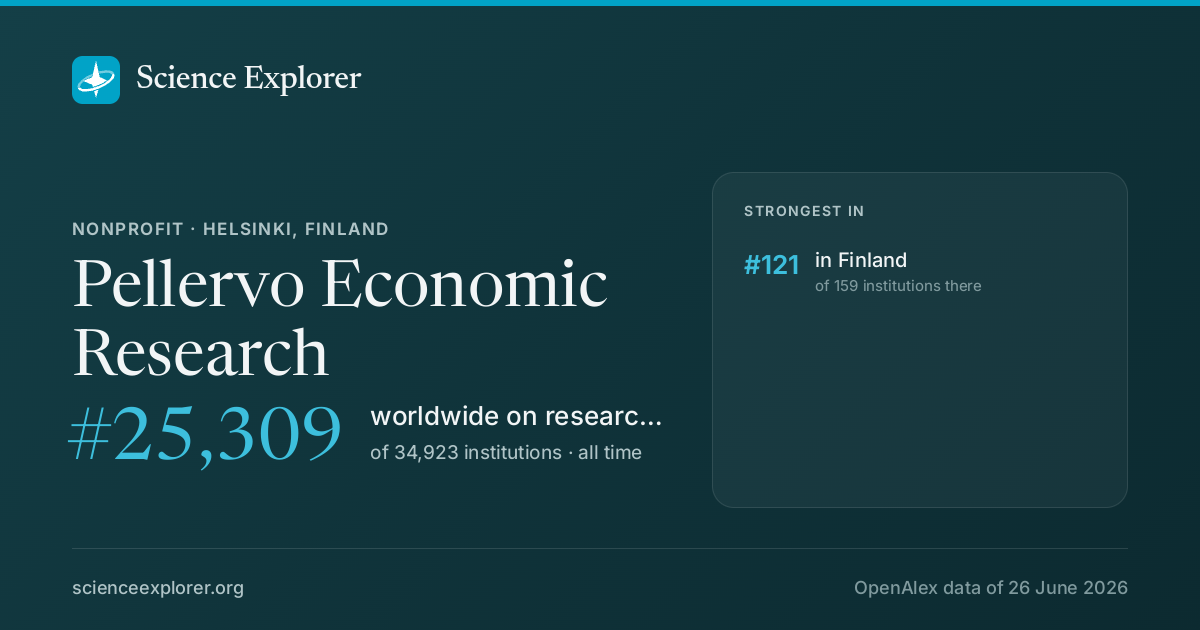
- #25,309 of 34,923
- Rank in Finland
- #121 of 159
- Research works
- 227 ▼ 41% vs 2018-21
- Citations
- 1.9k 8.2 per fractional work
- Top-10% rate
- 7.2% all institutions 10.0%
- vs its own fields
- 0.95× 1.00× is exactly expected
- Open access
- 75% world 40%
- International
- 14% world 18%
Which fields of science does Pellervo Economic Research work in?
In all years, 44% of research at Pellervo Economic Research is in Social Sciences, 27% in Physical Sciences. Its largest fields are Agricultural and Biological Sciences (26%), Business, Management and Accounting (15%), Economics, Econometrics and Finance (13%). It does 2.0× the world's share of Social Sciences.
Each ring splits the one inside it: the four domains of science, their fields, their subfields. Size is fractional works in all years. Every slice is a page; the interactive view zooms down to single topics and colours each by how much more of it this institution does than the world.
Its 4 domains and 22 fields, with their numbers
- Social Sciences10043.9%
- Business, Management and Accounting3414.8%
- Economics, Econometrics and Finance2912.9%
- Social Sciences2812.1%
- Decision Sciences41.8%
- Arts and Humanities31.3%
- Psychology21.1%
- Physical Sciences6026.6%
- Environmental Science2812.3%
- Engineering177.5%
- Computer Science93.8%
- Materials Science20.8%
- Energy20.8%
- Earth and Planetary Sciences10.6%
- Chemical Engineering10.6%
- Chemistry10.3%
- Mathematics00.1%
- Physics and Astronomy00.0%
- Life Sciences5926.1%
- Health Sciences83.3%
- Medicine31.4%
- Health Professions31.4%
- Veterinary10.6%
Field profile
Location quotient across every field it publishes in: outside the ring is more than an institution of this size would be expected to publish, inside it is less.
Rings at 0.5×, 1× and 2×. Widest outward: Economics, Econometrics and Finance, 7.8×. Every wedge is a field page.
All 11 fields, with their numbers
- Economics, Econometrics and Finance7.84×2 works
- Decision Sciences6.62×1 works
- Business, Management and Accounting4.46×2 works
- Arts and Humanities4.15×1 works
- Environmental Science2.06×1 works
- Social Sciences1.87×2 works
- Immunology and Microbiology0.79×0 works
- Agricultural and Biological Sciences0.63×0 works
- Health Professions0.61×0 works
- Psychology0.52×0 works
- Medicine0.50×1 works
Who are the top researchers at Pellervo Economic Research?
Ranked on the quality score, Jukka Jalava, Paula Horne and Eeva Alho lead among researchers whose main affiliation is Pellervo Economic Research.
- 1
Jukka Jalava
 Finland · #1,510,104 worldwide
801 citations · 40 works
- 2
Paula Horne
Finland · #1,710,886 worldwide
830 citations · 70 works
- 3
Eeva Alho
Finland · #2,376,631 worldwide
339 citations · 17 works
- 4
Janne Huovari
Finland · #2,521,427 worldwide
253 citations · 30 works
- 5
Terhi Virtanen
Finland · #3,581,106 worldwide
141 citations · 26 works
- 6
Panu Kallio
Finland · #3,762,815 worldwide
42 citations · 16 works
- 7
Kyösti Arovuori
Finland · #3,767,791 worldwide
126 citations · 49 works
- 8
Hanna Karikallio
Finland · #3,840,825 worldwide
96 citations · 22 works
- 9
Erno Järvinen
Finland · #3,900,554 worldwide
110 citations · 15 works
- 9
Pia Outa
Finland · #3,900,554 worldwide
15 citations · 15 works
Which keywords describe research at Pellervo Economic Research?
By fractional works in all years, weighted toward what it does more of than the world: Sustainability, Biodiversity, Environmental Policy, Common Agricultural Policy, Multifunctionality, Biodiversity Conservation, Climate Change Impacts and Forest Carbon Sequestration.
- Regional Disparities
- Fiscal Policy
- Productivity
- Global Warming
- Innovation Policy
- Monetary Policy
- Consumer Behavior
- Revealed Comparative Advantage
- Economic Development
- Environmental Impact
- Sustainable Development
- Social Sciences
- Pedagogy
- Healthcare
- Communication
- Education
- Forest Carbon Sequestration
- Biodiversity Conservation
- Common Agricultural Policy
- Biodiversity
- Sustainability
- Environmental Policy
- Multifunctionality
- Climate Change Impacts
- Sustainable Forest Management
- Innovation
- Phenomenology
- Ethics
- Qualitative Research
- Climate Change
- Rural Development
- Economic Growth
- Competitiveness Indices
- International Trade
- Global Value Chains
- Production Networks
- Supply Chain
- Regional Growth
- Trade Liberalization
- Economic Impacts
Size is fractional works in all years in the topics tagged with each word; colour is the word's share of this institution's work against its share of the world's. The 40 words are chosen for being large and distinctive. Each links to the topic it comes from most.
All 40 words, with their numbers
- Sustainability53▲ 13×25 topics
- Biodiversity36▲ 21×5 topics
- Environmental Policy35▲ 97×4 topics
- Common Agricultural Policy33▲ 902×1 topic
- Multifunctionality33▲ 256×1 topic
- Biodiversity Conservation18▲ 30×7 topics
- Climate Change Impacts14▲ 45×2 topics
- Forest Carbon Sequestration14▲ 255×1 topic
- Sustainable Forest Management14▲ 255×1 topic
- Education12▲ 4.0×3 topics
- Innovation12▲ 5.5×11 topics
- Communication11▲ 17×2 topics
- Phenomenology11▲ 39×2 topics
- Healthcare11▲ 6.7×2 topics
- Ethics11▲ 10×1 topic
- Pedagogy11▲ 14×1 topic
- Qualitative Research11▲ 8.2×2 topics
- Social Sciences11▲ 29×2 topics
- Climate Change10▲ 1.58×24 topics
- Sustainable Development9▲ 3.6×9 topics
- Rural Development8▲ 12×7 topics
- Environmental Impact8▲ 2.7×12 topics
- Economic Growth8▲ 4.8×12 topics
- Economic Development8▲ 5.2×6 topics
- Competitiveness Indices8▲ 105×1 topic
- Revealed Comparative Advantage8▲ 105×1 topic
- International Trade8▲ 23×3 topics
- Consumer Behavior6▲ 6.9×7 topics
- Global Value Chains6▲ 142×1 topic
- Monetary Policy6▲ 8.9×5 topics
- Production Networks6▲ 142×1 topic
- Innovation Policy5▲ 30×3 topics
- Supply Chain5▲ 12×3 topics
- Global Warming5▲ 5.6×8 topics
- Regional Growth5▲ 21×3 topics
- Productivity4▲ 35×1 topic
- Trade Liberalization4▲ 35×1 topic
- Fiscal Policy4▲ 8.7×4 topics
- Economic Impacts4▲ 27×2 topics
- Regional Disparities4▲ 38×2 topics
Which research topics does Pellervo Economic Research publish most on?
By volume in 2022-now: Cooperative Studies and Economics, European Cultural and National Identity, Hepatocellular Carcinoma Treatment and Prognosis and Balkans: History, Politics, Society.
Area is fractional works; colour is the subfield each topic belongs to.
- 1 Cooperative Studies and Economics Strategy and Management 1 works
- 2 European Cultural and National Identity Sociology and Political Science 0 works
- 3 Hepatocellular Carcinoma Treatment and Prognosis Hepatology 0 works
- 4 Balkans: History, Politics, Society Cultural Studies 0 works
- 5 Stock Market Forecasting Methods Management Science and Operations Research 0 works
- 6 Global trade and economics General Economics, Econometrics and Finance 0 works
- 7 Research in Social Sciences Education 0 works
- 8 Linguistics and Cultural Studies Language and Linguistics 0 works
- 9 Financial Literacy, Pension, Retirement Analysis Accounting 0 works
- 10 Cultural and Sociopolitical Studies Museology 0 works
How open and international is its research?
Against the world's own shares: the tick on each track. Both are shares of its output, so they sit on one scale and can be read against each other as well as against the world.
World: 40% of research is openly available.
World: 18% is written across borders.
How has Pellervo Economic Research's research output changed?
Output in 2022-2025 was 41% lower than in 2018-2021.
The same series as a ribbon: one cell per year, darker for more. The line above answers how much; this answers when.
Its share of all research
Growing output can still be a shrinking share: all of science grows. This is Pellervo Economic Research as a percentage of every work published that year, 0.000069% in 2024.
Fractional works of Pellervo Economic Research over all fractional works that year. How the balance of science has shifted.
Other research institutions in Helsinki
- University of Helsinki
- Finnish Institute for Health and Welfare
- Finnish Institute of Occupational Health
- Natural Resources Institute Finland
- Finnish Society of Sciences and Letters
- Finnish Meteorological Institute
- Finnish Environment Institute
- Hospital District of Helsinki and Uusimaa

Share Pellervo Economic Research's ranking
Badges for a website1Each links back here and updates with every snapshot

Research measures only: rankings here say nothing about teaching, admissions or student experience. Comparable institutions and collaboration partners have tabs of their own, above.
Discussion
Ask a question or share a note about Pellervo Economic Research. Keep it to the research: no personal attacks, advertising or links. Any reader can report a post, which collapses it for everyone until it is opened.