Science Explorer Back to mapMap
Discussion
Nonprofit · Alexandria · United States

Prevent Cancer Foundation

World rank, all time
#34,399
of 34,923
Rank in United States
#7,222
of 7,310
Research works
170
▼ 31% vs 2018-21
Citations
7.1k
42.1 per fractional work
Top-10% rate
9.3%
all institutions 10.0%
vs its own fields
0.94×
1.00× is exactly expected
Open access
19%
world 40%
International
9%
world 18%

Which fields of science does Prevent Cancer Foundation work in?

In all years, 47% of research at Prevent Cancer Foundation is in Life Sciences, 42% in Health Sciences. Its largest fields are Medicine (40%), Biochemistry, Genetics and Molecular Biology (37%), Immunology and Microbiology (6%). It does 2.9× the world's share of Life Sciences.

Life Sciences: 79 fractional works · 46.7% of its workBiochemistry, Genetics and Molecular Biology: 63 fractional works · 37.0% of its workMolecular Biology: 35 fractional works · 20.7% of its workGenetics: 13 fractional works · 7.7% of its workCancer Research: 8 fractional works · 4.5% of its workCell Biology: 3 fractional works · 1.8% of its workPhysiology: 2 fractional works · 0.9% of its workClinical Biochemistry: 1 fractional works · 0.5% of its workBiotechnology: 1 fractional works · 0.4% of its workBiochemistry: 0 fractional works · 0.3% of its workSmaller subfields together: 1 fractional works · 0.4% of its workImmunology and Microbiology: 11 fractional works · 6.5% of its workImmunology: 9 fractional works · 5.5% of its workVirology: 1 fractional works · 0.5% of its workParasitology: 1 fractional works · 0.4% of its workSmaller subfields together: 0 fractional works · 0.1% of its workAgricultural and Biological Sciences: 3 fractional works · 2.0% of its workFood Science: 1 fractional works · 0.6% of its workAnimal Science and Zoology: 1 fractional works · 0.5% of its workPlant Science: 1 fractional works · 0.4% of its workAgronomy and Crop Science: 1 fractional works · 0.3% of its workSmaller subfields together: 0 fractional works · 0.1% of its workPharmacology, Toxicology and Pharmaceutics: 1 fractional works · 0.7% of its workPharmacology: 1 fractional works · 0.4% of its workSmaller subfields together: 0 fractional works · 0.3% of its workNeuroscience: 1 fractional works · 0.5% of its workCellular and Molecular Neuroscience: 1 fractional works · 0.5% of its workSmaller subfields together: 0 fractional works · 0.0% of its workHealth Sciences: 71 fractional works · 42.1% of its workMedicine: 67 fractional works · 39.8% of its workOncology: 27 fractional works · 15.9% of its workPulmonary and Respiratory Medicine: 6 fractional works · 3.7% of its workRadiology, Nuclear Medicine and Imaging: 5 fractional works · 2.9% of its workPhysiology: 4 fractional works · 2.1% of its workEpidemiology: 3 fractional works · 2.0% of its workSurgery: 3 fractional works · 1.7% of its workPathology and Forensic Medicine: 3 fractional works · 1.6% of its workPublic Health, Environmental and Occupational Health: 2 fractional works · 1.5% of its workInfectious Diseases: 2 fractional works · 1.2% of its workPsychiatry and Mental health: 2 fractional works · 1.1% of its workPediatrics, Perinatology and Child Health: 2 fractional works · 0.9% of its workNeurology: 1 fractional works · 0.6% of its workRheumatology: 1 fractional works · 0.5% of its workPharmacology: 1 fractional works · 0.5% of its workCardiology and Cardiovascular Medicine: 1 fractional works · 0.4% of its workGenetics: 1 fractional works · 0.4% of its workEndocrinology, Diabetes and Metabolism: 1 fractional works · 0.4% of its workImmunology and Allergy: 1 fractional works · 0.4% of its workHematology: 1 fractional works · 0.4% of its workGeriatrics and Gerontology: 0 fractional works · 0.3% of its workReproductive Medicine: 0 fractional works · 0.3% of its workSmaller subfields together: 2 fractional works · 1.0% of its workHealth Professions: 2 fractional works · 1.4% of its workGeneral Health Professions: 2 fractional works · 0.9% of its workSmaller subfields together: 1 fractional works · 0.4% of its workNursing: 1 fractional works · 0.5% of its workNutrition and Dietetics: 1 fractional works · 0.5% of its workDentistry: 1 fractional works · 0.3% of its workOral Surgery: 0 fractional works · 0.2% of its workSmaller subfields together: 0 fractional works · 0.1% of its workVeterinary: 0 fractional works · 0.2% of its workPhysical Sciences: 11 fractional works · 6.6% of its workChemistry: 5 fractional works · 3.1% of its workOrganic Chemistry: 3 fractional works · 1.9% of its workSpectroscopy: 1 fractional works · 0.6% of its workSmaller subfields together: 1 fractional works · 0.6% of its workEngineering: 2 fractional works · 1.3% of its workBiomedical Engineering: 2 fractional works · 1.1% of its workSmaller subfields together: 0 fractional works · 0.2% of its workEnvironmental Science: 1 fractional works · 0.8% of its workHealth, Toxicology and Mutagenesis: 0 fractional works · 0.2% of its workSmaller subfields together: 1 fractional works · 0.6% of its workMathematics: 1 fractional works · 0.5% of its workStatistics and Probability: 1 fractional works · 0.5% of its workComputer Science: 1 fractional works · 0.5% of its workComputational Theory and Mathematics: 0 fractional works · 0.3% of its workSmaller subfields together: 0 fractional works · 0.2% of its workMaterials Science: 0 fractional works · 0.3% of its workBiomaterials: 0 fractional works · 0.3% of its workPhysics and Astronomy: 0 fractional works · 0.2% of its workSocial Sciences: 8 fractional works · 4.5% of its workEconomics, Econometrics and Finance: 3 fractional works · 1.8% of its workEconomics and Econometrics: 3 fractional works · 1.8% of its workSocial Sciences: 2 fractional works · 1.3% of its workSociology and Political Science: 1 fractional works · 0.8% of its workSmaller subfields together: 1 fractional works · 0.4% of its workPsychology: 2 fractional works · 0.9% of its workClinical Psychology: 1 fractional works · 0.8% of its workSmaller subfields together: 0 fractional works · 0.1% of its workDecision Sciences: 1 fractional works · 0.3% of its workBusiness, Management and Accounting: 0 fractional works · 0.2% of its workArts and Humanities: 0 fractional works · 0.1% of its workALL ITS WORKPrevent CancerFoundation170fractional works, all years
Life Sciences47%Physical Sciences7%Health Sciences42%Social Sciences5%

Each ring splits the one inside it: the four domains of science, their fields, their subfields. Size is fractional works in all years. Every slice is a page; the interactive view zooms down to single topics and colours each by how much more of it this institution does than the world.

Its 4 domains and 23 fields, with their numbers
    1. Biochemistry, Genetics and Molecular Biology6337.0%
    2. Immunology and Microbiology116.5%
    3. Agricultural and Biological Sciences32.0%
    4. Pharmacology, Toxicology and Pharmaceutics10.7%
    5. Neuroscience10.5%
    1. Medicine6739.8%
    2. Health Professions21.4%
    3. Nursing10.5%
    4. Dentistry10.3%
    5. Veterinary00.2%
    1. Chemistry53.1%
    2. Engineering21.3%
    3. Environmental Science10.8%
    4. Mathematics10.5%
    5. Computer Science10.5%
    6. Materials Science00.3%
    7. Physics and Astronomy00.2%
    1. Economics, Econometrics and Finance31.8%
    2. Social Sciences21.3%
    3. Psychology20.9%
    4. Decision Sciences10.3%
    5. Business, Management and Accounting00.2%
    6. Arts and Humanities00.1%
All of science, and how each field's share has moved since 1950: the Science domain explorer

Field profile

Location quotient across every field it publishes in: outside the ring is more than an institution of this size would be expected to publish, inside it is less.

Biochemistry, Genetics and Molecular Biology: 3.82× its world share, 1 worksBiochemistry, Geneti…Computer Science: 0.06× its world share, 0 worksComputer ScienceEnvironmental Science: 0.78× its world share, 0 worksEnvironmental ScienceHealth Professions: 4.51× its world share, 0 worksHealth ProfessionsMedicine: 1.53× its world share, 1 worksMedicineDecision Sciences: 4.35× its world share, 0 worksDecision SciencesEconomics, Econometrics and Finance: 12.84× its world share, 1 worksEconomics, Econometr…Social Sciences: 0.18× its world share, 0 worksSocial Sciences1×world share
more than its size predictsabout as predictedless

Rings at 0.5×, 1× and 2×. Widest outward: Economics, Econometrics and Finance, 12.8×. Every wedge is a field page.

All 8 fields, with their numbers
  1. Economics, Econometrics and Finance12.84×1 works
  2. Health Professions4.51×0 works
  3. Decision Sciences4.35×0 works
  4. Biochemistry, Genetics and Molecular Biology3.82×1 works
  5. Medicine1.53×1 works
  6. Environmental Science0.78×0 works
  7. Social Sciences0.18×0 works
  8. Computer Science0.06×0 works

Who are the top researchers at Prevent Cancer Foundation?

Ranked on the quality score, Charles M. McGrath, Carolyn R. Aldigé and Terry Maloney lead among researchers whose main affiliation is Prevent Cancer Foundation.

  1. 1 Charles M. McGrath United States · #1,750,041 worldwide 3.2k citations · 32 works
  2. 2 Carolyn R. Aldigé United States · #2,503,049 worldwide 785 citations · 24 works
  3. 3 Terry Maloney United States · #3,440,521 worldwide 2k citations · 18 works
  4. 4 Jim Frederick United States · #4,039,160 worldwide 20 citations · 18 works
  5. 5 Michael Dietz United States · #5,470,044 worldwide 146 citations · 17 works
  6. 6 Stanislav Chládek United States · #6,993,985 worldwide 1.5k citations · 93 works
All ranked researchers at Prevent Cancer Foundation

What are the most cited papers from Prevent Cancer Foundation?

The most cited paper from Prevent Cancer Foundation is "Isolation and characterization of a spontaneously immortalized human breast epithelial cell line, MCF-10." (Herbert D. Soule, Terry Maloney, Sandra R. Wolman et al., 1990), with 1,564 citations. Next come "Galectins: A family of animal β-galactoside-binding lectins" (1,218) and "Comparative Study of Human and Rat Mammary Tumorigenesis" (583).

Most cited papers
#PaperReleasedCitations
1 Isolation and characterization of a spontaneously immortalized human breast epithelial cell line, MCF-10. Herbert D. Soule, Terry Maloney, Sandra R. Wolman et al. · PubMed 15 Sep 1990 1,564
2 Galectins: A family of animal β-galactoside-binding lectins Samuel H. Barondes et al. · Cell Open access Feb 1994 1,218
3 Comparative Study of Human and Rat Mammary Tumorigenesis José Russo, Barry A. Gusterson, Adrianne E. Rogers et al. · Humana Press eBooks Book chapter 1990 583
4 Frequency of ultraviolet light-induced mutations is higher in xeroderma pigmentosum variant cells than in normal human cells Veronica M. Maher, Louis M. Ouellette, Rodger D. Curren et al. · Nature Jun 1976 331
5 Tumor heterogeneity: biological implications and therapeutic consequences Gloria H. Heppner, Bonnie E. Miller · Cancer and Metastasis Reviews Review 1983 312
All 60 most cited papers, with filters and sorting

Which keywords describe research at Prevent Cancer Foundation?

By fractional works in all years, weighted toward what it does more of than the world: Cancer, Drug Resistance, Breast Cancer, Epithelial-Mesenchymal Transition, Cancer Stem Cells, Tumor Metastasis, Glycosylation and Chemotherapy.

▲ more of its work than of the world's◆ about the world's share▼ less than the world's

Size is fractional works in all years in the topics tagged with each word; colour is the word's share of this institution's work against its share of the world's. The 40 words are chosen for being large and distinctive. Each links to the topic it comes from most.

All 40 words, with their numbers
  1. Cancer18▲ 7.7×22 topics
  2. Drug Resistance10▲ 18×2 topics
  3. Breast Cancer9▲ 19×8 topics
  4. Inflammation9▲ 2.3×19 topics
  5. Cancer Stem Cells9▲ 121×1 topic
  6. Epithelial-Mesenchymal Transition9▲ 60×2 topics
  7. Tumor Metastasis9▲ 86×1 topic
  8. Glycosylation8▲ 22×3 topics
  9. Chemotherapy8▲ 6.3×15 topics
  10. Metabolic Syndrome7▲ 4.8×5 topics
  11. Genomic Instability7▲ 31×3 topics
  12. Risk Factors6▲ 3.5×6 topics
  13. Therapeutic Targets6▲ 15×4 topics
  14. Cancer Incidence6▲ 24×4 topics
  15. Targeted Therapy6▲ 15×4 topics
  16. Precision Medicine6▲ 10×5 topics
  17. Tumor Microenvironment6▲ 9.2×6 topics
  18. Cancer Therapy5▲ 4.8×11 topics
  19. Gene Expression5▲ 5.0×7 topics
  20. Angiogenesis5▲ 7.1×6 topics
  21. Cancer Progression5▲ 12×5 topics
  22. Health Disparities5▲ 13×2 topics
  23. Cancer Risk4▲ 10×6 topics
  24. Immune System4▲ 7.7×3 topics
  25. Mortality Rates4▲ 27×2 topics
  26. Population-Based Study4▲ 42×2 topics
  27. Breast Cancer Screening4▲ 64×1 topic
  28. Global Surveillance4▲ 64×1 topic
  29. Transcriptional Regulation4▲ 9.7×5 topics
  30. DNA Damage4▲ 17×2 topics
  31. Ribosome4▲ 24×1 topic
  32. Translation4▲ 11×1 topic
  33. Fc Receptors4▲ 22×1 topic
  34. Genetic Variation4▲ 7.2×3 topics
  35. Survival4▲ 17×4 topics
  36. Therapeutic Antibodies4▲ 17×1 topic
  37. Genomic Integration4▲ 21×2 topics
  38. Glycans4▲ 26×1 topic
  39. Mucins4▲ 26×1 topic
  40. Nuclear Receptors4▲ 12×3 topics

Which research topics does Prevent Cancer Foundation publish most on?

By volume in 2022-now: Economic and Financial Impacts of Cancer, Cancer Genomics and Diagnostics, Healthcare cost, quality, practices and Biomedical Text Mining and Ontologies.

  1. 1 Economic and Financial Impacts of Cancer Economics and Econometrics 1 works
  2. 2 Cancer Genomics and Diagnostics Cancer Research 0 works
  3. 3 Healthcare cost, quality, practices General Health Professions 0 works
  4. 4 Biomedical Text Mining and Ontologies Molecular Biology 0 works
  5. 5 Evolution and Genetic Dynamics Genetics 0 works
  6. 6 Climate Change and Health Impacts Health, Toxicology and Mutagenesis 0 works
  7. 7 Radiation Dose and Imaging Radiology, Nuclear Medicine and Imaging 0 works
  8. 8 Genomics and Rare Diseases Genetics 0 works
  9. 9 Global Cancer Incidence and Screening Oncology 0 works
  10. 10 Childhood Cancer Survivors' Quality of Life Pediatrics, Perinatology and Child Health 0 works

How open and international is its research?

Against the world's own shares: the tick on each track. Both are shares of its output, so they sit on one scale and can be read against each other as well as against the world.

openly available19.4%not open80.6%

World: 40% of research is openly available.

with international co-authors8.7%domestic only91.3%

World: 18% is written across borders.

How has Prevent Cancer Foundation's research output changed?

Output in 2022-2025 was 31% lower than in 2018-2021.

still counting1990200020102020
grewheldshrank

The same series as a ribbon: one cell per year, darker for more. The line above answers how much; this answers when.

Its share of all research

Growing output can still be a shrinking share: all of science grows. This is Prevent Cancer Foundation as a percentage of every work published that year, 0.0000033% in 2024.

still counting0.0010%0.0020%0.0030%Prevent Cancer Foundation0.000028% in 202519801990200020102020

Fractional works of Prevent Cancer Foundation over all fractional works that year. How the balance of science has shifted.

Other research institutions in Alexandria

All research institutions in Alexandria

Share Prevent Cancer Foundation's ranking
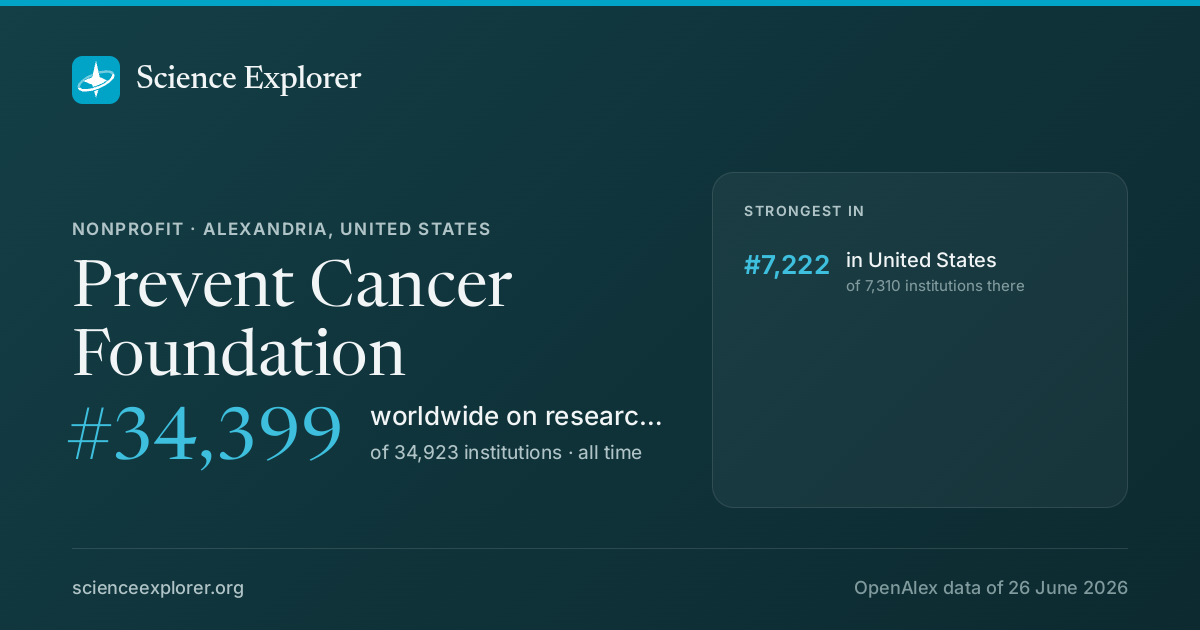
Prevent Cancer Foundation on Science Explorer

A card with Prevent Cancer Foundation's standing and the fields it leads in, for a post or a slide. A link to this page previews as the same card.

Download the card

1200 × 630 PNG, sized for social posts, drawn from the latest snapshot.

Badges for a website1Each links back here and updates with every snapshot

Research measures only: rankings here say nothing about teaching, admissions or student experience. Comparable institutions and collaboration partners have tabs of their own, above.

Discussion

Ask a question or share a note about Prevent Cancer Foundation. Keep it to the research: no personal attacks, advertising or links. Any reader can report a post, which collapses it for everyone until it is opened.