- World rank, all time
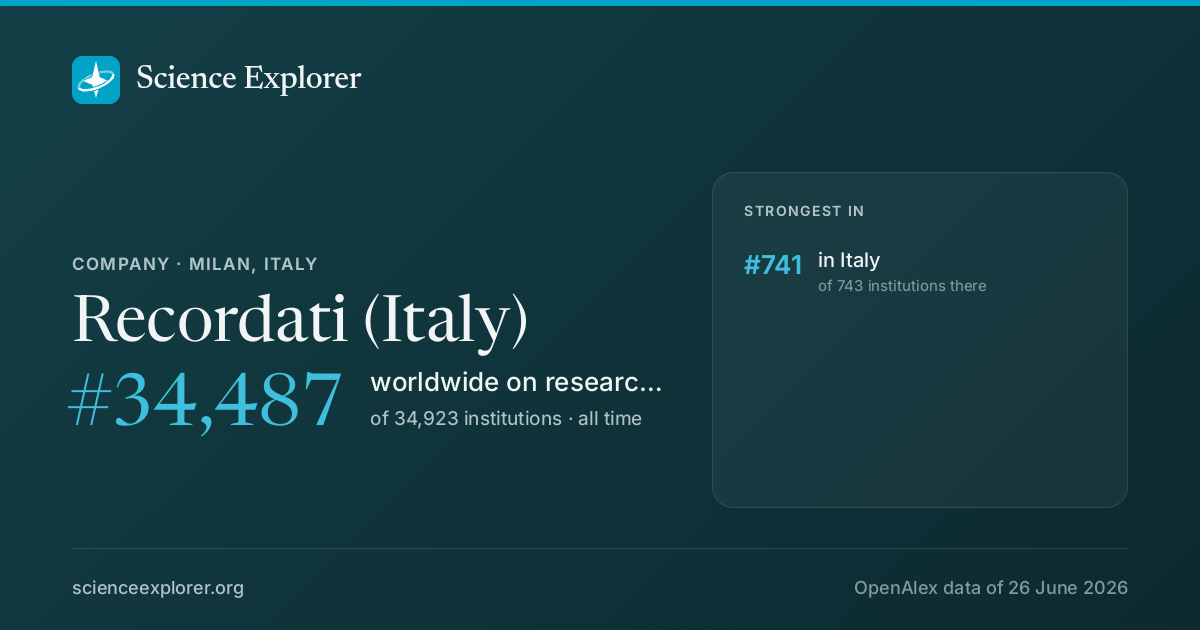
- #34,487 of 34,923
- Rank in Italy
- #741 of 743
- Research works
- 185 ▲ 51% vs 2018-21
- Citations
- 2.8k 15.4 per fractional work
- Top-10% rate
- 10.1% all institutions 10.0%
- vs its own fields
- 0.83× 1.00× is exactly expected
- Open access
- 24% world 40%
- International
- 13% world 18%
Which fields of science does Recordati (Italy) work in?
In all years, 39% of research at Recordati (Italy) is in Health Sciences, 37% in Life Sciences. Its largest fields are Medicine (37%), Biochemistry, Genetics and Molecular Biology (20%), Chemistry (17%). It does 2.3× the world's share of Life Sciences.
Each ring splits the one inside it: the four domains of science, their fields, their subfields. Size is fractional works in all years. Every slice is a page; the interactive view zooms down to single topics and colours each by how much more of it this institution does than the world.
Its 4 domains and 22 fields, with their numbers
- Health Sciences7138.7%
- Medicine6937.3%
- Nursing10.6%
- Veterinary10.5%
- Health Professions10.3%
- Life Sciences6937.2%
- Physical Sciences4222.5%
- Chemistry3116.9%
- Engineering31.8%
- Computer Science31.4%
- Materials Science31.4%
- Mathematics10.5%
- Environmental Science00.2%
- Physics and Astronomy00.2%
- Earth and Planetary Sciences00.1%
- Social Sciences31.6%
- Social Sciences10.5%
- Economics, Econometrics and Finance10.5%
- Psychology10.4%
- Decision Sciences00.1%
- Arts and Humanities00.1%
Field profile
Location quotient across every field it publishes in: outside the ring is more than an institution of this size would be expected to publish, inside it is less.
Rings at 0.5×, 1× and 2×. Widest outward: Pharmacology, Toxicology and Pharmaceutics, 4.0×. Every wedge is a field page.
All 8 fields, with their numbers
- Pharmacology, Toxicology and Pharmaceutics4.01×0 works
- Medicine4.01×6 works
- Economics, Econometrics and Finance2.31×0 works
- Immunology and Microbiology2.11×0 works
- Biochemistry, Genetics and Molecular Biology1.30×0 works
- Neuroscience0.87×0 works
- Arts and Humanities0.73×0 works
- Social Sciences0.32×0 works
Who are the top researchers at Recordati (Italy)?
Ranked on the quality score, Andrea Piacentini, Giancarlo Santus and Ivo Setnikar lead among researchers whose main affiliation is Recordati (Italy).
- 1
Andrea Piacentini
 Italy · #1,816,375 worldwide
89 citations · 44 works
- 2
Giancarlo Santus
Italy · #3,005,707 worldwide
800 citations · 20 works
- 3
Ivo Setnikar
Italy · #3,595,704 worldwide
3.4k citations · 224 works
- 4
Marina Ibba
Italy · #4,146,158 worldwide
348 citations · 16 works
- 5
Cristina Velasco
Italy · #4,263,737 worldwide
697 citations · 36 works
- 6
Patrizia Angelico
Italy · #4,543,714 worldwide
736 citations · 45 works
- 7
Renzo Pennini
Italy · #4,661,880 worldwide
198 citations · 18 works
- 8
L. Guarneri
Italy · #4,663,024 worldwide
661 citations · 30 works
- 9
Ralf Ruffmann
Italy · #4,683,729 worldwide
793 citations · 45 works
- 10
Rodolfo Testa
Italy · #4,743,378 worldwide
711 citations · 186 works
Which keywords describe research at Recordati (Italy)?
By fractional works in all years, weighted toward what it does more of than the world: Synthesis, Drug Discovery, Cell Signaling, Medicinal Chemistry, Pharmacology, Crystal Structure, Anticancer Agents and Urinary Incontinence.
- Flavonoids
- Synaptic Plasticity
- Genetic Variation
- Hypertension
- Antifungal Therapy
- Reactive Oxygen Species
- Biological Activity
- Anticancer
- Pharmacokinetics
- Heterocyclic Compounds
- Anxiety
- Heterocycles
- Depression
- Oxidative Stress
- G-Protein-Coupled Receptors
- Signal Transduction
- Anticancer Agents
- Pharmacology
- Epidemiology
- Drug Discovery
- Synthesis
- Cell Signaling
- Medicinal Chemistry
- Crystal Structure
- Urinary Incontinence
- Arrestin
- Stress
- Benign Prostatic Hyperplasia
- Lower Urinary Tract Symptoms
- Antimicrobial
- Neuropeptides
- Opioid
- Receptors
- Microwave-Assisted Synthesis
- Ion Channels
- Antioxidants
- Biological Activities
- Dendritic Spines
- Neurotransmission
- Calcium Signaling
Size is fractional works in all years in the topics tagged with each word; colour is the word's share of this institution's work against its share of the world's. The 40 words are chosen for being large and distinctive. Each links to the topic it comes from most.
All 40 words, with their numbers
- Synthesis19▲ 18×15 topics
- Drug Discovery18▲ 25×8 topics
- Cell Signaling14▲ 22×3 topics
- Epidemiology14▲ 1.82×16 topics
- Medicinal Chemistry13▲ 18×7 topics
- Pharmacology12▲ 21×6 topics
- Crystal Structure12▲ 26×2 topics
- Anticancer Agents12▲ 25×5 topics
- Urinary Incontinence11▲ 65×2 topics
- Signal Transduction10▲ 22×3 topics
- Arrestin10▲ 66×1 topic
- G-Protein-Coupled Receptors10▲ 66×1 topic
- Stress9▲ 12×4 topics
- Oxidative Stress8▲ 2.5×15 topics
- Benign Prostatic Hyperplasia7▲ 96×1 topic
- Depression7▲ 5.2×5 topics
- Lower Urinary Tract Symptoms7▲ 96×1 topic
- Heterocycles7▲ 21×5 topics
- Antimicrobial7▲ 15×5 topics
- Anxiety7▲ 10×4 topics
- Neuropeptides6▲ 32×2 topics
- Heterocyclic Compounds6▲ 21×4 topics
- Opioid6▲ 54×1 topic
- Pharmacokinetics6▲ 12×5 topics
- Receptors6▲ 54×1 topic
- Anticancer6▲ 16×4 topics
- Microwave-Assisted Synthesis6▲ 39×3 topics
- Biological Activity6▲ 27×4 topics
- Ion Channels6▲ 14×4 topics
- Reactive Oxygen Species6▲ 6.2×5 topics
- Antioxidants5▲ 6.3×2 topics
- Antifungal Therapy5▲ 27×3 topics
- Biological Activities5▲ 14×3 topics
- Hypertension5▲ 7.5×5 topics
- Dendritic Spines5▲ 16×2 topics
- Genetic Variation5▲ 8.4×2 topics
- Neurotransmission5▲ 20×1 topic
- Synaptic Plasticity5▲ 8.4×1 topic
- Calcium Signaling5▲ 19×4 topics
- Flavonoids5▲ 10×2 topics
Which research topics does Recordati (Italy) publish most on?
By volume in 2022-now: Pituitary Gland Disorders and Treatments, Health Systems, Economic Evaluations, Quality of Life, Anorectal Disease Treatments and Outcomes and Lipoproteins and Cardiovascular Health.
Area is fractional works; colour is the subfield each topic belongs to.
- 1 Pituitary Gland Disorders and Treatments Endocrinology, Diabetes and Metabolism 1 works
- 2 Health Systems, Economic Evaluations, Quality of Life Economics and Econometrics 0 works
- 3 Anorectal Disease Treatments and Outcomes Surgery 0 works
- 4 Lipoproteins and Cardiovascular Health Surgery 0 works
- 5 Adrenal Hormones and Disorders Endocrinology, Diabetes and Metabolism 0 works
- 6 Wound Healing and Treatments Rehabilitation 0 works
- 7 Hidradenitis Suppurativa and Treatments Dermatology 0 works
- 8 Adrenal and Paraganglionic Tumors Surgery 0 works
- 9 IgG4-Related and Inflammatory Diseases Rheumatology 0 works
- 10 Psychosomatic Disorders and Their Treatments Psychiatry and Mental health 0 works
How open and international is its research?
Against the world's own shares: the tick on each track. Both are shares of its output, so they sit on one scale and can be read against each other as well as against the world.
World: 40% of research is openly available.
World: 18% is written across borders.
How has Recordati (Italy)'s research output changed?
Output in 2022-2025 was 51% higher than in 2018-2021.
The same series as a ribbon: one cell per year, darker for more. The line above answers how much; this answers when.
Its share of all research
Growing output can still be a shrinking share: all of science grows. This is Recordati (Italy) as a percentage of every work published that year, 0.000023% in 2024.
Fractional works of Recordati (Italy) over all fractional works that year. How the balance of science has shifted.
Other research institutions in Milan
- University of Milan
- Politecnico di Milano
- Università Cattolica del Sacro Cuore
- University of Milano-Bicocca
- Vita-Salute San Raffaele University
- Fondazione IRCCS Ca' Granda Ospedale Maggiore Policlinico
- Fondazione IRCCS Istituto Nazionale dei Tumori
- Mario Negri Institute for Pharmacological Research
Share Recordati (Italy)'s ranking
Badges for a website1Each links back here and updates with every snapshot

Research measures only: rankings here say nothing about teaching, admissions or student experience. Comparable institutions and collaboration partners have tabs of their own, above.
Discussion
Ask a question or share a note about Recordati (Italy). Keep it to the research: no personal attacks, advertising or links. Any reader can report a post, which collapses it for everyone until it is opened.