Science Explorer Back to mapMap
Discussion
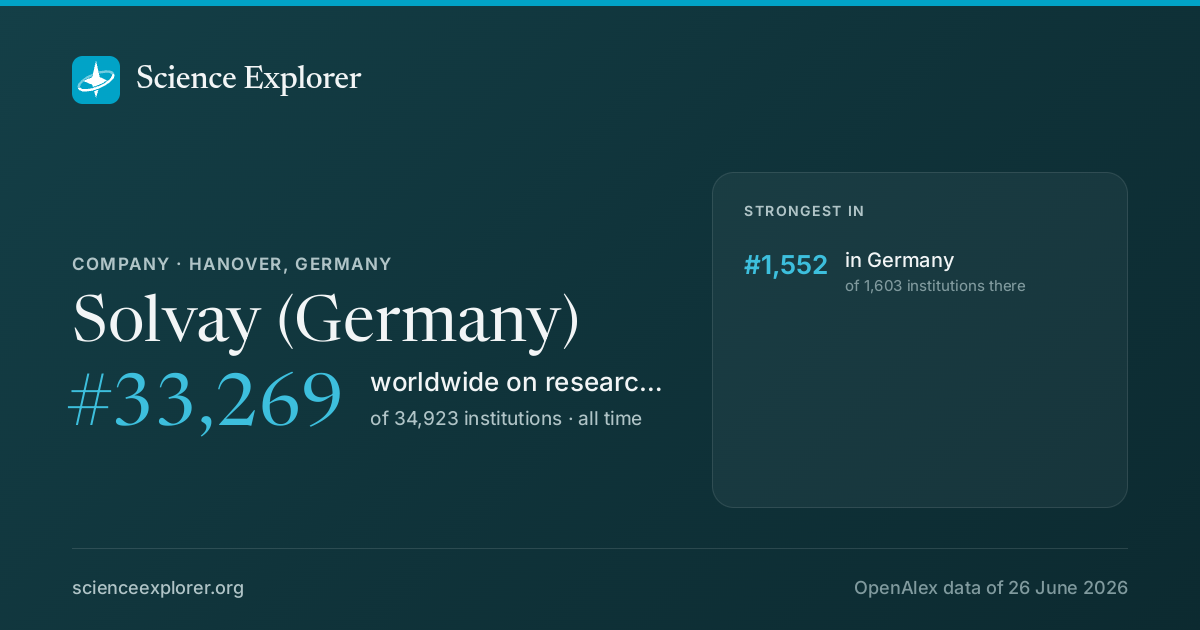
Company · Hanover · Germany

Solvay (Germany)

World rank, all time
#33,269
of 34,923
Rank in Germany
#1,552
of 1,603
Research works
129
▲ 10% vs 2018-21
Citations
3.1k
23.8 per fractional work
Top-10% rate
7.3%
all institutions 10.0%
vs its own fields
0.97×
1.00× is exactly expected
Open access
18%
world 40%
International
43%
world 18%

Which fields of science does Solvay (Germany) work in?

In all years, 38% of research at Solvay (Germany) is in Physical Sciences, 33% in Health Sciences. Its largest fields are Medicine (30%), Chemistry (12%), Biochemistry, Genetics and Molecular Biology (11%). It does 1.4× the world's share of Health Sciences.

Physical Sciences: 48 fractional works · 37.6% of its workChemistry: 16 fractional works · 12.3% of its workOrganic Chemistry: 10 fractional works · 7.7% of its workSpectroscopy: 2 fractional works · 1.8% of its workInorganic Chemistry: 2 fractional works · 1.5% of its workPhysical and Theoretical Chemistry: 1 fractional works · 0.7% of its workAnalytical Chemistry: 1 fractional works · 0.6% of its workMaterials Science: 12 fractional works · 9.0% of its workMaterials Chemistry: 6 fractional works · 4.7% of its workPolymers and Plastics: 4 fractional works · 2.8% of its workBiomaterials: 1 fractional works · 0.5% of its workCeramics and Composites: 0 fractional works · 0.4% of its workElectronic, Optical and Magnetic Materials: 0 fractional works · 0.3% of its workSmaller subfields together: 0 fractional works · 0.3% of its workEngineering: 10 fractional works · 8.0% of its workMechanical Engineering: 3 fractional works · 2.4% of its workBiomedical Engineering: 2 fractional works · 1.3% of its workElectrical and Electronic Engineering: 2 fractional works · 1.2% of its workSafety, Risk, Reliability and Quality: 1 fractional works · 0.6% of its workComputational Mechanics: 1 fractional works · 0.6% of its workAerospace Engineering: 1 fractional works · 0.4% of its workControl and Systems Engineering: 0 fractional works · 0.4% of its workAutomotive Engineering: 0 fractional works · 0.3% of its workBuilding and Construction: 0 fractional works · 0.3% of its workCivil and Structural Engineering: 0 fractional works · 0.3% of its workMechanics of Materials: 0 fractional works · 0.3% of its workEnvironmental Science: 4 fractional works · 2.9% of its workEnvironmental Chemistry: 1 fractional works · 0.8% of its workHealth, Toxicology and Mutagenesis: 1 fractional works · 0.7% of its workPollution: 1 fractional works · 0.5% of its workIndustrial and Manufacturing Engineering: 1 fractional works · 0.5% of its workGlobal and Planetary Change: 0 fractional works · 0.3% of its workSmaller subfields together: 0 fractional works · 0.2% of its workMathematics: 2 fractional works · 1.4% of its workStatistics and Probability: 1 fractional works · 1.1% of its workSmaller subfields together: 0 fractional works · 0.3% of its workPhysics and Astronomy: 2 fractional works · 1.3% of its workCondensed Matter Physics: 1 fractional works · 1.0% of its workSmaller subfields together: 0 fractional works · 0.2% of its workChemical Engineering: 2 fractional works · 1.2% of its workFluid Flow and Transfer Processes: 1 fractional works · 0.6% of its workProcess Chemistry and Technology: 0 fractional works · 0.3% of its workSmaller subfields together: 0 fractional works · 0.4% of its workEarth and Planetary Sciences: 1 fractional works · 0.6% of its workAtmospheric Science: 1 fractional works · 0.6% of its workComputer Science: 1 fractional works · 0.5% of its workComputer Networks and Communications: 0 fractional works · 0.3% of its workComputational Theory and Mathematics: 0 fractional works · 0.2% of its workEnergy: 1 fractional works · 0.5% of its workRenewable Energy, Sustainability and the Environment: 1 fractional works · 0.5% of its workHealth Sciences: 43 fractional works · 33.2% of its workMedicine: 39 fractional works · 29.9% of its workCardiology and Cardiovascular Medicine: 7 fractional works · 5.8% of its workPublic Health, Environmental and Occupational Health: 4 fractional works · 3.1% of its workEndocrinology, Diabetes and Metabolism: 4 fractional works · 3.0% of its workSurgery: 3 fractional works · 2.6% of its workPharmacology: 3 fractional works · 2.1% of its workPsychiatry and Mental health: 2 fractional works · 1.8% of its workPhysiology: 2 fractional works · 1.7% of its workPulmonary and Respiratory Medicine: 2 fractional works · 1.7% of its workPediatrics, Perinatology and Child Health: 2 fractional works · 1.6% of its workPathology and Forensic Medicine: 1 fractional works · 0.9% of its workOncology: 1 fractional works · 0.7% of its workGastroenterology: 1 fractional works · 0.7% of its workEpidemiology: 1 fractional works · 0.6% of its workRadiology, Nuclear Medicine and Imaging: 1 fractional works · 0.5% of its workReproductive Medicine: 1 fractional works · 0.5% of its workBiochemistry: 1 fractional works · 0.4% of its workRheumatology: 0 fractional works · 0.4% of its workObstetrics and Gynecology: 0 fractional works · 0.3% of its workDermatology: 0 fractional works · 0.3% of its workImmunology and Allergy: 0 fractional works · 0.3% of its workHematology: 0 fractional works · 0.2% of its workNephrology: 0 fractional works · 0.2% of its workSmaller subfields together: 1 fractional works · 0.5% of its workNursing: 2 fractional works · 1.5% of its workNutrition and Dietetics: 2 fractional works · 1.5% of its workHealth Professions: 1 fractional works · 1.1% of its workGeneral Health Professions: 1 fractional works · 0.9% of its workSpeech and Hearing: 0 fractional works · 0.3% of its workVeterinary: 1 fractional works · 0.7% of its workSmall Animals: 1 fractional works · 0.7% of its workLife Sciences: 27 fractional works · 20.7% of its workBiochemistry, Genetics and Molecular Biology: 14 fractional works · 11.0% of its workMolecular Biology: 9 fractional works · 6.8% of its workGenetics: 3 fractional works · 2.6% of its workCancer Research: 1 fractional works · 0.5% of its workBiochemistry: 1 fractional works · 0.5% of its workCell Biology: 0 fractional works · 0.3% of its workPhysiology: 0 fractional works · 0.3% of its workSmaller subfields together: 0 fractional works · 0.1% of its workNeuroscience: 5 fractional works · 3.6% of its workCellular and Molecular Neuroscience: 2 fractional works · 1.8% of its workEndocrine and Autonomic Systems: 1 fractional works · 0.6% of its workCognitive Neuroscience: 1 fractional works · 0.5% of its workSensory Systems: 0 fractional works · 0.3% of its workSmaller subfields together: 1 fractional works · 0.4% of its workPharmacology, Toxicology and Pharmaceutics: 4 fractional works · 3.0% of its workPharmacology: 2 fractional works · 1.2% of its workToxicology: 1 fractional works · 0.9% of its workPharmaceutical Science: 1 fractional works · 0.8% of its workAgricultural and Biological Sciences: 2 fractional works · 1.8% of its workAnimal Science and Zoology: 1 fractional works · 0.7% of its workPlant Science: 1 fractional works · 0.7% of its workAgronomy and Crop Science: 0 fractional works · 0.3% of its workSmaller subfields together: 0 fractional works · 0.2% of its workImmunology and Microbiology: 2 fractional works · 1.3% of its workImmunology: 2 fractional works · 1.3% of its workSocial Sciences: 11 fractional works · 8.5% of its workEconomics, Econometrics and Finance: 4 fractional works · 2.8% of its workEconomics and Econometrics: 4 fractional works · 2.8% of its workSocial Sciences: 2 fractional works · 1.8% of its workSociology and Political Science: 1 fractional works · 0.7% of its workEducation: 0 fractional works · 0.4% of its workCultural Studies: 0 fractional works · 0.4% of its workDevelopment: 0 fractional works · 0.3% of its workSmaller subfields together: 0 fractional works · 0.1% of its workArts and Humanities: 2 fractional works · 1.3% of its workLanguage and Linguistics: 1 fractional works · 0.8% of its workPhilosophy: 0 fractional works · 0.3% of its workVisual Arts and Performing Arts: 0 fractional works · 0.3% of its workBusiness, Management and Accounting: 1 fractional works · 0.9% of its workManagement Information Systems: 1 fractional works · 0.5% of its workStrategy and Management: 0 fractional works · 0.3% of its workSmaller subfields together: 0 fractional works · 0.1% of its workDecision Sciences: 1 fractional works · 0.9% of its workInformation Systems and Management: 1 fractional works · 0.6% of its workSmaller subfields together: 0 fractional works · 0.3% of its workPsychology: 1 fractional works · 0.6% of its workClinical Psychology: 1 fractional works · 0.5% of its workSmaller subfields together: 0 fractional works · 0.1% of its workALL ITS WORKSolvay (Germany)129fractional works, all years
Life Sciences21%Physical Sciences38%Health Sciences33%Social Sciences8%

Each ring splits the one inside it: the four domains of science, their fields, their subfields. Size is fractional works in all years. Every slice is a page; the interactive view zooms down to single topics and colours each by how much more of it this institution does than the world.

Its 4 domains and 25 fields, with their numbers
    1. Chemistry1612.3%
    2. Materials Science129.0%
    3. Engineering108.0%
    4. Environmental Science42.9%
    5. Mathematics21.4%
    6. Physics and Astronomy21.3%
    7. Chemical Engineering21.2%
    8. Earth and Planetary Sciences10.6%
    9. Computer Science10.5%
    10. Energy10.5%
    1. Medicine3929.9%
    2. Nursing21.5%
    3. Health Professions11.1%
    4. Veterinary10.7%
    1. Biochemistry, Genetics and Molecular Biology1411.0%
    2. Neuroscience53.6%
    3. Pharmacology, Toxicology and Pharmaceutics43.0%
    4. Agricultural and Biological Sciences21.8%
    5. Immunology and Microbiology21.3%
    1. Economics, Econometrics and Finance42.8%
    2. Social Sciences21.8%
    3. Arts and Humanities21.3%
    4. Business, Management and Accounting10.9%
    5. Decision Sciences10.9%
    6. Psychology10.6%
All of science, and how each field's share has moved since 1950: the Science domain explorer

Field profile

Location quotient across every field it publishes in: outside the ring is more than an institution of this size would be expected to publish, inside it is less.

Computer Science: 1.24× its world share, 0 worksComputer ScienceEngineering: 1.29× its world share, 1 worksEngineeringMaterials Science: 3.47× its world share, 0 worksMaterials ScienceMedicine: 0.38× its world share, 0 worksMedicineBusiness, Management and Accounting: 7.01× its world share, 1 worksBusiness, Management…Decision Sciences: 10.01× its world share, 0 worksDecision SciencesPsychology: 2.12× its world share, 0 worksPsychologySocial Sciences: 1.02× its world share, 0 worksSocial Sciences1×world share
more than its size predictsabout as predictedless

Rings at 0.5×, 1× and 2×. Widest outward: Decision Sciences, 10.0×. Every wedge is a field page.

All 8 fields, with their numbers
  1. Decision Sciences10.01×0 works
  2. Business, Management and Accounting7.01×1 works
  3. Materials Science3.47×0 works
  4. Psychology2.12×0 works
  5. Engineering1.29×1 works
  6. Computer Science1.24×0 works
  7. Social Sciences1.02×0 works
  8. Medicine0.38×0 works

Who are the top researchers at Solvay (Germany)?

Ranked on the quality score, Matthias Straub, Michael Wurl and Bettina Husen lead among researchers whose main affiliation is Solvay (Germany).

  1. 1 Matthias Straub Germany · #2,190,581 worldwide 1.3k citations · 14 works
  2. 2 Michael Wurl Germany · #2,445,689 worldwide 718 citations · 17 works
  3. 3 Bettina Husen Germany · #3,182,153 worldwide 1.9k citations · 56 works
  4. 4 Karl Köhler Germany · #3,696,083 worldwide 47 citations · 23 works
  5. 5 Uwe Schön Germany · #3,863,479 worldwide 478 citations · 26 works
  6. 6 York F Zoellner Germany · #3,988,682 worldwide 422 citations · 18 works
  7. 7 Emil Finner Germany · #4,191,816 worldwide 571 citations · 29 works
  8. 8 M.S.R. Prabhu Germany · #4,897,700 worldwide 140 citations · 29 works
  9. 9 Cornel Pater Germany · #5,256,477 worldwide 224 citations · 20 works
  10. 10 Josef Messinger Germany · #5,319,258 worldwide 1.2k citations · 88 works
All ranked researchers at Solvay (Germany)

What are the most cited papers from Solvay (Germany)?

The most cited paper from Solvay (Germany) is "Development of catalysts for a selective nitrate and nitrite removal from drinking water" (Sebastian Hörold, Klaus‐Dieter Vorlop, Thomas Tacke et al., 1993), with 366 citations. Next come "Cytotoxicity screening of 23 engineered nanomaterials using a test matrix of ten cell lines and three different assays" (226) and "Carbonic anhydrase inhibitors: SAR and X-ray crystallographic study for the interaction of sugar sulfamates/sulfamides with isozymes I, II and IV" (224).

Most cited papers
#PaperReleasedCitations
1 Development of catalysts for a selective nitrate and nitrite removal from drinking water Sebastian Hörold, Klaus‐Dieter Vorlop, Thomas Tacke et al. · Catalysis Today May 1993 366
2 Cytotoxicity screening of 23 engineered nanomaterials using a test matrix of ten cell lines and three different assays Alexandra Kröll, Christian Dierker, Christina E. Rommel et al. · Particle and Fibre Toxicology Open access 23 Feb 2011 226
3 Carbonic anhydrase inhibitors: SAR and X-ray crystallographic study for the interaction of sugar sulfamates/sulfamides with isozymes I, II and IV Angela Casini, Jochen Antel, Francesco Abbate et al. · Bioorganic & Medicinal Chemistry Letters Open access Mar 2003 224
4 Pancrelipase Delayed-Release Capsules (CREON) for Exocrine Pancreatic Insufficiency due to Chronic Pancreatitis or Pancreatic Surgery: A Double-Blind Randomized Trial David Clement Whitcomb, Glen A. Lehman, G. A. VASIL'EVA et al. · The American Journal of Gastroenterology 25 May 2010 197
5 Effects of Low Dose Sympathetic Inhibition on Glomerulosclerosis and Albuminuria in Subtotally Nephrectomized Rats Kerstin Amann, Lars Christian Rump, Aurelia Simonaviciene et al. · Journal of the American Society of Nephrology Aug 2000 193
All 61 most cited papers, with filters and sorting

Which keywords describe research at Solvay (Germany)?

By fractional works in all years, weighted toward what it does more of than the world: Cardiovascular Disease, Inflammation, Hypertension, Catalysis, Drug Discovery, Synthesis, Organic Synthesis and Genetic Testing.

▲ more of its work than of the world's◆ about the world's share▼ less than the world's

Size is fractional works in all years in the topics tagged with each word; colour is the word's share of this institution's work against its share of the world's. The 40 words are chosen for being large and distinctive. Each links to the topic it comes from most.

All 40 words, with their numbers
  1. Inflammation10▲ 3.1×25 topics
  2. Cardiovascular Disease8▲ 5.4×16 topics
  3. Catalysis7▲ 6.2×14 topics
  4. Hypertension6▲ 13×8 topics
  5. Drug Discovery6▲ 11×7 topics
  6. Oxidative Stress5▲ 2.2×19 topics
  7. Nanocomposites5▲ 4.9×10 topics
  8. Synthesis5▲ 6.3×11 topics
  9. Clinical Trials4▲ 5.5×7 topics
  10. Organic Synthesis4▲ 15×6 topics
  11. Environmental Impact4▲ 2.4×11 topics
  12. Genetic Testing4▲ 20×2 topics
  13. Nanoparticles4▲ 2.4×11 topics
  14. Cardiovascular Events4▲ 18×3 topics
  15. Medicinal Chemistry4▲ 7.5×8 topics
  16. Breast Cancer3▲ 9.4×3 topics
  17. Diabetes Mellitus3▲ 12×4 topics
  18. Medical Ethics3▲ 15×2 topics
  19. Metabolic Syndrome3▲ 3.1×7 topics
  20. Clinical Guidelines3▲ 8.0×4 topics
  21. Estrogen3▲ 33×2 topics
  22. Nuclear Receptors3▲ 14×3 topics
  23. Obesity3▲ 3.3×9 topics
  24. Transcriptional Regulation3▲ 9.9×4 topics
  25. Glucocorticoids3▲ 37×1 topic
  26. Ion Channels3▲ 9.5×3 topics
  27. Patient Rights3▲ 22×1 topic
  28. Receptor3▲ 29×1 topic
  29. Reproductive Medicine3▲ 83×1 topic
  30. Signaling3▲ 18×2 topics
  31. Transition Metal Catalysis3▲ 15×4 topics
  32. Adverse Drug Reactions2▲ 30×2 topics
  33. Pharmacology2▲ 6.0×6 topics
  34. Properties2▲ 16×2 topics
  35. Cell Signaling2▲ 5.6×3 topics
  36. Pharmaceutical Industry2▲ 47×2 topics
  37. Blood Pressure2▲ 25×2 topics
  38. Thermal Insulation2▲ 73×2 topics
  39. Drug Development2▲ 11×2 topics
  40. C-C Bond Formation2▲ 16×3 topics

Which research topics does Solvay (Germany) publish most on?

By volume in 2022-now: Business Process Modeling and Analysis, Safety Systems Engineering in Autonomy, Scientific Computing and Data Management and Software System Performance and Reliability.

  1. 1 Business Process Modeling and Analysis Management Information Systems 1 works
  2. 2 Safety Systems Engineering in Autonomy Safety, Risk, Reliability and Quality 0 works
  3. 3 Scientific Computing and Data Management Information Systems and Management 0 works
  4. 4 Software System Performance and Reliability Computer Networks and Communications 0 works
  5. 5 Catalytic Processes in Materials Science Materials Chemistry 0 works
  6. 6 Software Engineering and Design Patterns Development 0 works
  7. 7 Fire effects on concrete materials Civil and Structural Engineering 0 works
  8. 8 Fire dynamics and safety research Safety, Risk, Reliability and Quality 0 works
  9. 9 Engineering and Material Science Research General Materials Science 0 works
  10. 10 Psychotherapy Techniques and Applications Clinical Psychology 0 works

How open and international is its research?

Against the world's own shares: the tick on each track. Both are shares of its output, so they sit on one scale and can be read against each other as well as against the world.

openly available17.8%not open82.2%

World: 40% of research is openly available.

with international co-authors43.2%domestic only56.8%

World: 18% is written across borders.

How has Solvay (Germany)'s research output changed?

Output in 2022-2025 was 10% higher than in 2018-2021.

still counting1990200020102020
grewheldshrank

The same series as a ribbon: one cell per year, darker for more. The line above answers how much; this answers when.

Its share of all research

Growing output can still be a shrinking share: all of science grows. This is Solvay (Germany) as a percentage of every work published that year, 0.0000020% in 2024.

still counting0.0010%0.0020%Solvay (Germany)0.000013% in 202519801990200020102020

Fractional works of Solvay (Germany) over all fractional works that year. How the balance of science has shifted.

Other research institutions in Hanover

All research institutions in Hanover

Share Solvay (Germany)'s ranking

Solvay (Germany) on Science Explorer

A card with Solvay (Germany)'s standing and the fields it leads in, for a post or a slide. A link to this page previews as the same card.

Download the card

1200 × 630 PNG, sized for social posts, drawn from the latest snapshot.

Badges for a website1Each links back here and updates with every snapshot

Research measures only: rankings here say nothing about teaching, admissions or student experience. Comparable institutions and collaboration partners have tabs of their own, above.

Discussion

Ask a question or share a note about Solvay (Germany). Keep it to the research: no personal attacks, advertising or links. Any reader can report a post, which collapses it for everyone until it is opened.