STMicroelectronics (Switzerland)
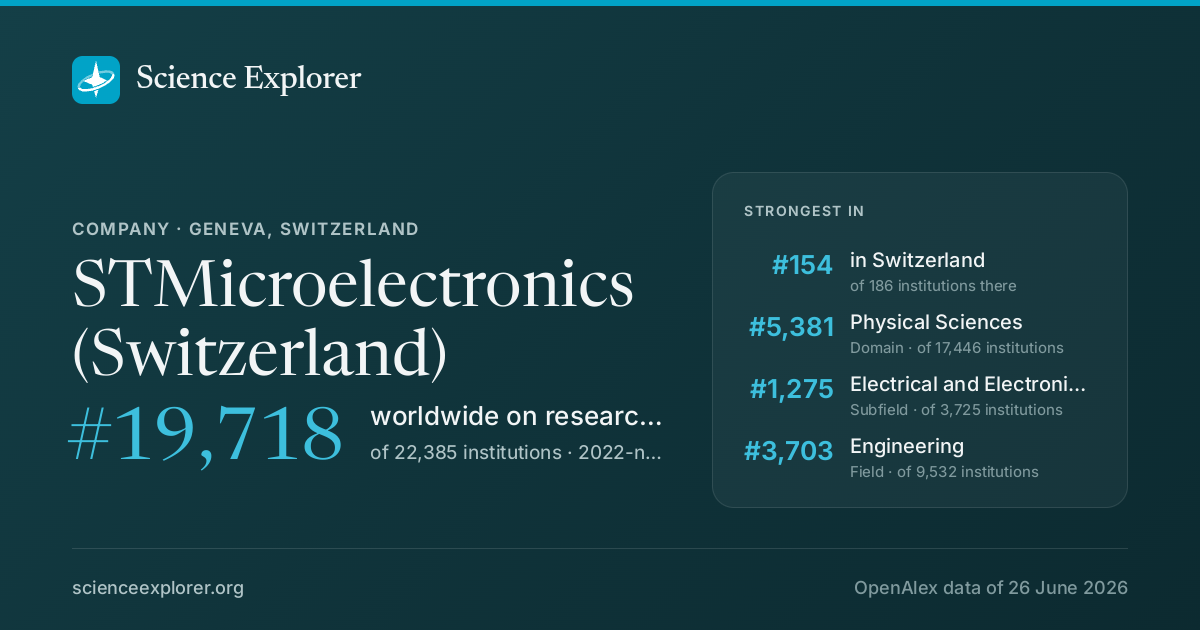
In research, STMicroelectronics (Switzerland) stands highest in Physical Sciences (#5,381 of 17,446 worldwide), Electrical and Electronic Engineering (#1,275 of 3,725 worldwide) and Engineering (#3,703 of 9,532 worldwide), over all time. Relative to its size it is most specialised in Electrical and Electronic Engineering (Electrical and Electronic Engineering is 10.3× its share of world research).
- World rank, 2022-now
- #19,718 of 22,385 · #12,253 all time
- Rank in Switzerland
- #154 of 186
- Research works
- 1.3k ▼ 51% vs 2018-21
- Citations
- 16k 11.7 per fractional work
- Top-10% rate
- 6.7% all institutions 10.0%
- vs its own fields
- 0.98× 1.00× is exactly expected
- Open access
- 22% world 40%
- International
- 71% world 18%
What is STMicroelectronics (Switzerland) known for in research?
The fields where it stands highest, over all time, ranked among every institution above the floor in each field.
| Field | World rank | Where that sits | Top-10% rate | Works |
|---|---|---|---|---|
| Physical SciencesDomain | #5,381 of 17,446 | 7.5% | 1,277 | |
| Electrical and Electronic EngineeringSubfield | #1,275 of 3,725 | 7.1% | 664 | |
| EngineeringField | #3,703 of 9,532 | 7.3% | 867 | |
| Computer ScienceField | #3,745 of 6,336 | 9.5% | 259 |
Each strip is that field's whole ranked pool, with the notch where STMicroelectronics (Switzerland) sits in it, in the colour of the band that rank falls in. The track under the rate is the rate itself: it carries no average mark, because the average differs by field (from about 6% in Dentistry to 21% in Economics).
Which fields of science does STMicroelectronics (Switzerland) work in?
In 2022-now, 79% of research at STMicroelectronics (Switzerland) is in Physical Sciences, 15% in Social Sciences. Its largest fields are Engineering (49%), Computer Science (16%), Social Sciences (13%). It does 2.0× the world's share of Physical Sciences.
Each ring splits the one inside it: the four domains of science, their fields, their subfields. Size is fractional works in 2022-now. Every slice is a page; the interactive view zooms down to single topics and colours each by how much more of it this institution does than the world.
Its 4 domains and 20 fields, with their numbers
- Physical Sciences7279.1%
- Engineering4549.5%
- Computer Science1416.0%
- Physics and Astronomy56.0%
- Materials Science33.7%
- Chemistry21.8%
- Mathematics10.9%
- Chemical Engineering00.5%
- Environmental Science00.4%
- Energy00.2%
- Earth and Planetary Sciences00.1%
- Social Sciences1314.7%
- Social Sciences1212.9%
- Business, Management and Accounting10.6%
- Psychology10.6%
- Arts and Humanities00.4%
- Decision Sciences00.1%
- Health Sciences44.0%
- Medicine43.9%
- Health Professions00.1%
- Life Sciences22.3%
What does STMicroelectronics (Switzerland) specialise in?
Where its research is concentrated relative to its size: Electrical and Electronic Engineering takes 10.3× the share of its output that it takes of world research.
- Electrical and Electronic EngineeringSubfield · 33.4 works10×
Location quotient, a volume reading rather than an impact one. It surfaces small, lopsided specialities.
Field profile
Location quotient across every field it publishes in: outside the ring is more than an institution of this size would be expected to publish, inside it is less.
Rings at 0.5×, 1× and 2×. Widest outward: Engineering, 3.3×. Every wedge is a field page.
All 20 fields, with their numbers
- Engineering3.30×45 works
- Physics and Astronomy2.71×6 works
- Computer Science2.06×14 works
- Chemical Engineering1.35×0 works
- Chemistry1.16×2 works
- Materials Science1.07×3 works
- Social Sciences1.02×12 works
- Neuroscience0.82×1 works
- Mathematics0.78×1 works
- Energy0.23×0 works
- Medicine0.20×4 works
- Business, Management and Accounting0.20×1 works
- Psychology0.18×0 works
- Arts and Humanities0.15×0 works
- Decision Sciences0.13×0 works
- Agricultural and Biological Sciences0.11×0 works
- Biochemistry, Genetics and Molecular Biology0.08×0 works
- Environmental Science0.08×0 works
- Health Professions0.05×0 works
- Earth and Planetary Sciences0.04×0 works
- Engineering 3.3×
- Physics and Astronomy 2.7×
- Computer Science 2.1×
- Chemical Engineering 1.4×
- Chemistry 1.2×
- Materials Science 1.1×
- Social Sciences 1.0×
- Neuroscience 0.8×
- Mathematics 0.8×
- Energy 0.2×
- Medicine 0.2×
- Business, Management and Accounting 0.2×
- Psychology 0.2×
- Arts and Humanities 0.1×
- Decision Sciences 0.1×
- Agricultural and Biological Sciences 0.1×
- Biochemistry, Genetics and Molecular Biology 0.1×
- Environmental Science 0.1×
- Health Professions 0.1×
- Earth and Planetary Sciences 0.0×
Who are the top researchers at STMicroelectronics (Switzerland)?
Ranked on the quality score, Thomas Boesch, Rachel Ouvinha de Oliveira and Michel Ouaknine lead among researchers whose main affiliation is STMicroelectronics (Switzerland).
- 1
Thomas Boesch
 Switzerland · #2,865,767 worldwide
278 citations · 17 works
- 2
Rachel Ouvinha de Oliveira
Switzerland · #4,665,944 worldwide
11 citations · 15 works
- 3
Michel Ouaknine
Switzerland · #5,171,808 worldwide
110 citations · 25 works
- 4
Camillo Bresolin
Switzerland · #5,571,108 worldwide
224 citations · 19 works
- 5
Michael D. Capili
Switzerland · #5,782,502 worldwide
3 citations · 18 works
- 6
F. Pio
Switzerland · #5,869,158 worldwide
430 citations · 39 works
- 7
P.G. Mattos
Switzerland · #5,942,872 worldwide
226 citations · 50 works
- 8
F.T. Liou
Switzerland · #6,051,510 worldwide
123 citations · 32 works
- 9
Ettore Messina
Switzerland · #6,327,683 worldwide
150 citations · 46 works
- 10
Bryan Christian S. Bacquian
Switzerland · #6,884,975 worldwide
43 citations · 41 works
Which keywords describe research at STMicroelectronics (Switzerland)?
By fractional works in 2022-now, weighted toward what it does more of than the world: Thermal Management, High-Temperature Electronics, Reliability, Power Devices, Silicon Carbide, Wide Bandgap Semiconductors, Character Education and Curriculum Development.
- Electric Vehicle Charging
- Radiation Effects
- GaN
- High-Speed Imaging
- CMOS Technology
- Semiconductors
- Nanoelectronics
- Band Parameters
- Photon Counting
- Nanowires
- Kampus Merdeka
- School Environment
- Local Wisdom
- Learning Outcomes
- Qualitative Research
- Digital Learning
- Curriculum Development
- Wide Bandgap Semiconductors
- Power Devices
- High-Temperature Electronics
- Thermal Management
- Reliability
- Silicon Carbide
- Character Education
- Deep Learning
- Power Electronics
- Islamic Education
- Neural Networks
- Religious Values
- Renewable Energy Integration
- Merdeka Belajar
- Online Learning
- Thermal Behavior
- Integrated Circuits
- Process Variation
- Atomic Layer Deposition
- High-k Dielectrics
- Light-Emitting Diodes
- III-Nitrides
- Biomedical Imaging
Size is fractional works in 2022-now in the topics tagged with each word; colour is the word's share of this institution's work against its share of the world's. The 40 words are chosen for being large and distinctive. Each links to the topic it comes from most.
All 40 words, with their numbers
- Thermal Management8▲ 27×4 topics
- High-Temperature Electronics8▲ 139×2 topics
- Reliability7▲ 109×2 topics
- Power Devices6▲ 104×2 topics
- Silicon Carbide6▲ 142×1 topic
- Wide Bandgap Semiconductors6▲ 164×1 topic
- Character Education6▲ 14×2 topics
- Curriculum Development6▲ 9.8×5 topics
- Deep Learning6▲ 1.87×28 topics
- Digital Learning5▲ 12×5 topics
- Power Electronics5▲ 18×7 topics
- Qualitative Research5▲ 6.0×3 topics
- Islamic Education4▲ 12×2 topics
- Learning Outcomes4▲ 9.7×2 topics
- Neural Networks4▲ 2.6×13 topics
- Local Wisdom3▲ 7.9×2 topics
- Religious Values3▲ 20×1 topic
- School Environment3▲ 20×1 topic
- Renewable Energy Integration3▲ 10×3 topics
- Kampus Merdeka3▲ 21×1 topic
- Merdeka Belajar3▲ 21×1 topic
- Nanowires3▲ 21×3 topics
- Online Learning3▲ 3.5×4 topics
- Photon Counting3▲ 45×2 topics
- Thermal Behavior3▲ 70×2 topics
- Band Parameters2▲ 51×2 topics
- Integrated Circuits2▲ 18×3 topics
- Nanoelectronics2▲ 30×2 topics
- Process Variation2▲ 42×2 topics
- Semiconductors2▲ 8.3×3 topics
- Atomic Layer Deposition2▲ 36×1 topic
- CMOS Technology2▲ 29×4 topics
- High-k Dielectrics2▲ 36×1 topic
- High-Speed Imaging2▲ 32×2 topics
- Light-Emitting Diodes2▲ 15×2 topics
- GaN2▲ 61×1 topic
- III-Nitrides2▲ 70×1 topic
- Radiation Effects2▲ 51×2 topics
- Biomedical Imaging2▲ 35×2 topics
- Electric Vehicle Charging2▲ 24×2 topics
Which research topics does STMicroelectronics (Switzerland) publish most on?
By volume in 2022-now: Silicon Carbide Semiconductor Technologies, Education and Character Development, Educational Curriculum and Learning Methods and Semiconductor materials and devices.
Area is fractional works; colour is the subfield each topic belongs to.
- 1 Silicon Carbide Semiconductor Technologies Electrical and Electronic Engineering 6 works
- 2 Education and Character Development Education 3 works
- 3 Educational Curriculum and Learning Methods Education 3 works
- 4 Semiconductor materials and devices Electrical and Electronic Engineering 2 works
- 5 GaN-based semiconductor devices and materials Condensed Matter Physics 2 works
- 6 CCD and CMOS Imaging Sensors Electrical and Electronic Engineering 2 works
- 7 Advanced DC-DC Converters Electrical and Electronic Engineering 2 works
- 8 Advancements in Semiconductor Devices and Circuit Design Electrical and Electronic Engineering 2 works
- 9 Electromagnetic Compatibility and Noise Suppression Electrical and Electronic Engineering 1 works
- 10 Electronic Packaging and Soldering Technologies Electrical and Electronic Engineering 1 works
How open and international is its research?
Against the world's own shares: the tick on each track. Both are shares of its output, so they sit on one scale and can be read against each other as well as against the world.
World: 40% of research is openly available.
World: 18% is written across borders.
How has STMicroelectronics (Switzerland)'s research output changed?
Output in 2022-2025 was 51% lower than in 2018-2021.
The same series as a ribbon: one cell per year, darker for more. The line above answers how much; this answers when.
Its share of all research
Growing output can still be a shrinking share: all of science grows. This is STMicroelectronics (Switzerland) as a percentage of every work published that year, 0.00015% in 2024.
Fractional works of STMicroelectronics (Switzerland) over all fractional works that year. How the balance of science has shifted.
How much of it reaches the world top 10%
Year by year, against all institutions in the same year.
Of each year's output, the share that reached the world's 10% most cited for its field and year. Peak 13.9% in 2021.
Other research institutions in Geneva
- University of Geneva
- European Organization for Nuclear Research
- World Health Organization
- Hôpital Beau-Séjour
- Graduate Institute of International and Development Studies
- Clayton Foundation
- Médecins Sans Frontières
- Musée d'Art et d'Histoire
Share STMicroelectronics (Switzerland)'s ranking
Badges for a website1Each links back here and updates with every snapshot

Research measures only: rankings here say nothing about teaching, admissions or student experience. Comparable institutions and collaboration partners have tabs of their own, above.
Discussion
Ask a question or share a note about STMicroelectronics (Switzerland). Posts are plain text and can be reported.