Tissue Genetics (United States)
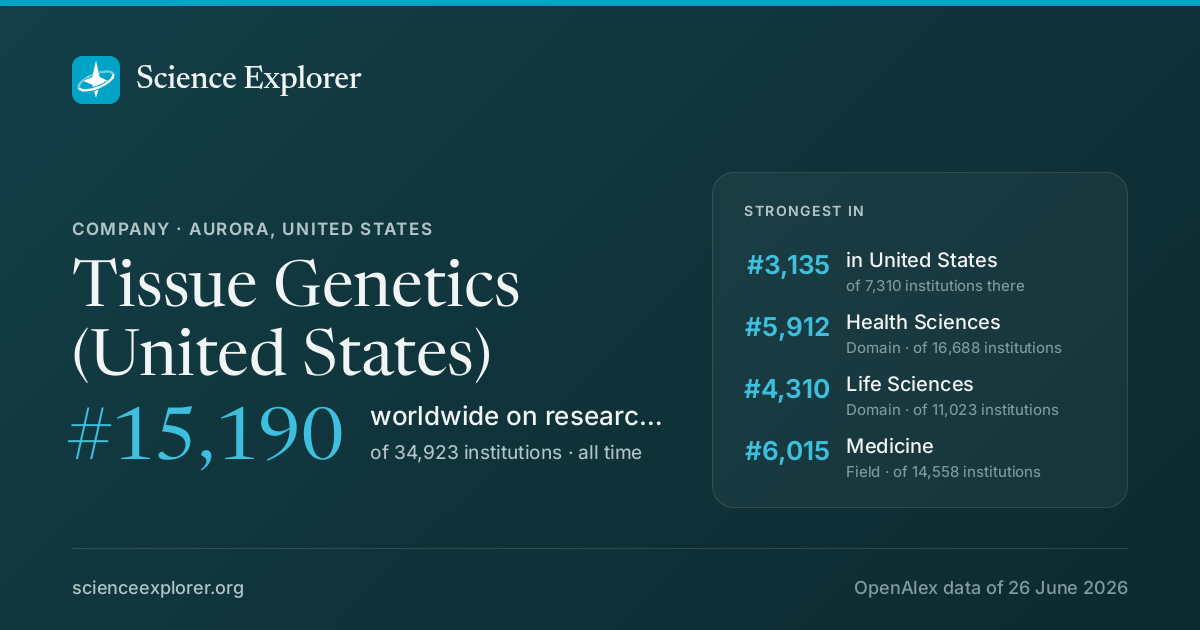
In research, Tissue Genetics (United States) stands highest in Health Sciences (#5,912 of 16,688 worldwide), Life Sciences (#4,310 of 11,023 worldwide) and Medicine (#6,015 of 14,558 worldwide), over all time.
- World rank, all time
- #15,190 of 34,923
- Rank in United States
- #3,135 of 7,310
- Research works
- 439 ▲ 433% vs 2018-21
- Citations
- 36k 81.3 per fractional work
- Top-10% rate
- 2.9% all institutions 10.0%
- vs its own fields
- 1.48× 1.00× is exactly expected
- Open access
- 46% world 40%
- International
- 20% world 18%
What is Tissue Genetics (United States) known for in research?
The fields where it stands highest, over all time, ranked among every institution above the floor in each field.
| Field | World rank | Where that sits | Top-10% rate | Works |
|---|---|---|---|---|
| Health SciencesDomain | #5,912 of 16,688 | 17.6% | 193 | |
| Life SciencesDomain | #4,310 of 11,023 | 20.9% | 209 | |
| MedicineField | #6,015 of 14,558 | 18.3% | 176 | |
| Biochemistry, Genetics and Molecular BiologyField | #2,526 of 5,801 | 20.7% | 171 |
Each strip is that field's whole ranked pool, with the notch where Tissue Genetics (United States) sits in it, in the colour of the band that rank falls in. The track under the rate is the rate itself: it carries no average mark, because the average differs by field (from about 6% in Dentistry to 21% in Economics).
Which fields of science does Tissue Genetics (United States) work in?
In all years, 48% of research at Tissue Genetics (United States) is in Life Sciences, 44% in Health Sciences. Its largest fields are Medicine (40%), Biochemistry, Genetics and Molecular Biology (39%), Immunology and Microbiology (3%). It does 3.1× the world's share of Life Sciences.
Each ring splits the one inside it: the four domains of science, their fields, their subfields. Size is fractional works in all years. Every slice is a page; the interactive view zooms down to single topics and colours each by how much more of it this institution does than the world.
Its 4 domains and 22 fields, with their numbers
- Life Sciences20947.7%
- Health Sciences19344.0%
- Medicine17640.1%
- Nursing102.3%
- Health Professions30.7%
- Dentistry20.5%
- Veterinary10.3%
- Physical Sciences347.7%
- Chemistry112.4%
- Materials Science92.0%
- Engineering71.5%
- Environmental Science40.9%
- Mathematics10.3%
- Computer Science10.3%
- Physics and Astronomy10.2%
- Chemical Engineering00.1%
- Social Sciences30.6%
Field profile
Location quotient across every field it publishes in: outside the ring is more than an institution of this size would be expected to publish, inside it is less.
Rings at 0.5×, 1× and 2×. Widest outward: Immunology and Microbiology, 4.7×. Every wedge is a field page.
All 13 fields, with their numbers
- Immunology and Microbiology4.66×1 works
- Dentistry4.23×0 works
- Biochemistry, Genetics and Molecular Biology3.78×4 works
- Medicine2.93×10 works
- Pharmacology, Toxicology and Pharmaceutics1.72×0 works
- Neuroscience1.12×0 works
- Nursing0.93×0 works
- Computer Science0.83×1 works
- Health Professions0.42×0 works
- Physics and Astronomy0.41×0 works
- Materials Science0.26×0 works
- Engineering0.25×1 works
- Agricultural and Biological Sciences0.15×0 works
- Immunology and Microbiology 4.7×
- Dentistry 4.2×
- Biochemistry, Genetics and Molecular Biology 3.8×
- Medicine 2.9×
- Pharmacology, Toxicology and Pharmaceutics 1.7×
- Neuroscience 1.1×
- Nursing 0.9×
- Computer Science 0.8×
- Health Professions 0.4×
- Physics and Astronomy 0.4×
- Materials Science 0.3×
- Engineering 0.2×
- Agricultural and Biological Sciences 0.1×
Who are the top researchers at Tissue Genetics (United States)?
Ranked on the quality score, John J. Reynolds, Rosalind M. Hembry and John T. Dingle lead among researchers whose main affiliation is Tissue Genetics (United States).
- 1
John J. Reynolds
 United States · #104,627 worldwide
15k citations · 220 works
- 2
Rosalind M. Hembry
United States · #567,767 worldwide
6.7k citations · 86 works
- 3
John T. Dingle
United States · #595,140 worldwide
7.8k citations · 155 works
- 4
W. ALAN GALLOWAY
United States · #1,316,727 worldwide
2.6k citations · 16 works
- 5
Mary C. Burleigh
United States · #1,631,429 worldwide
1.3k citations · 16 works
- 6
J J Reynolds
United States · #1,640,907 worldwide
988 citations · 16 works
- 7
Anthony Sellers
United States · #1,843,094 worldwide
1.2k citations · 17 works
- 8
J C Heath
United States · #2,014,014 worldwide
1.1k citations · 26 works
- 9
Alfred Glucksmann
United States · #2,165,330 worldwide
3.7k citations · 107 works
- 10
Molly A. Brown
United States · #2,249,138 worldwide
2.9k citations · 16 works
Which keywords describe research at Tissue Genetics (United States)?
By fractional works in all years, weighted toward what it does more of than the world: Angiogenesis, Inflammation, Cancer, Extracellular Matrix, Matrix Metalloproteinases, Cell Signaling, Cancer Progression and Metastasis.
- Therapeutics
- Immune Modulation
- Proteoglycans
- Synaptic Plasticity
- Biomaterials
- Glycosylation
- Integrins
- Toll-like Receptors
- Apoptosis
- Cartilage
- Antioxidant
- Regeneration
- Fibroblast Activation Protein
- PET Imaging
- Oxidative Stress
- Tissue Inhibitors of Metalloproteinases
- Metastasis
- Cell Signaling
- Extracellular Matrix
- Inflammation
- Angiogenesis
- Cancer
- Matrix Metalloproteinases
- Cancer Progression
- Extracellular Matrix Remodeling
- Cancer Therapy
- Tumor Microenvironment
- Stromal Cells
- Immunosuppression
- Osteoarthritis
- Mesenchymal Stem Cells
- Chondrocyte
- Cell Adhesion
- Focal Adhesion Kinase
- Immune System
- Tissue Engineering
- Transcriptional Regulation
- Hyaluronan
- Hemostasis
- Regenerative Medicine
Size is fractional works in all years in the topics tagged with each word; colour is the word's share of this institution's work against its share of the world's. The 40 words are chosen for being large and distinctive. Each links to the topic it comes from most.
All 40 words, with their numbers
- Angiogenesis78▲ 43×11 topics
- Inflammation75▲ 7.2×42 topics
- Cancer52▲ 8.4×38 topics
- Extracellular Matrix47▲ 44×5 topics
- Matrix Metalloproteinases47▲ 67×5 topics
- Cell Signaling43▲ 29×6 topics
- Cancer Progression41▲ 41×7 topics
- Metastasis35▲ 24×6 topics
- Extracellular Matrix Remodeling29▲ 193×1 topic
- Tissue Inhibitors of Metalloproteinases29▲ 193×1 topic
- Cancer Therapy28▲ 10.0×13 topics
- Oxidative Stress25▲ 3.1×27 topics
- Tumor Microenvironment25▲ 16×6 topics
- PET Imaging23▲ 24×3 topics
- Stromal Cells21▲ 52×2 topics
- Fibroblast Activation Protein21▲ 91×1 topic
- Immunosuppression21▲ 40×1 topic
- Regeneration17▲ 22×4 topics
- Osteoarthritis16▲ 30×4 topics
- Antioxidant16▲ 5.2×13 topics
- Mesenchymal Stem Cells15▲ 29×2 topics
- Cartilage15▲ 75×1 topic
- Chondrocyte15▲ 75×1 topic
- Apoptosis15▲ 8.7×13 topics
- Cell Adhesion15▲ 39×3 topics
- Toll-like Receptors14▲ 18×3 topics
- Focal Adhesion Kinase13▲ 51×1 topic
- Integrins13▲ 51×1 topic
- Immune System12▲ 8.2×8 topics
- Glycosylation12▲ 12×3 topics
- Tissue Engineering11▲ 4.8×8 topics
- Biomaterials11▲ 13×4 topics
- Transcriptional Regulation10▲ 9.4×7 topics
- Synaptic Plasticity10▲ 7.4×3 topics
- Hyaluronan10▲ 80×1 topic
- Proteoglycans10▲ 80×1 topic
- Hemostasis9▲ 14×4 topics
- Immune Modulation9▲ 15×3 topics
- Regenerative Medicine9▲ 9.0×5 topics
- Therapeutics8▲ 13×2 topics
Which research topics does Tissue Genetics (United States) publish most on?
By volume in 2022-now: AI in cancer detection, Colorectal Cancer Screening and Detection, Radiomics and Machine Learning in Medical Imaging and Thyroid Cancer Diagnosis and Treatment.
Area is fractional works; colour is the subfield each topic belongs to.
- 1 AI in cancer detection Artificial Intelligence 1 works
- 2 Colorectal Cancer Screening and Detection Oncology 1 works
- 3 Radiomics and Machine Learning in Medical Imaging Radiology, Nuclear Medicine and Imaging 1 works
- 4 Thyroid Cancer Diagnosis and Treatment Endocrinology, Diabetes and Metabolism 0 works
- 5 Dupuytren's Contracture and Treatments Rheumatology 0 works
- 6 Endometriosis Research and Treatment Reproductive Medicine 0 works
- 7 Reproductive System and Pregnancy Immunology 0 works
- 8 Cancer Cells and Metastasis Oncology 0 works
- 9 Genetic factors in colorectal cancer Pathology and Forensic Medicine 0 works
- 10 Cancer Immunotherapy and Biomarkers Oncology 0 works
How open and international is its research?
Against the world's own shares: the tick on each track. Both are shares of its output, so they sit on one scale and can be read against each other as well as against the world.
World: 40% of research is openly available.
World: 18% is written across borders.
How has Tissue Genetics (United States)'s research output changed?
Output in 2022-2025 was 433% higher than in 2018-2021.
The same series as a ribbon: one cell per year, darker for more. The line above answers how much; this answers when.
Its share of all research
Growing output can still be a shrinking share: all of science grows. This is Tissue Genetics (United States) as a percentage of every work published that year, 0.000011% in 2024.
Fractional works of Tissue Genetics (United States) over all fractional works that year. How the balance of science has shifted.
Other research institutions in Aurora
- University of Colorado Health
- University of Colorado Anschutz Medical Campus
- Children's Hospital Colorado
- Colorado School of Public Health
- The Medical Center of Aurora
- University Physicians
- Aurora Periodontics and Implant Dentistry
- American Sentinel University

Share Tissue Genetics (United States)'s ranking
Badges for a website1Each links back here and updates with every snapshot

Research measures only: rankings here say nothing about teaching, admissions or student experience. Comparable institutions and collaboration partners have tabs of their own, above.
Discussion
Ask a question or share a note about Tissue Genetics (United States). Posts are plain text and can be reported.