 Science in Namibia
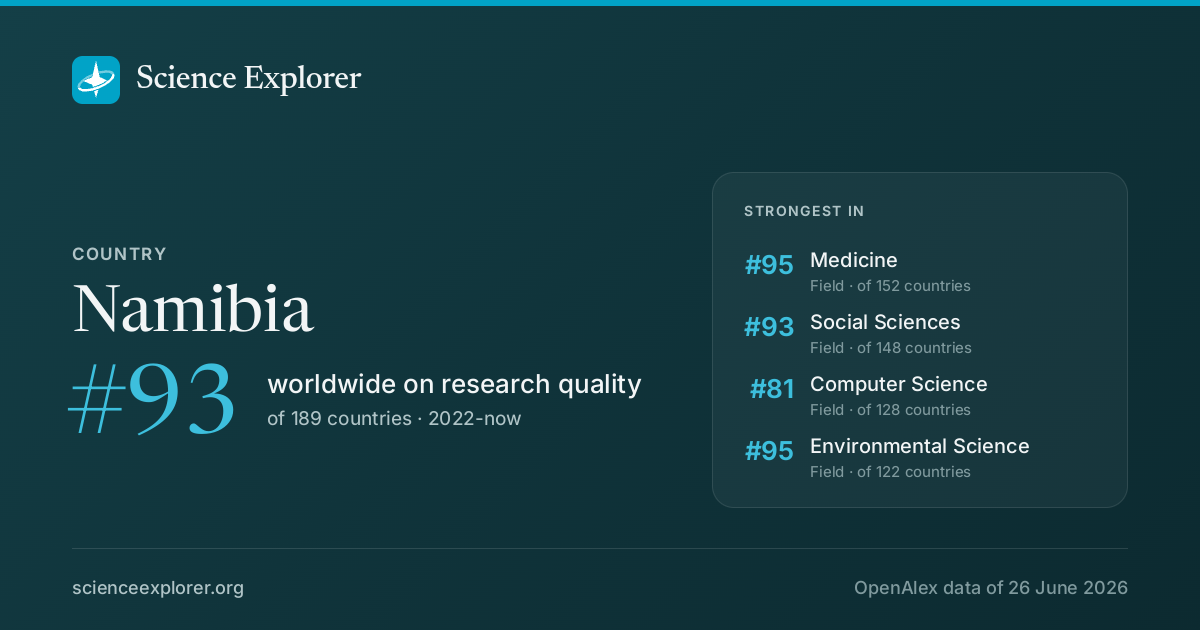
Namibia ranks #93 of 189 countries on research quality in 2022-now (#111 all time), with 2.3k research works and 6.2% of them in the world's top 10%.
- World rank, 2022-now
- #93 of 189 · #111 all time
- Works, 2022-now
- 2.3k ▲ 43% vs 2018-21
- Citations
- 60k 9.1 per fractional work, all time
- Top-10% rate
- 6.2% all institutions 10.0%
- vs its own fields
- 0.93× 1.00× is exactly expected
- In the world top 100
- 0 0 in the top 1,000
- Open access
- 57% world 40%
- International
- 38% world 18%
NamibiaWhat is Namibia strongest at in science?
On research quality in 2022-now, Namibia ranks highest in Medicine (#95 of 152), Social Sciences (#93 of 148) and Computer Science (#81 of 128). Relative to its size it is most specialised in Research and Theory, Archeology and Library and Information Sciences.
| Field | World rank | Where that sits | Top-10% rate | Works | All time | Institutions |
|---|---|---|---|---|---|---|
| MedicineField | #95 of 152 | 6.8% | 240 | #128 | Institutions | |
| Social SciencesField | #93 of 148 | 6.1% | 482 | #113 | Institutions | |
| Computer ScienceField | #81 of 128 | 4.4% | 210 | #103 | Institutions | |
| Environmental ScienceField | #95 of 122 | 6.0% | 208 | #106 | Institutions |
Where its research is concentrated
Location quotient: how much more (or less) of each node it does than its size predicts. Drawn around 1×, where "twice the world share" and "half of it" are the same distance apart in opposite directions. A volume reading, which on a country axis is largely population and industrial structure.
- Research and TheorySubfield · 12.6 works · #57 of 183 active here19×
- ArcheologySubfield · 6.6 works · #61 of 158 active here16×
- Library and Information SciencesSubfield · 4.4 works · #70 of 146 active here8.8×
- Linguistics and LanguageSubfield · 16.5 works · #101 of 194 active here5.5×
- Business and International ManagementSubfield · 10.9 works · #97 of 192 active here3.9×
- VirologySubfield · 5.8 works · #106 of 204 active here3.8×
- Ecological ModelingSubfield · 7.5 works · #91 of 210 active here3.7×
- ForestrySubfield · 9.1 works · #112 of 204 active here3.3×
The whole field profile
All 26 fields at once. A specialist and a generalist produce the same ranked list and a completely different shape.
Rings at 0.5×, 1× and 2×. Widest outward: Nursing, 2.8×. Every wedge is a field page.
All 26 fields, with their numbers
- Nursing2.75×36 works
- Business, Management and Accounting2.26×192 works
- Environmental Science1.99×260 works
- Social Sciences1.67×556 works
- Agricultural and Biological Sciences1.62×203 works
- Veterinary1.62×6 works
- Economics, Econometrics and Finance1.62×91 works
- Decision Sciences1.58×40 works
- Health Professions1.55×107 works
- Psychology1.47×118 works
- Arts and Humanities1.21×92 works
- Computer Science1.11×227 works
- Energy1.02×25 works
- Earth and Planetary Sciences0.95×39 works
- Immunology and Microbiology0.78×21 works
- Mathematics0.68×21 works
- Pharmacology, Toxicology and Pharmaceutics0.57×5 works
- Engineering0.55×218 works
- Medicine0.53×270 works
- Biochemistry, Genetics and Molecular Biology0.37×52 works
- Materials Science0.32×30 works
- Chemical Engineering0.30×3 works
- Chemistry0.24×10 works
- Dentistry0.15×2 works
- Physics and Astronomy0.11×6 works
- Neuroscience0.09×4 works
Which fields of science does Namibia work in?
In 2022-now, 41% of research in Namibia is in Social Sciences, 32% in Physical Sciences. Its largest fields are Social Sciences (21%), Medicine (10%), Environmental Science (10%). It does 1.7× the world's share of Social Sciences.
Each ring splits the one inside it: the four domains of science, their fields, their subfields. Size is fractional works in 2022-now. Every slice is a page; the interactive view zooms down to single topics and colours each by how much more of it this country does than the world.
Its 4 domains and 26 fields, with their numbers
- Social Sciences1,09041.4%
- Social Sciences55621.1%
- Business, Management and Accounting1927.3%
- Psychology1184.5%
- Arts and Humanities923.5%
- Economics, Econometrics and Finance913.5%
- Decision Sciences401.5%
- Physical Sciences83831.8%
- Environmental Science2609.9%
- Computer Science2278.6%
- Engineering2188.3%
- Earth and Planetary Sciences391.5%
- Materials Science301.1%
- Energy250.9%
- Mathematics210.8%
- Chemistry100.4%
- Physics and Astronomy60.2%
- Chemical Engineering30.1%
- Health Sciences42016.0%
- Medicine27010.2%
- Health Professions1074.1%
- Nursing351.3%
- Veterinary60.2%
- Dentistry20.1%
- Life Sciences28510.8%
Which keywords describe research in Namibia?
By fractional works in 2022-now, weighted toward what it does more of than the world: Sustainability, Climate Change, Higher Education, Globalization, Technology Integration, Machine Learning, Social Capital and Lifelong Learning.
- Gender Inequality
- Language Policy
- Animal Movement
- Multilingualism
- Poverty Reduction
- Community Health Workers
- Rural Development
- Job Satisfaction
- Colonialism
- Biodiversity
- Technology Integration
- Economic Development
- Social Capital
- Big Data
- Healthcare
- Renewable Energy
- Higher Education
- Artificial Intelligence
- Globalization
- Sustainability
- Climate Change
- Machine Learning
- Deep Learning
- Education
- Sustainable Development
- Mental Health
- Internet of Things
- Educational Technology
- Supply Chain Management
- Innovation
- Economic Growth
- Leadership
- Population Dynamics
- Lifelong Learning
- Habitat Selection
- Cloud Computing
- Trophic Cascades
- Student Perceptions
- Bilingual Education
- Occupancy Rates
Size is fractional works in 2022-now in the topics tagged with each word; colour is the word's share of this country's work against its share of the world's. The 40 words are chosen for being large and distinctive. Each links to the topic it comes from most.
All 40 words, with their numbers
- Climate Change142▲ 1.98×86 topics
- Sustainability137▲ 2.1×77 topics
- Machine Learning109▲ 1.25×64 topics
- Globalization101▲ 1.96×83 topics
- Deep Learning88◆ 0.97×63 topics
- Artificial Intelligence71▲ 1.89×38 topics
- Education66▲ 1.47×58 topics
- Higher Education65▲ 4.6×23 topics
- Sustainable Development65▲ 1.57×59 topics
- Renewable Energy62▲ 1.62×36 topics
- Mental Health60▲ 1.60×35 topics
- Healthcare59▲ 1.97×21 topics
- Internet of Things59▲ 2.6×22 topics
- Big Data58▲ 2.3×22 topics
- Educational Technology56▲ 1.80×29 topics
- Social Capital54▲ 4.0×17 topics
- Supply Chain Management54▲ 2.3×17 topics
- Economic Development50▲ 2.4×23 topics
- Innovation50▲ 1.82×44 topics
- Technology Integration48▲ 5.8×12 topics
- Economic Growth47▲ 2.2×26 topics
- Biodiversity46▲ 2.3×30 topics
- Leadership42▲ 3.2×21 topics
- Colonialism40▲ 3.2×16 topics
- Population Dynamics40▲ 5.8×10 topics
- Job Satisfaction39▲ 3.4×14 topics
- Lifelong Learning39▲ 7.2×9 topics
- Rural Development37▲ 4.1×13 topics
- Habitat Selection33▲ 17×2 topics
- Community Health Workers33▲ 14×2 topics
- Cloud Computing32▲ 4.3×12 topics
- Poverty Reduction32▲ 9.2×6 topics
- Trophic Cascades31▲ 13×2 topics
- Multilingualism31▲ 7.3×4 topics
- Student Perceptions28▲ 5.9×7 topics
- Animal Movement27▲ 20×1 topic
- Bilingual Education27▲ 8.9×3 topics
- Language Policy27▲ 7.4×3 topics
- Occupancy Rates27▲ 20×1 topic
- Gender Inequality24▲ 6.6×6 topics
Which research topics does Namibia publish the most in?
Its largest topics in 2022-now are Wildlife Ecology and Conservation, Global Maternal and Child Health, Rangeland Management and Livestock Ecology.
Area is fractional works in 2022-now; colour is the subfield each topic belongs to. Every tile is a topic page.
- 1 Wildlife Ecology and Conservation Ecology 27 works
- 2 Global Maternal and Child Health Pediatrics, Perinatology and Child Health 20 works
- 3 Rangeland Management and Livestock Ecology Management, Monitoring, Policy and Law 16 works
- 4 ICT Impact and Policies Media Technology 16 works
- 5 Child Nutrition and Water Access Nutrition and Dietetics 15 works
- 6 Multilingual Education and Policy Linguistics and Language 15 works
- 7 COVID-19 and Mental Health Clinical Psychology 15 works
- 8 Poverty, Education, and Child Welfare Safety Research 13 works
- 9 ICT in Developing Communities Information Systems 13 works
- 10 Nursing education and management Research and Theory 13 works
- 11 German Colonialism and Identity Studies Literature and Literary Theory 12 works
- 12 Big Data and Business Intelligence Management Information Systems 12 works
Which universities in Namibia lead research?
University of Namibia, Namibia University of Science and Technology and International University of Management rank highest in Namibia on research quality in 2022-now.
- 1University of NamibiaUniversity · Windhoek · #2,600 worldwide5.5% top 10% · 1.4k works
- 2Namibia University of Science and TechnologyUniversity · Windhoek · #3,577 worldwide7.0% top 10% · 641 works
- 3International University of ManagementUniversity · Windhoek · #13,205 worldwide6.6% top 10% · 111 works
The track on each row is its top-10% rate; the tick is the average of all institutions, 10.0% (how it is set): teal above it, red below.
All ranked institutions in NamibiaWho are the top researchers in Namibia?
Michael Sony, Uchendu Eugene Chigbu and Gillian Maggs‐Kölling rank highest among researchers based in Namibia.
- 1 Michael Sony #63,785 worldwide 6.2k citations · 191 works
- 2 Uchendu Eugene Chigbu #104,490 worldwide 2.1k citations · 87 works
- 3 Gillian Maggs‐Kölling #275,971 worldwide 2.7k citations · 102 works
- 4 Mary Seely #392,753 worldwide 5.9k citations · 164 works
- 5 Subhash S. Naik #540,111 worldwide 2k citations · 20 works
- 6 Sulaiman Olusegun Atiku #565,000 worldwide 1.3k citations · 86 works
- 7 Asa Romeo #597,640 worldwide 318 citations · 47 works
- 8 Nicola J. Bidwell #771,167 worldwide 3.1k citations · 159 works
- 9 Eugène Marais #846,366 worldwide 2.7k citations · 124 works
- 10 Gunar Günther #873,546 worldwide 2.8k citations · 135 works
How open and international is Namibia's research?
57% of its research is openly available (world: 40%), and 38% is written with international co-authors (world: 18%).
World: 40% of research is openly available.
World: 18% is written across borders.
In 2022-now, 67% of its research is openly available (world 63%) and 41% is written with co-authors abroad (world 22%). Against what its own mix of topics predicts, that is 1.00× the expected open access and 1.70× the expected international share, which puts it #124 of 173 countries on openness.
How has Namibia's research grown?
Output in 2022-2025 was 43% higher than in 2018-2021.
The same series as a ribbon: one cell per year, darker for more. The line above answers how much; this answers when.
Its share of all research
Growing output can still be a shrinking share: all of science grows. This is Namibia as a percentage of every work published that year, 0.0096% in 2024.
Fractional works of Namibia over all fractional works that year. How the balance of science has shifted.
How much of it reaches the world top 10%
Over the whole record, 6.3% of its 6.6k works since 1950 reached the world top 10% for their field and year.
Of each year's output, the share that reached the world's 10% most cited for its field and year. Peak 10.7% in 1994.
Which countries have research most like Namibia's?
Sierra Leone is Namibia's closest research twin: of all countries, its research is spread across the fields most like Namibia's, with both strong in Nursing.
- 1
 Sierra LeoneBoth strong in Nursing, Business, Management and Accounting, Agricultural and Biological Sciences
0.90 Compare
- 2
 ZimbabweBoth strong in Business, Management and Accounting, Nursing, Social Sciences
0.90 Compare
- 3
 GhanaBoth strong in Nursing, Business, Management and Accounting, Agricultural and Biological Sciences
0.89 Compare
- 4
 TanzaniaBoth strong in Nursing, Business, Management and Accounting, Environmental Science
0.89 Compare
- 5
 KenyaBoth strong in Nursing, Business, Management and Accounting, Social Sciences
0.88 Compare
Similarity is the correlation of each side's location quotients across every field it publishes in, on a log scale: 1 is the same shape of research, 0 is unrelated. It ignores size. How it is measured.
Compare Namibia with
 Botswana
 Morocco
 Kazakhstan
 Cambodia
 Oman
 Sri Lanka
Share Namibia's ranking
Badges for a website1Each links back here and updates with every snapshot

Research fields in Namibia
Discussion
Ask a question or share a note about Namibia. Posts are plain text and can be reported.