 Science in Puerto Rico
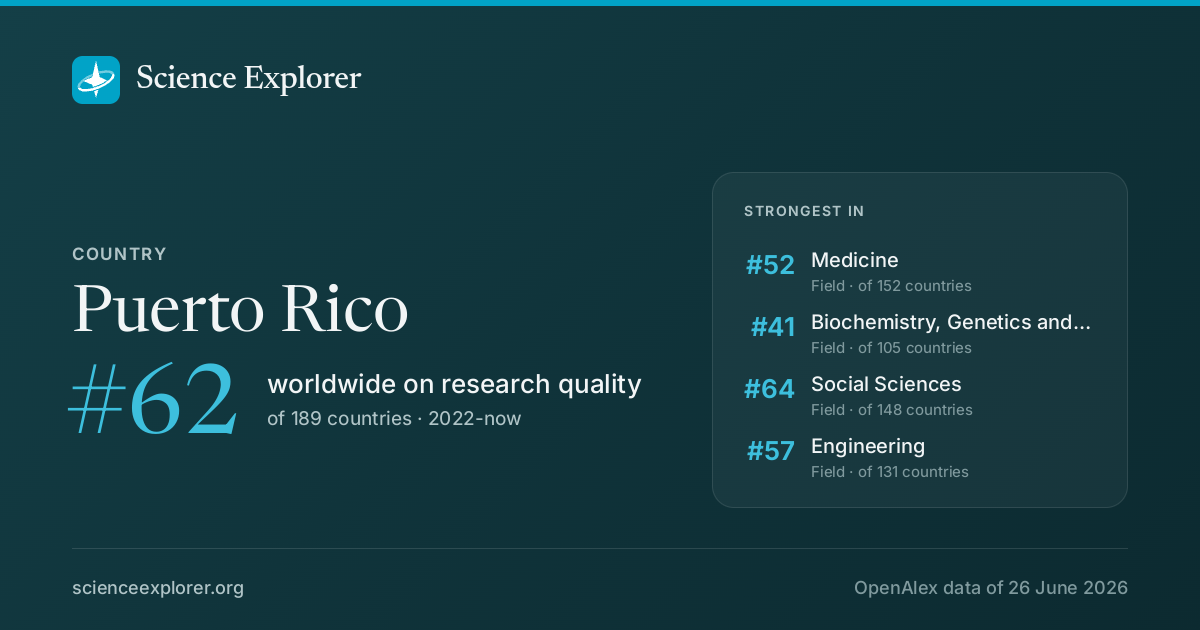
Puerto Rico ranks #62 of 189 countries on research quality in 2022-now (#64 all time), with 7.4k research works and 7.8% of them in the world's top 10%.
- World rank, 2022-now
- #62 of 189 · #64 all time
- Works, 2022-now
- 7.4k ▲ 3% vs 2018-21
- Citations
- 656k 15.2 per fractional work, all time
- Top-10% rate
- 7.8% all institutions 10.0%
- vs its own fields
- 0.71× 1.00× is exactly expected
- In the world top 100
- 0 1 in the top 1,000
- Open access
- 44% world 40%
- International
- 39% world 18%
Puerto RicoWhat is Puerto Rico strongest at in science?
On research quality in 2022-now, Puerto Rico ranks highest in Medicine (#52 of 152), Biochemistry, Genetics and Molecular Biology (#41 of 105) and Social Sciences (#64 of 148). Relative to its size it is most specialised in Microbiology, General Psychology and Horticulture.
| Field | World rank | Where that sits | Top-10% rate | Works | All time | Institutions |
|---|---|---|---|---|---|---|
| MedicineField | #52 of 152 | 7.2% | 2,145 | #53 | Institutions | |
| Biochemistry, Genetics and Molecular BiologyField | #41 of 105 | 9.1% | 634 | #44 | Institutions | |
| Social SciencesField | #64 of 148 | 8.9% | 1,018 | #61 | Institutions | |
| EngineeringField | #57 of 131 | 7.2% | 560 | #62 | Institutions | |
| Sociology and Political ScienceSubfield | #55 of 119 | 11.3% | 256 | #56 | ||
| Health ProfessionsField | #49 of 106 | 10.5% | 256 | #62 | ||
| Molecular BiologySubfield | #39 of 84 | 9.9% | 344 | #44 | Institutions | |
| PsychologyField | #53 of 106 | 5.4% | 318 | #50 | ||
| Environmental ScienceField | #63 of 122 | 6.7% | 361 | #59 | Institutions | |
| Computer ScienceField | #67 of 128 | 5.7% | 294 | #71 | ||
| SurgerySubfield | #47 of 86 | 7.3% | 282 | #55 | ||
| EducationSubfield | #67 of 112 | 9.1% | 244 | #68 |
Where its research is concentrated
Location quotient: how much more (or less) of each node it does than its size predicts. Drawn around 1×, where "twice the world share" and "half of it" are the same distance apart in opposite directions. A volume reading, which on a country axis is largely population and industrial structure.
- MicrobiologySubfield · 5.0 works · #39 of 137 active here9.9×
- General PsychologySubfield · 4.0 works · #45 of 123 active here4.4×
- HorticultureSubfield · 4.7 works · #71 of 178 active here4.0×
- General Social SciencesSubfield · 32.5 works · #74 of 191 active here3.4×
- ArchitectureSubfield · 10.4 works · #77 of 166 active here3.1×
- Library and Information SciencesSubfield · 4.9 works · #67 of 146 active here3.0×
- Neuropsychology and Physiological PsychologySubfield · 7.7 works · #67 of 169 active here2.7×
- Behavioral NeuroscienceSubfield · 9.0 works · #60 of 171 active here2.7×
The whole field profile
All 26 fields at once. A specialist and a generalist produce the same ranked list and a completely different shape.
Rings at 0.5×, 1× and 2×. Widest outward: Immunology and Microbiology, 1.6×. Every wedge is a field page.
All 26 fields, with their numbers
- Immunology and Microbiology1.63×142 works
- Biochemistry, Genetics and Molecular Biology1.59×734 works
- Medicine1.52×2,528 works
- Neuroscience1.42×199 works
- Psychology1.41×371 works
- Veterinary1.37×16 works
- Health Professions1.27×290 works
- Dentistry1.23×52 works
- Arts and Humanities1.10×274 works
- Social Sciences1.06×1,162 works
- Environmental Science1.00×430 works
- Pharmacology, Toxicology and Pharmaceutics0.99×30 works
- Agricultural and Biological Sciences0.88×363 works
- Nursing0.86×36 works
- Earth and Planetary Sciences0.82×111 works
- Economics, Econometrics and Finance0.75×140 works
- Decision Sciences0.73×61 works
- Energy0.70×56 works
- Business, Management and Accounting0.70×196 works
- Mathematics0.65×66 works
- Chemical Engineering0.63×19 works
- Materials Science0.63×191 works
- Chemistry0.61×83 works
- Physics and Astronomy0.53×101 works
- Computer Science0.52×352 works
- Engineering0.50×644 works
Which fields of science does Puerto Rico work in?
In 2022-now, 34% of research in Puerto Rico is in Health Sciences, 25% in Social Sciences. Its largest fields are Medicine (29%), Social Sciences (13%), Biochemistry, Genetics and Molecular Biology (8%). It does 1.5× the world's share of Health Sciences.
Each ring splits the one inside it: the four domains of science, their fields, their subfields. Size is fractional works in 2022-now. Every slice is a page; the interactive view zooms down to single topics and colours each by how much more of it this country does than the world.
Its 4 domains and 26 fields, with their numbers
- Health Sciences2,92233.8%
- Medicine2,52929.2%
- Health Professions2903.4%
- Dentistry520.6%
- Nursing360.4%
- Veterinary160.2%
- Social Sciences2,20325.5%
- Social Sciences1,16213.4%
- Psychology3714.3%
- Arts and Humanities2743.2%
- Business, Management and Accounting1962.3%
- Economics, Econometrics and Finance1401.6%
- Decision Sciences610.7%
- Physical Sciences2,05323.7%
- Engineering6457.5%
- Environmental Science4305.0%
- Computer Science3524.1%
- Materials Science1912.2%
- Earth and Planetary Sciences1111.3%
- Physics and Astronomy1011.2%
- Chemistry831.0%
- Mathematics660.8%
- Energy560.6%
- Chemical Engineering190.2%
- Life Sciences1,46917.0%
Which keywords describe research in Puerto Rico?
By fractional works in 2022-now, weighted toward what it does more of than the world: Epidemiology, Education, Mental Health, Public Health, Quality of Life, Inflammation, Climate Change and Cancer.
- Virtual Teaching
- Cancer Incidence
- Resilience
- Pedagogy
- Health Promotion
- Literature
- Teacher Training
- Metabolic Syndrome
- E-Learning
- Gender
- Healthcare
- Educational Technology
- Diagnosis
- Oxidative Stress
- Risk Factors
- Cancer
- Sustainability
- Public Health
- Inflammation
- Education
- Epidemiology
- Climate Change
- Mental Health
- Globalization
- Quality of Life
- COVID-19
- Treatment
- Innovation
- Depression
- Cardiovascular Disease
- Identity
- Chemotherapy
- Immunotherapy
- Genetics
- Global Burden
- Distance Learning
- Latin America
- Colonialism
- Genetic Mutations
- Human Papillomavirus
Size is fractional works in 2022-now in the topics tagged with each word; colour is the word's share of this country's work against its share of the world's. The 40 words are chosen for being large and distinctive. Each links to the topic it comes from most.
All 40 words, with their numbers
- Epidemiology612▲ 1.78×138 topics
- Education265▲ 1.78×10⁹ topics
- Climate Change257◆ 1.09×10⁴ topics
- Inflammation234▲ 1.27×83 topics
- Mental Health222▲ 1.79×45 topics
- Public Health220▲ 1.75×70 topics
- Globalization209▲ 1.23×131 topics
- Sustainability206◆ 0.98×10³ topics
- Quality of Life203▲ 1.63×60 topics
- Cancer185▲ 1.59×57 topics
- COVID-19172▲ 1.54×31 topics
- Risk Factors166▲ 1.74×37 topics
- Treatment161▲ 1.53×52 topics
- Oxidative Stress158◆ 1.11×62 topics
- Innovation142▲ 1.59×58 topics
- Diagnosis142▲ 1.76×41 topics
- Depression142▲ 1.86×26 topics
- Educational Technology130▲ 1.28×40 topics
- Cardiovascular Disease119▲ 1.20×38 topics
- Healthcare118▲ 1.20×35 topics
- Identity117▲ 1.87×60 topics
- Gender110▲ 2.4×43 topics
- Chemotherapy110▲ 1.80×25 topics
- E-Learning110▲ 1.32×23 topics
- Immunotherapy110▲ 1.76×19 topics
- Metabolic Syndrome105▲ 1.50×24 topics
- Genetics105▲ 1.72×27 topics
- Teacher Training95▲ 1.79×23 topics
- Global Burden94▲ 1.99×12 topics
- Literature91▲ 1.93×43 topics
- Distance Learning86▲ 2.9×12 topics
- Health Promotion84▲ 3.1×17 topics
- Latin America84▲ 5.1×22 topics
- Pedagogy84▲ 1.93×25 topics
- Colonialism83▲ 2.0×40 topics
- Resilience83▲ 1.95×17 topics
- Genetic Mutations82▲ 2.2×23 topics
- Cancer Incidence63▲ 5.3×4 topics
- Human Papillomavirus51▲ 4.8×3 topics
- Virtual Teaching41▲ 8.8×1 topic
Which research topics does Puerto Rico publish the most in?
Its largest topics in 2022-now are Educational Innovations and Technology, Cervical Cancer and HPV Research, Business, Innovation, and Economy.
Area is fractional works in 2022-now; colour is the subfield each topic belongs to. Every tile is a topic page.
- 1 Educational Innovations and Technology Information Systems 41 works
- 2 Cervical Cancer and HPV Research Epidemiology 36 works
- 3 Business, Innovation, and Economy Economics and Econometrics 29 works
- 4 Gut microbiota and health Molecular Biology 25 works
- 5 COVID-19 and Mental Health Clinical Psychology 25 works
- 6 E-Learning and Knowledge Management Computer Science Applications 23 works
- 7 Education and Teacher Training Education 23 works
- 8 Stress and Burnout Research Social Psychology 21 works
- 9 Coral and Marine Ecosystems Studies Ecology 21 works
- 10 Latin American Urban Studies Urban Studies 20 works
- 11 Mosquito-borne diseases and control Public Health, Environmental and Occupational Health 20 works
- 12 Health and Medical Research Impacts Public Health, Environmental and Occupational Health 19 works
How many world-class institutions does Puerto Rico hold?
Average quality and elite capacity disagree by construction, and both are worth knowing: the first is decided by a country's whole institution population, the second counts the institutions it holds at the top. One square per institution.
| Standing among countries | 2022-now | Where that sits | All time |
|---|---|---|---|
| Average qualityits whole institution population | #62 of 189 | #64 of 203 | |
| Elite capacitythe institutions it holds at the top | #40 of 204 | #38 of 216 |
Elite capacity counts a country's institutions by their worldwide rank, weighted so a place at #1 counts for more than one at #480. Countries under 100 fractional works are left out.
Bands are exclusive, so the squares add up to 1 (the institutions it holds in the world top 1,000), not to four times it.
Which universities in Puerto Rico lead research?
National University College, Universidad Metropolitana and Polytechnic University of Puerto Rico rank highest in Puerto Rico on research quality in 2022-now.
One dot per institution in the list below. The upper left is the interesting corner.
- 1National University CollegeUniversity · Bayamon · #708 worldwide17.6% top 10% · 927 works
- 2Universidad MetropolitanaUniversity · San Juan · #4,119 worldwide15.8% top 10% · 332 works
- 3Polytechnic University of Puerto RicoUniversity · San Juan · #4,227 worldwide7.6% top 10% · 712 works
- 4University of Puerto Rico SystemUniversity · San Juan · #4,663 worldwide7.3% top 10% · 1k works
- 5University of Puerto Rico at Río PiedrasUniversity · San Juan · #6,871 worldwide5.9% top 10% · 577 works
- 6Pontifical Catholic University of Puerto RicoUniversity · Ponce · #7,224 worldwide3.7% top 10% · 338 works
- 7University of Puerto Rico-MayaguezUniversity · Mayagüez · #7,900 worldwide4.1% top 10% · 752 works
- 8Ponce Health Sciences UniversityUniversity · Ponce · #10,690 worldwide7.0% top 10% · 329 works
- 9Ana G. Mendez University SystemUniversity · San Juan · #11,554 worldwide7.6% top 10% · 142 works
- 10InterAmerican University of Puerto RicoUniversity · San Germán · #14,033 worldwide4.9% top 10% · 110 works
- 11University of Puerto Rico, Medical Sciences CampusUniversity · San Juan · #14,523 worldwide4.5% top 10% · 608 works
- 12American Military AcademyUniversity · Guaynabo · #15,870 worldwide5.9% top 10% · 86 works
- 13Carlos Albizu UniversityUniversity · San Juan · #17,554 worldwide3.5% top 10% · 91 works
- 14San Juan Bautista School of MedicineUniversity · Caguas · #18,593 worldwide5.3% top 10% · 96 works
- 15Hospital DamasHospital / health system · Ponce · #19,323 worldwide6.5% top 10% · 68 works


The track on each row is its top-10% rate; the tick is the average of all institutions, 10.0% (how it is set): teal above it, red below.
All ranked institutions in Puerto RicoWho are the top researchers in Puerto Rico?
Justin Paul, T. Mitchell Aide and Jess K. Zimmerman rank highest among researchers based in Puerto Rico.
- 1 Justin Paul #306 worldwide 36k citations · 297 works
- 2 T. Mitchell Aide #13,830 worldwide 21k citations · 184 works
- 3 Jess K. Zimmerman #21,938 worldwide 19k citations · 279 works
- 4 Zhongfang Chen #23,734 worldwide 43k citations · 462 works
- 5 Gregory J. Quirk #27,119 worldwide 32k citations · 173 works
- 6 Michael Keller #87,694 worldwide 25k citations · 388 works
- 7 Javier O Morales-Ramirez #145,593 worldwide 4.4k citations · 26 works
- 8 GLORISA J. CANINO #155,711 worldwide 30k citations · 498 works
- 9 Stefanie Hampel #232,069 worldwide 1.2k citations · 42 works
- 10 Marconi Campos‐Cerqueira #241,549 worldwide 2.4k citations · 47 works
Which cities in Puerto Rico are research hubs?
- 1
San JuanPuerto Rico
25k works
How open and international is Puerto Rico's research?
44% of its research is openly available (world: 40%), and 39% is written with international co-authors (world: 18%).
World: 40% of research is openly available.
World: 18% is written across borders.
In 2022-now, 67% of its research is openly available (world 63%) and 49% is written with co-authors abroad (world 22%). Against what its own mix of topics predicts, that is 0.98× the expected open access and 2.15× the expected international share, which puts it #112 of 173 countries on openness.
How has Puerto Rico's research grown?
Output in 2022-2025 was 3% higher than in 2018-2021.
The same series as a ribbon: one cell per year, darker for more. The line above answers how much; this answers when.
Its share of all research
Growing output can still be a shrinking share: all of science grows. This is Puerto Rico as a percentage of every work published that year, 0.034% in 2024.
Fractional works of Puerto Rico over all fractional works that year. How the balance of science has shifted.
How much of it reaches the world top 10%
Over the whole record, 7.3% of its 43k works since 1950 reached the world top 10% for their field and year.
Of each year's output, the share that reached the world's 10% most cited for its field and year. Peak 8.6% in 2017.
Which countries have research most like Puerto Rico's?
Grenada is Puerto Rico's closest research twin: of all countries, its research is spread across the fields most like Puerto Rico's, with both strong in Immunology and Microbiology.
- 1
 GrenadaBoth strong in Immunology and Microbiology, Medicine, Veterinary
0.85 Compare
- 2
 Antigua and BarbudaBoth strong in Immunology and Microbiology, Medicine, Neuroscience
0.73 Compare
- 3
 CuraçaoBoth strong in Immunology and Microbiology, Medicine, Psychology
0.73 Compare
- 4
 IrelandBoth strong in Psychology, Medicine, Veterinary
0.72 Compare
- 5
 French GuianaBoth strong in Immunology and Microbiology, Medicine, Veterinary
0.72 Compare
Similarity is the correlation of each side's location quotients across every field it publishes in, on a log scale: 1 is the same shape of research, 0 is unrelated. It ignores size. How it is measured.
Compare Puerto Rico with
 Malawi
 Montenegro
 Ukraine
 Tanzania
 Colombia
 Indonesia
Share Puerto Rico's ranking
Badges for a website1Each links back here and updates with every snapshot

Research fields in Puerto Rico
Discussion
Ask a question or share a note about Puerto Rico. Posts are plain text and can be reported.