 Science in Sri Lanka
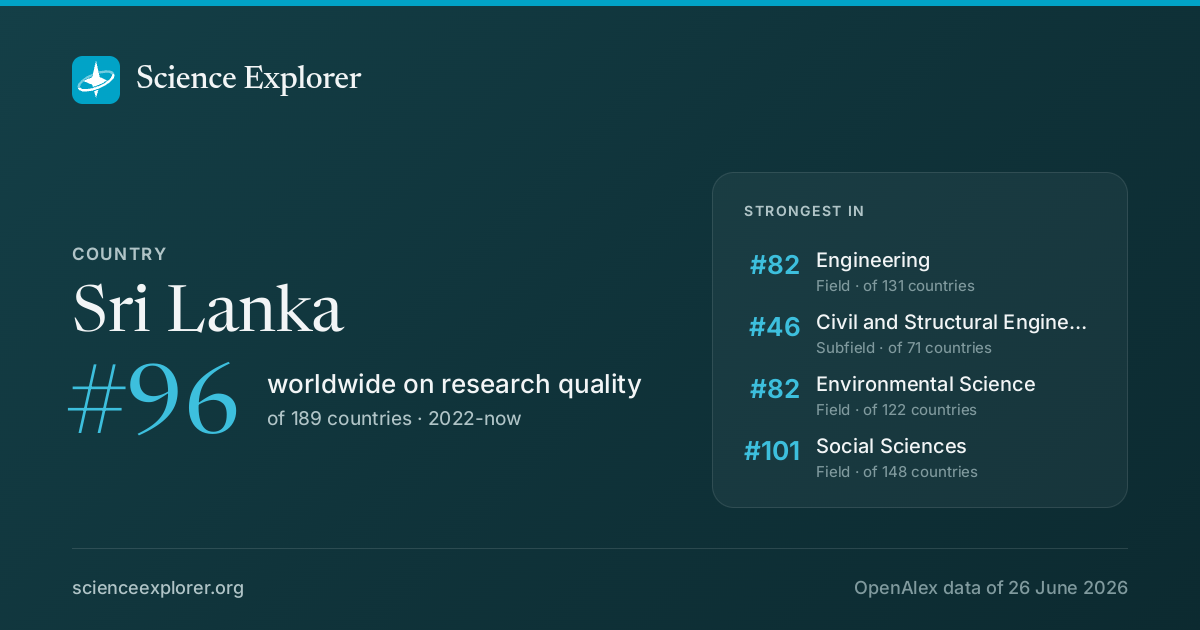
Sri Lanka ranks #96 of 189 countries on research quality in 2022-now (#99 all time), with 21k research works and 5.9% of them in the world's top 10%.
- World rank, 2022-now
- #96 of 189 · #99 all time
- Works, 2022-now
- 21k ▲ 16% vs 2018-21
- Citations
- 659k 9.3 per fractional work, all time
- Top-10% rate
- 5.9% all institutions 10.0%
- vs its own fields
- 0.52× 1.00× is exactly expected
- In the world top 100
- 0 0 in the top 1,000
- Open access
- 60% world 40%
- International
- 22% world 18%
Sri LankaWhat is Sri Lanka strongest at in science?
On research quality in 2022-now, Sri Lanka ranks highest in Engineering (#82 of 131), Civil and Structural Engineering (#46 of 71) and Environmental Science (#82 of 122). Relative to its size it is most specialised in Archeology, Space and Planetary Science and Paleontology.
| Field | World rank | Where that sits | Top-10% rate | Works | All time | Institutions |
|---|---|---|---|---|---|---|
| EngineeringField | #82 of 131 | 6.0% | 2,295 | #92 | Institutions | |
| Civil and Structural EngineeringSubfield | #46 of 71 | 9.2% | 350 | #67 | Institutions | |
| Environmental ScienceField | #82 of 122 | 6.2% | 1,642 | #83 | Institutions | |
| Social SciencesField | #101 of 148 | 7.2% | 2,389 | #101 | Institutions | |
| Agricultural and Biological SciencesField | #87 of 124 | 7.2% | 1,690 | #99 | Institutions | |
| Computer ScienceField | #90 of 128 | 4.8% | 1,769 | #93 | Institutions | |
| PsychologyField | #78 of 106 | 4.7% | 714 | #84 | Institutions | |
| Earth and Planetary SciencesField | #60 of 78 | 7.7% | 463 | #70 | Institutions | |
| Building and ConstructionSubfield | #56 of 71 | 5.3% | 339 | - | Institutions | |
| Plant ScienceSubfield | #72 of 90 | 6.7% | 709 | #88 | Institutions | |
| Biochemistry, Genetics and Molecular BiologyField | #84 of 105 | 6.2% | 787 | #90 | Institutions | |
| Sociology and Political ScienceSubfield | #97 of 119 | 5.7% | 710 | #100 | Institutions |
Where its research is concentrated
Location quotient: how much more (or less) of each node it does than its size predicts. Drawn around 1×, where "twice the world share" and "half of it" are the same distance apart in opposite directions. A volume reading, which on a country axis is largely population and industrial structure.
- ArcheologySubfield · 39.8 works · #18 of 158 active here11×
- Space and Planetary ScienceSubfield · 45.3 works · #22 of 158 active here9.3×
- PaleontologySubfield · 215.5 works · #31 of 212 active here7.3×
- Drug DiscoverySubfield · 12.8 works · #17 of 152 active here6.1×
- Library and Information SciencesSubfield · 21.3 works · #32 of 146 active here4.6×
- AnthropologySubfield · 308.6 works · #39 of 213 active here4.5×
- ArcheologySubfield · 303.8 works · #42 of 208 active here4.1×
- HorticultureSubfield · 12.9 works · #46 of 178 active here4.0×
The whole field profile
All 26 fields at once. A specialist and a generalist produce the same ranked list and a completely different shape.
Rings at 0.5×, 1× and 2×. Widest outward: Decision Sciences, 1.9×. Every wedge is a field page.
All 26 fields, with their numbers
- Decision Sciences1.95×459 works
- Business, Management and Accounting1.88×1,479 works
- Nursing1.69×202 works
- Agricultural and Biological Sciences1.66×1,921 works
- Environmental Science1.60×1,935 works
- Earth and Planetary Sciences1.43×546 works
- Pharmacology, Toxicology and Pharmaceutics1.41×121 works
- Economics, Econometrics and Finance1.41×736 works
- Arts and Humanities1.34×945 works
- Psychology1.15×855 works
- Computer Science1.12×2,115 works
- Health Professions1.10×709 works
- Veterinary1.09×36 works
- Immunology and Microbiology0.93×229 works
- Social Sciences0.92×2,827 works
- Medicine0.91×4,285 works
- Energy0.78×174 works
- Engineering0.71×2,589 works
- Dentistry0.71×85 works
- Biochemistry, Genetics and Molecular Biology0.70×913 works
- Chemistry0.66×251 works
- Materials Science0.57×488 works
- Neuroscience0.55×218 works
- Mathematics0.39×112 works
- Chemical Engineering0.32×27 works
- Physics and Astronomy0.24×130 works
Which fields of science does Sri Lanka work in?
In 2022-now, 34% of research in Sri Lanka is in Physical Sciences, 30% in Social Sciences. Its largest fields are Medicine (18%), Social Sciences (12%), Engineering (11%).
Each ring splits the one inside it: the four domains of science, their fields, their subfields. Size is fractional works in 2022-now. Every slice is a page; the interactive view zooms down to single topics and colours each by how much more of it this country does than the world.
Its 4 domains and 26 fields, with their numbers
- Physical Sciences8,36834.3%
- Engineering2,58910.6%
- Computer Science2,1158.7%
- Environmental Science1,9357.9%
- Earth and Planetary Sciences5462.2%
- Materials Science4882.0%
- Chemistry2511.0%
- Energy1740.7%
- Physics and Astronomy1300.5%
- Mathematics1120.5%
- Chemical Engineering270.1%
- Social Sciences7,30029.9%
- Social Sciences2,82711.6%
- Business, Management and Accounting1,4796.1%
- Arts and Humanities9453.9%
- Psychology8553.5%
- Economics, Econometrics and Finance7353.0%
- Decision Sciences4591.9%
- Health Sciences5,31621.8%
- Medicine4,28517.6%
- Health Professions7092.9%
- Nursing2020.8%
- Dentistry850.3%
- Veterinary360.1%
- Life Sciences3,40213.9%
Which keywords describe research in Sri Lanka?
By fractional works in 2022-now, weighted toward what it does more of than the world: Machine Learning, Deep Learning, Sustainability, Epidemiology, Climate Change, Environmental Impact, Supply Chain Management and Risk Management.
- economic effects
- Food Supply Chain
- Archaeology of Resistance
- Radiocarbon Dating
- Antimicrobial
- Intersectionality
- Recycling
- Environmental Monitoring
- Genetic Diversity
- Convolutional Neural Networks
- Antioxidant Activity
- Healthcare
- Risk Management
- Antioxidant
- Public Health
- Neural Networks
- Supply Chain Management
- Environmental Impact
- Sustainability
- Epidemiology
- Machine Learning
- Deep Learning
- Climate Change
- Globalization
- COVID-19
- Remote Sensing
- Renewable Energy
- Consumer Behavior
- Pandemic
- Economic Growth
- Social Capital
- Ecosystem Services
- Digital Transformation
- Vaccine Development
- Waste Management
- Social Inequality
- Agricultural Origins
- African Diaspora
- Black Feminist Theory
- business impact
Size is fractional works in 2022-now in the topics tagged with each word; colour is the word's share of this country's work against its share of the world's. The 40 words are chosen for being large and distinctive. Each links to the topic it comes from most.
All 40 words, with their numbers
- Machine Learning1,193▲ 1.47×96 topics
- Epidemiology1,177▲ 1.21×138 topics
- Deep Learning1,168▲ 1.39×85 topics
- Sustainability1,018▲ 1.71×114 topics
- Climate Change964▲ 1.45×116 topics
- Environmental Impact722▲ 1.74×68 topics
- Globalization519◆ 1.08×127 topics
- Supply Chain Management468▲ 2.1×24 topics
- COVID-19467▲ 1.48×29 topics
- Neural Networks460▲ 1.22×40 topics
- Remote Sensing423▲ 1.42×36 topics
- Public Health409◆ 1.15×60 topics
- Renewable Energy399◆ 1.13×55 topics
- Antioxidant389▲ 2.3×51 topics
- Consumer Behavior368▲ 2.4×18 topics
- Risk Management365▲ 3.1×20 topics
- Pandemic361▲ 1.49×13 topics
- Healthcare336▲ 1.21×36 topics
- Economic Growth310▲ 1.56×35 topics
- Antioxidant Activity293▲ 1.93×31 topics
- Social Capital292▲ 2.3×20 topics
- Convolutional Neural Networks282▲ 1.59×14 topics
- Ecosystem Services274▲ 2.9×14 topics
- Genetic Diversity269▲ 2.5×22 topics
- Digital Transformation249▲ 1.89×23 topics
- Environmental Monitoring224▲ 2.4×15 topics
- Vaccine Development223▲ 3.6×11 topics
- Recycling221▲ 2.4×10 topics
- Waste Management217▲ 2.2×11 topics
- Intersectionality203▲ 4.4×13 topics
- Social Inequality201▲ 3.1×13 topics
- Antimicrobial200▲ 2.9×13 topics
- Agricultural Origins190▲ 24×1 topic
- Radiocarbon Dating190▲ 24×1 topic
- African Diaspora177▲ 19×4 topics
- Archaeology of Resistance174▲ 79×1 topic
- Black Feminist Theory174▲ 79×1 topic
- Food Supply Chain159▲ 5.8×2 topics
- business impact135▲ 6.2×1 topic
- economic effects135▲ 6.2×1 topic
Which research topics does Sri Lanka publish the most in?
Its largest topics in 2022-now are Archaeology and ancient environmental studies, Historical and Cultural Archaeology Studies, COVID-19 Pandemic Impacts.
Area is fractional works in 2022-now; colour is the subfield each topic belongs to. Every tile is a topic page.
- 1 Archaeology and ancient environmental studies Paleontology 189 works
- 2 Historical and Cultural Archaeology Studies Anthropology 174 works
- 3 COVID-19 Pandemic Impacts Economics and Econometrics 135 works
- 4 Technology Adoption and User Behaviour Information Systems and Management 116 works
- 5 Smart Agriculture and AI Plant Science 107 works
- 6 Digital Marketing and Social Media Sociology and Political Science 93 works
- 7 Mosquito-borne diseases and control Public Health, Environmental and Occupational Health 86 works
- 8 Construction Project Management and Performance Management Science and Operations Research 85 works
- 9 Online Learning and Analytics Computer Science Applications 80 works
- 10 Historical Architecture and Urbanism History 78 works
- 11 Asian Geopolitics and Ethnography Political Science and International Relations 74 works
- 12 Environmental Sustainability in Business Marketing 74 works
Which universities in Sri Lanka lead research?
University of Moratuwa, University of Sri Jayewardenepura and Department of Archaeology rank highest in Sri Lanka on research quality in 2022-now.
One dot per institution in the list below. The upper left is the interesting corner.
- 1University of MoratuwaUniversity · Moratuwa · #2,507 worldwide5.1% top 10% · 2.2k works
- 2University of Sri JayewardenepuraUniversity · Colombo · #3,215 worldwide5.5% top 10% · 1.9k works
- 3Department of ArchaeologyGovernment institution · Colombo · #3,471 worldwide13.1% top 10% · 1.1k works
- 4University of JaffnaUniversity · Jaffna · #3,690 worldwide9.1% top 10% · 746 works
- 5University of PeradeniyaUniversity · Kandy · #4,479 worldwide5.7% top 10% · 1.9k works
- 6General Sir John Kotelawala Defence UniversityUniversity · Colombo · #4,506 worldwide3.9% top 10% · 569 works
- 7Sri Lanka Institute of Information TechnologyUniversity · Colombo · #4,632 worldwide4.7% top 10% · 1.6k works
- 8University of ColomboUniversity · Colombo · #4,964 worldwide4.3% top 10% · 2.3k works
- 9University of KelaniyaUniversity · Kelaniya · #5,054 worldwide4.7% top 10% · 1.5k works
- 10University of RuhunaUniversity · Galle · #5,075 worldwide5.2% top 10% · 862 works
- 11Sabaragamuwa University of Sri LankaUniversity · Ratnapura · #5,351 worldwide6.2% top 10% · 624 works
- 12Wayamba University of Sri LankaUniversity · Kuliyapitiya · #5,898 worldwide7.7% top 10% · 460 works
- 13Uva Wellassa UniversityUniversity · Badulla · #6,128 worldwide9.1% top 10% · 355 works
- 14Rajarata University of Sri LankaUniversity · Anuradhapura · #6,517 worldwide7.7% top 10% · 423 works
- 15University of the Visual & Performing ArtsUniversity · Colombo · #7,205 worldwide7.0% top 10% · 250 works
The track on each row is its top-10% rate; the tick is the average of all institutions, 10.0% (how it is set): teal above it, red below.
All ranked institutions in Sri LankaWho are the top researchers in Sri Lanka?
Samath Dhamminda Dharmaratne, Meththika Suharshini Vithanage and Nuwan Darshana Wickramasinghe rank highest among researchers based in Sri Lanka.
- 1 Samath Dhamminda Dharmaratne #11,594 worldwide 239k citations · 254 works
- 2 Meththika Suharshini Vithanage #12,535 worldwide 34k citations · 518 works
- 3 Nuwan Darshana Wickramasinghe #21,611 worldwide 40k citations · 179 works
- 4 Anushka Upamali Rajapaksha #43,312 worldwide 13k citations · 136 works
- 5 Devarajan Rathish #81,508 worldwide 12k citations · 102 works
- 6 Hasintha Wijesekara #89,789 worldwide 6.4k citations · 86 works
- 7 Nuwan Gunarathne #90,843 worldwide 2.3k citations · 92 works
- 8 Thilini Chathurika Gamage #133,466 worldwide 877 citations · 55 works
- 9 I. A. U. N. Gunatilleke #145,207 worldwide 9.8k citations · 157 works
- 10 Sachith Mettananda #153,988 worldwide 20k citations · 178 works
Which cities in Sri Lanka are research hubs?
How open and international is Sri Lanka's research?
60% of its research is openly available (world: 40%), and 22% is written with international co-authors (world: 18%).
World: 40% of research is openly available.
World: 18% is written across borders.
In 2022-now, 64% of its research is openly available (world 63%) and 23% is written with co-authors abroad (world 22%). Against what its own mix of topics predicts, that is 1.01× the expected open access and 1.03× the expected international share, which puts it #155 of 173 countries on openness.
How has Sri Lanka's research grown?
Output in 2022-2025 was 16% higher than in 2018-2021.
The same series as a ribbon: one cell per year, darker for more. The line above answers how much; this answers when.
Its share of all research
Growing output can still be a shrinking share: all of science grows. This is Sri Lanka as a percentage of every work published that year, 0.083% in 2024.
Fractional works of Sri Lanka over all fractional works that year. How the balance of science has shifted.
How much of it reaches the world top 10%
Over the whole record, 5.5% of its 71k works since 1950 reached the world top 10% for their field and year.
Of each year's output, the share that reached the world's 10% most cited for its field and year. Peak 9.1% in 2001.
Which countries have research most like Sri Lanka's?
Tanzania is Sri Lanka's closest research twin: of all countries, its research is spread across the fields most like Sri Lanka's, with both strong in Decision Sciences.
- 1
 TanzaniaBoth strong in Decision Sciences, Business, Management and Accounting, Nursing
0.81 Compare
- 2
 GhanaBoth strong in Business, Management and Accounting, Decision Sciences, Nursing
0.80 Compare
- 3
 BhutanBoth strong in Agricultural and Biological Sciences, Environmental Science, Pharmacology, Toxicology and Pharmaceutics
0.80 Compare
- 4
 FijiBoth strong in Nursing, Agricultural and Biological Sciences, Environmental Science
0.80 Compare
- 5
 NamibiaBoth strong in Business, Management and Accounting, Nursing, Agricultural and Biological Sciences
0.79 Compare
Similarity is the correlation of each side's location quotients across every field it publishes in, on a log scale: 1 is the same shape of research, 0 is unrelated. It ignores size. How it is measured.
Compare Sri Lanka with
 Cambodia
 Dominican Republic
 Morocco
 Paraguay
 Réunion
Share Sri Lanka's ranking
Badges for a website1Each links back here and updates with every snapshot

Research fields in Sri Lanka
- Physical Sciences
- Social Sciences
- Engineering
- Civil and Structural Engineering
- Environmental Science
- Social Sciences
- Agricultural and Biological Sciences
- Computer Science
- Life Sciences
- Psychology
- Earth and Planetary Sciences
- Building and Construction
- Plant Science
- Biochemistry, Genetics and Molecular Biology
- Sociology and Political Science
- Medicine
- Business, Management and Accounting
- Biomedical Engineering
- Public Health, Environmental and Occupational Health
- Health Sciences
- Arts and Humanities
- Archeology
- Electrical and Electronic Engineering
- Health Professions
- Molecular Biology
- Information Systems
- Computer Vision and Pattern Recognition
- Decision Sciences
- Strategy and Management
- Anthropology
- Artificial Intelligence
- Economics, Econometrics and Finance
- Materials Science
- Management Science and Operations Research
- Surgery
- Economics and Econometrics
Questions people ask
What is Sri Lanka strongest at in science?
On research quality in 2022-now, Sri Lanka ranks highest in Engineering (#82 of 131), Civil and Structural Engineering (#46 of 71) and Environmental Science (#82 of 122). Relative to its size it is most specialised in Archeology, Space and Planetary Science and Paleontology.
See the full answerDiscussion
Ask a question or share a note about Sri Lanka. Posts are plain text and can be reported.