Science Explorer Back to mapMap
Discussion
Institution · Ankara · Türkiye

Ankara Spine Center

In research, Ankara Spine Center stands highest in Health Sciences (#8,775 of 9,902 worldwide), 2022-now.

World rank, 2022-now
#19,421
of 22,385 · #28,114 all time
Rank in Türkiye
#281
of 297
Research works
610
▼ 18% vs 2018-21
Citations
9.7k
15.8 per fractional work
Top-10% rate
6.4%
all institutions 10.0%
vs its own fields
0.88×
1.00× is exactly expected
Open access
50%
world 40%
International
23%
world 18%

What is Ankara Spine Center known for in research?

The fields where it stands highest, 2022-now, ranked among every institution above the floor in each field.

FieldWorld rankWhere that sitsTop-10% rateWorksAll time
Health SciencesDomain #8,775 of 9,902 4.0%61 #14202

Each strip is that field's whole ranked pool, with the notch where Ankara Spine Center sits in it, in the colour of the band that rank falls in. The track under the rate is the rate itself: it carries no average mark, because the average differs by field (from about 6% in Dentistry to 21% in Economics).

Which fields of science does Ankara Spine Center work in?

In 2022-now, 65% of research at Ankara Spine Center is in Health Sciences, 13% in Life Sciences. Its largest fields are Medicine (58%), Biochemistry, Genetics and Molecular Biology (7%), Engineering (5%). It does 2.6× the world's share of Health Sciences.

Health Sciences: 66 fractional works · 64.6% of its workMedicine: 59 fractional works · 58.0% of its workSurgery: 17 fractional works · 16.4% of its workPulmonary and Respiratory Medicine: 9 fractional works · 8.8% of its workEpidemiology: 4 fractional works · 3.8% of its workPathology and Forensic Medicine: 3 fractional works · 3.4% of its workPublic Health, Environmental and Occupational Health: 3 fractional works · 2.5% of its workPhysiology: 2 fractional works · 2.4% of its workPsychiatry and Mental health: 2 fractional works · 1.9% of its workNeurology: 2 fractional works · 1.8% of its workPediatrics, Perinatology and Child Health: 2 fractional works · 1.6% of its workInfectious Diseases: 2 fractional works · 1.5% of its workOncology: 2 fractional works · 1.5% of its workReproductive Medicine: 1 fractional works · 1.1% of its workRadiology, Nuclear Medicine and Imaging: 1 fractional works · 1.0% of its workEndocrinology, Diabetes and Metabolism: 1 fractional works · 1.0% of its workComplementary and alternative medicine: 1 fractional works · 1.0% of its workRheumatology: 1 fractional works · 0.9% of its workGenetics: 1 fractional works · 0.8% of its workHepatology: 1 fractional works · 0.6% of its workCardiology and Cardiovascular Medicine: 1 fractional works · 0.6% of its workCritical Care and Intensive Care Medicine: 1 fractional works · 0.5% of its workPharmacology: 1 fractional works · 0.5% of its workOrthopedics and Sports Medicine: 0 fractional works · 0.5% of its workRehabilitation: 0 fractional works · 0.4% of its workNephrology: 0 fractional works · 0.4% of its workDermatology: 0 fractional works · 0.3% of its workOphthalmology: 0 fractional works · 0.3% of its workUrology: 0 fractional works · 0.3% of its workEmergency Medicine: 0 fractional works · 0.3% of its workObstetrics and Gynecology: 0 fractional works · 0.3% of its workOtorhinolaryngology: 0 fractional works · 0.3% of its workHealth Informatics: 0 fractional works · 0.2% of its workGeriatrics and Gerontology: 0 fractional works · 0.2% of its workSmaller subfields together: 1 fractional works · 0.8% of its workHealth Professions: 4 fractional works · 4.1% of its workGeneral Health Professions: 1 fractional works · 1.4% of its workHealth Information Management: 1 fractional works · 0.9% of its workSpeech and Hearing: 1 fractional works · 0.5% of its workEmergency Medical Services: 0 fractional works · 0.4% of its workPhysical Therapy, Sports Therapy and Rehabilitation: 0 fractional works · 0.3% of its workComplementary and Manual Therapy: 0 fractional works · 0.2% of its workSmaller subfields together: 0 fractional works · 0.3% of its workDentistry: 2 fractional works · 2.0% of its workOral Surgery: 1 fractional works · 0.9% of its workOrthodontics: 1 fractional works · 0.6% of its workPeriodontics: 0 fractional works · 0.4% of its workSmaller subfields together: 0 fractional works · 0.1% of its workNursing: 0 fractional works · 0.3% of its workNutrition and Dietetics: 0 fractional works · 0.3% of its workVeterinary: 0 fractional works · 0.2% of its workLife Sciences: 13 fractional works · 12.7% of its workBiochemistry, Genetics and Molecular Biology: 7 fractional works · 7.3% of its workMolecular Biology: 3 fractional works · 3.1% of its workGenetics: 1 fractional works · 1.4% of its workCell Biology: 1 fractional works · 1.3% of its workDevelopmental Biology: 0 fractional works · 0.5% of its workBiotechnology: 0 fractional works · 0.3% of its workPhysiology: 0 fractional works · 0.2% of its workClinical Biochemistry: 0 fractional works · 0.2% of its workSmaller subfields together: 0 fractional works · 0.3% of its workAgricultural and Biological Sciences: 2 fractional works · 2.3% of its workInsect Science: 1 fractional works · 0.5% of its workPlant Science: 0 fractional works · 0.5% of its workAgronomy and Crop Science: 0 fractional works · 0.4% of its workEcology, Evolution, Behavior and Systematics: 0 fractional works · 0.3% of its workForestry: 0 fractional works · 0.2% of its workSmaller subfields together: 0 fractional works · 0.3% of its workImmunology and Microbiology: 2 fractional works · 1.8% of its workImmunology: 1 fractional works · 1.0% of its workMicrobiology: 0 fractional works · 0.3% of its workVirology: 0 fractional works · 0.3% of its workSmaller subfields together: 0 fractional works · 0.2% of its workPharmacology, Toxicology and Pharmaceutics: 1 fractional works · 0.9% of its workPharmaceutical Science: 1 fractional works · 0.7% of its workToxicology: 0 fractional works · 0.2% of its workNeuroscience: 0 fractional works · 0.5% of its workCognitive Neuroscience: 0 fractional works · 0.3% of its workSmaller subfields together: 0 fractional works · 0.2% of its workPhysical Sciences: 13 fractional works · 12.3% of its workEngineering: 6 fractional works · 5.5% of its workBiomedical Engineering: 3 fractional works · 2.7% of its workBuilding and Construction: 1 fractional works · 0.8% of its workMechanical Engineering: 1 fractional works · 0.5% of its workElectrical and Electronic Engineering: 0 fractional works · 0.4% of its workMechanics of Materials: 0 fractional works · 0.4% of its workSafety, Risk, Reliability and Quality: 0 fractional works · 0.2% of its workSmaller subfields together: 0 fractional works · 0.4% of its workEnvironmental Science: 3 fractional works · 2.9% of its workHealth, Toxicology and Mutagenesis: 1 fractional works · 1.1% of its workEnvironmental Engineering: 1 fractional works · 0.6% of its workGlobal and Planetary Change: 1 fractional works · 0.5% of its workPollution: 0 fractional works · 0.3% of its workSmaller subfields together: 0 fractional works · 0.3% of its workComputer Science: 2 fractional works · 1.6% of its workArtificial Intelligence: 1 fractional works · 1.4% of its workSmaller subfields together: 0 fractional works · 0.2% of its workChemistry: 1 fractional works · 1.3% of its workOrganic Chemistry: 1 fractional works · 1.0% of its workInorganic Chemistry: 0 fractional works · 0.3% of its workMaterials Science: 0 fractional works · 0.4% of its workBiomaterials: 0 fractional works · 0.2% of its workSmaller subfields together: 0 fractional works · 0.2% of its workMathematics: 0 fractional works · 0.4% of its workApplied Mathematics: 0 fractional works · 0.3% of its workSmaller subfields together: 0 fractional works · 0.1% of its workPhysics and Astronomy: 0 fractional works · 0.2% of its workRadiation: 0 fractional works · 0.2% of its workEnergy: 0 fractional works · 0.1% of its workEarth and Planetary Sciences: 0 fractional works · 0.0% of its workSocial Sciences: 11 fractional works · 10.4% of its workArts and Humanities: 3 fractional works · 2.9% of its workHistory: 1 fractional works · 1.1% of its workLanguage and Linguistics: 1 fractional works · 1.0% of its workMusic: 0 fractional works · 0.3% of its workVisual Arts and Performing Arts: 0 fractional works · 0.2% of its workSmaller subfields together: 0 fractional works · 0.3% of its workSocial Sciences: 3 fractional works · 2.8% of its workSociology and Political Science: 1 fractional works · 1.2% of its workPolitical Science and International Relations: 1 fractional works · 0.7% of its workEducation: 0 fractional works · 0.4% of its workGender Studies: 0 fractional works · 0.2% of its workSmaller subfields together: 0 fractional works · 0.3% of its workPsychology: 2 fractional works · 2.4% of its workClinical Psychology: 1 fractional works · 1.1% of its workExperimental and Cognitive Psychology: 1 fractional works · 0.8% of its workSocial Psychology: 0 fractional works · 0.3% of its workSmaller subfields together: 0 fractional works · 0.2% of its workBusiness, Management and Accounting: 1 fractional works · 0.9% of its workAccounting: 1 fractional works · 0.7% of its workStrategy and Management: 0 fractional works · 0.2% of its workDecision Sciences: 1 fractional works · 0.8% of its workStatistics, Probability and Uncertainty: 1 fractional works · 0.7% of its workSmaller subfields together: 0 fractional works · 0.2% of its workEconomics, Econometrics and Finance: 1 fractional works · 0.6% of its workEconomics and Econometrics: 1 fractional works · 0.6% of its workALL ITS WORKAnkara SpineCenter102fractional works, 2022-now
Life Sciences13%Physical Sciences12%Health Sciences65%Social Sciences10%

Each ring splits the one inside it: the four domains of science, their fields, their subfields. Size is fractional works in 2022-now. Every slice is a page; the interactive view zooms down to single topics and colours each by how much more of it this institution does than the world.

Its 4 domains and 25 fields, with their numbers
    1. Medicine5958.0%
    2. Health Professions44.1%
    3. Dentistry22.0%
    4. Nursing00.3%
    5. Veterinary00.2%
    1. Biochemistry, Genetics and Molecular Biology77.3%
    2. Agricultural and Biological Sciences22.3%
    3. Immunology and Microbiology21.8%
    4. Pharmacology, Toxicology and Pharmaceutics10.9%
    5. Neuroscience00.5%
    1. Engineering65.5%
    2. Environmental Science32.9%
    3. Computer Science21.6%
    4. Chemistry11.3%
    5. Materials Science00.4%
    6. Mathematics00.4%
    7. Physics and Astronomy00.2%
    8. Energy00.1%
    9. Earth and Planetary Sciences00.0%
    1. Arts and Humanities32.9%
    2. Social Sciences32.8%
    3. Psychology22.4%
    4. Business, Management and Accounting10.9%
    5. Decision Sciences10.8%
    6. Economics, Econometrics and Finance10.6%
All of science, and how each field's share has moved since 1950: the Science domain explorer

Field profile

Location quotient across every field it publishes in: outside the ring is more than an institution of this size would be expected to publish, inside it is less.

Agricultural and Biological Sciences: 0.49× its world share, 2 worksAgricultural and Bio…Biochemistry, Genetics and Molecular Biology: 1.36× its world share, 7 worksBiochemistry, Geneti…Immunology and Microbiology: 1.77× its world share, 2 worksImmunology and Micro…Neuroscience: 0.28× its world share, 0 worksNeurosciencePharmacology, Toxicology and Pharmaceutics: 2.52× its world share, 1 worksPharmacology, Toxico…Chemistry: 0.83× its world share, 1 worksChemistryComputer Science: 0.20× its world share, 2 worksComputer ScienceEarth and Planetary Sciences: 0.02× its world share, 0 worksEarth and Planetary …Energy: 0.12× its world share, 0 worksEnergyEngineering: 0.37× its world share, 6 worksEngineeringEnvironmental Science: 0.58× its world share, 3 worksEnvironmental ScienceMaterials Science: 0.11× its world share, 0 worksMaterials ScienceMathematics: 0.30× its world share, 0 worksMathematicsPhysics and Astronomy: 0.10× its world share, 0 worksPhysics and AstronomyDentistry: 4.12× its world share, 2 worksDentistryHealth Professions: 1.55× its world share, 4 worksHealth ProfessionsMedicine: 3.02× its world share, 59 worksMedicineNursing: 0.67× its world share, 0 worksNursingVeterinary: 1.20× its world share, 0 worksVeterinaryArts and Humanities: 1.00× its world share, 3 worksArts and HumanitiesBusiness, Management and Accounting: 0.28× its world share, 1 worksBusiness, Management…Decision Sciences: 0.84× its world share, 1 worksDecision SciencesEconomics, Econometrics and Finance: 0.30× its world share, 1 worksEconomics, Econometr…Psychology: 0.77× its world share, 2 worksPsychologySocial Sciences: 0.22× its world share, 3 worksSocial Sciences1×world share
more than its size predictsabout as predictedless

Rings at 0.5×, 1× and 2×. Widest outward: Dentistry, 4.1×. Every wedge is a field page.

All 25 fields, with their numbers
  1. Dentistry4.12×2 works
  2. Medicine3.02×59 works
  3. Pharmacology, Toxicology and Pharmaceutics2.52×1 works
  4. Immunology and Microbiology1.77×2 works
  5. Health Professions1.55×4 works
  6. Biochemistry, Genetics and Molecular Biology1.36×7 works
  7. Veterinary1.20×0 works
  8. Arts and Humanities1.00×3 works
  9. Decision Sciences0.84×1 works
  10. Chemistry0.83×1 works
  11. Psychology0.77×2 works
  12. Nursing0.67×0 works
  13. Environmental Science0.58×3 works
  14. Agricultural and Biological Sciences0.49×2 works
  15. Engineering0.37×6 works
  16. Mathematics0.30×0 works
  17. Economics, Econometrics and Finance0.30×1 works
  18. Neuroscience0.28×0 works
  19. Business, Management and Accounting0.28×1 works
  20. Social Sciences0.22×3 works
  21. Computer Science0.20×2 works
  22. Energy0.12×0 works
  23. Materials Science0.11×0 works
  24. Physics and Astronomy0.10×0 works
  25. Earth and Planetary Sciences0.02×0 works

Who are the top researchers at Ankara Spine Center?

Ranked on the quality score, Emre R. Acaroglu, Tiro Mmopelwa and Tuğrul Şipit lead among researchers whose main affiliation is Ankara Spine Center.

  1. 1 Emre R. Acaroglu Türkiye · #1,313,691 worldwide 7.3k citations · 222 works
  2. 2 Tiro Mmopelwa Türkiye · #2,407,115 worldwide 385 citations · 21 works
  3. 3 Tuğrul Şipit Türkiye · #3,716,135 worldwide 533 citations · 36 works
  4. 4 Ümit Özgür Güler Türkiye · #3,874,900 worldwide 564 citations · 30 works
  5. 5 Şeref Özkara Türkiye · #4,145,987 worldwide 439 citations · 39 works
  6. 6 Bahadır Berktaş Türkiye · #4,246,309 worldwide 257 citations · 20 works
  7. 7 Seçkin Sarı Türkiye · #4,346,469 worldwide 264 citations · 17 works
  8. 8 Umut Doğu Aktürk Türkiye · #4,404,120 worldwide 131 citations · 18 works
  9. 9 Vugar Nabi Nabiyev Türkiye · #4,633,094 worldwide 308 citations · 33 works
  10. 10 Funda İncekara Türkiye · #4,643,626 worldwide 78 citations · 17 works
All ranked researchers at Ankara Spine Center

What are the most cited papers from Ankara Spine Center?

The most cited paper from Ankara Spine Center is "Global Alignment and Proportion (GAP) Score" (Çağlar Yılgör, Nuray Söğünmez, Louis Boissière et al., 2017), with 625 citations. Next come "A study on shear strength of sands reinforced with randomly distributed discrete fibers" (438) and "Epithelial barrier hypothesis: Effect of the external exposome on the microbiome and epithelial barriers in allergic disease" (418).

Most cited papers
#PaperReleasedCitations
1 Global Alignment and Proportion (GAP) Score Çağlar Yılgör, Nuray Söğünmez, Louis Boissière et al. · Journal of Bone and Joint Surgery 4 Oct 2017 625
2 A study on shear strength of sands reinforced with randomly distributed discrete fibers Temel Yetimoğlu, Omer Salbas · Geotextiles and Geomembranes 17 Feb 2003 438
3 Epithelial barrier hypothesis: Effect of the external exposome on the microbiome and epithelial barriers in allergic disease Zeynep Çelebi Sözener, Betül Özdel Öztürk, Pamir Çerçi et al. · Allergy Open access 2 Feb 2022 418
4 Impact on health related quality of life of adult spinal deformity (ASD) compared with other chronic conditions European Spine Study Group, ESSG, Ferrán Pellisé, Alba Vila-Casademunt et al. · European Spine Journal 13 Sep 2014 408
5 Chest injury due to blunt trauma Şerife Tuba Liman · European Journal of Cardio-Thoracic Surgery Open access Mar 2003 321
All 60 most cited papers, with filters and sorting

Which keywords describe research at Ankara Spine Center?

By fractional works in 2022-now, weighted toward what it does more of than the world: Epidemiology, Spinal Fusion, Management, Diagnosis, Degenerative Disc Disease, Surgical Treatment, Biomechanics and Clinical Outcomes.

▲ more of its work than of the world's◆ about the world's share▼ less than the world's

Size is fractional works in 2022-now in the topics tagged with each word; colour is the word's share of this institution's work against its share of the world's. The 40 words are chosen for being large and distinctive. Each links to the topic it comes from most.

All 40 words, with their numbers
  1. Epidemiology13▲ 3.2×52 topics
  2. Management6▲ 6.7×15 topics
  3. Spinal Fusion6▲ 56×2 topics
  4. Diagnosis5▲ 5.6×21 topics
  5. Degenerative Disc Disease4▲ 46×2 topics
  6. Surgical Treatment4▲ 22×4 topics
  7. Biomechanics4▲ 13×5 topics
  8. Treatment4▲ 3.1×20 topics
  9. Clinical Outcomes3▲ 16×3 topics
  10. Pedicle Screw Fixation3▲ 84×1 topic
  11. Vertebroplasty3▲ 84×1 topic
  12. Spinal Surgery3▲ 41×2 topics
  13. Quality of Life3▲ 2.1×20 topics
  14. Inflammation3▲ 1.37×15 topics
  15. Low Back Pain3▲ 18×2 topics
  16. Intervertebral Disc3▲ 43×1 topic
  17. Lumbar Disc Degeneration3▲ 43×1 topic
  18. Cancer3▲ 2.0×11 topics
  19. Genetics3▲ 3.7×7 topics
  20. Rehabilitation3▲ 6.7×8 topics
  21. Scoliosis3▲ 83×1 topic
  22. Spinal Deformity3▲ 83×1 topic
  23. Global Burden2▲ 4.4×3 topics
  24. COPD2▲ 34×1 topic
  25. spirometry2▲ 34×1 topic
  26. Radiotherapy2▲ 5.5×8 topics
  27. Surgical Management2▲ 5.3×9 topics
  28. Chemotherapy2▲ 2.8×8 topics
  29. Mortality2▲ 3.0×9 topics
  30. Fertility Preservation2▲ 30×1 topic
  31. Ovarian Tissue Cryopreservation2▲ 30×1 topic
  32. Pathophysiology2▲ 5.6×5 topics
  33. Anterior Cervical Discectomy2▲ 52×1 topic
  34. Cervical Spine Surgery2▲ 52×1 topic
  35. Asthma1▲ 12×2 topics
  36. Disease Control1▲ 27×2 topics
  37. Infertility1▲ 8.1×4 topics
  38. Medical History1▲ 33×2 topics
  39. Quarantine1▲ 7.8×2 topics
  40. Enzyme1▲ 63×2 topics

Which research topics does Ankara Spine Center publish most on?

By volume in 2022-now: Spinal Fractures and Fixation Techniques, Spine and Intervertebral Disc Pathology, Scoliosis diagnosis and treatment and Chronic Obstructive Pulmonary Disease (COPD) Research.

  1. 1 Spinal Fractures and Fixation Techniques Surgery 3 works
  2. 2 Spine and Intervertebral Disc Pathology Pathology and Forensic Medicine 3 works
  3. 3 Scoliosis diagnosis and treatment Surgery 3 works
  4. 4 Chronic Obstructive Pulmonary Disease (COPD) Research Pulmonary and Respiratory Medicine 2 works
  5. 5 Reproductive Biology and Fertility Public Health, Environmental and Occupational Health 2 works
  6. 6 Cervical and Thoracic Myelopathy Surgery 2 works
  7. 7 Asthma and respiratory diseases Physiology 1 works
  8. 8 Linguistics and Cultural Studies Language and Linguistics 1 works
  9. 9 melanin and skin pigmentation Cell Biology 1 works
  10. 10 Photopolymerization techniques and applications Organic Chemistry 1 works

How open and international is its research?

Against the world's own shares: the tick on each track. Both are shares of its output, so they sit on one scale and can be read against each other as well as against the world.

openly available50.5%not open49.5%

World: 40% of research is openly available.

with international co-authors23.3%domestic only76.7%

World: 18% is written across borders.

How has Ankara Spine Center's research output changed?

Output in 2022-2025 was 18% lower than in 2018-2021.

still counting1990200020102020
grewheldshrank

The same series as a ribbon: one cell per year, darker for more. The line above answers how much; this answers when.

Its share of all research

Growing output can still be a shrinking share: all of science grows. This is Ankara Spine Center as a percentage of every work published that year, 0.00032% in 2024.

still counting0.00050%0.0010%0.0015%Ankara Spine Center0.00034% in 202519801990200020102020

Fractional works of Ankara Spine Center over all fractional works that year. How the balance of science has shifted.

How much of it reaches the world top 10%

Year by year, against all institutions in the same year.

still counting5%10%15%all institutions10.0% in 2025Ankara Spine Center6.2% in 202520102020

Of each year's output, the share that reached the world's 10% most cited for its field and year. Peak 8.6% in 2019.

Other research institutions in Ankara

All research institutions in Ankara

Share Ankara Spine Center's ranking
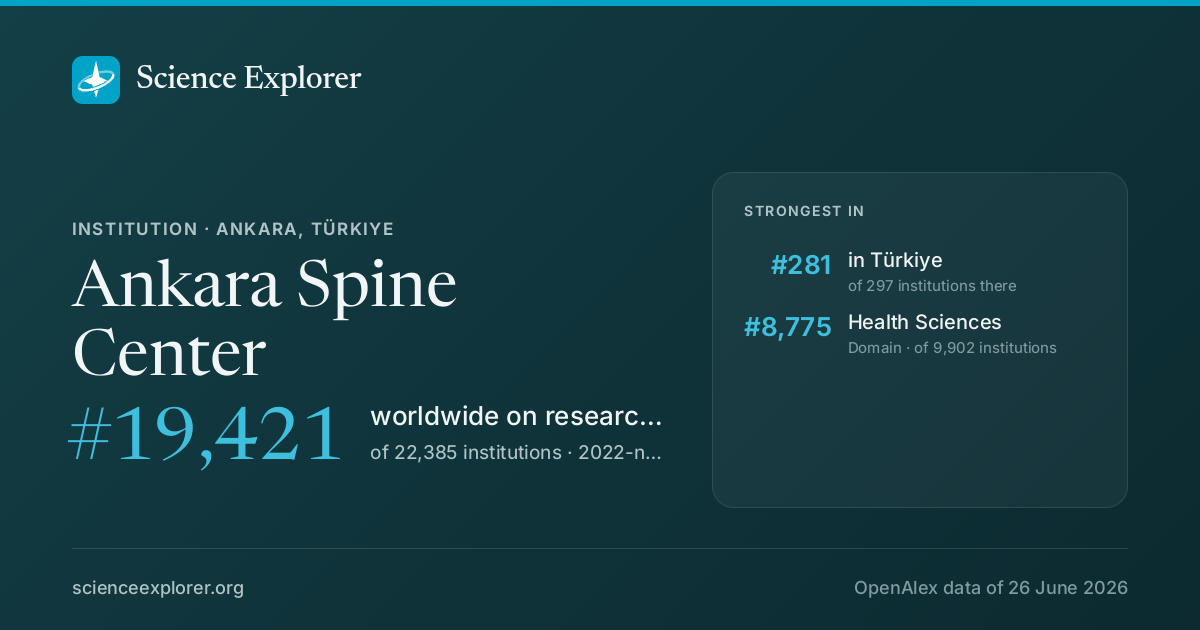
Ankara Spine Center on Science Explorer

A card with Ankara Spine Center's standing and the fields it leads in, for a post or a slide. A link to this page previews as the same card.

Download the card

1200 × 630 PNG, sized for social posts, drawn from the latest snapshot.

Badges for a website1Each links back here and updates with every snapshot

Research measures only: rankings here say nothing about teaching, admissions or student experience. Comparable institutions and collaboration partners have tabs of their own, above.

Discussion

Ask a question or share a note about Ankara Spine Center. Posts are plain text and can be reported.