Science Explorer Back to mapMap
Discussion
University · Bethlehem · United States

Bethlehem Area School District

In research, Bethlehem Area School District stands highest in Physical Sciences (#4,767 of 17,446 worldwide), Engineering (#4,013 of 9,532 worldwide) and Social Sciences (#7,967 of 14,833 worldwide), over all time.

World rank, 2022-now
#18,448
of 22,385 · #7,809 all time
Rank in United States
#2,717
of 3,332
Research works
597
▲ 40% vs 2018-21
Citations
8.5k
14.2 per fractional work
Top-10% rate
5.6%
all institutions 10.0%
vs its own fields
0.95×
1.00× is exactly expected
Open access
24%
world 40%
International
19%
world 18%

What is Bethlehem Area School District known for in research?

The fields where it stands highest, over all time, ranked among every institution above the floor in each field.

FieldWorld rankWhere that sitsTop-10% rateWorks
Physical SciencesDomain #4,767 of 17,446 8.7%328
EngineeringField #4,013 of 9,532 9.9%185
Social SciencesDomain #7,967 of 14,833 5.2%124

Each strip is that field's whole ranked pool, with the notch where Bethlehem Area School District sits in it, in the colour of the band that rank falls in. The track under the rate is the rate itself: it carries no average mark, because the average differs by field (from about 6% in Dentistry to 21% in Economics).

Which fields of science does Bethlehem Area School District work in?

In 2022-now, 38% of research at Bethlehem Area School District is in Social Sciences, 28% in Physical Sciences. Its largest fields are Social Sciences (17%), Medicine (15%), Engineering (14%). It does 1.5× the world's share of Social Sciences.

Social Sciences: 27 fractional works · 38.4% of its workSocial Sciences: 12 fractional works · 16.8% of its workEducation: 4 fractional works · 6.3% of its workSociology and Political Science: 3 fractional works · 4.3% of its workPolitical Science and International Relations: 2 fractional works · 2.4% of its workCultural Studies: 1 fractional works · 1.4% of its workGender Studies: 1 fractional works · 0.8% of its workHealth: 0 fractional works · 0.7% of its workDemography: 0 fractional works · 0.5% of its workPublic Administration: 0 fractional works · 0.5% of its workArts and Humanities: 7 fractional works · 9.3% of its workHistory: 1 fractional works · 2.0% of its workLiterature and Literary Theory: 1 fractional works · 1.9% of its workPhilosophy: 1 fractional works · 1.5% of its workReligious studies: 1 fractional works · 1.4% of its workVisual Arts and Performing Arts: 1 fractional works · 0.9% of its workArcheology: 0 fractional works · 0.6% of its workClassics: 0 fractional works · 0.5% of its workConservation: 0 fractional works · 0.5% of its workPsychology: 4 fractional works · 6.0% of its workSocial Psychology: 3 fractional works · 3.6% of its workClinical Psychology: 1 fractional works · 1.9% of its workExperimental and Cognitive Psychology: 0 fractional works · 0.5% of its workSmaller subfields together: 0 fractional works · 0.1% of its workEconomics, Econometrics and Finance: 3 fractional works · 4.8% of its workEconomics and Econometrics: 3 fractional works · 4.2% of its workGeneral Economics, Econometrics and Finance: 0 fractional works · 0.5% of its workSmaller subfields together: 0 fractional works · 0.1% of its workBusiness, Management and Accounting: 1 fractional works · 1.1% of its workStrategy and Management: 0 fractional works · 0.7% of its workOrganizational Behavior and Human Resource Management: 0 fractional works · 0.2% of its workSmaller subfields together: 0 fractional works · 0.1% of its workDecision Sciences: 0 fractional works · 0.5% of its workInformation Systems and Management: 0 fractional works · 0.5% of its workPhysical Sciences: 20 fractional works · 27.7% of its workEngineering: 10 fractional works · 14.0% of its workMechanical Engineering: 2 fractional works · 3.3% of its workElectrical and Electronic Engineering: 2 fractional works · 3.1% of its workBiomedical Engineering: 2 fractional works · 2.2% of its workMechanics of Materials: 1 fractional works · 1.6% of its workCivil and Structural Engineering: 1 fractional works · 1.5% of its workSafety, Risk, Reliability and Quality: 1 fractional works · 0.9% of its workGeneral Engineering: 0 fractional works · 0.5% of its workOcean Engineering: 0 fractional works · 0.5% of its workComputational Mechanics: 0 fractional works · 0.2% of its workControl and Systems Engineering: 0 fractional works · 0.2% of its workMaterials Science: 2 fractional works · 3.0% of its workMaterials Chemistry: 1 fractional works · 2.0% of its workCeramics and Composites: 0 fractional works · 0.5% of its workBiomaterials: 0 fractional works · 0.4% of its workSmaller subfields together: 0 fractional works · 0.2% of its workPhysics and Astronomy: 2 fractional works · 2.4% of its workAtomic and Molecular Physics, and Optics: 1 fractional works · 1.8% of its workRadiation: 0 fractional works · 0.5% of its workSmaller subfields together: 0 fractional works · 0.1% of its workEnvironmental Science: 2 fractional works · 2.4% of its workEcology: 1 fractional works · 1.0% of its workHealth, Toxicology and Mutagenesis: 0 fractional works · 0.5% of its workWater Science and Technology: 0 fractional works · 0.3% of its workEcological Modeling: 0 fractional works · 0.2% of its workSmaller subfields together: 0 fractional works · 0.4% of its workChemistry: 1 fractional works · 1.9% of its workSpectroscopy: 1 fractional works · 1.9% of its workComputer Science: 1 fractional works · 1.8% of its workInformation Systems: 1 fractional works · 1.3% of its workComputer Science Applications: 0 fractional works · 0.4% of its workSmaller subfields together: 0 fractional works · 0.2% of its workChemical Engineering: 1 fractional works · 0.9% of its workCatalysis: 0 fractional works · 0.5% of its workProcess Chemistry and Technology: 0 fractional works · 0.5% of its workEnergy: 1 fractional works · 0.9% of its workFuel Technology: 1 fractional works · 0.9% of its workEarth and Planetary Sciences: 0 fractional works · 0.4% of its workOceanography: 0 fractional works · 0.3% of its workSmaller subfields together: 0 fractional works · 0.1% of its workHealth Sciences: 16 fractional works · 23.0% of its workMedicine: 11 fractional works · 15.2% of its workSurgery: 2 fractional works · 2.5% of its workEmergency Medicine: 1 fractional works · 1.9% of its workCardiology and Cardiovascular Medicine: 1 fractional works · 1.5% of its workHealth Informatics: 1 fractional works · 1.3% of its workPublic Health, Environmental and Occupational Health: 1 fractional works · 1.0% of its workPulmonary and Respiratory Medicine: 1 fractional works · 0.9% of its workPsychiatry and Mental health: 0 fractional works · 0.7% of its workCritical Care and Intensive Care Medicine: 0 fractional works · 0.5% of its workPediatrics, Perinatology and Child Health: 0 fractional works · 0.5% of its workReproductive Medicine: 0 fractional works · 0.5% of its workOncology: 0 fractional works · 0.4% of its workPathology and Forensic Medicine: 0 fractional works · 0.4% of its workDermatology: 0 fractional works · 0.3% of its workEpidemiology: 0 fractional works · 0.3% of its workNeurology: 0 fractional works · 0.3% of its workRheumatology: 0 fractional works · 0.3% of its workOtorhinolaryngology: 0 fractional works · 0.3% of its workEndocrinology, Diabetes and Metabolism: 0 fractional works · 0.2% of its workImmunology and Allergy: 0 fractional works · 0.2% of its workRadiology, Nuclear Medicine and Imaging: 0 fractional works · 0.2% of its workSmaller subfields together: 1 fractional works · 1.0% of its workHealth Professions: 3 fractional works · 4.0% of its workHealth Information Management: 1 fractional works · 1.4% of its workGeneral Health Professions: 1 fractional works · 1.3% of its workSpeech and Hearing: 0 fractional works · 0.7% of its workRadiological and Ultrasound Technology: 0 fractional works · 0.5% of its workSmaller subfields together: 0 fractional works · 0.2% of its workDentistry: 3 fractional works · 3.8% of its workOral Surgery: 1 fractional works · 1.8% of its workGeneral Dentistry: 1 fractional works · 1.3% of its workOrthodontics: 0 fractional works · 0.6% of its workSmaller subfields together: 0 fractional works · 0.2% of its workNursing: 0 fractional works · 0.0% of its workLife Sciences: 8 fractional works · 10.9% of its workBiochemistry, Genetics and Molecular Biology: 3 fractional works · 4.5% of its workMolecular Biology: 2 fractional works · 2.7% of its workGenetics: 0 fractional works · 0.6% of its workCancer Research: 0 fractional works · 0.5% of its workEndocrinology: 0 fractional works · 0.3% of its workClinical Biochemistry: 0 fractional works · 0.2% of its workSmaller subfields together: 0 fractional works · 0.1% of its workAgricultural and Biological Sciences: 2 fractional works · 2.5% of its workEcology, Evolution, Behavior and Systematics: 0 fractional works · 0.7% of its workPlant Science: 0 fractional works · 0.6% of its workFood Science: 0 fractional works · 0.5% of its workAquatic Science: 0 fractional works · 0.2% of its workInsect Science: 0 fractional works · 0.2% of its workSmaller subfields together: 0 fractional works · 0.3% of its workNeuroscience: 1 fractional works · 2.1% of its workCognitive Neuroscience: 1 fractional works · 1.4% of its workBehavioral Neuroscience: 0 fractional works · 0.5% of its workSmaller subfields together: 0 fractional works · 0.2% of its workImmunology and Microbiology: 1 fractional works · 1.0% of its workParasitology: 1 fractional works · 0.9% of its workSmaller subfields together: 0 fractional works · 0.1% of its workPharmacology, Toxicology and Pharmaceutics: 1 fractional works · 0.8% of its workToxicology: 0 fractional works · 0.5% of its workPharmaceutical Science: 0 fractional works · 0.3% of its workALL ITS WORKBethlehem AreaSchool District71fractional works, 2022-now
Life Sciences11%Physical Sciences28%Health Sciences23%Social Sciences38%

Each ring splits the one inside it: the four domains of science, their fields, their subfields. Size is fractional works in 2022-now. Every slice is a page; the interactive view zooms down to single topics and colours each by how much more of it this institution does than the world.

Its 4 domains and 24 fields, with their numbers
    1. Social Sciences1216.8%
    2. Arts and Humanities79.3%
    3. Psychology46.0%
    4. Economics, Econometrics and Finance34.8%
    5. Business, Management and Accounting11.1%
    6. Decision Sciences00.5%
    1. Engineering1014.0%
    2. Materials Science23.0%
    3. Physics and Astronomy22.4%
    4. Environmental Science22.4%
    5. Chemistry11.9%
    6. Computer Science11.8%
    7. Chemical Engineering10.9%
    8. Energy10.9%
    9. Earth and Planetary Sciences00.4%
    1. Medicine1115.2%
    2. Health Professions34.0%
    3. Dentistry33.8%
    4. Nursing00.0%
    1. Biochemistry, Genetics and Molecular Biology34.5%
    2. Agricultural and Biological Sciences22.5%
    3. Neuroscience12.1%
    4. Immunology and Microbiology11.0%
    5. Pharmacology, Toxicology and Pharmaceutics10.8%
All of science, and how each field's share has moved since 1950: the Science domain explorer

Field profile

Location quotient across every field it publishes in: outside the ring is more than an institution of this size would be expected to publish, inside it is less.

Agricultural and Biological Sciences: 0.52× its world share, 2 worksAgricultural and Bio…Biochemistry, Genetics and Molecular Biology: 0.84× its world share, 3 worksBiochemistry, Geneti…Immunology and Microbiology: 0.98× its world share, 1 worksImmunology and Micro…Neuroscience: 1.29× its world share, 2 worksNeurosciencePharmacology, Toxicology and Pharmaceutics: 2.35× its world share, 1 worksPharmacology, Toxico…Chemical Engineering: 2.70× its world share, 1 worksChemical EngineeringChemistry: 1.20× its world share, 1 worksChemistryComputer Science: 0.23× its world share, 1 worksComputer ScienceEarth and Planetary Sciences: 0.23× its world share, 0 worksEarth and Planetary …Energy: 1.03× its world share, 1 worksEnergyEngineering: 0.93× its world share, 10 worksEngineeringEnvironmental Science: 0.48× its world share, 2 worksEnvironmental ScienceMaterials Science: 0.86× its world share, 2 worksMaterials SciencePhysics and Astronomy: 1.08× its world share, 2 worksPhysics and AstronomyDentistry: 7.75× its world share, 3 worksDentistryHealth Professions: 1.53× its world share, 3 worksHealth ProfessionsMedicine: 0.79× its world share, 11 worksMedicineNursing: 0.06× its world share, 0 worksNursingArts and Humanities: 3.22× its world share, 7 worksArts and HumanitiesBusiness, Management and Accounting: 0.33× its world share, 1 worksBusiness, Management…Decision Sciences: 0.49× its world share, 0 worksDecision SciencesEconomics, Econometrics and Finance: 2.22× its world share, 3 worksEconomics, Econometr…Psychology: 1.97× its world share, 4 worksPsychologySocial Sciences: 1.33× its world share, 12 worksSocial Sciences1×world share
more than its size predictsabout as predictedless

Rings at 0.5×, 1× and 2×. Widest outward: Dentistry, 7.8×. Every wedge is a field page.

All 24 fields, with their numbers
  1. Dentistry7.75×3 works
  2. Arts and Humanities3.22×7 works
  3. Chemical Engineering2.70×1 works
  4. Pharmacology, Toxicology and Pharmaceutics2.35×1 works
  5. Economics, Econometrics and Finance2.22×3 works
  6. Psychology1.97×4 works
  7. Health Professions1.53×3 works
  8. Social Sciences1.33×12 works
  9. Neuroscience1.29×2 works
  10. Chemistry1.20×1 works
  11. Physics and Astronomy1.08×2 works
  12. Energy1.03×1 works
  13. Immunology and Microbiology0.98×1 works
  14. Engineering0.93×10 works
  15. Materials Science0.86×2 works
  16. Biochemistry, Genetics and Molecular Biology0.84×3 works
  17. Medicine0.79×11 works
  18. Agricultural and Biological Sciences0.52×2 works
  19. Decision Sciences0.49×0 works
  20. Environmental Science0.48×2 works
  21. Business, Management and Accounting0.33×1 works
  22. Computer Science0.23×1 works
  23. Earth and Planetary Sciences0.23×0 works
  24. Nursing0.06×0 works

Who are the top researchers at Bethlehem Area School District?

Ranked on the quality score, Keith A. Taylor, Bruce L. Bramfitt and Jerry R. Johanson lead among researchers whose main affiliation is Bethlehem Area School District.

  1. 1 Keith A. Taylor United States · #730,329 worldwide 926 citations · 27 works
  2. 2 Bruce L. Bramfitt United States · #815,985 worldwide 3k citations · 38 works
  3. 3 Jerry R. Johanson United States · #938,973 worldwide 856 citations · 26 works
  4. 4 David M. Yen United States · #1,377,131 worldwide 1.4k citations · 41 works
  5. 5 HE Townsend United States · #1,610,289 worldwide 1.4k citations · 25 works
  6. 6 William L. Estes United States · #2,098,817 worldwide 285 citations · 34 works
  7. 7 Joseph V. Poplawski United States · #2,175,365 worldwide 613 citations · 31 works
  8. 8 Walter Lippmann United States · #2,353,432 worldwide 2.3k citations · 211 works
  9. 9 Halle Abrams United States · #2,650,160 worldwide 407 citations · 21 works
  10. 10 Carl H. Gronquist United States · #2,742,818 worldwide 1 citations · 26 works
All ranked researchers at Bethlehem Area School District

What are the most cited papers from Bethlehem Area School District?

The most cited paper from Bethlehem Area School District is "Characterization of Iron Oxides Commonly Formed as Corrosion Products on Steel" (Sei Jin Oh, D. C. Cook, HE Townsend, 1998), with 682 citations. Next come "The magnetic anisotropy of rocks" (626) and "A multicenter, randomized, double‐blind, placebo‐controlled trial of adjuvant methotrexate treatment for giant cell arteritis" (582).

Most cited papers
#PaperReleasedCitations
1 Characterization of Iron Oxides Commonly Formed as Corrosion Products on Steel Sei Jin Oh, D. C. Cook, HE Townsend · Hyperfine Interactions Dec 1998 682
2 The magnetic anisotropy of rocks K. P. Kodama · Tectonophysics Feb 1994 626
3 A multicenter, randomized, double‐blind, placebo‐controlled trial of adjuvant methotrexate treatment for giant cell arteritis Gary Stuart Hoffman et al. · Arthritis & Rheumatism May 2002 582
4 The morphology of martensite in iron alloys G. Krauß, A. R. Marder · Metallurgical Transactions Sep 1971 369
5 Grain size measurement by the intercept method Halle Abrams · Metallography Feb 1971 286
All 60 most cited papers, with filters and sorting

Which keywords describe research at Bethlehem Area School District?

By fractional works in 2022-now, weighted toward what it does more of than the world: Fiber Lasers, Nonlinear Optics, Identity, Religion, Numerical Simulation, Globalization, Courage and Heroism.

▲ more of its work than of the world's◆ about the world's share▼ less than the world's

Size is fractional works in 2022-now in the topics tagged with each word; colour is the word's share of this institution's work against its share of the world's. The 40 words are chosen for being large and distinctive. Each links to the topic it comes from most.

All 40 words, with their numbers
  1. Globalization3▲ 2.5×9 topics
  2. Epidemiology3▲ 1.17×20 topics
  3. Identity3▲ 5.2×8 topics
  4. Education3▲ 2.1×8 topics
  5. Fiber Lasers3▲ 39×3 topics
  6. Nonlinear Optics2▲ 31×3 topics
  7. Economic Development2▲ 3.8×4 topics
  8. Religion2▲ 6.6×6 topics
  9. Numerical Simulation2▲ 9.7×3 topics
  10. Literature2▲ 5.0×6 topics
  11. Courage2▲ 223×1 topic
  12. Heroism2▲ 223×1 topic
  13. Pedagogy2▲ 4.7×3 topics
  14. Stress2▲ 6.4×5 topics
  15. Design Optimization1▲ 55×2 topics
  16. Human Capital1▲ 13×3 topics
  17. Material Properties1▲ 21×2 topics
  18. Chiral Separation1▲ 45×1 topic
  19. Feminism1▲ 6.4×3 topics
  20. Liquid Chromatography1▲ 31×1 topic
  21. Professional Development1▲ 9.1×4 topics
  22. Structural Analysis1▲ 21×2 topics
  23. Demographic Transition1▲ 27×2 topics
  24. Labor Market1▲ 6.1×4 topics
  25. High-Power Laser1▲ 88×1 topic
  26. Metal Recovery1▲ 8.1×2 topics
  27. Optical Frequency Combs1▲ 30×1 topic
  28. Stability1▲ 7.0×2 topics
  29. Supercontinuum Generation1▲ 88×1 topic
  30. Ultrafast Lasers1▲ 30×1 topic
  31. Battery Recycling1▲ 18×1 topic
  32. Coal Seam1▲ 70×2 topics
  33. Coal Water Slurry1▲ 111×1 topic
  34. Family Therapy1▲ 81×2 topics
  35. Fatigue Analysis1▲ 52×1 topic
  36. Finite Element Method1▲ 15×1 topic
  37. Health Care Utilization1▲ 13×2 topics
  38. Hermeneutics1▲ 18×2 topics
  39. Leadership Development1▲ 40×3 topics
  40. Muslim Students1▲ 21×1 topic

Which research topics does Bethlehem Area School District publish most on?

By volume in 2022-now: Leadership, Courage, and Heroism Studies, Analytical Chemistry and Chromatography, Photonic Crystal and Fiber Optics and Advanced Fiber Laser Technologies.

  1. 1 Leadership, Courage, and Heroism Studies Social Psychology 2 works
  2. 2 Analytical Chemistry and Chromatography Spectroscopy 1 works
  3. 3 Photonic Crystal and Fiber Optics Electrical and Electronic Engineering 1 works
  4. 4 Advanced Fiber Laser Technologies Atomic and Molecular Physics, and Optics 1 works
  5. 5 Education and Islamic Studies Education 1 works
  6. 6 Engineering Applied Research Civil and Structural Engineering 1 works
  7. 7 Extraction and Separation Processes Mechanical Engineering 1 works
  8. 8 Coal Combustion and Slurry Processing Mechanical Engineering 1 works
  9. 9 Dental Research and COVID-19 General Dentistry 1 works
  10. 10 Dental Radiography and Imaging Oral Surgery 1 works

How open and international is its research?

Against the world's own shares: the tick on each track. Both are shares of its output, so they sit on one scale and can be read against each other as well as against the world.

openly available23.6%not open76.4%

World: 40% of research is openly available.

with international co-authors18.9%domestic only81.1%

World: 18% is written across borders.

How has Bethlehem Area School District's research output changed?

Output in 2022-2025 was 40% higher than in 2018-2021.

still counting1990200020102020
grewheldshrank

The same series as a ribbon: one cell per year, darker for more. The line above answers how much; this answers when.

Its share of all research

Growing output can still be a shrinking share: all of science grows. This is Bethlehem Area School District as a percentage of every work published that year, 0.00030% in 2024.

still counting0.0020%0.0040%0.0060%Bethlehem Area School District0.00036% in 202519801990200020102020

Fractional works of Bethlehem Area School District over all fractional works that year. How the balance of science has shifted.

Other research institutions in Bethlehem

All research institutions in Bethlehem

Share Bethlehem Area School District's ranking
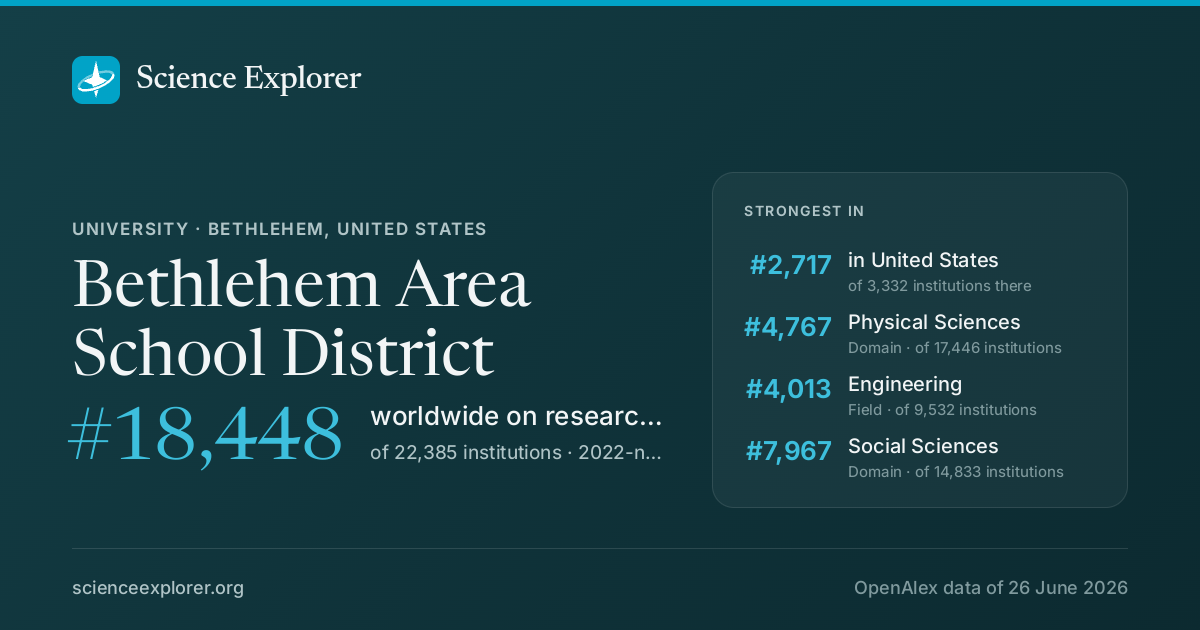
Bethlehem Area School District on Science Explorer

A card with Bethlehem Area School District's standing and the fields it leads in, for a post or a slide. A link to this page previews as the same card.

Download the card

1200 × 630 PNG, sized for social posts, drawn from the latest snapshot.

Badges for a website1Each links back here and updates with every snapshot

Research measures only: rankings here say nothing about teaching, admissions or student experience. Comparable institutions and collaboration partners have tabs of their own, above.

Discussion

Ask a question or share a note about Bethlehem Area School District. Posts are plain text and can be reported.
