Science Explorer Back to mapMap
Discussion
University · Brooklyn · United States

Brooklyn Technical High School

In research, Brooklyn Technical High School stands highest in Physical Sciences (#10,470 of 17,446 worldwide), over all time.

World rank, all time
#17,228
of 34,923
Rank in United States
#3,581
of 7,310
Research works
289
▲ 52% vs 2018-21
Citations
3.4k
11.9 per fractional work
Top-10% rate
9.3%
all institutions 10.0%
vs its own fields
0.98×
1.00× is exactly expected
Open access
19%
world 40%
International
13%
world 18%

What is Brooklyn Technical High School known for in research?

The fields where it stands highest, over all time, ranked among every institution above the floor in each field.

FieldWorld rankWhere that sitsTop-10% rateWorks
Physical SciencesDomain #10,470 of 17,446 11.3%138

Each strip is that field's whole ranked pool, with the notch where Brooklyn Technical High School sits in it, in the colour of the band that rank falls in. The track under the rate is the rate itself: it carries no average mark, because the average differs by field (from about 6% in Dentistry to 21% in Economics).

Which fields of science does Brooklyn Technical High School work in?

In 2022-now, 36% of research at Brooklyn Technical High School is in Social Sciences, 35% in Physical Sciences. Its largest fields are Social Sciences (22%), Engineering (17%), Medicine (9%). It does 1.3× the world's share of Social Sciences.

Social Sciences: 15 fractional works · 35.9% of its workSocial Sciences: 9 fractional works · 22.3% of its workEducation: 3 fractional works · 7.7% of its workSociology and Political Science: 2 fractional works · 5.0% of its workCultural Studies: 1 fractional works · 2.0% of its workDemography: 1 fractional works · 1.9% of its workUrban Studies: 1 fractional works · 1.6% of its workLinguistics and Language: 0 fractional works · 0.8% of its workDevelopment: 0 fractional works · 0.7% of its workHuman Factors and Ergonomics: 0 fractional works · 0.7% of its workTransportation: 0 fractional works · 0.7% of its workGender Studies: 0 fractional works · 0.4% of its workLaw: 0 fractional works · 0.3% of its workSafety Research: 0 fractional works · 0.3% of its workSmaller subfields together: 0 fractional works · 0.3% of its workBusiness, Management and Accounting: 2 fractional works · 4.5% of its workStrategy and Management: 1 fractional works · 2.0% of its workMarketing: 0 fractional works · 1.1% of its workOrganizational Behavior and Human Resource Management: 0 fractional works · 0.8% of its workManagement of Technology and Innovation: 0 fractional works · 0.6% of its workSmaller subfields together: 0 fractional works · 0.0% of its workArts and Humanities: 2 fractional works · 4.0% of its workHistory: 1 fractional works · 2.4% of its workLanguage and Linguistics: 0 fractional works · 0.8% of its workLiterature and Literary Theory: 0 fractional works · 0.8% of its workSmaller subfields together: 0 fractional works · 0.0% of its workEconomics, Econometrics and Finance: 1 fractional works · 2.5% of its workEconomics and Econometrics: 0 fractional works · 1.2% of its workFinance: 0 fractional works · 1.0% of its workGeneral Economics, Econometrics and Finance: 0 fractional works · 0.3% of its workPsychology: 1 fractional works · 2.1% of its workSocial Psychology: 1 fractional works · 1.3% of its workExperimental and Cognitive Psychology: 0 fractional works · 0.8% of its workDecision Sciences: 0 fractional works · 0.4% of its workManagement Science and Operations Research: 0 fractional works · 0.4% of its workPhysical Sciences: 15 fractional works · 35.4% of its workEngineering: 7 fractional works · 17.5% of its workControl and Systems Engineering: 2 fractional works · 4.0% of its workElectrical and Electronic Engineering: 2 fractional works · 3.8% of its workMechanical Engineering: 1 fractional works · 2.4% of its workBiomedical Engineering: 1 fractional works · 2.1% of its workCivil and Structural Engineering: 1 fractional works · 1.7% of its workMedia Technology: 0 fractional works · 1.1% of its workAerospace Engineering: 0 fractional works · 0.9% of its workOcean Engineering: 0 fractional works · 0.4% of its workAutomotive Engineering: 0 fractional works · 0.4% of its workIndustrial and Manufacturing Engineering: 0 fractional works · 0.3% of its workSafety, Risk, Reliability and Quality: 0 fractional works · 0.2% of its workSmaller subfields together: 0 fractional works · 0.1% of its workMaterials Science: 2 fractional works · 5.1% of its workMaterials Chemistry: 1 fractional works · 3.1% of its workPolymers and Plastics: 0 fractional works · 1.0% of its workBiomaterials: 0 fractional works · 0.5% of its workCeramics and Composites: 0 fractional works · 0.2% of its workElectronic, Optical and Magnetic Materials: 0 fractional works · 0.2% of its workEnvironmental Science: 2 fractional works · 5.0% of its workEcology: 1 fractional works · 2.8% of its workGlobal and Planetary Change: 1 fractional works · 1.5% of its workNature and Landscape Conservation: 0 fractional works · 0.4% of its workSmaller subfields together: 0 fractional works · 0.2% of its workComputer Science: 2 fractional works · 4.8% of its workComputer Vision and Pattern Recognition: 1 fractional works · 1.5% of its workHuman-Computer Interaction: 1 fractional works · 1.5% of its workComputer Science Applications: 0 fractional works · 0.9% of its workInformation Systems: 0 fractional works · 0.5% of its workArtificial Intelligence: 0 fractional works · 0.3% of its workSmaller subfields together: 0 fractional works · 0.2% of its workEarth and Planetary Sciences: 1 fractional works · 1.8% of its workAtmospheric Science: 1 fractional works · 1.6% of its workOceanography: 0 fractional works · 0.2% of its workMathematics: 0 fractional works · 0.7% of its workModeling and Simulation: 0 fractional works · 0.4% of its workStatistics and Probability: 0 fractional works · 0.3% of its workSmaller subfields together: 0 fractional works · 0.0% of its workChemistry: 0 fractional works · 0.3% of its workPhysical and Theoretical Chemistry: 0 fractional works · 0.3% of its workEnergy: 0 fractional works · 0.1% of its workLife Sciences: 6 fractional works · 14.9% of its workImmunology and Microbiology: 3 fractional works · 6.2% of its workMicrobiology: 1 fractional works · 3.2% of its workImmunology: 1 fractional works · 3.0% of its workBiochemistry, Genetics and Molecular Biology: 1 fractional works · 3.6% of its workMolecular Biology: 1 fractional works · 3.0% of its workCell Biology: 0 fractional works · 0.2% of its workGenetics: 0 fractional works · 0.2% of its workSmaller subfields together: 0 fractional works · 0.2% of its workNeuroscience: 1 fractional works · 3.4% of its workNeurology: 1 fractional works · 1.7% of its workCellular and Molecular Neuroscience: 0 fractional works · 0.8% of its workCognitive Neuroscience: 0 fractional works · 0.8% of its workSmaller subfields together: 0 fractional works · 0.0% of its workAgricultural and Biological Sciences: 1 fractional works · 1.7% of its workGeneral Agricultural and Biological Sciences: 0 fractional works · 0.8% of its workEcology, Evolution, Behavior and Systematics: 0 fractional works · 0.5% of its workFood Science: 0 fractional works · 0.4% of its workHealth Sciences: 6 fractional works · 13.9% of its workMedicine: 4 fractional works · 9.1% of its workInfectious Diseases: 1 fractional works · 2.4% of its workEpidemiology: 1 fractional works · 2.2% of its workOncology: 0 fractional works · 1.1% of its workNeurology: 0 fractional works · 0.9% of its workObstetrics and Gynecology: 0 fractional works · 0.8% of its workPhysiology: 0 fractional works · 0.4% of its workCardiology and Cardiovascular Medicine: 0 fractional works · 0.2% of its workHepatology: 0 fractional works · 0.2% of its workPathology and Forensic Medicine: 0 fractional works · 0.2% of its workRadiology, Nuclear Medicine and Imaging: 0 fractional works · 0.2% of its workSmaller subfields together: 0 fractional works · 0.4% of its workHealth Professions: 2 fractional works · 4.0% of its workGeneral Health Professions: 1 fractional works · 2.8% of its workEmergency Medical Services: 0 fractional works · 0.8% of its workComplementary and Manual Therapy: 0 fractional works · 0.4% of its workDentistry: 0 fractional works · 0.8% of its workOrthodontics: 0 fractional works · 0.8% of its workALL ITS WORKBrooklynTechnical High…41fractional works, 2022-now
Life Sciences15%Physical Sciences35%Health Sciences14%Social Sciences36%

Each ring splits the one inside it: the four domains of science, their fields, their subfields. Size is fractional works in 2022-now. Every slice is a page; the interactive view zooms down to single topics and colours each by how much more of it this institution does than the world.

Its 4 domains and 21 fields, with their numbers
    1. Social Sciences922.3%
    2. Business, Management and Accounting24.5%
    3. Arts and Humanities24.0%
    4. Economics, Econometrics and Finance12.5%
    5. Psychology12.1%
    6. Decision Sciences00.4%
    1. Engineering717.5%
    2. Materials Science25.1%
    3. Environmental Science25.0%
    4. Computer Science24.8%
    5. Earth and Planetary Sciences11.8%
    6. Mathematics00.7%
    7. Chemistry00.3%
    8. Energy00.1%
    1. Immunology and Microbiology36.2%
    2. Biochemistry, Genetics and Molecular Biology13.6%
    3. Neuroscience13.4%
    4. Agricultural and Biological Sciences11.7%
    1. Medicine49.1%
    2. Health Professions24.0%
    3. Dentistry00.8%
All of science, and how each field's share has moved since 1950: the Science domain explorer

Field profile

Location quotient across every field it publishes in: outside the ring is more than an institution of this size would be expected to publish, inside it is less.

Agricultural and Biological Sciences: 0.36× its world share, 1 worksAgricultural and Bio…Biochemistry, Genetics and Molecular Biology: 0.68× its world share, 2 worksBiochemistry, Geneti…Immunology and Microbiology: 6.15× its world share, 3 worksImmunology and Micro…Neuroscience: 2.07× its world share, 1 worksNeuroscienceChemistry: 0.17× its world share, 0 worksChemistryComputer Science: 0.62× its world share, 2 worksComputer ScienceEarth and Planetary Sciences: 1.16× its world share, 1 worksEarth and Planetary …Energy: 0.13× its world share, 0 worksEnergyEngineering: 1.16× its world share, 7 worksEngineeringEnvironmental Science: 1.01× its world share, 2 worksEnvironmental ScienceMaterials Science: 1.46× its world share, 2 worksMaterials ScienceMathematics: 0.61× its world share, 0 worksMathematicsDentistry: 1.66× its world share, 0 worksDentistryHealth Professions: 1.51× its world share, 2 worksHealth ProfessionsMedicine: 0.47× its world share, 4 worksMedicineArts and Humanities: 1.40× its world share, 2 worksArts and HumanitiesBusiness, Management and Accounting: 1.40× its world share, 2 worksBusiness, Management…Decision Sciences: 0.42× its world share, 0 worksDecision SciencesEconomics, Econometrics and Finance: 1.17× its world share, 1 worksEconomics, Econometr…Psychology: 0.69× its world share, 1 worksPsychologySocial Sciences: 1.76× its world share, 9 worksSocial Sciences1×world share
more than its size predictsabout as predictedless

Rings at 0.5×, 1× and 2×. Widest outward: Immunology and Microbiology, 6.2×. Every wedge is a field page.

All 21 fields, with their numbers
  1. Immunology and Microbiology6.15×3 works
  2. Neuroscience2.07×1 works
  3. Social Sciences1.76×9 works
  4. Dentistry1.66×0 works
  5. Health Professions1.51×2 works
  6. Materials Science1.46×2 works
  7. Arts and Humanities1.40×2 works
  8. Business, Management and Accounting1.40×2 works
  9. Economics, Econometrics and Finance1.17×1 works
  10. Earth and Planetary Sciences1.16×1 works
  11. Engineering1.16×7 works
  12. Environmental Science1.01×2 works
  13. Psychology0.69×1 works
  14. Biochemistry, Genetics and Molecular Biology0.68×2 works
  15. Computer Science0.62×2 works
  16. Mathematics0.61×0 works
  17. Medicine0.47×4 works
  18. Decision Sciences0.42×0 works
  19. Agricultural and Biological Sciences0.36×1 works
  20. Chemistry0.17×0 works
  21. Energy0.13×0 works

Who are the top researchers at Brooklyn Technical High School?

Ranked on the quality score, E. P. Otocka, Nathan Lazar and Arthur Latham Baker lead among researchers whose main affiliation is Brooklyn Technical High School.

  1. 1 E. P. Otocka United States · #1,648,588 worldwide 777 citations · 30 works
  2. 2 Nathan Lazar United States · #2,434,126 worldwide 4 citations · 73 works
  3. 3 Arthur Latham Baker United States · #2,826,757 worldwide 24 citations · 41 works
  4. 4 Arthur Minton United States · #3,587,615 worldwide 15 citations · 45 works
  5. 5 Maxim Newmark United States · #4,338,330 worldwide 264 citations · 46 works
  6. 6 Fred Bendheim United States · #5,064,662 worldwide 15 citations · 20 works
  7. 7 Charles A. Tonsor United States · #5,188,227 worldwide 3 citations · 28 works
All ranked researchers at Brooklyn Technical High School

What are the most cited papers from Brooklyn Technical High School?

The most cited paper from Brooklyn Technical High School is "Orlicz centroid bodies" (Erwin Lutwak, Deane Yang, Gaoyong Zhang, 2010), with 263 citations. Next come "Nonphotochemical, Polarization-Dependent, Laser-Induced Nucleation in Supersaturated Aqueous Urea Solutions" (262) and "Management of Flatback and Related Kyphotic Decompensation Syndromes" (232).

Most cited papers
#PaperReleasedCitations
1 Orlicz centroid bodies Erwin Lutwak, Deane Yang, Gaoyong Zhang · Journal of Differential Geometry Open access Feb 2010 263
2 Nonphotochemical, Polarization-Dependent, Laser-Induced Nucleation in Supersaturated Aqueous Urea Solutions Bruce A. Garetz, Janice E. Aber, Noël L. Goddard et al. · Physical Review Letters 14 Oct 1996 262
3 Management of Flatback and Related Kyphotic Decompensation Syndromes Jean-Pierre C. Farcy, Frank J. Schwab · Spine Oct 1997 232
4 Factors influencing quality of experience of commonly used mobile applications Selim İckin, Katarzyna Wac, Markus Fiedler et al. · IEEE Communications Magazine Open access Apr 2012 227
5 Polylactide/cellulose nanocrystal nanocomposites: Efficient routes for nanofiber modification and effects of nanofiber chemistry on PLA reinforcement Stephen Spinella, Giada Lo Re, Bo Liu et al. · Polymer 5 Mar 2015 196
All 60 most cited papers, with filters and sorting

Which keywords describe research at Brooklyn Technical High School?

By fractional works in 2022-now, weighted toward what it does more of than the world: Education, Sexually Transmitted Infections, Vaginal Microbiome, Religion, Cancer, Critical Race Theory, Racism and Student Achievement.

▲ more of its work than of the world's◆ about the world's share▼ less than the world's

Size is fractional works in 2022-now in the topics tagged with each word; colour is the word's share of this institution's work against its share of the world's. The 25 words are chosen for being large and distinctive. Each links to the topic it comes from most.

All 25 words, with their numbers
  1. Education3▲ 4.0×6 topics
  2. Climate Change2▲ 1.66×7 topics
  3. Cancer2▲ 3.1×4 topics
  4. Epidemiology2◆ 1.02×7 topics
  5. Innovation1▲ 3.0×6 topics
  6. Religion1▲ 7.0×2 topics
  7. Sexually Transmitted Infections1▲ 64×1 topic
  8. Vaginal Microbiome1▲ 118×1 topic
  9. COVID-191▲ 2.3×5 topics
  10. Educational Technology1▲ 2.5×3 topics
  11. Globalization1▲ 1.51×4 topics
  12. Critical Race Theory1▲ 182×1 topic
  13. E-Learning1▲ 2.7×2 topics
  14. Immune Response1▲ 4.6×4 topics
  15. Online Learning1▲ 3.1×2 topics
  16. Racism1▲ 101×1 topic
  17. Student Achievement1▲ 30×2 topics
  18. Family Engagement1▲ 59×1 topic
  19. Google Classroom1▲ 23×1 topic
  20. Inflammation1◆ 1.14×4 topics
  21. Parental Involvement1▲ 13×1 topic
  22. Qualitative Research1▲ 2.9×4 topics
  23. Scandinavia1▲ 174×1 topic
  24. Technology Integration1▲ 7.7×1 topic
  25. Viking Age1▲ 174×1 topic

Which research topics does Brooklyn Technical High School publish most on?

By volume in 2022-now: Reproductive tract infections research, Critical Race Theory in Education, Parental Involvement in Education and Technology-Enhanced Education Studies.

  1. 1 Reproductive tract infections research Microbiology 1 works
  2. 2 Critical Race Theory in Education Sociology and Political Science 1 works
  3. 3 Parental Involvement in Education Education 1 works
  4. 4 Technology-Enhanced Education Studies Education 1 works
  5. 5 Historical and Archaeological Studies History 1 works
  6. 6 Management and Optimization Techniques Strategy and Management 1 works
  7. 7 Immune cells in cancer Immunology 1 works
  8. 8 Extracellular vesicles in disease Molecular Biology 1 works
  9. 9 Neuroinflammation and Neurodegeneration Mechanisms Neurology 1 works
  10. 10 Ecology and biodiversity studies Ecology 0 works

How open and international is its research?

Against the world's own shares: the tick on each track. Both are shares of its output, so they sit on one scale and can be read against each other as well as against the world.

openly available18.6%not open81.4%

World: 40% of research is openly available.

with international co-authors13.2%domestic only86.8%

World: 18% is written across borders.

How has Brooklyn Technical High School's research output changed?

Output in 2022-2025 was 52% higher than in 2018-2021.

still counting1990200020102020
grewheldshrank

The same series as a ribbon: one cell per year, darker for more. The line above answers how much; this answers when.

Its share of all research

Growing output can still be a shrinking share: all of science grows. This is Brooklyn Technical High School as a percentage of every work published that year, 0.00016% in 2024.

still counting0.0020%0.0040%Brooklyn Technical High School0.00011% in 202519801990200020102020

Fractional works of Brooklyn Technical High School over all fractional works that year. How the balance of science has shifted.

Other research institutions in Brooklyn

All research institutions in Brooklyn

Share Brooklyn Technical High School's ranking
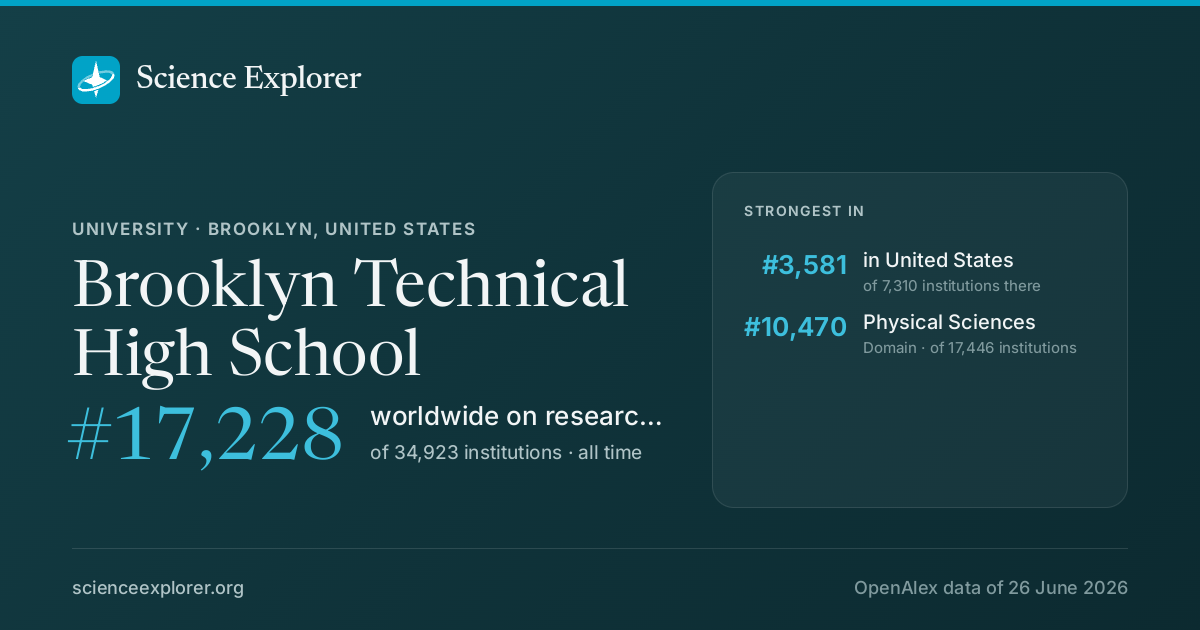
Brooklyn Technical High School on Science Explorer

A card with Brooklyn Technical High School's standing and the fields it leads in, for a post or a slide. A link to this page previews as the same card.

Download the card

1200 × 630 PNG, sized for social posts, drawn from the latest snapshot.

Badges for a website1Each links back here and updates with every snapshot

Research measures only: rankings here say nothing about teaching, admissions or student experience. Comparable institutions and collaboration partners have tabs of their own, above.

Discussion

Ask a question or share a note about Brooklyn Technical High School. Posts are plain text and can be reported.