Science Explorer Back to mapMap
Discussion
Nonprofit · Taoyuan · Taiwan

Electronics Testing Center

In research, Electronics Testing Center stands highest in Engineering (#5,042 of 9,532 worldwide) and Physical Sciences (#10,266 of 17,446 worldwide), over all time.

World rank, 2022-now
#20,202
of 22,385 · #15,645 all time
Rank in Taiwan
#164
of 185
Research works
563
▼ 18% vs 2018-21
Citations
3.9k
7.0 per fractional work
Top-10% rate
7.6%
all institutions 10.0%
vs its own fields
0.92×
1.00× is exactly expected
Open access
20%
world 40%
International
23%
world 18%

What is Electronics Testing Center known for in research?

The fields where it stands highest, over all time, ranked among every institution above the floor in each field.

FieldWorld rankWhere that sitsTop-10% rateWorks
EngineeringField #5,042 of 9,532 6.3%270
Physical SciencesDomain #10,266 of 17,446 6.5%410

Each strip is that field's whole ranked pool, with the notch where Electronics Testing Center sits in it, in the colour of the band that rank falls in. The track under the rate is the rate itself: it carries no average mark, because the average differs by field (from about 6% in Dentistry to 21% in Economics).

Which fields of science does Electronics Testing Center work in?

In 2022-now, 64% of research at Electronics Testing Center is in Physical Sciences, 20% in Social Sciences. Its largest fields are Engineering (43%), Computer Science (9%), Agricultural and Biological Sciences (5%). It does 1.6× the world's share of Physical Sciences.

Physical Sciences: 56 fractional works · 63.7% of its workEngineering: 38 fractional works · 42.8% of its workElectrical and Electronic Engineering: 12 fractional works · 13.2% of its workAutomotive Engineering: 6 fractional works · 7.1% of its workMechanical Engineering: 4 fractional works · 4.7% of its workCivil and Structural Engineering: 4 fractional works · 4.7% of its workControl and Systems Engineering: 3 fractional works · 3.8% of its workAerospace Engineering: 3 fractional works · 3.0% of its workBiomedical Engineering: 1 fractional works · 1.6% of its workMechanics of Materials: 1 fractional works · 1.1% of its workBuilding and Construction: 1 fractional works · 1.1% of its workSafety, Risk, Reliability and Quality: 1 fractional works · 0.9% of its workOcean Engineering: 1 fractional works · 0.9% of its workComputational Mechanics: 0 fractional works · 0.4% of its workSmaller subfields together: 0 fractional works · 0.3% of its workComputer Science: 8 fractional works · 8.8% of its workComputer Vision and Pattern Recognition: 2 fractional works · 2.5% of its workArtificial Intelligence: 2 fractional works · 2.3% of its workHardware and Architecture: 1 fractional works · 1.0% of its workComputer Networks and Communications: 1 fractional works · 0.8% of its workSoftware: 1 fractional works · 0.8% of its workInformation Systems: 1 fractional works · 0.6% of its workSignal Processing: 1 fractional works · 0.6% of its workSmaller subfields together: 0 fractional works · 0.1% of its workEnvironmental Science: 3 fractional works · 3.9% of its workWater Science and Technology: 1 fractional works · 0.6% of its workEnvironmental Engineering: 0 fractional works · 0.6% of its workGlobal and Planetary Change: 0 fractional works · 0.6% of its workEnvironmental Chemistry: 0 fractional works · 0.5% of its workPollution: 0 fractional works · 0.4% of its workManagement, Monitoring, Policy and Law: 0 fractional works · 0.4% of its workNature and Landscape Conservation: 0 fractional works · 0.4% of its workEcology: 0 fractional works · 0.3% of its workSmaller subfields together: 0 fractional works · 0.2% of its workMaterials Science: 3 fractional works · 3.1% of its workMaterials Chemistry: 1 fractional works · 1.3% of its workPolymers and Plastics: 0 fractional works · 0.5% of its workMetals and Alloys: 0 fractional works · 0.4% of its workSurfaces, Coatings and Films: 0 fractional works · 0.3% of its workBiomaterials: 0 fractional works · 0.2% of its workSmaller subfields together: 0 fractional works · 0.3% of its workEnergy: 2 fractional works · 2.2% of its workRenewable Energy, Sustainability and the Environment: 1 fractional works · 1.3% of its workNuclear Energy and Engineering: 1 fractional works · 0.8% of its workSmaller subfields together: 0 fractional works · 0.2% of its workChemistry: 1 fractional works · 1.2% of its workOrganic Chemistry: 1 fractional works · 0.8% of its workAnalytical Chemistry: 0 fractional works · 0.2% of its workSmaller subfields together: 0 fractional works · 0.1% of its workPhysics and Astronomy: 1 fractional works · 0.7% of its workInstrumentation: 0 fractional works · 0.6% of its workSmaller subfields together: 0 fractional works · 0.2% of its workChemical Engineering: 0 fractional works · 0.4% of its workChemical Health and Safety: 0 fractional works · 0.4% of its workEarth and Planetary Sciences: 0 fractional works · 0.4% of its workMathematics: 0 fractional works · 0.2% of its workSocial Sciences: 18 fractional works · 19.9% of its workSocial Sciences: 5 fractional works · 5.3% of its workEducation: 3 fractional works · 3.3% of its workCommunication: 0 fractional works · 0.4% of its workGender Studies: 0 fractional works · 0.4% of its workPolitical Science and International Relations: 0 fractional works · 0.4% of its workTransportation: 0 fractional works · 0.4% of its workSmaller subfields together: 0 fractional works · 0.5% of its workPsychology: 5 fractional works · 5.1% of its workClinical Psychology: 2 fractional works · 1.8% of its workSocial Psychology: 1 fractional works · 1.5% of its workDevelopmental and Educational Psychology: 1 fractional works · 1.1% of its workExperimental and Cognitive Psychology: 0 fractional works · 0.4% of its workApplied Psychology: 0 fractional works · 0.4% of its workArts and Humanities: 3 fractional works · 3.9% of its workLanguage and Linguistics: 2 fractional works · 2.3% of its workLiterature and Literary Theory: 1 fractional works · 1.3% of its workSmaller subfields together: 0 fractional works · 0.4% of its workDecision Sciences: 3 fractional works · 3.3% of its workManagement Science and Operations Research: 1 fractional works · 1.6% of its workStatistics, Probability and Uncertainty: 1 fractional works · 1.5% of its workSmaller subfields together: 0 fractional works · 0.2% of its workBusiness, Management and Accounting: 1 fractional works · 1.6% of its workStrategy and Management: 1 fractional works · 0.8% of its workManagement of Technology and Innovation: 0 fractional works · 0.4% of its workManagement Information Systems: 0 fractional works · 0.4% of its workSmaller subfields together: 0 fractional works · 0.1% of its workEconomics, Econometrics and Finance: 1 fractional works · 0.6% of its workFinance: 0 fractional works · 0.4% of its workEconomics and Econometrics: 0 fractional works · 0.2% of its workLife Sciences: 8 fractional works · 8.7% of its workAgricultural and Biological Sciences: 5 fractional works · 5.4% of its workPlant Science: 2 fractional works · 2.1% of its workEcology, Evolution, Behavior and Systematics: 1 fractional works · 0.9% of its workSoil Science: 1 fractional works · 0.6% of its workAnimal Science and Zoology: 1 fractional works · 0.6% of its workFood Science: 1 fractional works · 0.6% of its workAgronomy and Crop Science: 0 fractional works · 0.4% of its workSmaller subfields together: 0 fractional works · 0.2% of its workBiochemistry, Genetics and Molecular Biology: 2 fractional works · 2.8% of its workMolecular Biology: 1 fractional works · 1.4% of its workCancer Research: 0 fractional works · 0.5% of its workBiophysics: 0 fractional works · 0.3% of its workCell Biology: 0 fractional works · 0.3% of its workSmaller subfields together: 0 fractional works · 0.4% of its workPharmacology, Toxicology and Pharmaceutics: 0 fractional works · 0.2% of its workNeuroscience: 0 fractional works · 0.1% of its workImmunology and Microbiology: 0 fractional works · 0.1% of its workHealth Sciences: 7 fractional works · 7.8% of its workMedicine: 5 fractional works · 5.3% of its workPublic Health, Environmental and Occupational Health: 1 fractional works · 0.9% of its workPhysiology: 1 fractional works · 0.8% of its workSurgery: 1 fractional works · 0.6% of its workEpidemiology: 0 fractional works · 0.4% of its workRheumatology: 0 fractional works · 0.3% of its workRadiology, Nuclear Medicine and Imaging: 0 fractional works · 0.2% of its workSmaller subfields together: 2 fractional works · 2.2% of its workHealth Professions: 1 fractional works · 1.6% of its workRadiological and Ultrasound Technology: 1 fractional works · 1.1% of its workSmaller subfields together: 0 fractional works · 0.5% of its workDentistry: 0 fractional works · 0.5% of its workNursing: 0 fractional works · 0.4% of its workNutrition and Dietetics: 0 fractional works · 0.4% of its workALL ITS WORKElectronicsTesting Center88fractional works, 2022-now
Life Sciences9%Physical Sciences64%Health Sciences8%Social Sciences20%

Each ring splits the one inside it: the four domains of science, their fields, their subfields. Size is fractional works in 2022-now. Every slice is a page; the interactive view zooms down to single topics and colours each by how much more of it this institution does than the world.

Its 4 domains and 25 fields, with their numbers
    1. Engineering3842.8%
    2. Computer Science88.8%
    3. Environmental Science33.9%
    4. Materials Science33.1%
    5. Energy22.2%
    6. Chemistry11.2%
    7. Physics and Astronomy10.7%
    8. Chemical Engineering00.4%
    9. Earth and Planetary Sciences00.4%
    10. Mathematics00.2%
    1. Social Sciences55.3%
    2. Psychology55.1%
    3. Arts and Humanities33.9%
    4. Decision Sciences33.3%
    5. Business, Management and Accounting11.6%
    6. Economics, Econometrics and Finance10.6%
    1. Agricultural and Biological Sciences55.4%
    2. Biochemistry, Genetics and Molecular Biology22.8%
    3. Pharmacology, Toxicology and Pharmaceutics00.2%
    4. Neuroscience00.1%
    5. Immunology and Microbiology00.1%
    1. Medicine55.3%
    2. Health Professions11.6%
    3. Dentistry00.5%
    4. Nursing00.4%
All of science, and how each field's share has moved since 1950: the Science domain explorer

Field profile

Location quotient across every field it publishes in: outside the ring is more than an institution of this size would be expected to publish, inside it is less.

Agricultural and Biological Sciences: 1.14× its world share, 5 worksAgricultural and Bio…Biochemistry, Genetics and Molecular Biology: 0.52× its world share, 2 worksBiochemistry, Geneti…Immunology and Microbiology: 0.09× its world share, 0 worksImmunology and Micro…Neuroscience: 0.08× its world share, 0 worksNeurosciencePharmacology, Toxicology and Pharmaceutics: 0.69× its world share, 0 worksPharmacology, Toxico…Chemical Engineering: 1.08× its world share, 0 worksChemical EngineeringChemistry: 0.76× its world share, 1 worksChemistryComputer Science: 1.13× its world share, 8 worksComputer ScienceEarth and Planetary Sciences: 0.24× its world share, 0 worksEarth and Planetary …Energy: 2.40× its world share, 2 worksEnergyEngineering: 2.85× its world share, 38 worksEngineeringEnvironmental Science: 0.79× its world share, 4 worksEnvironmental ScienceMaterials Science: 0.89× its world share, 3 worksMaterials ScienceMathematics: 0.16× its world share, 0 worksMathematicsPhysics and Astronomy: 0.33× its world share, 1 worksPhysics and AstronomyDentistry: 1.10× its world share, 0 worksDentistryHealth Professions: 0.60× its world share, 1 worksHealth ProfessionsMedicine: 0.28× its world share, 5 worksMedicineNursing: 0.77× its world share, 0 worksNursingArts and Humanities: 1.37× its world share, 4 worksArts and HumanitiesBusiness, Management and Accounting: 0.51× its world share, 1 worksBusiness, Management…Decision Sciences: 3.39× its world share, 3 worksDecision SciencesEconomics, Econometrics and Finance: 0.29× its world share, 1 worksEconomics, Econometr…Psychology: 1.68× its world share, 4 worksPsychologySocial Sciences: 0.42× its world share, 5 worksSocial Sciences1×world share
more than its size predictsabout as predictedless

Rings at 0.5×, 1× and 2×. Widest outward: Decision Sciences, 3.4×. Every wedge is a field page.

All 25 fields, with their numbers
  1. Decision Sciences3.39×3 works
  2. Engineering2.85×38 works
  3. Energy2.40×2 works
  4. Psychology1.68×4 works
  5. Arts and Humanities1.37×4 works
  6. Agricultural and Biological Sciences1.14×5 works
  7. Computer Science1.13×8 works
  8. Dentistry1.10×0 works
  9. Chemical Engineering1.08×0 works
  10. Materials Science0.89×3 works
  11. Environmental Science0.79×4 works
  12. Nursing0.77×0 works
  13. Chemistry0.76×1 works
  14. Pharmacology, Toxicology and Pharmaceutics0.69×0 works
  15. Health Professions0.60×1 works
  16. Biochemistry, Genetics and Molecular Biology0.52×2 works
  17. Business, Management and Accounting0.51×1 works
  18. Social Sciences0.42×5 works
  19. Physics and Astronomy0.33×1 works
  20. Economics, Econometrics and Finance0.29×1 works
  21. Medicine0.28×5 works
  22. Earth and Planetary Sciences0.24×0 works
  23. Mathematics0.16×0 works
  24. Immunology and Microbiology0.09×0 works
  25. Neuroscience0.08×0 works

Who are the top researchers at Electronics Testing Center?

Ranked on the quality score, Test Author, Yong-Yuan Ku and Chan Wei Hsu lead among researchers whose main affiliation is Electronics Testing Center.

  1. 1 Test Author Taiwan · #3,252,107 worldwide 0 citations · 100 works
  2. 2 Yong-Yuan Ku Taiwan · #3,498,361 worldwide 177 citations · 16 works
  3. 3 Chan Wei Hsu Taiwan · #4,255,167 worldwide 75 citations · 16 works
  4. 4 Liang-Yang Lin Taiwan · #4,510,367 worldwide 79 citations · 19 works
  5. 5 Tsung-Ming Hsu Taiwan · #4,640,369 worldwide 91 citations · 17 works
  6. 6 Yuan-Fu Ku Taiwan · #5,418,914 worldwide 10 citations · 21 works
All ranked researchers at Electronics Testing Center

What are the most cited papers from Electronics Testing Center?

The most cited paper from Electronics Testing Center is "Ti 3 C 2 MXene quantum dot-encapsulated liposomes for photothermal immunoassays using a portable near-infrared imaging camera on a smartphone" (Guoneng Cai, Zhenzhong Yu, Ping Tong et al., 2019), with 345 citations. Next come "Molecular engineering of a colorless, extremely tough, superiorly self-recoverable, and healable poly(urethane–urea) elastomer for impact-resistant applications" (236) and "A Biomechanical Evaluation of Cyclic and Static Stretch in Human Skeletal Muscle" (198).

Most cited papers
#PaperReleasedCitations
1 Ti 3 C 2 MXene quantum dot-encapsulated liposomes for photothermal immunoassays using a portable near-infrared imaging camera on a smartphone Guoneng Cai, Zhenzhong Yu, Ping Tong et al. · Nanoscale 2019 345
2 Molecular engineering of a colorless, extremely tough, superiorly self-recoverable, and healable poly(urethane–urea) elastomer for impact-resistant applications Dong Wang, Zhifeng Wang, Shangyang Ren et al. · Materials Horizons 2021 236
3 A Biomechanical Evaluation of Cyclic and Static Stretch in Human Skeletal Muscle Stig Peter Magnusson, P. Aagard, Erik Bruun Simonsen et al. · International Journal of Sports Medicine Jul 1998 198
4 Hierarchical NiCo 2 O 4 /Co 3 O 4 /NiO porous composite: a lightweight electromagnetic wave absorber with tunable absorbing performance Xiaofang Liu, Chengcheng Hao, He Jiang et al. · Journal of Materials Chemistry C 2017 189
5 Mesenchymal Stem Cell-Derived Exosomes Ameliorate Alzheimer’s Disease Pathology and Improve Cognitive Deficits Yi‐An Chen, Cheng-Hsiu Lu, Chien‐Chih Ke et al. · Biomedicines Open access 24 May 2021 166
All 60 most cited papers, with filters and sorting

Which keywords describe research at Electronics Testing Center?

By fractional works in 2022-now, weighted toward what it does more of than the world: Electric Vehicles, Power Electronics, Autonomous Vehicles, Model Predictive Control, Electromagnetic Compatibility, EMI, Deep Learning and Language Teaching.

▲ more of its work than of the world's◆ about the world's share▼ less than the world's

Size is fractional works in 2022-now in the topics tagged with each word; colour is the word's share of this institution's work against its share of the world's. The 40 words are chosen for being large and distinctive. Each links to the topic it comes from most.

All 40 words, with their numbers
  1. Deep Learning5▲ 1.77×18 topics
  2. Electric Vehicles4▲ 16×4 topics
  3. Machine Learning4▲ 1.19×11 topics
  4. Power Electronics3▲ 12×4 topics
  5. Autonomous Vehicles3▲ 18×3 topics
  6. Mechanical Properties3▲ 3.4×12 topics
  7. Model Predictive Control3▲ 12×3 topics
  8. EMI3▲ 156×1 topic
  9. Electromagnetic Compatibility3▲ 156×1 topic
  10. Leadership2▲ 5.4×3 topics
  11. Language Teaching2▲ 9.2×4 topics
  12. Collision Avoidance2▲ 12×2 topics
  13. Convolutional Neural Networks2▲ 2.9×8 topics
  14. Control Systems2▲ 11×3 topics
  15. Corrective Feedback2▲ 25×1 topic
  16. Microstructure2▲ 3.7×7 topics
  17. Second Language Acquisition2▲ 21×1 topic
  18. Smart Grid2▲ 5.5×5 topics
  19. Driver Assistance Systems2▲ 31×1 topic
  20. Life Cycle Assessment2▲ 6.4×4 topics
  21. Trajectory Prediction2▲ 31×1 topic
  22. Additive Manufacturing2▲ 5.6×5 topics
  23. Thermal Management2▲ 5.3×5 topics
  24. CMOS Technology1▲ 20×3 topics
  25. Intelligent Transportation Systems1▲ 11×3 topics
  26. Vehicle Dynamics1▲ 27×2 topics
  27. Accident Prevention1▲ 22×2 topics
  28. Active Steering1▲ 50×1 topic
  29. Antenna Measurement1▲ 138×1 topic
  30. Control Strategies1▲ 11×2 topics
  31. Recycled Materials1▲ 13×2 topics
  32. Reverberation Chambers1▲ 138×1 topic
  33. Safety Culture1▲ 22×2 topics
  34. Tire-Road Friction Estimation1▲ 50×1 topic
  35. Vocational Education1▲ 17×2 topics
  36. Energy Storage Systems1▲ 9.5×2 topics
  37. Localization1▲ 12×2 topics
  38. Robotics1▲ 5.6×2 topics
  39. Traffic Flow1▲ 14×2 topics
  40. Measurement Invariance1▲ 113×1 topic

Which research topics does Electronics Testing Center publish most on?

By volume in 2022-now: Electromagnetic Compatibility and Noise Suppression, EFL/ESL Teaching and Learning, Autonomous Vehicle Technology and Safety and Vehicle Dynamics and Control Systems.

  1. 1 Electromagnetic Compatibility and Noise Suppression Electrical and Electronic Engineering 3 works
  2. 2 EFL/ESL Teaching and Learning Language and Linguistics 2 works
  3. 3 Autonomous Vehicle Technology and Safety Automotive Engineering 2 works
  4. 4 Vehicle Dynamics and Control Systems Automotive Engineering 1 works
  5. 5 Electromagnetic Compatibility and Measurements Electrical and Electronic Engineering 1 works
  6. 6 Psychometric Methodologies and Testing Management Science and Operations Research 1 works
  7. 7 Risk and Safety Analysis Statistics, Probability and Uncertainty 1 works
  8. 8 Occupational Health and Safety Research Radiological and Ultrasound Technology 1 works
  9. 9 Innovative Educational Techniques Education 1 works
  10. 10 Competency Development and Evaluation Social Psychology 1 works

How open and international is its research?

Against the world's own shares: the tick on each track. Both are shares of its output, so they sit on one scale and can be read against each other as well as against the world.

openly available19.5%not open80.5%

World: 40% of research is openly available.

with international co-authors23.2%domestic only76.8%

World: 18% is written across borders.

How has Electronics Testing Center's research output changed?

Output in 2022-2025 was 18% lower than in 2018-2021.

still counting1990200020102020
grewheldshrank

The same series as a ribbon: one cell per year, darker for more. The line above answers how much; this answers when.

Its share of all research

Growing output can still be a shrinking share: all of science grows. This is Electronics Testing Center as a percentage of every work published that year, 0.00025% in 2024.

still counting0.00050%0.0010%0.0015%Electronics Testing Center0.00042% in 202519801990200020102020

Fractional works of Electronics Testing Center over all fractional works that year. How the balance of science has shifted.

How much of it reaches the world top 10%

Year by year, against all institutions in the same year.

still counting5%10%15%all institutions10.0% in 2025Electronics Testing Center7.3% in 202520102020

Of each year's output, the share that reached the world's 10% most cited for its field and year. Peak 8.9% in 2012.

Other research institutions in Taoyuan

All research institutions in Taoyuan

Share Electronics Testing Center's ranking
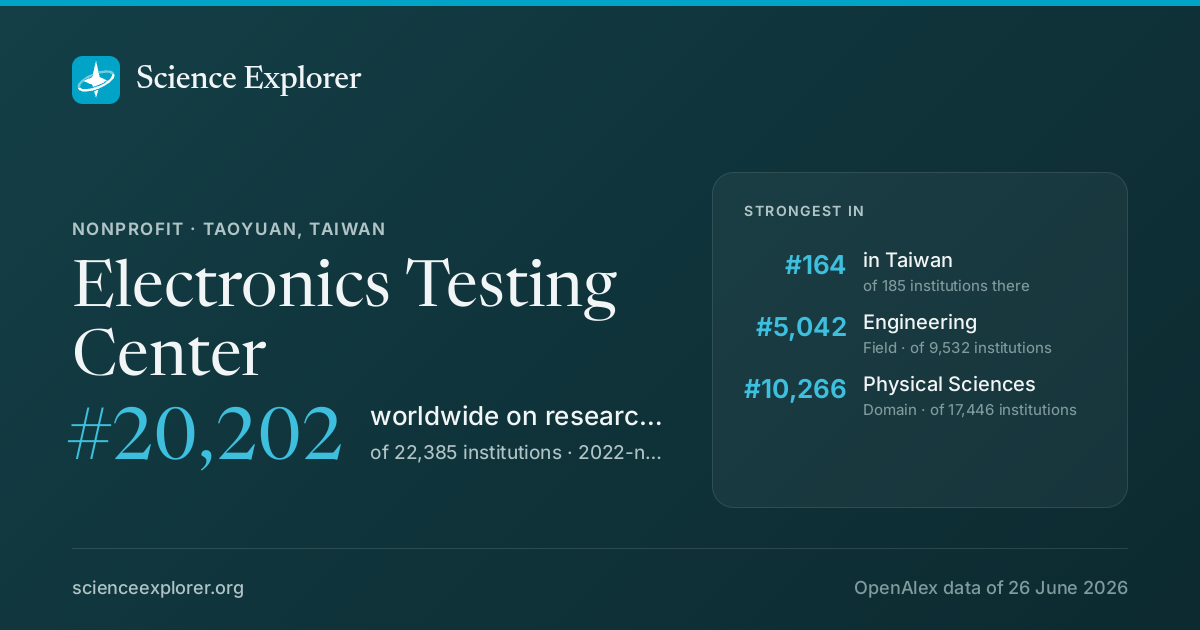
Electronics Testing Center on Science Explorer

A card with Electronics Testing Center's standing and the fields it leads in, for a post or a slide. A link to this page previews as the same card.

Download the card

1200 × 630 PNG, sized for social posts, drawn from the latest snapshot.

Badges for a website1Each links back here and updates with every snapshot

Research measures only: rankings here say nothing about teaching, admissions or student experience. Comparable institutions and collaboration partners have tabs of their own, above.

Discussion

Ask a question or share a note about Electronics Testing Center. Posts are plain text and can be reported.