Science Explorer Back to mapMap
Discussion
Hospital / health system · Trabzon · Türkiye

Farabi Hastanesi

World rank, all time
#22,276
of 34,923
Rank in Türkiye
#237
of 335
Research works
258
▼ 59% vs 2018-21
Citations
1.7k
6.6 per fractional work
Top-10% rate
5.4%
all institutions 10.0%
vs its own fields
0.89×
1.00× is exactly expected
Open access
66%
world 40%
International
10%
world 18%

Which fields of science does Farabi Hastanesi work in?

In 2022-now, 51% of research at Farabi Hastanesi is in Health Sciences, 35% in Social Sciences. Its largest fields are Medicine (46%), Social Sciences (20%), Decision Sciences (7%). It does 2.0× the world's share of Health Sciences.

Health Sciences: 30 fractional works · 50.8% of its workMedicine: 27 fractional works · 46.0% of its workSurgery: 4 fractional works · 6.9% of its workCardiology and Cardiovascular Medicine: 3 fractional works · 5.4% of its workPulmonary and Respiratory Medicine: 2 fractional works · 3.5% of its workOrthopedics and Sports Medicine: 2 fractional works · 2.8% of its workEndocrinology, Diabetes and Metabolism: 2 fractional works · 2.6% of its workPsychiatry and Mental health: 1 fractional works · 2.2% of its workOncology: 1 fractional works · 2.1% of its workNeurology: 1 fractional works · 1.8% of its workEpidemiology: 1 fractional works · 1.7% of its workObstetrics and Gynecology: 1 fractional works · 1.7% of its workPathology and Forensic Medicine: 1 fractional works · 1.5% of its workPediatrics, Perinatology and Child Health: 1 fractional works · 1.5% of its workRadiology, Nuclear Medicine and Imaging: 1 fractional works · 1.4% of its workPharmacology: 1 fractional works · 1.2% of its workPublic Health, Environmental and Occupational Health: 1 fractional works · 1.1% of its workCritical Care and Intensive Care Medicine: 1 fractional works · 1.0% of its workPhysiology: 0 fractional works · 0.8% of its workDermatology: 0 fractional works · 0.8% of its workEmergency Medicine: 0 fractional works · 0.6% of its workRheumatology: 0 fractional works · 0.6% of its workOphthalmology: 0 fractional works · 0.6% of its workInfectious Diseases: 0 fractional works · 0.4% of its workAnesthesiology and Pain Medicine: 0 fractional works · 0.4% of its workNephrology: 0 fractional works · 0.4% of its workComplementary and alternative medicine: 0 fractional works · 0.4% of its workHematology: 0 fractional works · 0.3% of its workAnatomy: 0 fractional works · 0.3% of its workFamily Practice: 0 fractional works · 0.3% of its workHealth Informatics: 0 fractional works · 0.3% of its workHepatology: 0 fractional works · 0.3% of its workInternal Medicine: 0 fractional works · 0.3% of its workReproductive Medicine: 0 fractional works · 0.3% of its workUrology: 0 fractional works · 0.3% of its workSmaller subfields together: 0 fractional works · 0.4% of its workHealth Professions: 2 fractional works · 3.1% of its workPharmacy: 1 fractional works · 1.1% of its workEmergency Medical Services: 0 fractional works · 0.4% of its workGeneral Health Professions: 0 fractional works · 0.4% of its workRadiological and Ultrasound Technology: 0 fractional works · 0.4% of its workComplementary and Manual Therapy: 0 fractional works · 0.3% of its workOccupational Therapy: 0 fractional works · 0.3% of its workSmaller subfields together: 0 fractional works · 0.2% of its workDentistry: 1 fractional works · 1.3% of its workOrthodontics: 0 fractional works · 0.6% of its workOral Surgery: 0 fractional works · 0.4% of its workPeriodontics: 0 fractional works · 0.3% of its workNursing: 0 fractional works · 0.4% of its workNutrition and Dietetics: 0 fractional works · 0.4% of its workSocial Sciences: 20 fractional works · 35.0% of its workSocial Sciences: 12 fractional works · 19.9% of its workEducation: 8 fractional works · 13.3% of its workSociology and Political Science: 3 fractional works · 4.9% of its workDemography: 0 fractional works · 0.7% of its workLaw: 0 fractional works · 0.6% of its workSafety Research: 0 fractional works · 0.4% of its workDecision Sciences: 4 fractional works · 7.2% of its workManagement Science and Operations Research: 4 fractional works · 7.2% of its workPsychology: 2 fractional works · 2.6% of its workSocial Psychology: 1 fractional works · 1.2% of its workClinical Psychology: 1 fractional works · 1.1% of its workExperimental and Cognitive Psychology: 0 fractional works · 0.3% of its workArts and Humanities: 1 fractional works · 1.9% of its workPhilosophy: 0 fractional works · 0.6% of its workLiterature and Literary Theory: 0 fractional works · 0.3% of its workSmaller subfields together: 1 fractional works · 1.0% of its workBusiness, Management and Accounting: 1 fractional works · 1.7% of its workMarketing: 0 fractional works · 0.7% of its workStrategy and Management: 0 fractional works · 0.6% of its workManagement of Technology and Innovation: 0 fractional works · 0.3% of its workSmaller subfields together: 0 fractional works · 0.2% of its workEconomics, Econometrics and Finance: 1 fractional works · 1.7% of its workEconomics and Econometrics: 1 fractional works · 1.7% of its workLife Sciences: 5 fractional works · 9.4% of its workBiochemistry, Genetics and Molecular Biology: 2 fractional works · 3.3% of its workMolecular Biology: 1 fractional works · 1.2% of its workGenetics: 1 fractional works · 1.0% of its workCancer Research: 0 fractional works · 0.4% of its workMolecular Medicine: 0 fractional works · 0.3% of its workSmaller subfields together: 0 fractional works · 0.4% of its workNeuroscience: 2 fractional works · 2.7% of its workNeurology: 1 fractional works · 1.2% of its workCellular and Molecular Neuroscience: 0 fractional works · 0.7% of its workCognitive Neuroscience: 0 fractional works · 0.5% of its workSmaller subfields together: 0 fractional works · 0.3% of its workPharmacology, Toxicology and Pharmaceutics: 1 fractional works · 1.5% of its workToxicology: 1 fractional works · 1.2% of its workPharmacology: 0 fractional works · 0.3% of its workImmunology and Microbiology: 1 fractional works · 1.0% of its workImmunology: 0 fractional works · 0.8% of its workSmaller subfields together: 0 fractional works · 0.2% of its workAgricultural and Biological Sciences: 1 fractional works · 0.9% of its workPlant Science: 0 fractional works · 0.9% of its workPhysical Sciences: 3 fractional works · 4.8% of its workMathematics: 1 fractional works · 1.7% of its workStatistics and Probability: 1 fractional works · 1.4% of its workMathematical Physics: 0 fractional works · 0.3% of its workEngineering: 1 fractional works · 1.7% of its workBuilding and Construction: 1 fractional works · 1.2% of its workBiomedical Engineering: 0 fractional works · 0.5% of its workEnvironmental Science: 0 fractional works · 0.6% of its workHealth, Toxicology and Mutagenesis: 0 fractional works · 0.5% of its workSmaller subfields together: 0 fractional works · 0.1% of its workComputer Science: 0 fractional works · 0.5% of its workInformation Systems: 0 fractional works · 0.3% of its workComputational Theory and Mathematics: 0 fractional works · 0.2% of its workChemistry: 0 fractional works · 0.3% of its workInorganic Chemistry: 0 fractional works · 0.3% of its workALL ITS WORKFarabi Hastanesi58fractional works, 2022-now
Life Sciences9%Physical Sciences5%Health Sciences51%Social Sciences35%

Each ring splits the one inside it: the four domains of science, their fields, their subfields. Size is fractional works in 2022-now. Every slice is a page; the interactive view zooms down to single topics and colours each by how much more of it this institution does than the world.

Its 4 domains and 20 fields, with their numbers
    1. Medicine2746.0%
    2. Health Professions23.1%
    3. Dentistry11.3%
    4. Nursing00.4%
    1. Social Sciences1219.9%
    2. Decision Sciences47.2%
    3. Psychology22.6%
    4. Arts and Humanities11.9%
    5. Business, Management and Accounting11.7%
    6. Economics, Econometrics and Finance11.7%
    1. Biochemistry, Genetics and Molecular Biology23.3%
    2. Neuroscience22.7%
    3. Pharmacology, Toxicology and Pharmaceutics11.5%
    4. Immunology and Microbiology11.0%
    5. Agricultural and Biological Sciences10.9%
    1. Mathematics11.7%
    2. Engineering11.7%
    3. Environmental Science00.6%
    4. Computer Science00.5%
    5. Chemistry00.3%
All of science, and how each field's share has moved since 1950: the Science domain explorer

Field profile

Location quotient across every field it publishes in: outside the ring is more than an institution of this size would be expected to publish, inside it is less.

Agricultural and Biological Sciences: 0.18× its world share, 0 worksAgricultural and Bio…Biochemistry, Genetics and Molecular Biology: 0.63× its world share, 2 worksBiochemistry, Geneti…Immunology and Microbiology: 0.99× its world share, 1 worksImmunology and Micro…Neuroscience: 1.69× its world share, 2 worksNeurosciencePharmacology, Toxicology and Pharmaceutics: 4.21× its world share, 1 worksPharmacology, Toxico…Chemistry: 0.18× its world share, 0 worksChemistryComputer Science: 0.06× its world share, 0 worksComputer ScienceEngineering: 0.11× its world share, 1 worksEngineeringEnvironmental Science: 0.13× its world share, 0 worksEnvironmental ScienceMathematics: 1.48× its world share, 1 worksMathematicsDentistry: 2.76× its world share, 1 worksDentistryHealth Professions: 1.16× its world share, 2 worksHealth ProfessionsMedicine: 2.39× its world share, 27 worksMedicineNursing: 0.85× its world share, 0 worksNursingArts and Humanities: 0.65× its world share, 1 worksArts and HumanitiesBusiness, Management and Accounting: 0.54× its world share, 1 worksBusiness, Management…Decision Sciences: 7.42× its world share, 4 worksDecision SciencesEconomics, Econometrics and Finance: 0.78× its world share, 1 worksEconomics, Econometr…Psychology: 0.87× its world share, 2 worksPsychologySocial Sciences: 1.57× its world share, 12 worksSocial Sciences1×world share
more than its size predictsabout as predictedless

Rings at 0.5×, 1× and 2×. Widest outward: Decision Sciences, 7.4×. Every wedge is a field page.

All 20 fields, with their numbers
  1. Decision Sciences7.42×4 works
  2. Pharmacology, Toxicology and Pharmaceutics4.21×1 works
  3. Dentistry2.76×1 works
  4. Medicine2.39×27 works
  5. Neuroscience1.69×2 works
  6. Social Sciences1.57×12 works
  7. Mathematics1.48×1 works
  8. Health Professions1.16×2 works
  9. Immunology and Microbiology0.99×1 works
  10. Psychology0.87×2 works
  11. Nursing0.85×0 works
  12. Economics, Econometrics and Finance0.78×1 works
  13. Arts and Humanities0.65×1 works
  14. Biochemistry, Genetics and Molecular Biology0.63×2 works
  15. Business, Management and Accounting0.54×1 works
  16. Agricultural and Biological Sciences0.18×0 works
  17. Chemistry0.18×0 works
  18. Environmental Science0.13×0 works
  19. Engineering0.11×1 works
  20. Computer Science0.06×0 works

Who are the top researchers at Farabi Hastanesi?

Ranked on the quality score, Osman Tüfekçi and Mustafa Kemal İlik lead among researchers whose main affiliation is Farabi Hastanesi.

  1. 1 Osman Tüfekçi Türkiye · #4,311,903 worldwide 221 citations · 33 works
  2. 2 Mustafa Kemal İlik Türkiye · #5,081,577 worldwide 86 citations · 26 works
All ranked researchers at Farabi Hastanesi

What are the most cited papers from Farabi Hastanesi?

The most cited paper from Farabi Hastanesi is "Mortality analysis of COVID-19 infection in chronic kidney disease, haemodialysis and renal transplant patients compared with patients without kidney disease: a nationwide analysis from Turkey" (Savaş Öztürk et al., 2020), with 237 citations. Next come "Venlafaxine Treatment of Fibromyalgia" (159) and "The Stoppa approach versus the ilioinguinal approach for anterior acetabular fractures: A case control study assessing blood loss complications and function outcomes" (106).

Most cited papers
#PaperReleasedCitations
1 Mortality analysis of COVID-19 infection in chronic kidney disease, haemodialysis and renal transplant patients compared with patients without kidney disease: a nationwide analysis from Turkey Savaş Öztürk et al. · Nephrology Dialysis Transplantation Open access 7 Oct 2020 237
2 Venlafaxine Treatment of Fibromyalgia Kemal Sayar, Gokhan Aksu, İsmail Ak et al. · Annals of Pharmacotherapy 18 Sep 2003 159
3 The Stoppa approach versus the ilioinguinal approach for anterior acetabular fractures: A case control study assessing blood loss complications and function outcomes Mehmet Elmadağ, Yunus Güzel, Mehmet Ali Acar et al. · Orthopaedics & Traumatology Surgery & Research Open access 23 Aug 2014 106
4 Comparison of fingolimod, dimethyl fumarate and teriflunomide for multiple sclerosis Tomáš Kalinčík et al. · Journal of Neurology Neurosurgery & Psychiatry Open access 13 Jan 2019 88
5 Determinants of mortality in a large group of hemodialysis patients hospitalized for COVID-19 Kenan Turgutalp et al. · BMC Nephrology Open access 14 Jan 2021 83
All 61 most cited papers, with filters and sorting

Which keywords describe research at Farabi Hastanesi?

By fractional works in 2022-now, weighted toward what it does more of than the world: Qualitative Research, Islamic Education, Character Education, Risk Management, Digital Learning, Learning Outcomes, Religious Values and School Environment.

▲ more of its work than of the world's◆ about the world's share▼ less than the world's

Size is fractional works in 2022-now in the topics tagged with each word; colour is the word's share of this institution's work against its share of the world's. The 40 words are chosen for being large and distinctive. Each links to the topic it comes from most.

All 40 words, with their numbers
  1. Epidemiology4▲ 1.90×30 topics
  2. Qualitative Research4▲ 7.8×4 topics
  3. Islamic Education3▲ 16×3 topics
  4. Character Education3▲ 10×3 topics
  5. Quality of Life3▲ 3.3×18 topics
  6. Digital Learning3▲ 9.0×2 topics
  7. Risk Management3▲ 9.7×2 topics
  8. Community Empowerment2▲ 6.0×3 topics
  9. Curriculum Development2▲ 6.4×6 topics
  10. Learning Outcomes2▲ 10×2 topics
  11. Inflammation2▲ 1.92×23 topics
  12. Media Literacy2▲ 7.6×2 topics
  13. Religious Values2▲ 22×1 topic
  14. School Environment2▲ 22×1 topic
  15. Sustainability2▲ 1.55×4 topics
  16. Construction Projects2▲ 77×1 topic
  17. Educational Technology2▲ 2.9×3 topics
  18. Project Scheduling2▲ 738×1 topic
  19. Project Success2▲ 87×1 topic
  20. Resource-Constrained2▲ 738×1 topic
  21. Child Development2▲ 8.0×3 topics
  22. Cardiovascular Disease2▲ 2.7×12 topics
  23. Guidelines2▲ 6.2×7 topics
  24. Management2▲ 3.6×8 topics
  25. Sustainable Development2▲ 1.87×3 topics
  26. Appropriate Technology2▲ 22×1 topic
  27. Digital Parenting2▲ 22×1 topic
  28. Treatment2▲ 2.1×11 topics
  29. Clinical Practice Guidelines1▲ 4.3×7 topics
  30. Meta-Analysis1▲ 3.8×5 topics
  31. Online Learning1▲ 2.8×4 topics
  32. Clinical Trials1▲ 3.2×10 topics
  33. Diagnosis1▲ 2.3×9 topics
  34. Financial Performance1▲ 3.6×3 topics
  35. Complications1▲ 3.7×7 topics
  36. Pain Management1▲ 7.8×5 topics
  37. Radiotherapy1▲ 4.7×7 topics
  38. Character Development1▲ 11×2 topics
  39. Neurological Disorders1▲ 3.1×5 topics
  40. Religious Education1▲ 11×2 topics

Which research topics does Farabi Hastanesi publish most on?

By volume in 2022-now: Education and Character Development, Construction Project Management and Performance, Resource-Constrained Project Scheduling and Educational Methods and Impacts.

  1. 1 Education and Character Development Education 2 works
  2. 2 Construction Project Management and Performance Management Science and Operations Research 2 works
  3. 3 Resource-Constrained Project Scheduling Management Science and Operations Research 2 works
  4. 4 Educational Methods and Impacts Education 2 works
  5. 5 Islamic Finance and Communication Sociology and Political Science 1 works
  6. 6 Pancasila Values in Education Education 1 works
  7. 7 Advanced Causal Inference Techniques Statistics and Probability 1 works
  8. 8 Economic and Environmental Valuation Economics and Econometrics 1 works
  9. 9 Educational Research and Methods Education 1 works
  10. 10 BIM and Construction Integration Building and Construction 1 works

How open and international is its research?

Against the world's own shares: the tick on each track. Both are shares of its output, so they sit on one scale and can be read against each other as well as against the world.

openly available66.0%not open34.0%

World: 40% of research is openly available.

with international co-authors10.4%domestic only89.6%

World: 18% is written across borders.

How has Farabi Hastanesi's research output changed?

Output in 2022-2025 was 59% lower than in 2018-2021.

still counting1990200020102020
grewheldshrank

The same series as a ribbon: one cell per year, darker for more. The line above answers how much; this answers when.

Its share of all research

Growing output can still be a shrinking share: all of science grows. This is Farabi Hastanesi as a percentage of every work published that year, 0.00018% in 2024.

still counting0.00050%0.0010%0.0015%Farabi Hastanesi0.00022% in 202519801990200020102020

Fractional works of Farabi Hastanesi over all fractional works that year. How the balance of science has shifted.

Other research institutions in Trabzon

All research institutions in Trabzon

Share Farabi Hastanesi's ranking
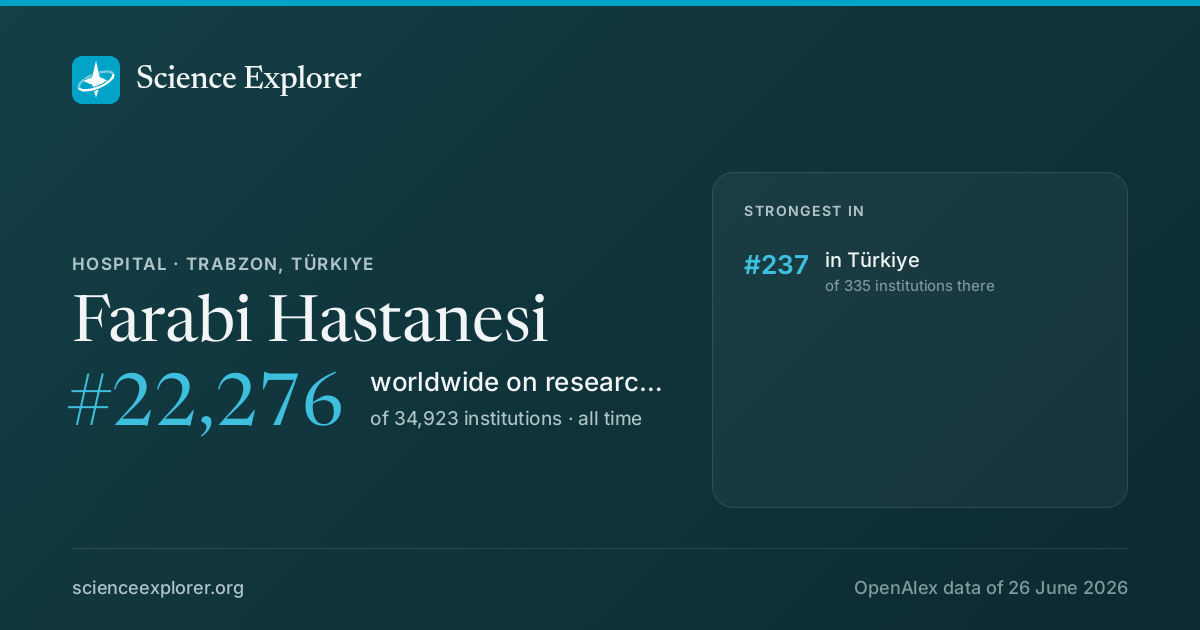
Farabi Hastanesi on Science Explorer

A card with Farabi Hastanesi's standing and the fields it leads in, for a post or a slide. A link to this page previews as the same card.

Download the card

1200 × 630 PNG, sized for social posts, drawn from the latest snapshot.

Badges for a website1Each links back here and updates with every snapshot

Research measures only: rankings here say nothing about teaching, admissions or student experience. Comparable institutions and collaboration partners have tabs of their own, above.

Discussion

Ask a question or share a note about Farabi Hastanesi. Posts are plain text and can be reported.