Fundación Universitaria Sanitas
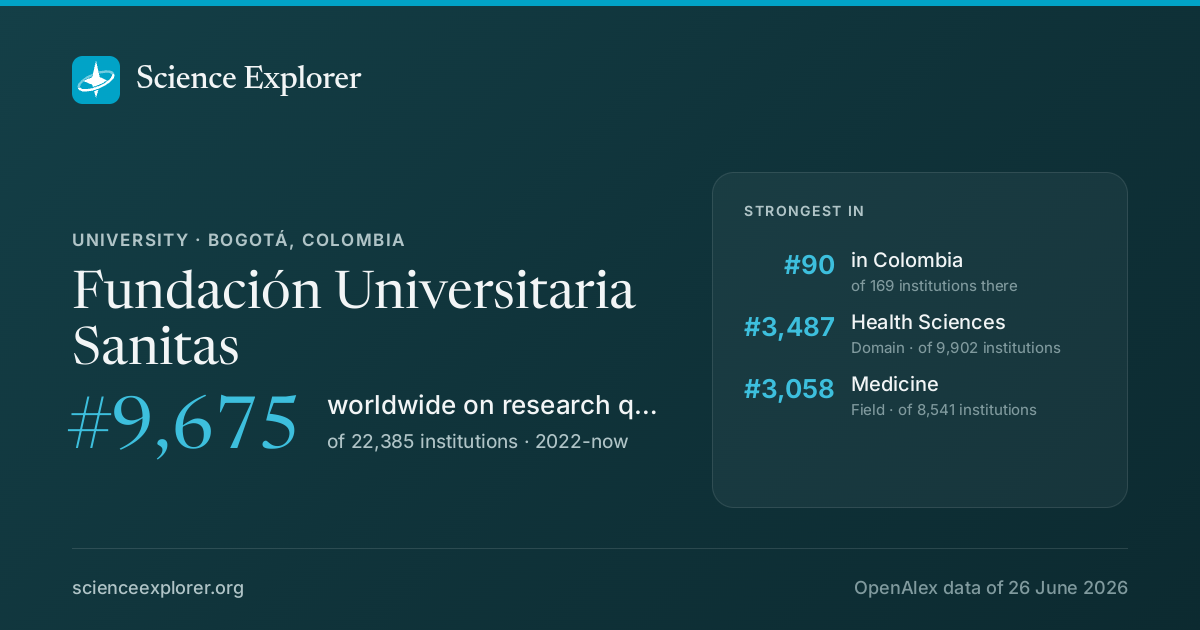
In research, Fundación Universitaria Sanitas stands highest in Health Sciences (#3,487 of 9,902 worldwide) and Medicine (#3,058 of 8,541 worldwide), 2022-now.
- World rank, 2022-now
- #9,675 of 22,385 · #12,396 all time
- Rank in Colombia
- #90 of 169
- Research works
- 935 ▲ 23% vs 2018-21
- Citations
- 3.4k 3.6 per fractional work
- Top-10% rate
- 4.6% all institutions 10.0%
- vs its own fields
- 0.90× 1.00× is exactly expected
- Open access
- 71% world 40%
- International
- 20% world 18%
What is Fundación Universitaria Sanitas known for in research?
The fields where it stands highest, 2022-now, ranked among every institution above the floor in each field.
| Field | World rank | Where that sits | Top-10% rate | Works | All time |
|---|---|---|---|---|---|
| Health SciencesDomain | #3,487 of 9,902 | 3.9% | 232 | #5492 | |
| MedicineField | #3,058 of 8,541 | 3.9% | 207 | #4782 |
Each strip is that field's whole ranked pool, with the notch where Fundación Universitaria Sanitas sits in it, in the colour of the band that rank falls in. The track under the rate is the rate itself: it carries no average mark, because the average differs by field (from about 6% in Dentistry to 21% in Economics).
Which fields of science does Fundación Universitaria Sanitas work in?
In 2022-now, 74% of research at Fundación Universitaria Sanitas is in Health Sciences, 11% in Social Sciences. Its largest fields are Medicine (66%), Health Professions (6%), Social Sciences (5%). It does 3.1× the world's share of Health Sciences.
Each ring splits the one inside it: the four domains of science, their fields, their subfields. Size is fractional works in 2022-now. Every slice is a page; the interactive view zooms down to single topics and colours each by how much more of it this institution does than the world.
Its 4 domains and 23 fields, with their numbers
- Health Sciences26773.9%
- Medicine24066.3%
- Health Professions215.8%
- Dentistry31.0%
- Nursing20.6%
- Veterinary10.2%
- Social Sciences3910.9%
- Life Sciences369.9%
- Physical Sciences195.3%
- Computer Science82.2%
- Environmental Science61.8%
- Engineering41.1%
- Materials Science00.1%
- Mathematics00.1%
- Physics and Astronomy00.1%
- Chemistry00.0%
Field profile
Location quotient across every field it publishes in: outside the ring is more than an institution of this size would be expected to publish, inside it is less.
Rings at 0.5×, 1× and 2×. Widest outward: Medicine, 3.5×. Every wedge is a field page.
All 22 fields, with their numbers
- Medicine3.45×240 works
- Health Professions2.18×21 works
- Dentistry1.98×4 works
- Veterinary1.72×1 works
- Neuroscience1.43×8 works
- Immunology and Microbiology1.42×5 works
- Nursing1.28×2 works
- Psychology1.25×14 works
- Biochemistry, Genetics and Molecular Biology0.94×18 works
- Pharmacology, Toxicology and Pharmaceutics0.49×1 works
- Economics, Econometrics and Finance0.43×3 works
- Social Sciences0.40×18 works
- Environmental Science0.36×6 works
- Computer Science0.28×8 works
- Agricultural and Biological Sciences0.20×3 works
- Business, Management and Accounting0.20×2 works
- Decision Sciences0.15×0 works
- Arts and Humanities0.10×1 works
- Mathematics0.08×0 works
- Engineering0.07×4 works
- Materials Science0.04×0 works
- Physics and Astronomy0.03×0 works
- Medicine 3.5×
- Health Professions 2.2×
- Dentistry 2.0×
- Veterinary 1.7×
- Neuroscience 1.4×
- Immunology and Microbiology 1.4×
- Nursing 1.3×
- Psychology 1.2×
- Biochemistry, Genetics and Molecular Biology 0.9×
- Pharmacology, Toxicology and Pharmaceutics 0.5×
- Economics, Econometrics and Finance 0.4×
- Social Sciences 0.4×
- Environmental Science 0.4×
- Computer Science 0.3×
- Agricultural and Biological Sciences 0.2×
- Business, Management and Accounting 0.2×
- Decision Sciences 0.1×
- Arts and Humanities 0.1×
- Mathematics 0.1×
- Engineering 0.1×
- Materials Science 0.0×
- Physics and Astronomy 0.0×
Who are the top researchers at Fundación Universitaria Sanitas?
Ranked on the quality score, Claudia I. Guevara, Mauricio Herrera and Pedro Ibarra lead among researchers whose main affiliation is Fundación Universitaria Sanitas.
- 1
Claudia I. Guevara
 Colombia · #1,600,179 worldwide
1.2k citations · 35 works
- 2
Mauricio Herrera
Colombia · #1,757,799 worldwide
671 citations · 101 works
- 3
Pedro Ibarra
Colombia · #2,310,027 worldwide
553 citations · 71 works
- 4
Jairo Moreno
Colombia · #2,711,560 worldwide
231 citations · 47 works
- 5
Claudia Carolina Colmenares Mejía
Colombia · #3,632,986 worldwide
215 citations · 39 works
- 6
Álvaro J. Mejía-Vergara
Colombia · #3,640,534 worldwide
261 citations · 20 works
- 7
M. Rebolledo
Colombia · #3,690,579 worldwide
73 citations · 19 works
- 8
José Gabriel Rugeles Ortíz
Colombia · #3,727,028 worldwide
160 citations · 20 works
- 9
Mario Arturo Isaza-Ruget
Colombia · #3,776,426 worldwide
124 citations · 16 works
- 10
Tania Lizveth Orjuela Lara
Colombia · #3,987,507 worldwide
0 citations · 26 works
Which keywords describe research at Fundación Universitaria Sanitas?
By fractional works in 2022-now, weighted toward what it does more of than the world: Epidemiology, Complications, Diagnosis, Quality of Life, Treatment, Guidelines, Health Promotion and Mortality.
- Hearing Loss
- Healthcare Quality
- Postoperative Complications
- Elderly Patients
- Critical Care
- Rehabilitation
- Medical Education
- Pain Management
- Global Health
- Depression
- Survival Analysis
- Clinical Practice Guidelines
- Pandemic
- Mortality
- Health Promotion
- Management
- Guidelines
- Inflammation
- Treatment
- Quality of Life
- Epidemiology
- Diagnosis
- Complications
- Public Health
- Risk Factors
- Chemotherapy
- Mental Health
- COVID-19
- Surgical Management
- Surgery
- Obesity
- Genetic Mutations
- SARS-CoV-2
- Prevention
- Pathophysiology
- Thrombosis
- ACE2 Receptor
- Chronic Pain
- Surgical Treatment
- Health Policy
Size is fractional works in 2022-now in the topics tagged with each word; colour is the word's share of this institution's work against its share of the world's. The 40 words are chosen for being large and distinctive. Each links to the topic it comes from most.
All 40 words, with their numbers
- Epidemiology52▲ 3.6×10⁷ topics
- Quality of Life19▲ 3.7×39 topics
- Diagnosis17▲ 5.0×34 topics
- Treatment17▲ 3.8×43 topics
- Complications15▲ 8.3×16 topics
- Inflammation14▲ 1.88×40 topics
- Public Health14▲ 2.7×29 topics
- Guidelines12▲ 7.2×11 topics
- Risk Factors12▲ 3.0×22 topics
- Management12▲ 4.1×25 topics
- Chemotherapy11▲ 4.5×20 topics
- Health Promotion11▲ 9.8×8 topics
- Mental Health11▲ 2.1×14 topics
- Mortality11▲ 5.2×11 topics
- COVID-1911▲ 2.3×18 topics
- Pandemic9▲ 2.6×8 topics
- Surgical Management9▲ 6.2×20 topics
- Clinical Practice Guidelines8▲ 4.2×13 topics
- Surgery8▲ 6.6×9 topics
- Survival Analysis8▲ 8.3×6 topics
- Obesity8▲ 2.9×16 topics
- Depression8▲ 2.4×17 topics
- Genetic Mutations6▲ 4.0×17 topics
- Global Health6▲ 11×4 topics
- SARS-CoV-26▲ 5.7×6 topics
- Pain Management6▲ 7.2×9 topics
- Prevention6▲ 4.0×12 topics
- Medical Education6▲ 6.1×11 topics
- Pathophysiology6▲ 5.6×9 topics
- Rehabilitation6▲ 4.0×8 topics
- Thrombosis5▲ 5.4×7 topics
- Critical Care5▲ 6.0×7 topics
- ACE2 Receptor5▲ 6.3×3 topics
- Elderly Patients5▲ 8.3×4 topics
- Chronic Pain5▲ 6.1×5 topics
- Postoperative Complications5▲ 10×4 topics
- Surgical Treatment4▲ 6.4×6 topics
- Healthcare Quality4▲ 12×3 topics
- Health Policy4▲ 7.8×3 topics
- Hearing Loss4▲ 9.8×4 topics
Which research topics does Fundación Universitaria Sanitas publish most on?
By volume in 2022-now: Health and Lifestyle Studies, Health and Medical Education, COVID-19 Clinical Research Studies and Sepsis Diagnosis and Treatment.
Area is fractional works; colour is the subfield each topic belongs to.
- 1 Health and Lifestyle Studies General Health Professions 4 works
- 2 Health and Medical Education General Health Professions 4 works
- 3 COVID-19 Clinical Research Studies Infectious Diseases 3 works
- 4 Sepsis Diagnosis and Treatment Epidemiology 3 works
- 5 Spine and Intervertebral Disc Pathology Pathology and Forensic Medicine 3 works
- 6 Cardiac, Anesthesia and Surgical Outcomes Cardiology and Cardiovascular Medicine 3 works
- 7 Long-Term Effects of COVID-19 Neurology 3 works
- 8 Colorectal Cancer Screening and Detection Oncology 2 works
- 9 Esophageal and GI Pathology Surgery 2 works
- 10 Nail Diseases and Treatments Epidemiology 2 works
How open and international is its research?
Against the world's own shares: the tick on each track. Both are shares of its output, so they sit on one scale and can be read against each other as well as against the world.
World: 40% of research is openly available.
World: 18% is written across borders.
How has Fundación Universitaria Sanitas's research output changed?
Output in 2022-2025 was 23% higher than in 2018-2021.
The same series as a ribbon: one cell per year, darker for more. The line above answers how much; this answers when.
Its share of all research
Growing output can still be a shrinking share: all of science grows. This is Fundación Universitaria Sanitas as a percentage of every work published that year, 0.0015% in 2024.
Fractional works of Fundación Universitaria Sanitas over all fractional works that year. How the balance of science has shifted.
How much of it reaches the world top 10%
Year by year, against all institutions in the same year.
Of each year's output, the share that reached the world's 10% most cited for its field and year. Peak 6.9% in 2018.
Other research institutions in Bogotá
- Universidad Nacional de Colombia
- Pontificia Universidad Javeriana
- Universidad de Los Andes
- Universidad Distrital Francisco José de Caldas
- Universidad del Rosario
- Military University Nueva Granada
- Universidad Libre de Colombia
- Universidad Externado de Colombia






Share Fundación Universitaria Sanitas's ranking
Badges for a website1Each links back here and updates with every snapshot

Research measures only: rankings here say nothing about teaching, admissions or student experience. Comparable institutions and collaboration partners have tabs of their own, above.
Discussion
Ask a question or share a note about Fundación Universitaria Sanitas. Keep it to the research: no personal attacks, advertising or links. Any reader can report a post, which collapses it for everyone until it is opened.