Science Explorer Back to mapMap
Discussion
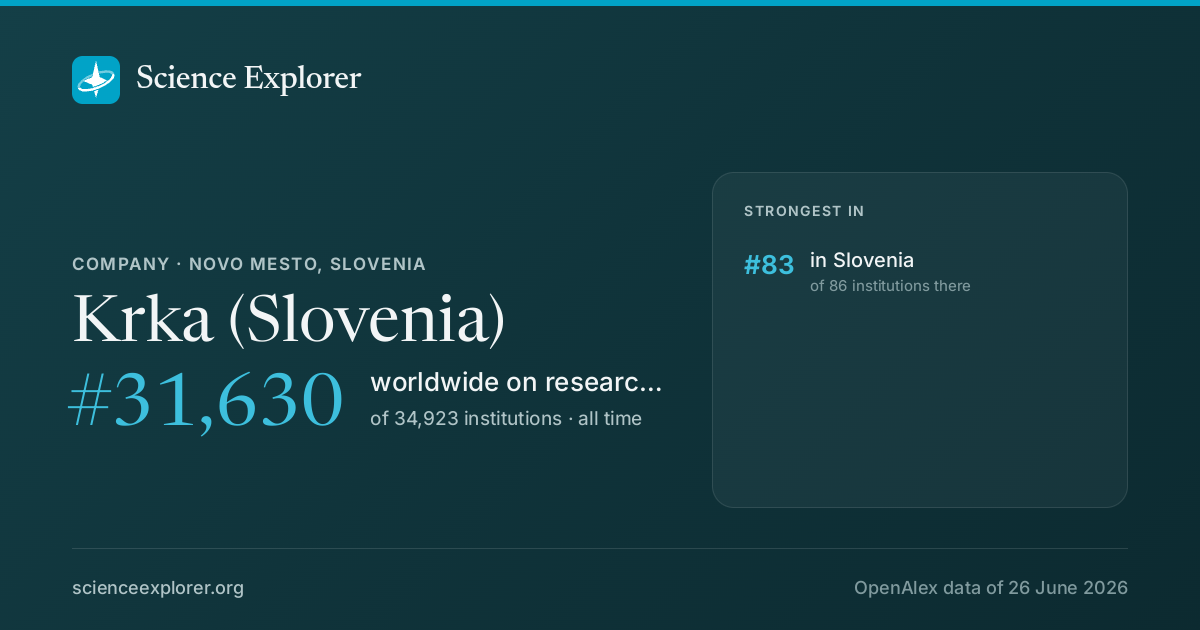
Company · Novo Mesto · Slovenia

Krka (Slovenia)

World rank, all time
#31,630
of 34,923
Rank in Slovenia
#83
of 86
Research works
186
▼ 34% vs 2018-21
Citations
3.9k
21.2 per fractional work
Top-10% rate
14.6%
all institutions 10.0%
vs its own fields
0.83×
1.00× is exactly expected
Open access
44%
world 40%
International
14%
world 18%

Which fields of science does Krka (Slovenia) work in?

In all years, 35% of research at Krka (Slovenia) is in Physical Sciences, 32% in Health Sciences. Its largest fields are Medicine (28%), Chemistry (18%), Biochemistry, Genetics and Molecular Biology (12%). It does 1.9× the world's share of Life Sciences.

Physical Sciences: 66 fractional works · 35.4% of its workChemistry: 34 fractional works · 18.5% of its workOrganic Chemistry: 13 fractional works · 7.2% of its workAnalytical Chemistry: 11 fractional works · 5.9% of its workSpectroscopy: 7 fractional works · 4.0% of its workPhysical and Theoretical Chemistry: 2 fractional works · 1.0% of its workInorganic Chemistry: 1 fractional works · 0.5% of its workEngineering: 16 fractional works · 8.4% of its workBiomedical Engineering: 6 fractional works · 3.0% of its workControl and Systems Engineering: 4 fractional works · 2.1% of its workMechanical Engineering: 3 fractional works · 1.5% of its workComputational Mechanics: 1 fractional works · 0.8% of its workElectrical and Electronic Engineering: 1 fractional works · 0.7% of its workSmaller subfields together: 1 fractional works · 0.3% of its workMaterials Science: 8 fractional works · 4.5% of its workMaterials Chemistry: 7 fractional works · 3.5% of its workBiomaterials: 1 fractional works · 0.4% of its workPolymers and Plastics: 1 fractional works · 0.4% of its workSmaller subfields together: 0 fractional works · 0.2% of its workEnvironmental Science: 4 fractional works · 1.9% of its workPollution: 1 fractional works · 0.7% of its workHealth, Toxicology and Mutagenesis: 1 fractional works · 0.5% of its workWater Science and Technology: 1 fractional works · 0.4% of its workSmaller subfields together: 1 fractional works · 0.3% of its workComputer Science: 2 fractional works · 1.2% of its workArtificial Intelligence: 1 fractional works · 0.7% of its workComputational Theory and Mathematics: 1 fractional works · 0.4% of its workSmaller subfields together: 0 fractional works · 0.0% of its workChemical Engineering: 1 fractional works · 0.5% of its workFluid Flow and Transfer Processes: 1 fractional works · 0.3% of its workBioengineering: 0 fractional works · 0.2% of its workEnergy: 1 fractional works · 0.4% of its workGeneral Energy: 0 fractional works · 0.3% of its workSmaller subfields together: 0 fractional works · 0.1% of its workHealth Sciences: 60 fractional works · 32.3% of its workMedicine: 52 fractional works · 28.3% of its workCardiology and Cardiovascular Medicine: 12 fractional works · 6.7% of its workSurgery: 10 fractional works · 5.2% of its workPharmacology: 4 fractional works · 2.2% of its workEndocrinology, Diabetes and Metabolism: 3 fractional works · 1.8% of its workOncology: 3 fractional works · 1.6% of its workPediatrics, Perinatology and Child Health: 2 fractional works · 1.3% of its workInfectious Diseases: 2 fractional works · 1.0% of its workPulmonary and Respiratory Medicine: 2 fractional works · 1.0% of its workPublic Health, Environmental and Occupational Health: 2 fractional works · 1.0% of its workRheumatology: 2 fractional works · 0.9% of its workRadiology, Nuclear Medicine and Imaging: 1 fractional works · 0.8% of its workEpidemiology: 1 fractional works · 0.8% of its workPhysiology: 1 fractional works · 0.6% of its workEmergency Medicine: 1 fractional works · 0.5% of its workGastroenterology: 1 fractional works · 0.5% of its workOrthopedics and Sports Medicine: 1 fractional works · 0.4% of its workPsychiatry and Mental health: 1 fractional works · 0.3% of its workComplementary and alternative medicine: 0 fractional works · 0.3% of its workFamily Practice: 0 fractional works · 0.3% of its workGeriatrics and Gerontology: 0 fractional works · 0.3% of its workNeurology: 0 fractional works · 0.2% of its workSmaller subfields together: 1 fractional works · 0.5% of its workHealth Professions: 5 fractional works · 2.5% of its workGeneral Health Professions: 4 fractional works · 2.3% of its workSmaller subfields together: 0 fractional works · 0.2% of its workNursing: 2 fractional works · 0.9% of its workNutrition and Dietetics: 2 fractional works · 0.9% of its workVeterinary: 1 fractional works · 0.6% of its workSmall Animals: 1 fractional works · 0.6% of its workLife Sciences: 54 fractional works · 29.3% of its workBiochemistry, Genetics and Molecular Biology: 22 fractional works · 11.8% of its workMolecular Biology: 13 fractional works · 6.8% of its workCancer Research: 2 fractional works · 1.3% of its workBiotechnology: 2 fractional works · 1.2% of its workBiophysics: 1 fractional works · 0.7% of its workGenetics: 1 fractional works · 0.5% of its workCell Biology: 1 fractional works · 0.5% of its workClinical Biochemistry: 1 fractional works · 0.4% of its workMolecular Medicine: 0 fractional works · 0.2% of its workBiochemistry: 0 fractional works · 0.2% of its workSmaller subfields together: 0 fractional works · 0.1% of its workPharmacology, Toxicology and Pharmaceutics: 19 fractional works · 10.0% of its workPharmaceutical Science: 16 fractional works · 8.5% of its workPharmacology: 2 fractional works · 1.3% of its workSmaller subfields together: 0 fractional works · 0.2% of its workAgricultural and Biological Sciences: 9 fractional works · 4.9% of its workFood Science: 3 fractional works · 1.6% of its workPlant Science: 2 fractional works · 0.8% of its workAnimal Science and Zoology: 2 fractional works · 0.8% of its workAquatic Science: 1 fractional works · 0.5% of its workGeneral Agricultural and Biological Sciences: 1 fractional works · 0.4% of its workInsect Science: 1 fractional works · 0.4% of its workAgronomy and Crop Science: 1 fractional works · 0.3% of its workSmaller subfields together: 0 fractional works · 0.1% of its workImmunology and Microbiology: 4 fractional works · 2.3% of its workImmunology: 2 fractional works · 1.3% of its workMicrobiology: 2 fractional works · 0.9% of its workSmaller subfields together: 0 fractional works · 0.1% of its workNeuroscience: 1 fractional works · 0.3% of its workSocial Sciences: 6 fractional works · 3.0% of its workSocial Sciences: 2 fractional works · 1.1% of its workDemography: 1 fractional works · 0.4% of its workPolitical Science and International Relations: 0 fractional works · 0.3% of its workSmaller subfields together: 1 fractional works · 0.4% of its workEconomics, Econometrics and Finance: 2 fractional works · 0.8% of its workEconomics and Econometrics: 2 fractional works · 0.8% of its workArts and Humanities: 1 fractional works · 0.4% of its workPsychology: 1 fractional works · 0.3% of its workDecision Sciences: 0 fractional works · 0.2% of its workBusiness, Management and Accounting: 0 fractional works · 0.2% of its workALL ITS WORKKrka (Slovenia)186fractional works, all years
Life Sciences29%Physical Sciences35%Health Sciences32%Social Sciences3%

Each ring splits the one inside it: the four domains of science, their fields, their subfields. Size is fractional works in all years. Every slice is a page; the interactive view zooms down to single topics and colours each by how much more of it this institution does than the world.

Its 4 domains and 22 fields, with their numbers
    1. Chemistry3418.5%
    2. Engineering168.4%
    3. Materials Science84.5%
    4. Environmental Science41.9%
    5. Computer Science21.2%
    6. Chemical Engineering10.5%
    7. Energy10.4%
    1. Medicine5228.3%
    2. Health Professions52.5%
    3. Nursing20.9%
    4. Veterinary10.6%
    1. Biochemistry, Genetics and Molecular Biology2211.8%
    2. Pharmacology, Toxicology and Pharmaceutics1910.0%
    3. Agricultural and Biological Sciences94.9%
    4. Immunology and Microbiology42.3%
    5. Neuroscience10.3%
    1. Social Sciences21.1%
    2. Economics, Econometrics and Finance20.8%
    3. Arts and Humanities10.4%
    4. Psychology10.3%
    5. Decision Sciences00.2%
    6. Business, Management and Accounting00.2%
All of science, and how each field's share has moved since 1950: the Science domain explorer

Field profile

Location quotient across every field it publishes in: outside the ring is more than an institution of this size would be expected to publish, inside it is less.

Agricultural and Biological Sciences: 0.70× its world share, 0 worksAgricultural and Bio…Biochemistry, Genetics and Molecular Biology: 0.21× its world share, 0 worksBiochemistry, Geneti…Pharmacology, Toxicology and Pharmaceutics: 31.58× its world share, 2 worksPharmacology, Toxico…Chemistry: 14.18× its world share, 3 worksChemistryComputer Science: 1.00× its world share, 1 worksComputer ScienceEngineering: 1.31× its world share, 3 worksEngineeringMaterials Science: 2.98× its world share, 2 worksMaterials ScienceHealth Professions: 2.65× its world share, 1 worksHealth ProfessionsMedicine: 0.44× its world share, 1 worksMedicineNursing: 3.79× its world share, 0 worksNursingBusiness, Management and Accounting: 0.23× its world share, 0 worksBusiness, Management…Decision Sciences: 0.33× its world share, 0 worksDecision SciencesPsychology: 1.22× its world share, 1 worksPsychologySocial Sciences: 0.18× its world share, 0 worksSocial Sciences1×world share
more than its size predictsabout as predictedless

Rings at 0.5×, 1× and 2×. Widest outward: Pharmacology, Toxicology and Pharmaceutics, 31.6×. Every wedge is a field page.

All 14 fields, with their numbers
  1. Pharmacology, Toxicology and Pharmaceutics31.58×2 works
  2. Chemistry14.18×3 works
  3. Nursing3.79×0 works
  4. Materials Science2.98×2 works
  5. Health Professions2.65×1 works
  6. Engineering1.31×3 works
  7. Psychology1.22×1 works
  8. Computer Science1.00×1 works
  9. Agricultural and Biological Sciences0.70×0 works
  10. Medicine0.44×1 works
  11. Decision Sciences0.33×0 works
  12. Business, Management and Accounting0.23×0 works
  13. Biochemistry, Genetics and Molecular Biology0.21×0 works
  14. Social Sciences0.18×0 works

Who are the top researchers at Krka (Slovenia)?

Ranked on the quality score, Franc Vrečer, Sanja Brus and T. Fajdiga lead among researchers whose main affiliation is Krka (Slovenia).

  1. 1 Franc Vrečer Slovenia · #2,265,981 worldwide 3k citations · 81 works
  2. 2 Sanja Brus Slovenia · #4,842,668 worldwide 45 citations · 16 works
  3. 3 T. Fajdiga Slovenia · #4,932,979 worldwide 126 citations · 16 works
  4. 4 Miha Japelj Slovenia · #5,052,801 worldwide 248 citations · 39 works
  5. 5 Mateja Grošelj Slovenia · #5,674,101 worldwide 8 citations · 26 works
  6. 6 Breda Barbič-Žagar Slovenia · #6,513,771 worldwide 59 citations · 47 works
All ranked researchers at Krka (Slovenia)

What are the most cited papers from Krka (Slovenia)?

The most cited paper from Krka (Slovenia) is "Production of fungal xylanases" (Dietmar Haltrich, Bernd Nidetzky, Klaus D. Kulbe et al., 1996), with 394 citations. Next come "Characterization of quercetin binding site on DNA gyrase" (372) and "Optimisation of floating matrix tablets and evaluation of their gastric residence time" (307).

Most cited papers
#PaperReleasedCitations
1 Production of fungal xylanases Dietmar Haltrich, Bernd Nidetzky, Klaus D. Kulbe et al. · Bioresource Technology Nov 1996 394
2 Characterization of quercetin binding site on DNA gyrase Andreja Plaper, Mojca Golob, Iva Hafner et al. · Biochemical and Biophysical Research Communications Jun 2003 372
3 Optimisation of floating matrix tablets and evaluation of their gastric residence time Saša Baumgartner, Julijana Kristl, Franc Vrečer et al. · International Journal of Pharmaceutics Feb 2000 307
4 Electrospun nanofibers for customized drug-delivery systems Saša Kajdič, Odon Planinšek, Mirjana Gašperlin et al. · Journal of Drug Delivery Science and Technology 26 Mar 2019 252
5 Lipid-based systems as a promising approach for enhancing the bioavailability of poorly water-soluble drugs Katja Čerpnjak, Alenka Zvonar, Mirjana Gašperlin et al. · Acta Pharmaceutica Open access Dec 2013 225
All 60 most cited papers, with filters and sorting

Which keywords describe research at Krka (Slovenia)?

By fractional works in all years, weighted toward what it does more of than the world: Polymeric Materials, Cyclodextrins, Solid Dispersions, Cardiovascular Events, Hypertension, Clinical Trials, Method Validation and Cardiovascular Disease.

▲ more of its work than of the world's◆ about the world's share▼ less than the world's

Size is fractional works in all years in the topics tagged with each word; colour is the word's share of this institution's work against its share of the world's. The 40 words are chosen for being large and distinctive. Each links to the topic it comes from most.

All 40 words, with their numbers
  1. Polymeric Materials13▲ 110×2 topics
  2. Cyclodextrins12▲ 286×1 topic
  3. Solid Dispersions12▲ 286×1 topic
  4. Cardiovascular Events11▲ 35×4 topics
  5. Hypertension10▲ 15×7 topics
  6. Cardiovascular Disease9▲ 4.5×11 topics
  7. Clinical Trials9▲ 7.9×5 topics
  8. Inflammation8▲ 1.90×21 topics
  9. Method Validation7▲ 52×2 topics
  10. Statins7▲ 48×2 topics
  11. Green Analytical Chemistry7▲ 41×2 topics
  12. Synthesis7▲ 6.5×11 topics
  13. Cardiovascular Disease Prevention7▲ 48×2 topics
  14. Liquid Chromatography7▲ 25×2 topics
  15. Risk Factors7▲ 3.6×6 topics
  16. Genetic Variants7▲ 17×2 topics
  17. Pharmaceutical Analysis7▲ 118×1 topic
  18. Validation7▲ 37×1 topic
  19. C-Reactive Protein7▲ 42×2 topics
  20. Cholesterol-lowering6▲ 70×1 topic
  21. LDL Cholesterol6▲ 85×1 topic
  22. Chiral Separation6▲ 28×1 topic
  23. Gas Chromatography6▲ 28×1 topic
  24. Clinical Guidelines6▲ 11×2 topics
  25. Blood Pressure6▲ 46×2 topics
  26. Diabetes Mellitus6▲ 14×2 topics
  27. Antihypertensive Drugs6▲ 58×1 topic
  28. Renal Denervation6▲ 58×1 topic
  29. Antioxidant Activity6▲ 5.5×12 topics
  30. Drug Discovery5▲ 6.3×8 topics
  31. Crystal Engineering4▲ 20×3 topics
  32. Crystal Growth4▲ 7.1×3 topics
  33. Crystallization4▲ 36×2 topics
  34. Biological Evaluation4▲ 17×5 topics
  35. Nucleation4▲ 76×1 topic
  36. Solubility4▲ 76×1 topic
  37. Anticancer Agents4▲ 8.2×7 topics
  38. Antimicrobial Resistance4▲ 8.2×5 topics
  39. Medicinal Chemistry4▲ 5.5×7 topics
  40. Bioactive Compounds4▲ 9.9×4 topics

Which research topics does Krka (Slovenia) publish most on?

By volume in 2022-now: Drug Solubulity and Delivery Systems, Analytical Chemistry and Chromatography, Organizational and Employee Performance and Analytical Methods in Pharmaceuticals.

  1. 1 Drug Solubulity and Delivery Systems Pharmaceutical Science 1 works
  2. 2 Analytical Chemistry and Chromatography Spectroscopy 1 works
  3. 3 Organizational and Employee Performance Artificial Intelligence 1 works
  4. 4 Analytical Methods in Pharmaceuticals Analytical Chemistry 1 works
  5. 5 Employment and Welfare Studies General Health Professions 1 works
  6. 6 Crystallization and Solubility Studies Materials Chemistry 1 works
  7. 7 Spectroscopy and Chemometric Analyses Analytical Chemistry 1 works
  8. 8 Vaccine Coverage and Hesitancy Health 0 works
  9. 9 Fault Detection and Control Systems Control and Systems Engineering 0 works
  10. 10 Pesticide Residue Analysis and Safety Food Science 0 works

How open and international is its research?

Against the world's own shares: the tick on each track. Both are shares of its output, so they sit on one scale and can be read against each other as well as against the world.

openly available43.5%not open56.5%

World: 40% of research is openly available.

with international co-authors13.8%domestic only86.2%

World: 18% is written across borders.

How has Krka (Slovenia)'s research output changed?

Output in 2022-2025 was 34% lower than in 2018-2021.

still counting1990200020102020
grewheldshrank

The same series as a ribbon: one cell per year, darker for more. The line above answers how much; this answers when.

Its share of all research

Growing output can still be a shrinking share: all of science grows. This is Krka (Slovenia) as a percentage of every work published that year, 0.000056% in 2024.

still counting0.00050%0.0010%Krka (Slovenia)0.000065% in 202519801990200020102020

Fractional works of Krka (Slovenia) over all fractional works that year. How the balance of science has shifted.

Other research institutions in Novo Mesto

All research institutions in Novo Mesto

Share Krka (Slovenia)'s ranking

Krka (Slovenia) on Science Explorer

A card with Krka (Slovenia)'s standing and the fields it leads in, for a post or a slide. A link to this page previews as the same card.

Download the card

1200 × 630 PNG, sized for social posts, drawn from the latest snapshot.

Badges for a website1Each links back here and updates with every snapshot

Research measures only: rankings here say nothing about teaching, admissions or student experience. Comparable institutions and collaboration partners have tabs of their own, above.

Discussion

Ask a question or share a note about Krka (Slovenia). Keep it to the research: no personal attacks, advertising or links. Any reader can report a post, which collapses it for everyone until it is opened.