Science Explorer Back to mapMap
Discussion
Hospital / health system · Malacca · Malaysia

Malacca General Hospital

In research, Malacca General Hospital stands highest in Medicine (#6,983 of 8,541 worldwide) and Health Sciences (#8,457 of 9,902 worldwide), 2022-now.

World rank, 2022-now
#20,070
of 22,385 · #29,008 all time
Rank in Malaysia
#121
of 124
Research works
266
▲ 23% vs 2018-21
Citations
1.3k
4.8 per fractional work
Top-10% rate
4.7%
all institutions 10.0%
vs its own fields
0.89×
1.00× is exactly expected
Open access
64%
world 40%
International
11%
world 18%

What is Malacca General Hospital known for in research?

The fields where it stands highest, 2022-now, ranked among every institution above the floor in each field.

FieldWorld rankWhere that sitsTop-10% rateWorksAll time
MedicineField #6,983 of 8,541 4.8%60 #11175
Health SciencesDomain #8,457 of 9,902 4.6%64 #13256

Each strip is that field's whole ranked pool, with the notch where Malacca General Hospital sits in it, in the colour of the band that rank falls in. The track under the rate is the rate itself: it carries no average mark, because the average differs by field (from about 6% in Dentistry to 21% in Economics).

Which fields of science does Malacca General Hospital work in?

In 2022-now, 69% of research at Malacca General Hospital is in Health Sciences, 13% in Social Sciences. Its largest fields are Medicine (66%), Biochemistry, Genetics and Molecular Biology (6%), Social Sciences (5%). It does 2.8× the world's share of Health Sciences.

Health Sciences: 66 fractional works · 69.2% of its workMedicine: 63 fractional works · 66.0% of its workSurgery: 13 fractional works · 13.4% of its workEpidemiology: 5 fractional works · 5.7% of its workEndocrinology, Diabetes and Metabolism: 4 fractional works · 3.8% of its workInfectious Diseases: 4 fractional works · 3.7% of its workPulmonary and Respiratory Medicine: 3 fractional works · 3.4% of its workPublic Health, Environmental and Occupational Health: 3 fractional works · 3.0% of its workOncology: 3 fractional works · 2.8% of its workOphthalmology: 3 fractional works · 2.8% of its workPathology and Forensic Medicine: 2 fractional works · 2.5% of its workEmergency Medicine: 2 fractional works · 2.4% of its workRheumatology: 2 fractional works · 2.2% of its workRadiology, Nuclear Medicine and Imaging: 2 fractional works · 1.9% of its workHematology: 2 fractional works · 1.8% of its workDermatology: 2 fractional works · 1.8% of its workPhysiology: 2 fractional works · 1.7% of its workPediatrics, Perinatology and Child Health: 2 fractional works · 1.6% of its workCardiology and Cardiovascular Medicine: 2 fractional works · 1.6% of its workNeurology: 1 fractional works · 1.4% of its workGenetics: 1 fractional works · 1.2% of its workCritical Care and Intensive Care Medicine: 1 fractional works · 1.0% of its workOrthopedics and Sports Medicine: 1 fractional works · 0.9% of its workNephrology: 1 fractional works · 0.9% of its workObstetrics and Gynecology: 1 fractional works · 0.7% of its workOtorhinolaryngology: 1 fractional works · 0.7% of its workPharmacology: 1 fractional works · 0.7% of its workHepatology: 1 fractional works · 0.6% of its workAnesthesiology and Pain Medicine: 0 fractional works · 0.5% of its workFamily Practice: 0 fractional works · 0.3% of its workBiochemistry: 0 fractional works · 0.3% of its workSmaller subfields together: 1 fractional works · 0.8% of its workHealth Professions: 1 fractional works · 1.4% of its workRadiological and Ultrasound Technology: 0 fractional works · 0.5% of its workSpeech and Hearing: 0 fractional works · 0.4% of its workGeneral Health Professions: 0 fractional works · 0.3% of its workSmaller subfields together: 0 fractional works · 0.2% of its workDentistry: 1 fractional works · 0.8% of its workOral Surgery: 0 fractional works · 0.5% of its workPeriodontics: 0 fractional works · 0.3% of its workVeterinary: 1 fractional works · 0.7% of its workSmall Animals: 1 fractional works · 0.7% of its workNursing: 0 fractional works · 0.4% of its workNutrition and Dietetics: 0 fractional works · 0.4% of its workSocial Sciences: 12 fractional works · 13.1% of its workSocial Sciences: 5 fractional works · 5.2% of its workSociology and Political Science: 3 fractional works · 2.7% of its workCommunication: 1 fractional works · 0.6% of its workDemography: 1 fractional works · 0.6% of its workEducation: 1 fractional works · 0.6% of its workHealth: 0 fractional works · 0.4% of its workSmaller subfields together: 0 fractional works · 0.2% of its workBusiness, Management and Accounting: 3 fractional works · 3.4% of its workOrganizational Behavior and Human Resource Management: 1 fractional works · 1.2% of its workManagement of Technology and Innovation: 1 fractional works · 1.0% of its workAccounting: 0 fractional works · 0.4% of its workBusiness and International Management: 0 fractional works · 0.3% of its workStrategy and Management: 0 fractional works · 0.3% of its workSmaller subfields together: 0 fractional works · 0.2% of its workPsychology: 2 fractional works · 2.3% of its workSocial Psychology: 1 fractional works · 1.0% of its workClinical Psychology: 1 fractional works · 0.6% of its workExperimental and Cognitive Psychology: 0 fractional works · 0.5% of its workSmaller subfields together: 0 fractional works · 0.2% of its workDecision Sciences: 1 fractional works · 0.9% of its workInformation Systems and Management: 0 fractional works · 0.5% of its workStatistics, Probability and Uncertainty: 0 fractional works · 0.3% of its workSmaller subfields together: 0 fractional works · 0.1% of its workEconomics, Econometrics and Finance: 1 fractional works · 0.7% of its workEconomics and Econometrics: 1 fractional works · 0.7% of its workArts and Humanities: 1 fractional works · 0.6% of its workArcheology: 0 fractional works · 0.3% of its workSmaller subfields together: 0 fractional works · 0.3% of its workLife Sciences: 12 fractional works · 12.3% of its workBiochemistry, Genetics and Molecular Biology: 6 fractional works · 6.3% of its workMolecular Biology: 2 fractional works · 2.4% of its workEndocrinology: 1 fractional works · 1.4% of its workGenetics: 1 fractional works · 1.2% of its workClinical Biochemistry: 0 fractional works · 0.4% of its workCell Biology: 0 fractional works · 0.4% of its workMolecular Medicine: 0 fractional works · 0.3% of its workSmaller subfields together: 0 fractional works · 0.2% of its workImmunology and Microbiology: 3 fractional works · 2.7% of its workImmunology: 2 fractional works · 1.9% of its workParasitology: 1 fractional works · 0.6% of its workSmaller subfields together: 0 fractional works · 0.3% of its workNeuroscience: 1 fractional works · 1.5% of its workCognitive Neuroscience: 1 fractional works · 0.7% of its workNeurology: 1 fractional works · 0.6% of its workSmaller subfields together: 0 fractional works · 0.1% of its workAgricultural and Biological Sciences: 1 fractional works · 1.3% of its workPlant Science: 0 fractional works · 0.4% of its workGeneral Agricultural and Biological Sciences: 0 fractional works · 0.3% of its workEcology, Evolution, Behavior and Systematics: 0 fractional works · 0.3% of its workSmaller subfields together: 0 fractional works · 0.3% of its workPharmacology, Toxicology and Pharmaceutics: 1 fractional works · 0.5% of its workToxicology: 0 fractional works · 0.5% of its workSmaller subfields together: 0 fractional works · 0.0% of its workPhysical Sciences: 5 fractional works · 5.3% of its workEngineering: 3 fractional works · 2.7% of its workBiomedical Engineering: 1 fractional works · 1.2% of its workControl and Systems Engineering: 0 fractional works · 0.3% of its workElectrical and Electronic Engineering: 0 fractional works · 0.3% of its workIndustrial and Manufacturing Engineering: 0 fractional works · 0.3% of its workMedia Technology: 0 fractional works · 0.3% of its workSmaller subfields together: 0 fractional works · 0.4% of its workComputer Science: 1 fractional works · 1.2% of its workArtificial Intelligence: 1 fractional works · 0.5% of its workInformation Systems: 0 fractional works · 0.3% of its workSmaller subfields together: 0 fractional works · 0.3% of its workEnvironmental Science: 1 fractional works · 0.9% of its workPollution: 0 fractional works · 0.3% of its workHealth, Toxicology and Mutagenesis: 0 fractional works · 0.3% of its workSmaller subfields together: 0 fractional works · 0.3% of its workEarth and Planetary Sciences: 0 fractional works · 0.3% of its workMathematics: 0 fractional works · 0.2% of its workModeling and Simulation: 0 fractional works · 0.2% of its workALL ITS WORKMalacca GeneralHospital95fractional works, 2022-now
Life Sciences12%Physical Sciences5%Health Sciences69%Social Sciences13%

Each ring splits the one inside it: the four domains of science, their fields, their subfields. Size is fractional works in 2022-now. Every slice is a page; the interactive view zooms down to single topics and colours each by how much more of it this institution does than the world.

Its 4 domains and 21 fields, with their numbers
    1. Medicine6366.0%
    2. Health Professions11.4%
    3. Dentistry10.8%
    4. Veterinary10.7%
    5. Nursing00.4%
    1. Social Sciences55.2%
    2. Business, Management and Accounting33.4%
    3. Psychology22.3%
    4. Decision Sciences10.9%
    5. Economics, Econometrics and Finance10.7%
    6. Arts and Humanities10.6%
    1. Biochemistry, Genetics and Molecular Biology66.3%
    2. Immunology and Microbiology32.7%
    3. Neuroscience11.5%
    4. Agricultural and Biological Sciences11.3%
    5. Pharmacology, Toxicology and Pharmaceutics10.5%
    1. Engineering32.7%
    2. Computer Science11.2%
    3. Environmental Science10.9%
    4. Earth and Planetary Sciences00.3%
    5. Mathematics00.2%
All of science, and how each field's share has moved since 1950: the Science domain explorer

Field profile

Location quotient across every field it publishes in: outside the ring is more than an institution of this size would be expected to publish, inside it is less.

Agricultural and Biological Sciences: 0.28× its world share, 1 worksAgricultural and Bio…Biochemistry, Genetics and Molecular Biology: 1.19× its world share, 6 worksBiochemistry, Geneti…Immunology and Microbiology: 2.66× its world share, 3 worksImmunology and Micro…Neuroscience: 0.91× its world share, 1 worksNeurosciencePharmacology, Toxicology and Pharmaceutics: 1.56× its world share, 0 worksPharmacology, Toxico…Computer Science: 0.15× its world share, 1 worksComputer ScienceEarth and Planetary Sciences: 0.22× its world share, 0 worksEarth and Planetary …Engineering: 0.18× its world share, 3 worksEngineeringEnvironmental Science: 0.19× its world share, 1 worksEnvironmental ScienceMathematics: 0.17× its world share, 0 worksMathematicsDentistry: 1.64× its world share, 1 worksDentistryHealth Professions: 0.52× its world share, 1 worksHealth ProfessionsMedicine: 3.43× its world share, 63 worksMedicineNursing: 0.76× its world share, 0 worksNursingVeterinary: 4.93× its world share, 1 worksVeterinaryArts and Humanities: 0.19× its world share, 0 worksArts and HumanitiesBusiness, Management and Accounting: 1.07× its world share, 3 worksBusiness, Management…Decision Sciences: 0.90× its world share, 1 worksDecision SciencesEconomics, Econometrics and Finance: 0.33× its world share, 1 worksEconomics, Econometr…Psychology: 0.76× its world share, 2 worksPsychologySocial Sciences: 0.41× its world share, 5 worksSocial Sciences1×world share
more than its size predictsabout as predictedless

Rings at 0.5×, 1× and 2×. Widest outward: Veterinary, 4.9×. Every wedge is a field page.

All 21 fields, with their numbers
  1. Veterinary4.93×1 works
  2. Medicine3.43×63 works
  3. Immunology and Microbiology2.66×3 works
  4. Dentistry1.64×1 works
  5. Pharmacology, Toxicology and Pharmaceutics1.56×0 works
  6. Biochemistry, Genetics and Molecular Biology1.19×6 works
  7. Business, Management and Accounting1.07×3 works
  8. Neuroscience0.91×1 works
  9. Decision Sciences0.90×1 works
  10. Nursing0.76×0 works
  11. Psychology0.76×2 works
  12. Health Professions0.52×1 works
  13. Social Sciences0.41×5 works
  14. Economics, Econometrics and Finance0.33×1 works
  15. Agricultural and Biological Sciences0.28×1 works
  16. Earth and Planetary Sciences0.22×0 works
  17. Environmental Science0.19×1 works
  18. Arts and Humanities0.19×0 works
  19. Engineering0.18×3 works
  20. Mathematics0.17×0 works
  21. Computer Science0.15×1 works

Who are the top researchers at Malacca General Hospital?

Ranked on the quality score, Nor Zaila Binti Zaidan, Kok Hwee Chia and Raja Norliza Raja Omar lead among researchers whose main affiliation is Malacca General Hospital.

  1. 1 Nor Zaila Binti Zaidan Malaysia · #1,049,253 worldwide 872 citations · 20 works
  2. 2 Kok Hwee Chia Malaysia · #3,858,448 worldwide 20 citations · 22 works
  3. 3 Raja Norliza Raja Omar Malaysia · #4,979,013 worldwide 49 citations · 15 works
  4. 4 Chin Voon Tong Malaysia · #5,563,799 worldwide 492 citations · 70 works
  5. 5 Thanigasalam Thevi Malaysia · #5,966,181 worldwide 257 citations · 36 works
All ranked researchers at Malacca General Hospital

What are the most cited papers from Malacca General Hospital?

The most cited paper from Malacca General Hospital is "Sedation depth and long-term mortality in mechanically ventilated critically ill adults: a prospective longitudinal multicentre cohort study" (The Sedation Practice in Intensive Care Evaluation (SPICE) Study Group investiga, Yahya Shehabi, Lucy L. K. Chan et al., 2013), with 358 citations. Next come "Sedation Intensity in the First 48 Hours of Mechanical Ventilation and 180-Day Mortality: A Multinational Prospective Longitudinal Cohort Study*" (241) and "Biomaterials for Repair of Orbital Floor Blowout Fractures: A Systematic Review" (121).

Most cited papers
#PaperReleasedCitations
1 Sedation depth and long-term mortality in mechanically ventilated critically ill adults: a prospective longitudinal multicentre cohort study The Sedation Practice in Intensive Care Evaluation (SPICE) Study Group investiga, Yahya Shehabi, Lucy L. K. Chan et al. · Intensive Care Medicine Open access 23 Jan 2013 358
2 Sedation Intensity in the First 48 Hours of Mechanical Ventilation and 180-Day Mortality: A Multinational Prospective Longitudinal Cohort Study* Yahya Shehabi, Rinaldo Bellomo, Suhaini Kadiman et al. · Critical Care Medicine 2 Mar 2018 241
3 Biomaterials for Repair of Orbital Floor Blowout Fractures: A Systematic Review Dharmindra Rajah Gunarajah, Nabil Samman · Journal of Oral and Maxillofacial Surgery Review 18 Feb 2013 121
4 Efficacy of Ivermectin Treatment on Disease Progression Among Adults With Mild to Moderate COVID-19 and Comorbidities Steven Chee Loon Lim et al. · JAMA Internal Medicine Open access228 authors 18 Feb 2022 105
5 Pharmacovigilance: pharmacists’ perspective on spontaneous adverse drug reaction reporting Muhammad Abdul Hadi, Chin Fen Neoh, Rosdi Md Zin et al. · Integrated Pharmacy Research and Practice Open access Mar 2017 96
All 60 most cited papers, with filters and sorting

Which keywords describe research at Malacca General Hospital?

By fractional works in 2022-now, weighted toward what it does more of than the world: Epidemiology, Surgical Management, Diagnosis, Complications, Pathogenesis, Treatment, Antifungal Therapy and Meta-Analysis.

▲ more of its work than of the world's◆ about the world's share▼ less than the world's

Size is fractional works in 2022-now in the topics tagged with each word; colour is the word's share of this institution's work against its share of the world's. The 40 words are chosen for being large and distinctive. Each links to the topic it comes from most.

All 40 words, with their numbers
  1. Epidemiology14▲ 3.7×56 topics
  2. Diagnosis4▲ 4.8×16 topics
  3. Inflammation4▲ 1.95×23 topics
  4. Treatment4▲ 3.3×18 topics
  5. Surgical Management4▲ 9.5×9 topics
  6. Complications3▲ 6.4×9 topics
  7. Pathogenesis3▲ 6.3×11 topics
  8. Meta-Analysis3▲ 4.7×7 topics
  9. Antifungal Therapy2▲ 29×3 topics
  10. COVID-192▲ 2.0×10 topics
  11. Cardiovascular Disease2▲ 2.3×14 topics
  12. Clinical Practice Guidelines2▲ 4.8×7 topics
  13. Management2▲ 3.0×8 topics
  14. Chemotherapy2▲ 3.2×10 topics
  15. Prognostic Factors2▲ 4.9×9 topics
  16. Thyroid Carcinoma2▲ 41×2 topics
  17. Antiretroviral Therapy2▲ 12×4 topics
  18. Genetic Mutations2▲ 4.5×7 topics
  19. Metabolic Syndrome2▲ 2.4×11 topics
  20. Diagnostic Imaging2▲ 15×3 topics
  21. Differentiated Thyroid Cancer2▲ 44×1 topic
  22. Thyroid Nodules2▲ 44×1 topic
  23. Virulence Factors2▲ 12×3 topics
  24. Parathyroid Hormone2▲ 17×3 topics
  25. Antibiotic Resistance2▲ 4.0×6 topics
  26. Biomechanics2▲ 5.3×3 topics
  27. Children2▲ 6.8×5 topics
  28. Critical Care1▲ 6.1×7 topics
  29. Food Safety1▲ 5.0×3 topics
  30. Biofilm Formation1▲ 21×2 topics
  31. HIV Infection1▲ 13×3 topics
  32. Immunocompromised Patients1▲ 24×2 topics
  33. Bone Mineral Density1▲ 16×2 topics
  34. Fungal Pathogens1▲ 9.4×2 topics
  35. Glycemic Control1▲ 7.8×4 topics
  36. Type 1 Diabetes1▲ 15×2 topics
  37. Endoscopic Surgery1▲ 12×3 topics
  38. Immune Dysregulation1▲ 15×2 topics
  39. Insulin Therapy1▲ 9.2×3 topics
  40. Palliative Treatment1▲ 18×2 topics

Which research topics does Malacca General Hospital publish most on?

By volume in 2022-now: Thyroid Cancer Diagnosis and Treatment, Fungal Infections and Studies, Halal products and consumer behavior and Vibrio bacteria research studies.

  1. 1 Thyroid Cancer Diagnosis and Treatment Endocrinology, Diabetes and Metabolism 2 works
  2. 2 Fungal Infections and Studies Epidemiology 1 works
  3. 3 Halal products and consumer behavior Sociology and Political Science 1 works
  4. 4 Vibrio bacteria research studies Endocrinology 1 works
  5. 5 Antifungal resistance and susceptibility Infectious Diseases 1 works
  6. 6 Bone health and osteoporosis research Orthopedics and Sports Medicine 1 works
  7. 7 Infectious Diseases and Tuberculosis Surgery 1 works
  8. 8 Job Satisfaction and Organizational Behavior Organizational Behavior and Human Resource Management 1 works
  9. 9 Retinal and Optic Conditions Ophthalmology 1 works
  10. 10 Diabetes Management and Research Endocrinology, Diabetes and Metabolism 1 works

How open and international is its research?

Against the world's own shares: the tick on each track. Both are shares of its output, so they sit on one scale and can be read against each other as well as against the world.

openly available63.9%not open36.1%

World: 40% of research is openly available.

with international co-authors11.4%domestic only88.6%

World: 18% is written across borders.

How has Malacca General Hospital's research output changed?

Output in 2022-2025 was 23% higher than in 2018-2021.

still counting200020102020
grewheldshrank

The same series as a ribbon: one cell per year, darker for more. The line above answers how much; this answers when.

Its share of all research

Growing output can still be a shrinking share: all of science grows. This is Malacca General Hospital as a percentage of every work published that year, 0.00026% in 2024.

still counting0.00025%0.00050%0.00075%Malacca General Hospital0.00041% in 2025200020102020

Fractional works of Malacca General Hospital over all fractional works that year. How the balance of science has shifted.

How much of it reaches the world top 10%

Year by year, against all institutions in the same year.

still counting5%10%15%all institutions10.0% in 2025Malacca General Hospital2.2% in 20252020

Of each year's output, the share that reached the world's 10% most cited for its field and year. Peak 5.1% in 2023.

Other research institutions in Malacca

All research institutions in Malacca

Share Malacca General Hospital's ranking
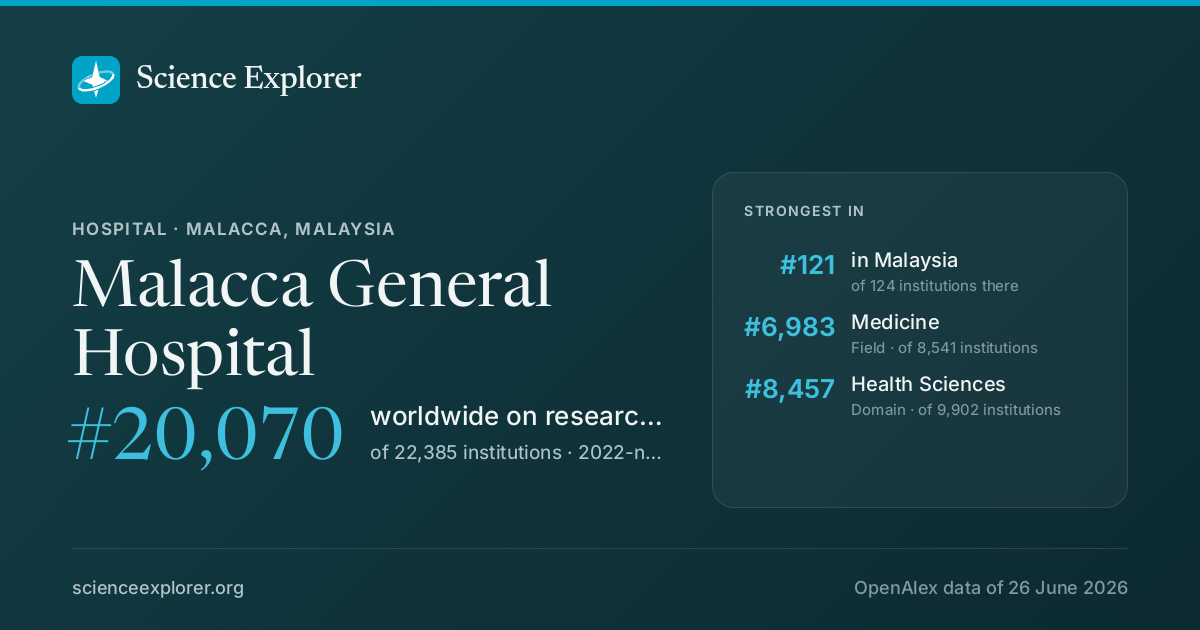
Malacca General Hospital on Science Explorer

A card with Malacca General Hospital's standing and the fields it leads in, for a post or a slide. A link to this page previews as the same card.

Download the card

1200 × 630 PNG, sized for social posts, drawn from the latest snapshot.

Badges for a website1Each links back here and updates with every snapshot

Research measures only: rankings here say nothing about teaching, admissions or student experience. Comparable institutions and collaboration partners have tabs of their own, above.

Discussion

Ask a question or share a note about Malacca General Hospital. Posts are plain text and can be reported.