Soochow University
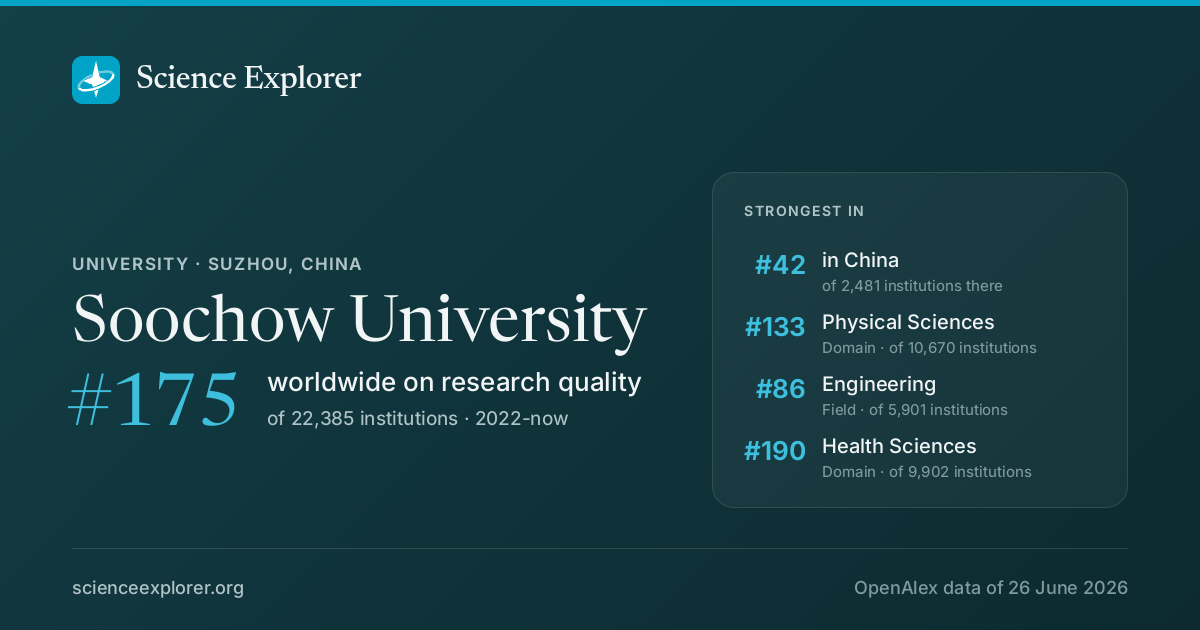
In research, Soochow University stands highest in Physical Sciences (#133 of 10,670 worldwide), Engineering (#86 of 5,901 worldwide) and Health Sciences (#190 of 9,902 worldwide), 2022-now. Relative to its size it is most specialised in Hematology, Cancer Research and Surfaces, Coatings and Films (Hematology is 4.2× its share of world research).
- World rank, 2022-now
- #175 of 22,385 · #254 all time
- Rank in China
- #42 of 2,481
- Research works
- 66k ▲ 44% vs 2018-21
- Citations
- 1.3M 19.1 per fractional work
- Top-10% rate
- 13.0% all institutions 10.0%
- vs its own fields
- 1.13× 1.00× is exactly expected
- Open access
- 34% world 40%
- International
- 13% world 18%
What is Soochow University known for in research?
The fields where it stands highest, 2022-now, ranked among every institution above the floor in each field.
| Field | World rank | Where that sits | Top-10% rate | Works | All time |
|---|---|---|---|---|---|
| Physical SciencesDomain | #133 of 10,670 | 12.6% | 8,890 | #171 | |
| EngineeringField | #86 of 5,901 | 13.7% | 3,783 | #140 | |
| Health SciencesDomain | #190 of 9,902 | 13.9% | 6,403 | #410 | |
| MedicineField | #172 of 8,541 | 13.6% | 6,116 | #359 | |
| Life SciencesDomain | #151 of 6,403 | 12.5% | 3,727 | #300 | |
| Electrical and Electronic EngineeringSubfield | #62 of 2,176 | 13.0% | 1,420 | #95 | |
| Materials ScienceField | #84 of 2,276 | 13.6% | 1,674 | #101 | |
| Materials ChemistrySubfield | #57 of 1,473 | 15.1% | 864 | #81 | |
| Biomedical EngineeringSubfield | #66 of 1,539 | 14.7% | 837 | #91 | |
| Social SciencesDomain | #418 of 9,585 | 16.2% | 1,167 | #517 |
Each strip is that field's whole ranked pool, with the notch where Soochow University sits in it, in the colour of the band that rank falls in. The track under the rate is the rate itself: it carries no average mark, because the average differs by field (from about 6% in Dentistry to 21% in Economics).
Which of those standings moved
The same fields on both windows: where it stood over the whole record, and where it stands in 2022-now. The distance is the story, and it is the one thing the two rank columns above cannot show.
- Physical Sciences#171 #133
- Engineering#140 #86
- Health Sciences#410 #190
- Medicine#359 #172
- Life Sciences#300 #151
- Electrical and Electronic Engineering#95 #62
- Materials Science#101 #84
- Materials Chemistry#81 #57
- Biomedical Engineering#91 #66
- Social Sciences#517 #418
A dot further right is a better standing. Fields it was not ranked in over the whole record are left out.
Which fields of science does Soochow University work in?
In 2022-now, 43% of research at Soochow University is in Physical Sciences, 32% in Health Sciences. Its largest fields are Medicine (31%), Engineering (18%), Biochemistry, Genetics and Molecular Biology (12%). It does 1.4× the world's share of Life Sciences.
Each ring splits the one inside it: the four domains of science, their fields, their subfields. Size is fractional works in 2022-now. Every slice is a page; the interactive view zooms down to single topics and colours each by how much more of it this institution does than the world.
Its 4 domains and 26 fields, with their numbers
- Physical Sciences9,85843.2%
- Engineering4,17718.3%
- Materials Science1,8478.1%
- Computer Science1,5356.7%
- Chemistry6973.1%
- Energy4171.8%
- Environmental Science4131.8%
- Physics and Astronomy4011.8%
- Mathematics1850.8%
- Chemical Engineering1250.5%
- Earth and Planetary Sciences600.3%
- Health Sciences7,41332.5%
- Medicine7,07531.0%
- Health Professions1840.8%
- Nursing1050.5%
- Dentistry380.2%
- Veterinary110.1%
- Life Sciences4,23218.5%
- Social Sciences1,3305.8%
- Social Sciences4572.0%
- Psychology3271.4%
- Business, Management and Accounting2040.9%
- Economics, Econometrics and Finance1390.6%
- Arts and Humanities1130.5%
- Decision Sciences880.4%
What does Soochow University specialise in?
Where its research is concentrated relative to its size: Hematology takes 4.2× the share of its output that it takes of world research.
- HematologySubfield · 288.6 works4.2×
- Cancer ResearchSubfield · 405.5 works4.1×
- Surfaces, Coatings and FilmsSubfield · 88.8 works4.0×
- ImmunologySubfield · 521.3 works3.3×
- Polymers and PlasticsSubfield · 270.4 works2.9×
- Process Chemistry and TechnologySubfield · 27.1 works2.9×
- BiomaterialsSubfield · 275.6 works2.8×
Location quotient, a volume reading rather than an impact one. It surfaces small, lopsided specialities.
Field profile
Location quotient across every field it publishes in: outside the ring is more than an institution of this size would be expected to publish, inside it is less.
Rings at 0.5×, 1× and 2×. Widest outward: Immunology and Microbiology, 2.5×. Every wedge is a field page.
All 26 fields, with their numbers
- Immunology and Microbiology2.54×585 works
- Materials Science2.32×1,847 works
- Biochemistry, Genetics and Molecular Biology2.25×2,739 works
- Energy1.99×417 works
- Chemistry1.95×697 works
- Medicine1.61×7,075 works
- Neuroscience1.59×588 works
- Chemical Engineering1.56×125 works
- Engineering1.22×4,177 works
- Pharmacology, Toxicology and Pharmaceutics1.18×95 works
- Nursing0.94×105 works
- Computer Science0.86×1,535 works
- Physics and Astronomy0.79×401 works
- Mathematics0.69×185 works
- Psychology0.47×327 works
- Decision Sciences0.40×88 works
- Veterinary0.37×11 works
- Environmental Science0.36×413 works
- Dentistry0.35×38 works
- Health Professions0.31×184 works
- Business, Management and Accounting0.28×204 works
- Economics, Econometrics and Finance0.28×139 works
- Agricultural and Biological Sciences0.21×226 works
- Earth and Planetary Sciences0.17×60 works
- Arts and Humanities0.17×113 works
- Social Sciences0.16×457 works
- Immunology and Microbiology 2.5×
- Materials Science 2.3×
- Biochemistry, Genetics and Molecular Biology 2.2×
- Energy 2.0×
- Chemistry 1.9×
- Medicine 1.6×
- Neuroscience 1.6×
- Chemical Engineering 1.6×
- Engineering 1.2×
- Pharmacology, Toxicology and Pharmaceutics 1.2×
- Nursing 0.9×
- Computer Science 0.9×
- Physics and Astronomy 0.8×
- Mathematics 0.7×
- Psychology 0.5×
- Decision Sciences 0.4×
- Veterinary 0.4×
- Environmental Science 0.4×
- Dentistry 0.3×
- Health Professions 0.3×
- Business, Management and Accounting 0.3×
- Economics, Econometrics and Finance 0.3×
- Agricultural and Biological Sciences 0.2×
- Earth and Planetary Sciences 0.2×
- Arts and Humanities 0.2×
- Social Sciences 0.2×
Who are the top researchers at Soochow University?
Ranked on the quality score, Liang Cheng, Zhuang Liu and Yanguang Li lead among researchers whose main affiliation is Soochow University.
- 1
Liang Cheng
 China · #641 worldwide
49k citations · 444 works
- 2
Zhuang Liu
China · #1,025 worldwide
142k citations · 1,151 works
- 3
Yanguang Li
China · #2,440 worldwide
67k citations · 370 works
- 4
Ziliang Dong
China · #3,161 worldwide
20k citations · 150 works
- 5
Liangzhu Feng
China · #3,356 worldwide
28k citations · 202 works
- 6
Chao Liang
China · #4,782 worldwide
29k citations · 287 works
- 7
Chenglin Yan
China · #4,963 worldwide
27k citations · 404 works
- 8
Zhen Wen
China · #5,382 worldwide
21k citations · 315 works
- 9
Xiaoqing Huang
China · #7,251 worldwide
49k citations · 524 works
- 10
Fei Gong
China · #7,608 worldwide
8.6k citations · 85 works
Which keywords describe research at Soochow University?
By fractional works in 2022-now, weighted toward what it does more of than the world: Cancer, Inflammation, Tumor Microenvironment, Oxidative Stress, Biomedical Applications, Immunotherapy, Nanoparticles and Deep Learning.
- Photothermal Therapy
- Fluorescence Imaging
- Bioimaging
- Efficiency
- Tumor Targeting
- Water Splitting
- Metastasis
- Cell Death
- Reactive Oxygen Species
- Metal-Organic Frameworks
- Chemotherapy
- Catalysis
- Biomarkers
- Tissue Engineering
- Gene Expression
- Tumor Microenvironment
- Nanomaterials
- Biomedical Applications
- Deep Learning
- Cancer
- Inflammation
- Epidemiology
- Oxidative Stress
- Nanoparticles
- Neural Networks
- Immunotherapy
- Nanocomposites
- Drug Delivery
- Graphene
- Energy Storage
- Cathode Materials
- Cancer Therapy
- Immunity
- Prognostic Factors
- Photodynamic Therapy
- Innate Immunity
- Biogenesis
- Semiconductors
- Electrocatalysis
- Nanofibers
Size is fractional works in 2022-now in the topics tagged with each word; colour is the word's share of this institution's work against its share of the world's. The 40 words are chosen for being large and distinctive. Each links to the topic it comes from most.
All 40 words, with their numbers
- Inflammation1,294▲ 2.7×83 topics
- Cancer1,171▲ 3.8×57 topics
- Epidemiology955◆ 1.05×125 topics
- Deep Learning936▲ 1.19×84 topics
- Oxidative Stress840▲ 2.2×62 topics
- Biomedical Applications707▲ 2.6×36 topics
- Nanoparticles653▲ 2.3×44 topics
- Nanomaterials562▲ 2.4×20 topics
- Neural Networks548▲ 1.56×38 topics
- Tumor Microenvironment542▲ 5.2×8 topics
- Immunotherapy537▲ 3.3×19 topics
- Gene Expression462▲ 3.2×20 topics
- Nanocomposites456▲ 2.5×21 topics
- Tissue Engineering448▲ 3.2×13 topics
- Drug Delivery438▲ 3.5×16 topics
- Biomarkers413▲ 2.6×18 topics
- Graphene410▲ 2.7×11 topics
- Catalysis401▲ 2.6×28 topics
- Energy Storage382▲ 2.6×12 topics
- Chemotherapy352▲ 2.2×24 topics
- Cathode Materials352▲ 4.0×3 topics
- Metal-Organic Frameworks339▲ 3.6×6 topics
- Cancer Therapy334▲ 2.6×19 topics
- Reactive Oxygen Species334▲ 3.5×14 topics
- Immunity329▲ 3.6×11 topics
- Cell Death325▲ 5.9×6 topics
- Prognostic Factors318▲ 3.2×14 topics
- Metastasis310▲ 4.0×12 topics
- Photodynamic Therapy303▲ 5.8×6 topics
- Water Splitting300▲ 3.5×4 topics
- Innate Immunity284▲ 3.9×11 topics
- Tumor Targeting266▲ 6.3×3 topics
- Biogenesis262▲ 6.7×3 topics
- Efficiency262▲ 3.8×8 topics
- Semiconductors257▲ 3.9×6 topics
- Bioimaging255▲ 4.9×6 topics
- Electrocatalysis254▲ 3.9×5 topics
- Fluorescence Imaging252▲ 7.4×2 topics
- Nanofibers234▲ 5.0×3 topics
- Photothermal Therapy195▲ 6.7×2 topics
Which research topics does Soochow University publish most on?
By volume in 2022-now: Perovskite Materials and Applications, Nanoplatforms for cancer theranostics, Ferroptosis and cancer prognosis and Advanced Sensor and Energy Harvesting Materials.
Area is fractional works; colour is the subfield each topic belongs to.
- 1 Perovskite Materials and Applications Electrical and Electronic Engineering 179 works
- 2 Nanoplatforms for cancer theranostics Biomedical Engineering 172 works
- 3 Ferroptosis and cancer prognosis Pulmonary and Respiratory Medicine 171 works
- 4 Advanced Sensor and Energy Harvesting Materials Biomedical Engineering 164 works
- 5 Advanced Photocatalysis Techniques Renewable Energy, Sustainability and the Environment 145 works
- 6 Advancements in Battery Materials Electrical and Electronic Engineering 138 works
- 7 Cancer-related molecular mechanisms research Cancer Research 131 works
- 8 Conducting polymers and applications Polymers and Plastics 131 works
- 9 Electrocatalysts for Energy Conversion Renewable Energy, Sustainability and the Environment 128 works
- 10 Cancer Immunotherapy and Biomarkers Oncology 127 works
How open and international is its research?
Against the world's own shares: the tick on each track. Both are shares of its output, so they sit on one scale and can be read against each other as well as against the world.
World: 40% of research is openly available.
World: 18% is written across borders.
How has Soochow University's research output changed?
Output in 2022-2025 was 44% higher than in 2018-2021.
The same series as a ribbon: one cell per year, darker for more. The line above answers how much; this answers when.
Its share of all research
Growing output can still be a shrinking share: all of science grows. This is Soochow University as a percentage of every work published that year, 0.094% in 2024.
Fractional works of Soochow University over all fractional works that year. How the balance of science has shifted.
How much of it reaches the world top 10%
Year by year, against all institutions in the same year.
Of each year's output, the share that reached the world's 10% most cited for its field and year. Peak 13.8% in 2024.
Other research institutions in Suzhou
- Suzhou University of Science and Technology
- Xi’an Jiaotong-Liverpool University
- Suzhou Vocational University
- Suzhou Municipal Hospital
- Suzhou Vocational Health College
- Suzhou Vocational Institute of Industrial Technology
- Suzhou Traditional Chinese Medicine Hospital
- Suzhou Polytechnic Institute of Agriculture
Which institutions have research most like Soochow University's?
Among the world's leading institutions, Zhengzhou University has the research profile closest to Soochow University's, with both strong in Materials Science.
- 1
Zhengzhou UniversityChina · Both strong in Materials Science, Biochemistry, Genetics and Molecular Biology, Immunology and Microbiology
0.93 Compare
- 2
Sungkyunkwan University
 South Korea · Both strong in Materials Science, Medicine, Chemical Engineering
0.91 Compare
- 3
Huazhong University of Science and TechnologyChina · Both strong in Immunology and Microbiology, Materials Science, Energy
0.87 Compare
- 4
Qingdao UniversityChina · Both strong in Materials Science, Immunology and Microbiology, Biochemistry, Genetics and Molecular Biology
0.86 Compare
- 5
Agency for Science, Technology and Research
 Singapore · Both strong in Materials Science, Energy, Chemistry
0.86 Compare
Similarity is the correlation of each side's location quotients across every field it publishes in, on a log scale: 1 is the same shape of research, 0 is unrelated. It ignores size. How it is measured.
Compare Soochow University with
- vs Northwestern Polytechnical University
- vs
 Lund University
- vs
 University of Bonn
- vs
 University of Liverpool
- vs Ministry of Education of the People's Republic of China
- vs Johannes Gutenberg University Mainz
Share Soochow University's ranking



Research measures only: rankings here say nothing about teaching, admissions or student experience. Comparable institutions and collaboration partners have tabs of their own, above.
Discussion
Ask a question or share a note about Soochow University. Keep it to the research: no personal attacks, advertising or links. Any reader can report a post, which collapses it for everyone until it is opened.