Science Explorer Back to mapMap
Discussion
Company · Kyoto · Japan

Takara (Japan)

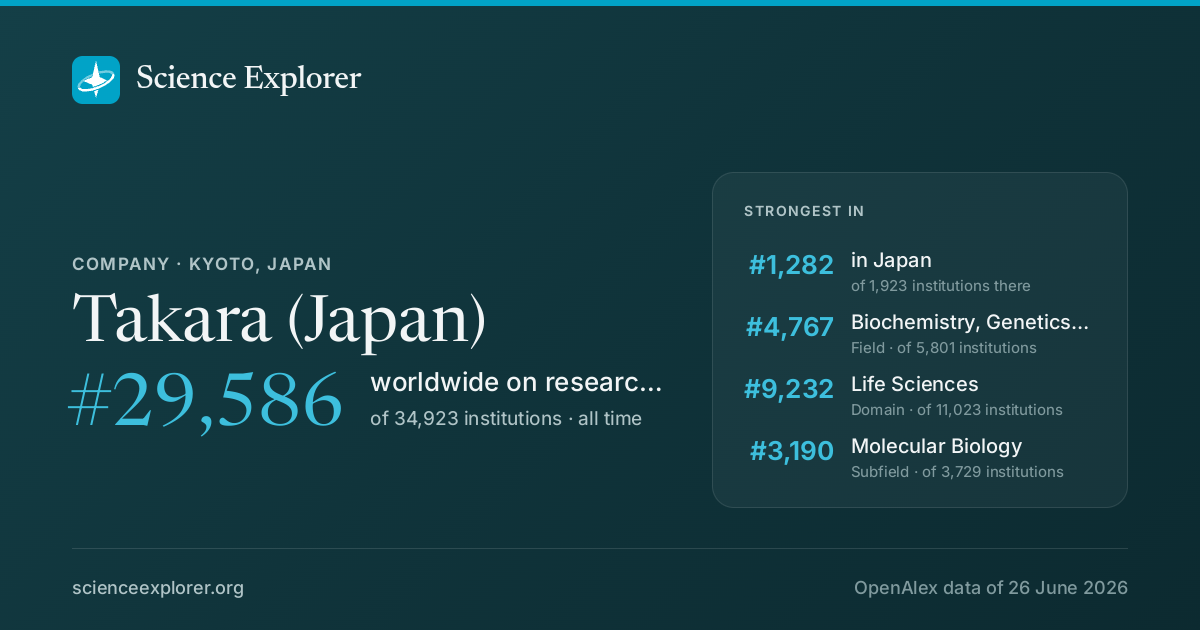
In research, Takara (Japan) stands highest in Biochemistry, Genetics and Molecular Biology (#4,767 of 5,801 worldwide), Life Sciences (#9,232 of 11,023 worldwide) and Molecular Biology (#3,190 of 3,729 worldwide), over all time.

World rank, all time
#29,586
of 34,923
Rank in Japan
#1,282
of 1,923
Research works
1.3k
▼ 9% vs 2018-21
Citations
29k
23.2 per fractional work
Top-10% rate
7.2%
all institutions 10.0%
vs its own fields
0.70×
1.00× is exactly expected
Open access
37%
world 40%
International
16%
world 18%

What is Takara (Japan) known for in research?

The fields where it stands highest, over all time, ranked among every institution above the floor in each field.

FieldWorld rankWhere that sitsTop-10% rateWorks
Biochemistry, Genetics and Molecular BiologyField #4,767 of 5,801 6.9%331
Life SciencesDomain #9,232 of 11,023 6.2%586
Molecular BiologySubfield #3,190 of 3,729 7.0%211
ChemistryField #2,603 of 2,902 7.0%134
Agricultural and Biological SciencesField #4,818 of 5,126 5.0%168
MedicineField #13,712 of 14,558 8.2%254
Health SciencesDomain #15,871 of 16,688 8.3%279
Physical SciencesDomain #17,252 of 17,446 5.9%370

Each strip is that field's whole ranked pool, with the notch where Takara (Japan) sits in it, in the colour of the band that rank falls in. The track under the rate is the rate itself: it carries no average mark, because the average differs by field (from about 6% in Dentistry to 21% in Economics).

Which fields of science does Takara (Japan) work in?

In 2022-now, 42% of research at Takara (Japan) is in Health Sciences, 33% in Life Sciences. Its largest fields are Medicine (37%), Biochemistry, Genetics and Molecular Biology (16%), Agricultural and Biological Sciences (10%). It does 2.1× the world's share of Life Sciences.

Health Sciences: 27 fractional works · 42.0% of its workMedicine: 24 fractional works · 37.0% of its workEndocrinology, Diabetes and Metabolism: 3 fractional works · 4.4% of its workOncology: 2 fractional works · 3.5% of its workPhysiology: 2 fractional works · 3.0% of its workEpidemiology: 1 fractional works · 2.0% of its workInfectious Diseases: 1 fractional works · 1.9% of its workRadiology, Nuclear Medicine and Imaging: 1 fractional works · 1.9% of its workSurgery: 1 fractional works · 1.9% of its workPublic Health, Environmental and Occupational Health: 1 fractional works · 1.6% of its workPathology and Forensic Medicine: 1 fractional works · 1.6% of its workPharmacology: 1 fractional works · 1.6% of its workNephrology: 1 fractional works · 1.5% of its workCardiology and Cardiovascular Medicine: 1 fractional works · 1.4% of its workComplementary and alternative medicine: 1 fractional works · 1.4% of its workPulmonary and Respiratory Medicine: 1 fractional works · 1.2% of its workGastroenterology: 1 fractional works · 1.1% of its workRehabilitation: 1 fractional works · 1.0% of its workOrthopedics and Sports Medicine: 1 fractional works · 1.0% of its workHematology: 0 fractional works · 0.7% of its workUrology: 0 fractional works · 0.6% of its workNeurology: 0 fractional works · 0.6% of its workDermatology: 0 fractional works · 0.5% of its workGenetics: 0 fractional works · 0.4% of its workPediatrics, Perinatology and Child Health: 0 fractional works · 0.3% of its workHepatology: 0 fractional works · 0.3% of its workAnesthesiology and Pain Medicine: 0 fractional works · 0.3% of its workPsychiatry and Mental health: 0 fractional works · 0.3% of its workOphthalmology: 0 fractional works · 0.2% of its workRheumatology: 0 fractional works · 0.2% of its workSmaller subfields together: 0 fractional works · 0.5% of its workNursing: 2 fractional works · 2.6% of its workNutrition and Dietetics: 2 fractional works · 2.6% of its workHealth Professions: 1 fractional works · 1.8% of its workSpeech and Hearing: 0 fractional works · 0.5% of its workGeneral Health Professions: 0 fractional works · 0.4% of its workPhysical Therapy, Sports Therapy and Rehabilitation: 0 fractional works · 0.4% of its workSmaller subfields together: 0 fractional works · 0.4% of its workDentistry: 0 fractional works · 0.5% of its workOral Surgery: 0 fractional works · 0.4% of its workSmaller subfields together: 0 fractional works · 0.1% of its workVeterinary: 0 fractional works · 0.1% of its workLife Sciences: 21 fractional works · 32.9% of its workBiochemistry, Genetics and Molecular Biology: 10 fractional works · 15.6% of its workMolecular Biology: 6 fractional works · 8.9% of its workGenetics: 1 fractional works · 2.3% of its workClinical Biochemistry: 1 fractional works · 1.9% of its workCell Biology: 1 fractional works · 1.0% of its workBiotechnology: 0 fractional works · 0.5% of its workCancer Research: 0 fractional works · 0.5% of its workBiochemistry: 0 fractional works · 0.3% of its workSmaller subfields together: 0 fractional works · 0.3% of its workAgricultural and Biological Sciences: 6 fractional works · 9.7% of its workPlant Science: 3 fractional works · 3.9% of its workFood Science: 2 fractional works · 2.7% of its workEcology, Evolution, Behavior and Systematics: 1 fractional works · 1.2% of its workInsect Science: 1 fractional works · 1.0% of its workAquatic Science: 0 fractional works · 0.5% of its workAnimal Science and Zoology: 0 fractional works · 0.2% of its workSmaller subfields together: 0 fractional works · 0.1% of its workImmunology and Microbiology: 2 fractional works · 3.6% of its workImmunology: 2 fractional works · 3.4% of its workSmaller subfields together: 0 fractional works · 0.3% of its workNeuroscience: 2 fractional works · 2.3% of its workNeurology: 0 fractional works · 0.6% of its workCellular and Molecular Neuroscience: 0 fractional works · 0.6% of its workBehavioral Neuroscience: 0 fractional works · 0.3% of its workBiological Psychiatry: 0 fractional works · 0.3% of its workCognitive Neuroscience: 0 fractional works · 0.2% of its workSmaller subfields together: 0 fractional works · 0.4% of its workPharmacology, Toxicology and Pharmaceutics: 1 fractional works · 1.6% of its workPharmacology: 1 fractional works · 1.1% of its workPharmaceutical Science: 0 fractional works · 0.5% of its workPhysical Sciences: 13 fractional works · 20.7% of its workEngineering: 5 fractional works · 7.6% of its workBiomedical Engineering: 2 fractional works · 2.9% of its workMechanical Engineering: 1 fractional works · 1.0% of its workCivil and Structural Engineering: 1 fractional works · 0.9% of its workAerospace Engineering: 0 fractional works · 0.6% of its workOcean Engineering: 0 fractional works · 0.5% of its workElectrical and Electronic Engineering: 0 fractional works · 0.4% of its workControl and Systems Engineering: 0 fractional works · 0.3% of its workBuilding and Construction: 0 fractional works · 0.3% of its workComputational Mechanics: 0 fractional works · 0.3% of its workSmaller subfields together: 0 fractional works · 0.4% of its workEnvironmental Science: 3 fractional works · 4.6% of its workEcology: 1 fractional works · 2.1% of its workPollution: 1 fractional works · 0.9% of its workHealth, Toxicology and Mutagenesis: 1 fractional works · 0.9% of its workManagement, Monitoring, Policy and Law: 0 fractional works · 0.3% of its workEcological Modeling: 0 fractional works · 0.2% of its workSmaller subfields together: 0 fractional works · 0.2% of its workChemistry: 2 fractional works · 3.4% of its workOrganic Chemistry: 2 fractional works · 2.4% of its workAnalytical Chemistry: 0 fractional works · 0.5% of its workInorganic Chemistry: 0 fractional works · 0.5% of its workMathematics: 1 fractional works · 2.0% of its workGeometry and Topology: 1 fractional works · 1.3% of its workApplied Mathematics: 0 fractional works · 0.4% of its workMathematical Physics: 0 fractional works · 0.3% of its workSmaller subfields together: 0 fractional works · 0.0% of its workMaterials Science: 1 fractional works · 1.6% of its workCeramics and Composites: 0 fractional works · 0.8% of its workMaterials Chemistry: 0 fractional works · 0.4% of its workPolymers and Plastics: 0 fractional works · 0.3% of its workSmaller subfields together: 0 fractional works · 0.1% of its workComputer Science: 0 fractional works · 0.7% of its workComputer Vision and Pattern Recognition: 0 fractional works · 0.5% of its workSmaller subfields together: 0 fractional works · 0.2% of its workEarth and Planetary Sciences: 0 fractional works · 0.6% of its workGeochemistry and Petrology: 0 fractional works · 0.6% of its workSmaller subfields together: 0 fractional works · 0.0% of its workPhysics and Astronomy: 0 fractional works · 0.1% of its workSocial Sciences: 3 fractional works · 4.4% of its workSocial Sciences: 2 fractional works · 2.8% of its workCultural Studies: 1 fractional works · 1.5% of its workSociology and Political Science: 0 fractional works · 0.6% of its workEducation: 0 fractional works · 0.3% of its workSmaller subfields together: 0 fractional works · 0.4% of its workPsychology: 1 fractional works · 1.0% of its workExperimental and Cognitive Psychology: 0 fractional works · 0.3% of its workClinical Psychology: 0 fractional works · 0.3% of its workSocial Psychology: 0 fractional works · 0.2% of its workSmaller subfields together: 0 fractional works · 0.2% of its workArts and Humanities: 0 fractional works · 0.3% of its workArcheology: 0 fractional works · 0.3% of its workEconomics, Econometrics and Finance: 0 fractional works · 0.3% of its workEconomics and Econometrics: 0 fractional works · 0.3% of its workALL ITS WORKTakara (Japan)65fractional works, 2022-now
Life Sciences33%Physical Sciences21%Health Sciences42%Social Sciences4%

Each ring splits the one inside it: the four domains of science, their fields, their subfields. Size is fractional works in 2022-now. Every slice is a page; the interactive view zooms down to single topics and colours each by how much more of it this institution does than the world.

Its 4 domains and 22 fields, with their numbers
    1. Medicine2437.0%
    2. Nursing22.6%
    3. Health Professions11.8%
    4. Dentistry00.5%
    5. Veterinary00.1%
    1. Biochemistry, Genetics and Molecular Biology1015.6%
    2. Agricultural and Biological Sciences69.7%
    3. Immunology and Microbiology23.6%
    4. Neuroscience22.3%
    5. Pharmacology, Toxicology and Pharmaceutics11.6%
    1. Engineering57.6%
    2. Environmental Science34.6%
    3. Chemistry23.4%
    4. Mathematics12.0%
    5. Materials Science11.6%
    6. Computer Science00.7%
    7. Earth and Planetary Sciences00.6%
    8. Physics and Astronomy00.1%
    1. Social Sciences22.8%
    2. Psychology11.0%
    3. Arts and Humanities00.3%
    4. Economics, Econometrics and Finance00.3%
All of science, and how each field's share has moved since 1950: the Science domain explorer

Field profile

Location quotient across every field it publishes in: outside the ring is more than an institution of this size would be expected to publish, inside it is less.

Agricultural and Biological Sciences: 2.04× its world share, 6 worksAgricultural and Bio…Biochemistry, Genetics and Molecular Biology: 2.93× its world share, 10 worksBiochemistry, Geneti…Immunology and Microbiology: 3.63× its world share, 2 worksImmunology and Micro…Neuroscience: 1.43× its world share, 2 worksNeurosciencePharmacology, Toxicology and Pharmaceutics: 4.61× its world share, 1 worksPharmacology, Toxico…Chemistry: 2.16× its world share, 2 worksChemistryComputer Science: 0.09× its world share, 0 worksComputer ScienceEarth and Planetary Sciences: 0.40× its world share, 0 worksEarth and Planetary …Engineering: 0.51× its world share, 5 worksEngineeringEnvironmental Science: 0.93× its world share, 3 worksEnvironmental ScienceMaterials Science: 0.45× its world share, 1 worksMaterials ScienceMathematics: 1.73× its world share, 1 worksMathematicsPhysics and Astronomy: 0.05× its world share, 0 worksPhysics and AstronomyDentistry: 1.09× its world share, 0 worksDentistryHealth Professions: 0.68× its world share, 1 worksHealth ProfessionsMedicine: 1.93× its world share, 24 worksMedicineNursing: 5.25× its world share, 2 worksNursingVeterinary: 0.75× its world share, 0 worksVeterinaryArts and Humanities: 0.09× its world share, 0 worksArts and HumanitiesEconomics, Econometrics and Finance: 0.12× its world share, 0 worksEconomics, Econometr…Psychology: 0.34× its world share, 1 worksPsychologySocial Sciences: 0.22× its world share, 2 worksSocial Sciences1×world share
more than its size predictsabout as predictedless

Rings at 0.5×, 1× and 2×. Widest outward: Nursing, 5.2×. Every wedge is a field page.

All 22 fields, with their numbers
  1. Nursing5.25×2 works
  2. Pharmacology, Toxicology and Pharmaceutics4.61×1 works
  3. Immunology and Microbiology3.63×2 works
  4. Biochemistry, Genetics and Molecular Biology2.93×10 works
  5. Chemistry2.16×2 works
  6. Agricultural and Biological Sciences2.04×6 works
  7. Medicine1.93×24 works
  8. Mathematics1.73×1 works
  9. Neuroscience1.43×2 works
  10. Dentistry1.09×0 works
  11. Environmental Science0.93×3 works
  12. Veterinary0.75×0 works
  13. Health Professions0.68×1 works
  14. Engineering0.51×5 works
  15. Materials Science0.45×1 works
  16. Earth and Planetary Sciences0.40×0 works
  17. Psychology0.34×1 works
  18. Social Sciences0.22×2 works
  19. Economics, Econometrics and Finance0.12×0 works
  20. Computer Science0.09×0 works
  21. Arts and Humanities0.09×0 works
  22. Physics and Astronomy0.05×0 works

Who are the top researchers at Takara (Japan)?

Ranked on the quality score, Wolfgang Wernet, Junichi Mineno and Tetsuya Inaoka lead among researchers whose main affiliation is Takara (Japan).

  1. 1 Wolfgang Wernet Japan · #2,108,033 worldwide 1.5k citations · 24 works
  2. 2 Junichi Mineno Japan · #2,781,760 worldwide 2.9k citations · 172 works
  3. 3 Tetsuya Inaoka Japan · #3,296,928 worldwide 1.5k citations · 22 works
  4. 4 Ikunoshin Kato Japan · #4,066,042 worldwide 7.1k citations · 162 works
  5. 5 Ikuei Nukaya Japan · #4,669,581 worldwide 1.1k citations · 55 works
  6. 6 Takashi Uemori Japan · #4,828,110 worldwide 1.3k citations · 31 works
  7. 7 Kazutoh Takesako Japan · #5,320,839 worldwide 3.2k citations · 111 works
  8. 8 YOSHIHISA UMEDA Japan · #5,481,932 worldwide 461 citations · 15 works
  9. 9 KATSUSHIGE IKAI Japan · #5,548,666 worldwide 789 citations · 23 works
  10. 10 Ikunoshin Kato Japan · #5,568,087 worldwide 1.8k citations · 63 works
All ranked researchers at Takara (Japan)

What are the most cited papers from Takara (Japan)?

The most cited paper from Takara (Japan) is "Complete sequencing and characterization of 21,243 full-length human cDNAs" (Toshio Ota et al., 2003), with 934 citations. Next come "Identification of primitive human hematopoietic cells capable of repopulating NOD/SCID mouse bone marrow: Implications for gene therapy" (774) and "Several Common HLA-DR Types Share Largely Overlapping Peptide Binding Repertoires" (670).

Most cited papers
#PaperReleasedCitations
1 Complete sequencing and characterization of 21,243 full-length human cDNAs Toshio Ota et al. · Nature Genetics 157 authors 21 Dec 2003 934
2 Identification of primitive human hematopoietic cells capable of repopulating NOD/SCID mouse bone marrow: Implications for gene therapy André Larochelle, Josef H. Vormoor, Helmut Hanenberg et al. · Nature Medicine Dec 1996 774
3 Several Common HLA-DR Types Share Largely Overlapping Peptide Binding Repertoires Scott Southwood, John Sidney, Akihiro Kondo et al. · The Journal of Immunology Apr 1998 670
4 A novel chimeric antigen receptor containing a JAK–STAT signaling domain mediates superior antitumor effects Yuki Kagoya, Shinya Tanaka, Tingxi Guo et al. · Nature Medicine Open access 5 Feb 2018 628
5 Colocalization of retrovirus and target cells on specific fibronectin fragments increases genetic transduction of mammalian cells Helmut Hanenberg, Xiang Li Xiao, Dagmar Dilloo et al. · Nature Medicine Aug 1996 560
All 61 most cited papers, with filters and sorting

Which keywords describe research at Takara (Japan)?

By fractional works in 2022-now, weighted toward what it does more of than the world: Inflammation, Metabolic Syndrome, Diabetes, Oxidative Stress, Antioxidant, Cancer Immunotherapy, Cardiovascular Disease and Insulin Resistance.

▲ more of its work than of the world's◆ about the world's share▼ less than the world's

Size is fractional works in 2022-now in the topics tagged with each word; colour is the word's share of this institution's work against its share of the world's. The 40 words are chosen for being large and distinctive. Each links to the topic it comes from most.

All 40 words, with their numbers
  1. Inflammation5▲ 3.9×25 topics
  2. Oxidative Stress4▲ 3.6×17 topics
  3. Epidemiology4▲ 1.37×27 topics
  4. Metabolic Syndrome4▲ 6.6×11 topics
  5. Cardiovascular Disease3▲ 4.0×15 topics
  6. Diabetes3▲ 9.1×11 topics
  7. Antioxidant3▲ 6.4×16 topics
  8. Cancer Immunotherapy2▲ 24×2 topics
  9. Insulin Resistance2▲ 7.4×5 topics
  10. Obesity2▲ 4.4×8 topics
  11. Cancer2▲ 2.4×16 topics
  12. Antioxidant Activity2▲ 5.0×9 topics
  13. Clinical Trials2▲ 4.6×8 topics
  14. Immunotherapy2▲ 4.1×5 topics
  15. Lymphoma2▲ 18×2 topics
  16. CAR T Cells2▲ 37×1 topic
  17. Chimeric Antigen Receptor2▲ 37×1 topic
  18. Probiotics2▲ 11×3 topics
  19. Gut Microbiota2▲ 7.0×4 topics
  20. Microbiota2▲ 12×4 topics
  21. Heart Failure2▲ 5.1×10 topics
  22. Hypertension2▲ 8.1×7 topics
  23. Metabolism2▲ 4.5×9 topics
  24. Metabolic Health1▲ 11×2 topics
  25. Vaccine1▲ 5.4×5 topics
  26. Hepatic Steatosis1▲ 14×2 topics
  27. Immunity1▲ 5.0×5 topics
  28. Neurological Disorders1▲ 3.2×4 topics
  29. Advanced Glycation End Products1▲ 100×1 topic
  30. Gene Therapy1▲ 8.4×2 topics
  31. Glucose Metabolism1▲ 17×2 topics
  32. Glycosylation1▲ 16×3 topics
  33. HMGB11▲ 100×1 topic
  34. Immune Function1▲ 21×3 topics
  35. Innate Immunity1▲ 5.3×4 topics
  36. Medicinal Plants1▲ 4.5×6 topics
  37. Microbial Communities1▲ 3.7×2 topics
  38. Weight Loss1▲ 10×2 topics
  39. Genomic Integration1▲ 28×2 topics
  40. Rheological Properties1▲ 8.6×2 topics

Which research topics does Takara (Japan) publish most on?

By volume in 2022-now: CAR-T cell therapy research, Advanced Glycation End Products research, Virus-based gene therapy research and Viral Infectious Diseases and Gene Expression in Insects.

  1. 1 CAR-T cell therapy research Oncology 2 works
  2. 2 Advanced Glycation End Products research Clinical Biochemistry 1 works
  3. 3 Virus-based gene therapy research Genetics 1 works
  4. 4 Viral Infectious Diseases and Gene Expression in Insects Molecular Biology 1 works
  5. 5 Gut microbiota and health Molecular Biology 1 works
  6. 6 Probiotics and Fermented Foods Food Science 1 works
  7. 7 Immunotherapy and Immune Responses Immunology 1 works
  8. 8 Diet, Metabolism, and Disease Endocrinology, Diabetes and Metabolism 1 works
  9. 9 Diet and metabolism studies Physiology 1 works
  10. 10 Gastrointestinal motility and disorders Gastroenterology 1 works

How open and international is its research?

Against the world's own shares: the tick on each track. Both are shares of its output, so they sit on one scale and can be read against each other as well as against the world.

openly available36.8%not open63.2%

World: 40% of research is openly available.

with international co-authors15.8%domestic only84.2%

World: 18% is written across borders.

How has Takara (Japan)'s research output changed?

Output in 2022-2025 was 9% lower than in 2018-2021.

still counting1990200020102020
grewheldshrank

The same series as a ribbon: one cell per year, darker for more. The line above answers how much; this answers when.

Its share of all research

Growing output can still be a shrinking share: all of science grows. This is Takara (Japan) as a percentage of every work published that year, 0.00031% in 2024.

still counting0.0025%0.0050%0.0075%Takara (Japan)0.00011% in 202519801990200020102020

Fractional works of Takara (Japan) over all fractional works that year. How the balance of science has shifted.

How much of it reaches the world top 10%

Year by year, against all institutions in the same year.

5%10%15%all institutions10.0% in 2023Takara (Japan)4.5% in 2023200020102020

Of each year's output, the share that reached the world's 10% most cited for its field and year. Peak 12.9% in 2004.

Other research institutions in Kyoto

All research institutions in Kyoto

Share Takara (Japan)'s ranking

Takara (Japan) on Science Explorer

A card with Takara (Japan)'s standing and the fields it leads in, for a post or a slide. A link to this page previews as the same card.

Download the card

1200 × 630 PNG, sized for social posts, drawn from the latest snapshot.

Badges for a website1Each links back here and updates with every snapshot

Research measures only: rankings here say nothing about teaching, admissions or student experience. Comparable institutions and collaboration partners have tabs of their own, above.

Discussion

Ask a question or share a note about Takara (Japan). Posts are plain text and can be reported.