Science Explorer Back to mapMap
Discussion

W. M. Keck Foundation

In research, W. M. Keck Foundation stands highest in Life Sciences (#1,620 of 11,023 worldwide), Biochemistry, Genetics and Molecular Biology (#1,396 of 5,801 worldwide) and Neuroscience (#581 of 2,157 worldwide), over all time.

World rank, all time
#4,189
of 34,923
Rank in United States
#949
of 7,310
Research works
625
▼ 5% vs 2018-21
Citations
68k
109.3 per fractional work
Top-10% rate
18.9%
all institutions 10.0%
vs its own fields
1.63×
1.00× is exactly expected
Open access
47%
world 40%
International
13%
world 18%

What is W. M. Keck Foundation known for in research?

The fields where it stands highest, over all time, ranked among every institution above the floor in each field.

FieldWorld rankWhere that sitsTop-10% rateWorks
Life SciencesDomain #1,620 of 11,023 26.0%367
Biochemistry, Genetics and Molecular BiologyField #1,396 of 5,801 21.6%124
NeuroscienceField #581 of 2,157 28.6%219
Physical SciencesDomain #4,917 of 17,446 21.3%150

Each strip is that field's whole ranked pool, with the notch where W. M. Keck Foundation sits in it, in the colour of the band that rank falls in. The track under the rate is the rate itself: it carries no average mark, because the average differs by field (from about 6% in Dentistry to 21% in Economics).

Which fields of science does W. M. Keck Foundation work in?

In 2022-now, 48% of research at W. M. Keck Foundation is in Life Sciences, 25% in Health Sciences. Its largest fields are Biochemistry, Genetics and Molecular Biology (31%), Medicine (25%), Neuroscience (13%). It does 2.5× the world's share of Life Sciences.

Life Sciences: 15 fractional works · 48.4% of its workBiochemistry, Genetics and Molecular Biology: 10 fractional works · 31.1% of its workMolecular Biology: 6 fractional works · 20.4% of its workGenetics: 1 fractional works · 4.6% of its workCell Biology: 1 fractional works · 3.1% of its workCancer Research: 0 fractional works · 1.4% of its workBiochemistry: 0 fractional works · 0.7% of its workClinical Biochemistry: 0 fractional works · 0.6% of its workPhysiology: 0 fractional works · 0.4% of its workNeuroscience: 4 fractional works · 12.8% of its workCellular and Molecular Neuroscience: 1 fractional works · 4.5% of its workNeurology: 1 fractional works · 1.7% of its workBiological Psychiatry: 0 fractional works · 1.6% of its workCognitive Neuroscience: 0 fractional works · 1.6% of its workBehavioral Neuroscience: 0 fractional works · 1.2% of its workSensory Systems: 0 fractional works · 1.1% of its workDevelopmental Neuroscience: 0 fractional works · 0.8% of its workEndocrine and Autonomic Systems: 0 fractional works · 0.2% of its workImmunology and Microbiology: 1 fractional works · 3.3% of its workImmunology: 1 fractional works · 2.9% of its workVirology: 0 fractional works · 0.4% of its workSmaller subfields together: 0 fractional works · 0.0% of its workAgricultural and Biological Sciences: 0 fractional works · 0.9% of its workPlant Science: 0 fractional works · 0.9% of its workPharmacology, Toxicology and Pharmaceutics: 0 fractional works · 0.2% of its workToxicology: 0 fractional works · 0.2% of its workHealth Sciences: 8 fractional works · 25.1% of its workMedicine: 8 fractional works · 24.6% of its workPhysiology: 1 fractional works · 4.6% of its workPediatrics, Perinatology and Child Health: 1 fractional works · 2.9% of its workOncology: 1 fractional works · 2.2% of its workSurgery: 0 fractional works · 1.6% of its workCritical Care and Intensive Care Medicine: 0 fractional works · 1.4% of its workEpidemiology: 0 fractional works · 1.1% of its workEmergency Medicine: 0 fractional works · 1.1% of its workObstetrics and Gynecology: 0 fractional works · 1.1% of its workDermatology: 0 fractional works · 0.9% of its workPulmonary and Respiratory Medicine: 0 fractional works · 0.9% of its workPharmacology: 0 fractional works · 0.8% of its workPathology and Forensic Medicine: 0 fractional works · 0.8% of its workEndocrinology, Diabetes and Metabolism: 0 fractional works · 0.8% of its workInfectious Diseases: 0 fractional works · 0.7% of its workNephrology: 0 fractional works · 0.6% of its workPublic Health, Environmental and Occupational Health: 0 fractional works · 0.6% of its workNeurology: 0 fractional works · 0.5% of its workPsychiatry and Mental health: 0 fractional works · 0.5% of its workHepatology: 0 fractional works · 0.4% of its workOphthalmology: 0 fractional works · 0.4% of its workRadiology, Nuclear Medicine and Imaging: 0 fractional works · 0.4% of its workCardiology and Cardiovascular Medicine: 0 fractional works · 0.3% of its workGenetics: 0 fractional works · 0.2% of its workNursing: 0 fractional works · 0.6% of its workNutrition and Dietetics: 0 fractional works · 0.6% of its workPhysical Sciences: 6 fractional works · 19.7% of its workEngineering: 3 fractional works · 8.8% of its workBiomedical Engineering: 1 fractional works · 3.2% of its workAutomotive Engineering: 1 fractional works · 2.3% of its workElectrical and Electronic Engineering: 0 fractional works · 1.1% of its workMechanical Engineering: 0 fractional works · 1.1% of its workIndustrial and Manufacturing Engineering: 0 fractional works · 0.6% of its workMechanics of Materials: 0 fractional works · 0.4% of its workSmaller subfields together: 0 fractional works · 0.2% of its workChemistry: 1 fractional works · 3.6% of its workSpectroscopy: 1 fractional works · 2.1% of its workInorganic Chemistry: 0 fractional works · 0.7% of its workOrganic Chemistry: 0 fractional works · 0.7% of its workSmaller subfields together: 0 fractional works · 0.0% of its workPhysics and Astronomy: 1 fractional works · 3.2% of its workAstronomy and Astrophysics: 1 fractional works · 2.2% of its workAtomic and Molecular Physics, and Optics: 0 fractional works · 0.4% of its workCondensed Matter Physics: 0 fractional works · 0.4% of its workStatistical and Nonlinear Physics: 0 fractional works · 0.3% of its workMaterials Science: 1 fractional works · 2.2% of its workMaterials Chemistry: 0 fractional works · 1.0% of its workBiomaterials: 0 fractional works · 0.6% of its workElectronic, Optical and Magnetic Materials: 0 fractional works · 0.4% of its workMetals and Alloys: 0 fractional works · 0.3% of its workComputer Science: 0 fractional works · 1.0% of its workComputational Theory and Mathematics: 0 fractional works · 0.6% of its workArtificial Intelligence: 0 fractional works · 0.5% of its workEnvironmental Science: 0 fractional works · 0.7% of its workPollution: 0 fractional works · 0.7% of its workMathematics: 0 fractional works · 0.2% of its workSocial Sciences: 2 fractional works · 6.7% of its workSocial Sciences: 1 fractional works · 2.5% of its workUrban Studies: 0 fractional works · 1.1% of its workEducation: 0 fractional works · 0.6% of its workSafety Research: 0 fractional works · 0.6% of its workSociology and Political Science: 0 fractional works · 0.2% of its workArts and Humanities: 1 fractional works · 2.2% of its workLiterature and Literary Theory: 0 fractional works · 1.1% of its workVisual Arts and Performing Arts: 0 fractional works · 1.1% of its workSmaller subfields together: 0 fractional works · 0.0% of its workPsychology: 1 fractional works · 2.1% of its workDevelopmental and Educational Psychology: 0 fractional works · 1.1% of its workClinical Psychology: 0 fractional works · 0.4% of its workSocial Psychology: 0 fractional works · 0.4% of its workExperimental and Cognitive Psychology: 0 fractional works · 0.2% of its workALL ITS WORKW. M. KeckFoundation31fractional works, 2022-now
Life Sciences48%Physical Sciences20%Health Sciences25%Social Sciences7%

Each ring splits the one inside it: the four domains of science, their fields, their subfields. Size is fractional works in 2022-now. Every slice is a page; the interactive view zooms down to single topics and colours each by how much more of it this institution does than the world.

Its 4 domains and 17 fields, with their numbers
    1. Biochemistry, Genetics and Molecular Biology1031.1%
    2. Neuroscience412.8%
    3. Immunology and Microbiology13.3%
    4. Agricultural and Biological Sciences00.9%
    5. Pharmacology, Toxicology and Pharmaceutics00.2%
    1. Medicine824.6%
    2. Nursing00.6%
    1. Engineering38.8%
    2. Chemistry13.6%
    3. Physics and Astronomy13.2%
    4. Materials Science12.2%
    5. Computer Science01.0%
    6. Environmental Science00.7%
    7. Mathematics00.2%
    1. Social Sciences12.5%
    2. Arts and Humanities12.2%
    3. Psychology12.1%
All of science, and how each field's share has moved since 1950: the Science domain explorer

Field profile

Location quotient across every field it publishes in: outside the ring is more than an institution of this size would be expected to publish, inside it is less.

Agricultural and Biological Sciences: 0.19× its world share, 0 worksAgricultural and Bio…Biochemistry, Genetics and Molecular Biology: 5.84× its world share, 10 worksBiochemistry, Geneti…Immunology and Microbiology: 3.30× its world share, 1 worksImmunology and Micro…Neuroscience: 7.91× its world share, 4 worksNeurosciencePharmacology, Toxicology and Pharmaceutics: 0.62× its world share, 0 worksPharmacology, Toxico…Chemistry: 2.29× its world share, 1 worksChemistryComputer Science: 0.13× its world share, 0 worksComputer ScienceEngineering: 0.59× its world share, 3 worksEngineeringEnvironmental Science: 0.15× its world share, 0 worksEnvironmental ScienceMaterials Science: 0.64× its world share, 1 worksMaterials ScienceMathematics: 0.13× its world share, 0 worksMathematicsPhysics and Astronomy: 1.43× its world share, 1 worksPhysics and AstronomyMedicine: 1.28× its world share, 8 worksMedicineNursing: 1.11× its world share, 0 worksNursingArts and Humanities: 0.76× its world share, 1 worksArts and HumanitiesPsychology: 0.69× its world share, 1 worksPsychologySocial Sciences: 0.19× its world share, 1 worksSocial Sciences1×world share
more than its size predictsabout as predictedless

Rings at 0.5×, 1× and 2×. Widest outward: Neuroscience, 7.9×. Every wedge is a field page.

All 17 fields, with their numbers
  1. Neuroscience7.91×4 works
  2. Biochemistry, Genetics and Molecular Biology5.84×10 works
  3. Immunology and Microbiology3.30×1 works
  4. Chemistry2.29×1 works
  5. Physics and Astronomy1.43×1 works
  6. Medicine1.28×8 works
  7. Nursing1.11×0 works
  8. Arts and Humanities0.76×1 works
  9. Psychology0.69×1 works
  10. Materials Science0.64×1 works
  11. Pharmacology, Toxicology and Pharmaceutics0.62×0 works
  12. Engineering0.59×3 works
  13. Agricultural and Biological Sciences0.19×0 works
  14. Social Sciences0.19×1 works
  15. Environmental Science0.15×0 works
  16. Computer Science0.13×0 works
  17. Mathematics0.13×0 works

Who are the top researchers at W. M. Keck Foundation?

Ranked on the quality score, S. G. Lisberger and Ewa J Folta‐Stogniew lead among researchers whose main affiliation is W. M. Keck Foundation.

  1. 1 S. G. Lisberger United States · #68,131 worldwide 7.1k citations · 42 works
  2. 2 Ewa J Folta‐Stogniew United States · #632,835 worldwide 2.4k citations · 43 works
All ranked researchers at W. M. Keck Foundation

What are the most cited papers from W. M. Keck Foundation?

The most cited paper from W. M. Keck Foundation is "Impaired Nociception and Pain Sensation in Mice Lacking the Capsaicin Receptor" (Michael J. Caterina, Andreas Leffler, Annika B. Malmberg et al., 2000), with 3,554 citations. Next come "The Cloned Capsaicin Receptor Integrates Multiple Pain-Producing Stimuli" (3,109) and "RNA-seq: An assessment of technical reproducibility and comparison with gene expression arrays" (2,869).

Most cited papers
#PaperReleasedCitations
1 Impaired Nociception and Pain Sensation in Mice Lacking the Capsaicin Receptor Michael J. Caterina, Andreas Leffler, Annika B. Malmberg et al. · Science 14 Apr 2000 3,554
2 The Cloned Capsaicin Receptor Integrates Multiple Pain-Producing Stimuli Makoto Tominaga, Michael J. Caterina, Annika B. Malmberg et al. · Neuron Open access Sep 1998 3,109
3 RNA-seq: An assessment of technical reproducibility and comparison with gene expression arrays John C. Marioni, Christopher E. Mason, Shrikant Mane et al. · Genome Research Open access 11 Jun 2008 2,869
4 Competitive Hebbian learning through spike-timing-dependent synaptic plasticity Sen Song, Kenneth D. Miller, L. F. Abbott · Nature Neuroscience Sep 2000 2,810
5 Fear memories require protein synthesis in the amygdala for reconsolidation after retrieval Karim Nader, Glenn E. Schafe, Joseph E. Le Doux · Nature 17 Aug 2000 2,749
All 60 most cited papers, with filters and sorting

Which keywords describe research at W. M. Keck Foundation?

By fractional works in 2022-now, weighted toward what it does more of than the world: Oxidative Stress, Neuroinflammation, Neurodegeneration, Cancer Therapy, Additive Manufacturing, Angiogenesis, Cancer and Depression.

▲ more of its work than of the world's◆ about the world's share▼ less than the world's

Size is fractional works in 2022-now in the topics tagged with each word; colour is the word's share of this institution's work against its share of the world's. The 9 words are chosen for being large and distinctive. Each links to the topic it comes from most.

All 9 words, with their numbers
  1. Oxidative Stress3▲ 5.4×16 topics
  2. Inflammation2▲ 2.3×15 topics
  3. Cancer1▲ 3.5×14 topics
  4. Neuroinflammation1▲ 16×5 topics
  5. Cancer Therapy1▲ 6.8×6 topics
  6. Depression1▲ 4.3×4 topics
  7. Neurodegeneration1▲ 12×5 topics
  8. Additive Manufacturing1▲ 11×2 topics
  9. Angiogenesis1▲ 10×4 topics

Which research topics does W. M. Keck Foundation publish most on?

By volume in 2022-now: Additive Manufacturing and 3D Printing Technologies, Tryptophan and brain disorders, Alzheimer's disease research and treatments and Mitochondrial Function and Pathology.

  1. 1 Additive Manufacturing and 3D Printing Technologies Automotive Engineering 1 works
  2. 2 Tryptophan and brain disorders Biological Psychiatry 0 works
  3. 3 Alzheimer's disease research and treatments Physiology 0 works
  4. 4 Mitochondrial Function and Pathology Molecular Biology 0 works
  5. 5 Neurotransmitter Receptor Influence on Behavior Cellular and Molecular Neuroscience 0 works
  6. 6 RNA Research and Splicing Molecular Biology 0 works
  7. 7 Peptidase Inhibition and Analysis Oncology 0 works
  8. 8 Neuroscience and Neuropharmacology Research Cellular and Molecular Neuroscience 0 works
  9. 9 Stress Responses and Cortisol Behavioral Neuroscience 0 works
  10. 10 Extracellular vesicles in disease Molecular Biology 0 works

How open and international is its research?

Against the world's own shares: the tick on each track. Both are shares of its output, so they sit on one scale and can be read against each other as well as against the world.

openly available47.4%not open52.6%

World: 40% of research is openly available.

with international co-authors13.1%domestic only86.9%

World: 18% is written across borders.

How has W. M. Keck Foundation's research output changed?

Output in 2022-2025 was 5% lower than in 2018-2021.

still counting1990200020102020
grewheldshrank

The same series as a ribbon: one cell per year, darker for more. The line above answers how much; this answers when.

Its share of all research

Growing output can still be a shrinking share: all of science grows. This is W. M. Keck Foundation as a percentage of every work published that year, 0.000075% in 2024.

still counting0.0020%0.0040%W. M. Keck Foundation0.00013% in 202519801990200020102020

Fractional works of W. M. Keck Foundation over all fractional works that year. How the balance of science has shifted.

How much of it reaches the world top 10%

Year by year, against all institutions in the same year.

20%40%W. M. Keck Foundation25.2% in 2011all institutions10.0% in 201120002010

Of each year's output, the share that reached the world's 10% most cited for its field and year. Peak 37.3% in 1999.

Other research institutions in Los Angeles

All research institutions in Los Angeles

Share W. M. Keck Foundation's ranking
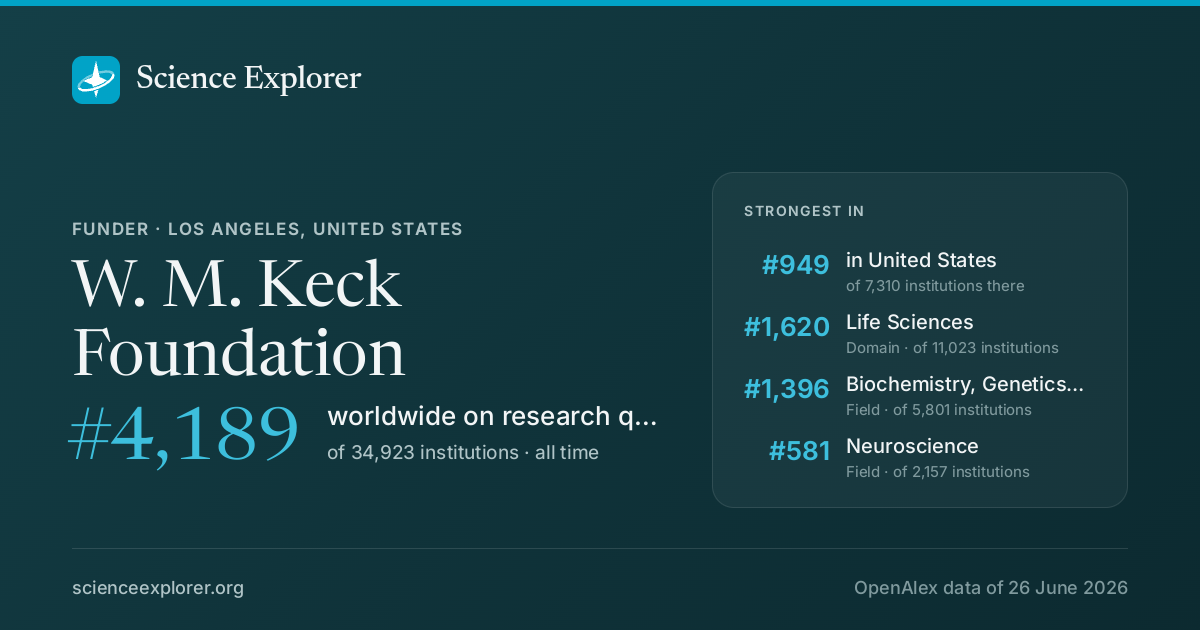
W. M. Keck Foundation on Science Explorer

A card with W. M. Keck Foundation's standing and the fields it leads in, for a post or a slide. A link to this page previews as the same card.

Download the card

1200 × 630 PNG, sized for social posts, drawn from the latest snapshot.

Badges for a website1Each links back here and updates with every snapshot

Research measures only: rankings here say nothing about teaching, admissions or student experience. Comparable institutions and collaboration partners have tabs of their own, above.

Discussion

Ask a question or share a note about W. M. Keck Foundation. Posts are plain text and can be reported.