 Science in Botswana
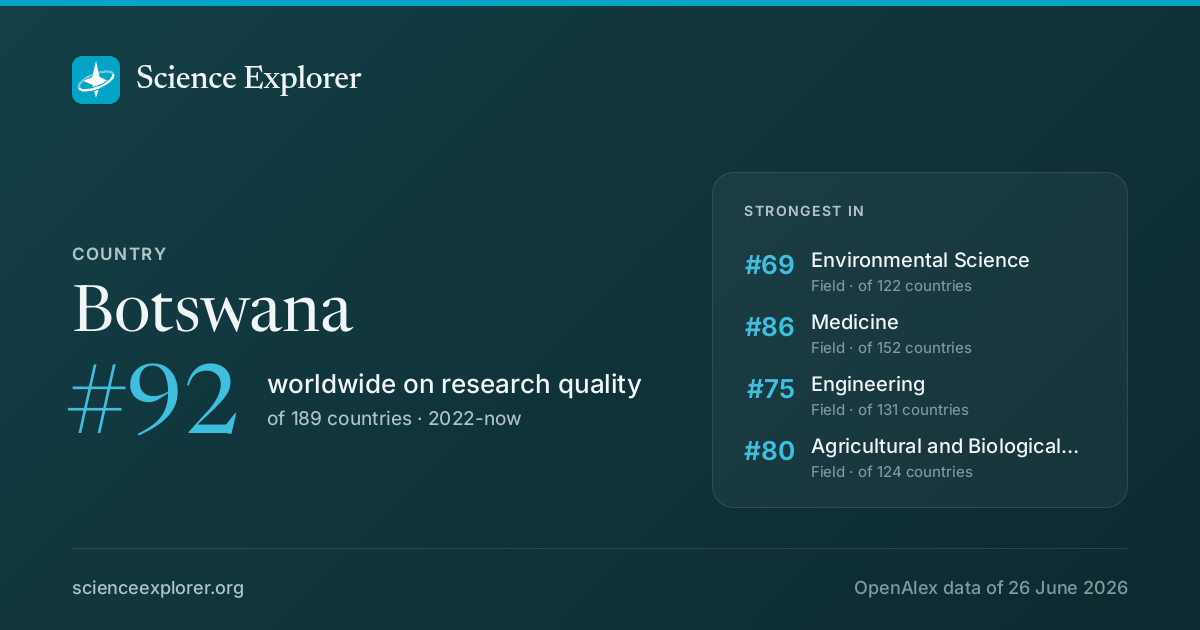
Botswana ranks #92 of 189 countries on research quality in 2022-now (#91 all time), with 3k research works and 8.5% of them in the world's top 10%.
- World rank, 2022-now
- #92 of 189 · #91 all time
- Works, 2022-now
- 3k ▲ 16% vs 2018-21
- Citations
- 158k 12.4 per fractional work, all time
- Top-10% rate
- 8.5% all institutions 10.0%
- vs its own fields
- 0.90× 1.00× is exactly expected
- In the world top 100
- 0 0 in the top 1,000
- Open access
- 47% world 40%
- International
- 33% world 18%
BotswanaWhat is Botswana strongest at in science?
On research quality in 2022-now, Botswana ranks highest in Environmental Science (#69 of 122), Medicine (#86 of 152) and Engineering (#75 of 131). Relative to its size it is most specialised in Archeology, Forestry and Statistics and Probability.
| Field | World rank | Where that sits | Top-10% rate | Works | All time | Institutions |
|---|---|---|---|---|---|---|
| Environmental ScienceField | #69 of 122 | 8.7% | 284 | #73 | Institutions | |
| MedicineField | #86 of 152 | 9.0% | 335 | #82 | Institutions | |
| EngineeringField | #75 of 131 | 10.7% | 360 | #96 | Institutions | |
| Agricultural and Biological SciencesField | #80 of 124 | 10.7% | 308 | #92 | Institutions | |
| Social SciencesField | #114 of 148 | 7.4% | 471 | #90 | Institutions | |
| Computer ScienceField | #101 of 128 | 7.0% | 208 | #96 | Institutions |
Where its research is concentrated
Location quotient: how much more (or less) of each node it does than its size predicts. Drawn around 1×, where "twice the world share" and "half of it" are the same distance apart in opposite directions. A volume reading, which on a country axis is largely population and industrial structure.
- ArcheologySubfield · 5.6 works · #68 of 158 active here11×
- ForestrySubfield · 20.9 works · #88 of 204 active here5.9×
- Statistics and ProbabilitySubfield · 40.4 works · #75 of 198 active here5.5×
- VirologySubfield · 10.9 works · #84 of 204 active here5.5×
- Geochemistry and PetrologySubfield · 14.5 works · #84 of 199 active here4.1×
- Library and Information SciencesSubfield · 2.6 works · #86 of 146 active here4.0×
- Aquatic ScienceSubfield · 21.2 works · #99 of 214 active here3.4×
- Numerical AnalysisSubfield · 9.9 works · #91 of 173 active here3.4×
The whole field profile
All 26 fields at once. A specialist and a generalist produce the same ranked list and a completely different shape.
Rings at 0.5×, 1× and 2×. Widest outward: Agricultural and Biological Sciences, 2.2×. Every wedge is a field page.
All 26 fields, with their numbers
- Agricultural and Biological Sciences2.21×360 works
- Mathematics2.02×82 works
- Decision Sciences2.00×66 works
- Environmental Science1.90×324 works
- Economics, Econometrics and Finance1.74×128 works
- Nursing1.66×28 works
- Earth and Planetary Sciences1.37×74 works
- Social Sciences1.25×544 works
- Immunology and Microbiology1.24×43 works
- Business, Management and Accounting1.20×133 works
- Health Professions1.12×101 works
- Veterinary0.98×5 works
- Energy0.96×30 works
- Computer Science0.88×235 works
- Engineering0.78×403 works
- Psychology0.77×81 works
- Chemistry0.76×41 works
- Biochemistry, Genetics and Molecular Biology0.74×135 works
- Physics and Astronomy0.67×52 works
- Pharmacology, Toxicology and Pharmaceutics0.62×8 works
- Arts and Humanities0.61×61 works
- Chemical Engineering0.60×7 works
- Materials Science0.60×72 works
- Medicine0.60×395 works
- Neuroscience0.38×21 works
- Dentistry0.20×3 works
Which fields of science does Botswana work in?
In 2022-now, 38% of research in Botswana is in Physical Sciences, 30% in Social Sciences. Its largest fields are Social Sciences (16%), Engineering (12%), Medicine (12%). It does 1.3× the world's share of Life Sciences.
Each ring splits the one inside it: the four domains of science, their fields, their subfields. Size is fractional works in 2022-now. Every slice is a page; the interactive view zooms down to single topics and colours each by how much more of it this country does than the world.
Its 4 domains and 26 fields, with their numbers
- Physical Sciences1,31938.5%
- Engineering40311.8%
- Environmental Science3249.5%
- Computer Science2356.8%
- Mathematics822.4%
- Earth and Planetary Sciences742.1%
- Materials Science722.1%
- Physics and Astronomy511.5%
- Chemistry411.2%
- Energy300.9%
- Chemical Engineering70.2%
- Social Sciences1,01229.5%
- Social Sciences54315.8%
- Business, Management and Accounting1333.9%
- Economics, Econometrics and Finance1283.7%
- Psychology812.4%
- Decision Sciences661.9%
- Arts and Humanities611.8%
- Life Sciences56716.5%
- Health Sciences53215.5%
- Medicine39511.5%
- Health Professions1012.9%
- Nursing280.8%
- Veterinary50.1%
- Dentistry30.1%
Which keywords describe research in Botswana?
By fractional works in 2022-now, weighted toward what it does more of than the world: Climate Change, Sustainability, Machine Learning, Colonialism, Antiretroviral Therapy, Environmental Impact, Globalization and Poverty Reduction.
- HIV Transmission
- Child Mortality
- Livelihoods
- Generalized Exponential
- Land Reform
- Nutritional Value
- Health Inequalities
- Community Health Workers
- Land Use Change
- Smallholder Farmers
- Adaptation
- Higher Education
- Risk Management
- Development
- Antiretroviral Therapy
- Economic Growth
- Renewable Energy
- Environmental Impact
- Epidemiology
- Sustainability
- Climate Change
- Machine Learning
- Globalization
- Deep Learning
- Remote Sensing
- Colonialism
- Social Justice
- Biodiversity Conservation
- Sustainable Agriculture
- Genetic Diversity
- Political Economy
- Poverty Reduction
- Maternal Mortality
- Bayesian Inference
- Mortality Rates
- Gender Inequality
- Weibull Distribution
- Skew Distributions
- Phytochemicals
- Health Systems
Size is fractional works in 2022-now in the topics tagged with each word; colour is the word's share of this country's work against its share of the world's. The 40 words are chosen for being large and distinctive. Each links to the topic it comes from most.
All 40 words, with their numbers
- Climate Change192▲ 2.1×87 topics
- Sustainability159▲ 1.89×75 topics
- Machine Learning144▲ 1.26×77 topics
- Epidemiology104▼ 0.76×111 topics
- Globalization95▲ 1.40×72 topics
- Environmental Impact91▲ 1.55×52 topics
- Deep Learning89▼ 0.76×67 topics
- Renewable Energy73▲ 1.46×40 topics
- Remote Sensing70▲ 1.67×31 topics
- Economic Growth66▲ 2.4×27 topics
- Colonialism66▲ 4.0×14 topics
- Antiretroviral Therapy48▲ 8.6×6 topics
- Social Justice47▲ 2.3×26 topics
- Development46▲ 3.8×19 topics
- Biodiversity Conservation46▲ 3.6×13 topics
- Risk Management46▲ 2.8×13 topics
- Sustainable Agriculture44▲ 4.1×12 topics
- Higher Education42▲ 2.3×17 topics
- Genetic Diversity41▲ 2.7×20 topics
- Adaptation40▲ 4.0×11 topics
- Political Economy40▲ 4.5×11 topics
- Smallholder Farmers37▲ 5.1×5 topics
- Poverty Reduction36▲ 8.1×5 topics
- Land Use Change35▲ 3.4×7 topics
- Maternal Mortality31▲ 4.1×5 topics
- Community Health Workers31▲ 10×2 topics
- Bayesian Inference30▲ 8.9×4 topics
- Health Inequalities28▲ 6.8×3 topics
- Mortality Rates28▲ 8.5×2 topics
- Nutritional Value27▲ 7.0×4 topics
- Gender Inequality27▲ 5.7×6 topics
- Land Reform27▲ 17×2 topics
- Weibull Distribution26▲ 17×2 topics
- Generalized Exponential25▲ 44×1 topic
- Skew Distributions25▲ 44×1 topic
- Livelihoods25▲ 21×2 topics
- Phytochemicals25▲ 6.7×7 topics
- Child Mortality25▲ 10×1 topic
- Health Systems25▲ 10×1 topic
- HIV Transmission23▲ 8.7×2 topics
Which research topics does Botswana publish the most in?
Its largest topics in 2022-now are Statistical Distribution Estimation and Applications, Global Maternal and Child Health, Rangeland Management and Livestock Ecology.
Area is fractional works in 2022-now; colour is the subfield each topic belongs to. Every tile is a topic page.
- 1 Statistical Distribution Estimation and Applications Statistics and Probability 25 works
- 2 Global Maternal and Child Health Pediatrics, Perinatology and Child Health 25 works
- 3 Rangeland Management and Livestock Ecology Management, Monitoring, Policy and Law 21 works
- 4 African studies and sociopolitical issues Sociology and Political Science 20 works
- 5 HIV/AIDS Research and Interventions Infectious Diseases 20 works
- 6 Poverty, Education, and Child Welfare Safety Research 17 works
- 7 African history and culture studies Anthropology 16 works
- 8 African Botany and Ecology Studies Forestry 15 works
- 9 Diverse Aspects of Tourism Research Sociology and Political Science 15 works
- 10 Wildlife Ecology and Conservation Ecology 14 works
- 11 Legal Issues in South Africa Law 14 works
- 12 Online and Blended Learning Education 14 works
Which universities in Botswana lead research?
University of Botswana, Botswana International University of Science and Technology and Botswana Geoscience Institute rank highest in Botswana on research quality in 2022-now.
One dot per institution in the list below. The upper left is the interesting corner.
- 1University of BotswanaUniversity · Gaborone · #3,292 worldwide7.6% top 10% · 1.4k works
- 2Botswana International University of Science and TechnologyUniversity · Palapye · #7,534 worldwide8.6% top 10% · 674 works
- 3Botswana Geoscience InstituteInstitution · Lobatse · #10,680 worldwide8.8% top 10% · 116 works
- 4Botho UniversityUniversity · Gaborone · #10,805 worldwide8.5% top 10% · 148 works
- 5Ministry of AgricultureGovernment institution · Gaborone · #11,433 worldwide14.6% top 10% · 169 works
- 6Botswana Open UniversityUniversity · Gaborone · #17,157 worldwide3.9% top 10% · 76 works
- 7Botswana Accountancy CollegeUniversity · Gaborone · #19,659 worldwide9.6% top 10% · 69 works
- 8Botswana University of Agriculture and Natural ResourcesUniversity · Gaborone · #20,020 worldwide11.8% top 10% · 86 works
The track on each row is its top-10% rate; the tick is the average of all institutions, 10.0% (how it is set): teal above it, red below.
All ranked institutions in BotswanaWho are the top researchers in Botswana?
Godfrey Mutashambara Rwegerera, John Weldon McNutt and Joseph M. Makhema rank highest among researchers based in Botswana.
- 1 Godfrey Mutashambara Rwegerera #31,057 worldwide 54k citations · 105 works
- 2 John Weldon McNutt #207,426 worldwide 5.3k citations · 119 works
- 3 Joseph M. Makhema #280,791 worldwide 14k citations · 95 works
- 4 Peter Vuylsteke #396,259 worldwide 7.7k citations · 317 works
- 5 Sununguko Wata Mpoloka #453,404 worldwide 2.7k citations · 62 works
- 6 Kasim Rafiq #493,584 worldwide 704 citations · 47 works
- 7 Rosemary Mubanga Musonda #531,669 worldwide 6.7k citations · 125 works
- 8 Gaerolwe R. Masheto #601,630 worldwide 1.4k citations · 44 works
- 9 Julius Chacha Mwita #609,417 worldwide 9.6k citations · 97 works
- 10 Aida Asmelash #638,342 worldwide 3.4k citations · 32 works
How open and international is Botswana's research?
47% of its research is openly available (world: 40%), and 33% is written with international co-authors (world: 18%).
World: 40% of research is openly available.
World: 18% is written across borders.
In 2022-now, 64% of its research is openly available (world 63%) and 46% is written with co-authors abroad (world 22%). Against what its own mix of topics predicts, that is 1.01× the expected open access and 1.80× the expected international share, which puts it #119 of 173 countries on openness.
How has Botswana's research grown?
Output in 2022-2025 was 16% higher than in 2018-2021.
The same series as a ribbon: one cell per year, darker for more. The line above answers how much; this answers when.
Its share of all research
Growing output can still be a shrinking share: all of science grows. This is Botswana as a percentage of every work published that year, 0.015% in 2024.
Fractional works of Botswana over all fractional works that year. How the balance of science has shifted.
How much of it reaches the world top 10%
Over the whole record, 7.7% of its 13k works since 1950 reached the world top 10% for their field and year.
Of each year's output, the share that reached the world's 10% most cited for its field and year. Peak 14.2% in 1996.
Which countries have research most like Botswana's?
South Africa is Botswana's closest research twin: of all countries, its research is spread across the fields most like Botswana's, with both strong in Economics, Econometrics and Finance.
- 1
 South AfricaBoth strong in Economics, Econometrics and Finance, Decision Sciences, Nursing
0.75 Compare
- 2
 Papua New GuineaBoth strong in Agricultural and Biological Sciences, Environmental Science, Nursing
0.75 Compare
- 3
 NamibiaBoth strong in Environmental Science, Nursing, Agricultural and Biological Sciences
0.75 Compare
- 4
 Sierra LeoneBoth strong in Agricultural and Biological Sciences, Economics, Econometrics and Finance, Nursing
0.74 Compare
- 5
 ZimbabweBoth strong in Agricultural and Biological Sciences, Decision Sciences, Economics, Econometrics and Finance
0.74 Compare
Similarity is the correlation of each side's location quotients across every field it publishes in, on a log scale: 1 is the same shape of research, 0 is unrelated. It ignores size. How it is measured.
Compare Botswana with
 Kazakhstan
 Oman
 Morocco
 Democratic Republic of the Congo
 Cambodia
Share Botswana's ranking
Badges for a website1Each links back here and updates with every snapshot

Research fields in Botswana
Discussion
Ask a question or share a note about Botswana. Posts are plain text and can be reported.