Institut Pasteur
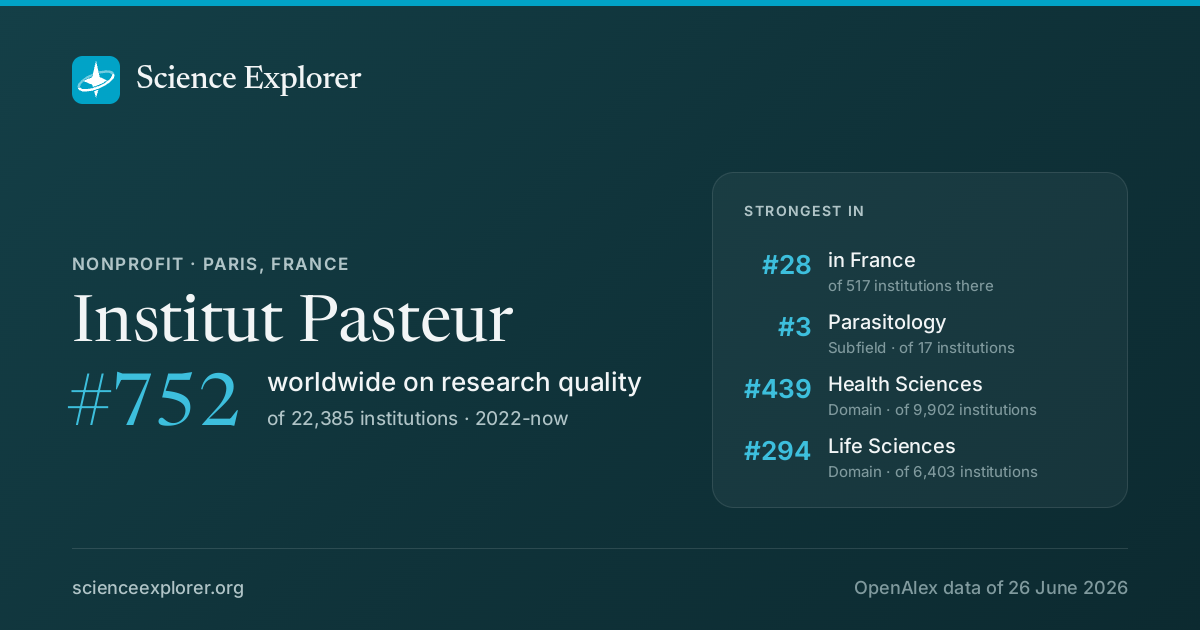
In research, Institut Pasteur stands highest in Health Sciences (#439 of 9,902 worldwide), Life Sciences (#294 of 6,403 worldwide) and Medicine (#469 of 8,541 worldwide), 2022-now. Relative to its size it is most specialised in Endocrinology, Virology and Parasitology (Endocrinology is 19.0× its share of world research).
- World rank, 2022-now
- #752 of 22,385 · #666 all time
- Rank in France
- #28 of 517
- Research works
- 37k ▼ 8% vs 2018-21
- Citations
- 1.5M 39.4 per fractional work
- Top-10% rate
- 10.0% all institutions 10.0%
- vs its own fields
- 1.03× 1.00× is exactly expected
- Open access
- 46% world 40%
- International
- 29% world 18%
What is Institut Pasteur known for in research?
The fields where it stands highest, 2022-now, ranked among every institution above the floor in each field.
| Field | World rank | Where that sits | Top-10% rate | Works | All time |
|---|---|---|---|---|---|
| Health SciencesDomain | #439 of 9,902 | 10.4% | 1,639 | #377 | |
| Life SciencesDomain | #294 of 6,403 | 9.8% | 1,643 | #283 | |
| MedicineField | #469 of 8,541 | 10.4% | 1,516 | #420 | |
| Biochemistry, Genetics and Molecular BiologyField | #326 of 2,964 | 9.4% | 905 | #280 | |
| Agricultural and Biological SciencesField | #513 of 3,157 | 9.4% | 271 | #428 | |
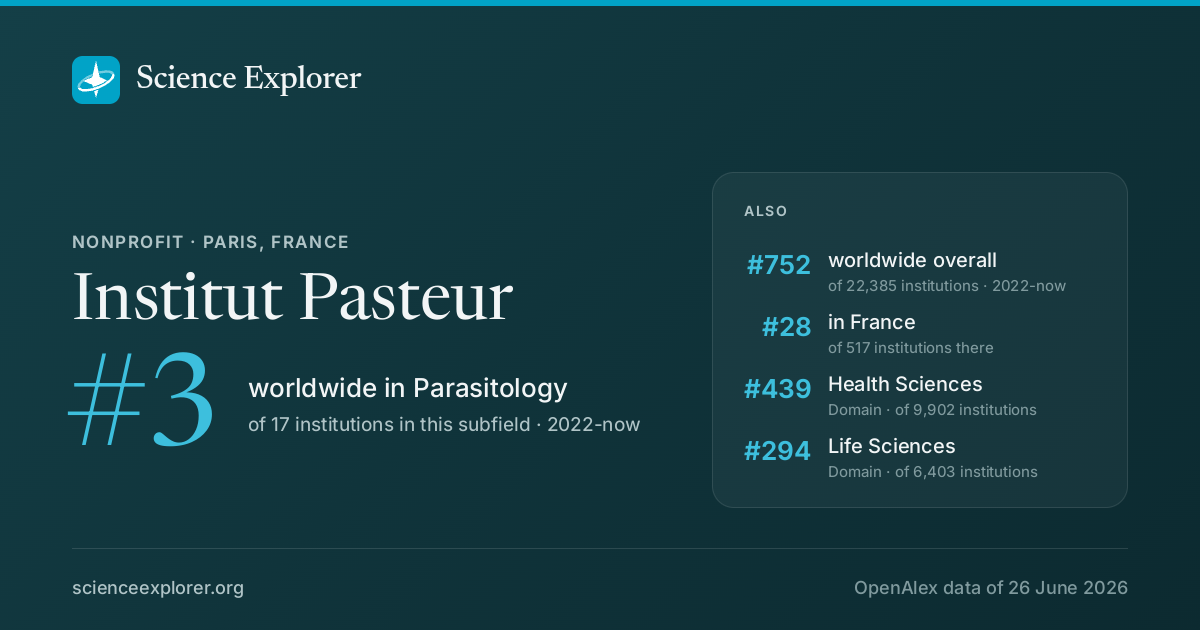
| ParasitologySubfield | #3 of 17 | 15.0% | 75 | #33 | |
| Molecular BiologySubfield | #348 of 1,880 | 8.7% | 508 | #311 | |
| Immunology and MicrobiologyField | #128 of 681 | 10.8% | 340 | #131 | |
| Social SciencesDomain | #2,147 of 9,585 | 10.1% | 291 | #2969 | |
| Public Health, Environmental and Occupational HealthSubfield | #197 of 858 | 9.5% | 230 | #207 |
Each strip is that field's whole ranked pool, with the notch where Institut Pasteur sits in it, in the colour of the band that rank falls in. The track under the rate is the rate itself: it carries no average mark, because the average differs by field (from about 6% in Dentistry to 21% in Economics).
Which of those standings moved
The same fields on both windows: where it stood over the whole record, and where it stands in 2022-now. The distance is the story, and it is the one thing the two rank columns above cannot show.
- Health Sciences#377 #439
- Life Sciences#283 #294
- Medicine#420 #469
- Biochemistry, Genetics and Molecular Biology#280 #326
- Agricultural and Biological Sciences#428 #513
- Parasitology#33 #3
- Molecular Biology#311 #348
- Immunology and Microbiology#131 #128
- Social Sciences#2,969 #2,147
- Public Health, Environmental and Occupational Health#207 #197
A dot further right is a better standing. Fields it was not ranked in over the whole record are left out.
Which fields of science does Institut Pasteur work in?
In 2022-now, 41% of research at Institut Pasteur is in Life Sciences, 40% in Health Sciences. Its largest fields are Medicine (37%), Biochemistry, Genetics and Molecular Biology (22%), Immunology and Microbiology (9%). It does 3.1× the world's share of Life Sciences.
Each ring splits the one inside it: the four domains of science, their fields, their subfields. Size is fractional works in 2022-now. Every slice is a page; the interactive view zooms down to single topics and colours each by how much more of it this institution does than the world.
Its 4 domains and 26 fields, with their numbers
- Life Sciences1,88841.0%
- Health Sciences1,84540.1%
- Medicine1,70837.1%
- Health Professions731.6%
- Nursing370.8%
- Veterinary190.4%
- Dentistry80.2%
- Physical Sciences53211.5%
- Environmental Science1483.2%
- Engineering1032.2%
- Chemistry841.8%
- Computer Science671.5%
- Materials Science641.4%
- Mathematics260.6%
- Earth and Planetary Sciences140.3%
- Physics and Astronomy130.3%
- Energy80.2%
- Chemical Engineering30.1%
- Social Sciences3407.4%
- Social Sciences1834.0%
- Arts and Humanities761.7%
- Psychology350.8%
- Economics, Econometrics and Finance200.4%
- Business, Management and Accounting140.3%
- Decision Sciences130.3%
What does Institut Pasteur specialise in?
Where its research is concentrated relative to its size: Endocrinology takes 19.0× the share of its output that it takes of world research.
- EndocrinologySubfield · 68.7 works19×
- VirologySubfield · 49.8 works19×
- ParasitologySubfield · 85.9 works18×
- MicrobiologySubfield · 63.4 works13×
- Infectious DiseasesSubfield · 346.6 works11×
- Molecular MedicineSubfield · 52.2 works10×
- Immunology and MicrobiologyField · 399.9 works8.6×
- Clinical BiochemistrySubfield · 25.3 works6.6×
Location quotient, a volume reading rather than an impact one. It surfaces small, lopsided specialities.
Field profile
Location quotient across every field it publishes in: outside the ring is more than an institution of this size would be expected to publish, inside it is less.
Rings at 0.5×, 1× and 2×. Widest outward: Immunology and Microbiology, 8.6×. Every wedge is a field page.
All 26 fields, with their numbers
- Immunology and Microbiology8.63×400 works
- Biochemistry, Genetics and Molecular Biology4.22×1,036 works
- Veterinary3.04×19 works
- Pharmacology, Toxicology and Pharmaceutics1.96×32 works
- Medicine1.93×1,708 works
- Nursing1.63×37 works
- Neuroscience1.56×116 works
- Agricultural and Biological Sciences1.39×304 works
- Chemistry1.17×84 works
- Environmental Science0.65×148 works
- Health Professions0.60×73 works
- Arts and Humanities0.57×76 works
- Mathematics0.48×26 works
- Materials Science0.40×64 works
- Dentistry0.36×8 works
- Social Sciences0.31×182 works
- Decision Sciences0.28×13 works
- Psychology0.25×35 works
- Chemical Engineering0.20×3 works
- Energy0.20×8 works
- Economics, Econometrics and Finance0.20×20 works
- Computer Science0.19×67 works
- Earth and Planetary Sciences0.19×14 works
- Engineering0.15×103 works
- Physics and Astronomy0.13×13 works
- Business, Management and Accounting0.09×14 works
- Immunology and Microbiology 8.6×
- Biochemistry, Genetics and Molecular Biology 4.2×
- Veterinary 3.0×
- Pharmacology, Toxicology and Pharmaceutics 2.0×
- Medicine 1.9×
- Nursing 1.6×
- Neuroscience 1.6×
- Agricultural and Biological Sciences 1.4×
- Chemistry 1.2×
- Environmental Science 0.7×
- Health Professions 0.6×
- Arts and Humanities 0.6×
- Mathematics 0.5×
- Materials Science 0.4×
- Dentistry 0.4×
- Social Sciences 0.3×
- Decision Sciences 0.3×
- Psychology 0.2×
- Chemical Engineering 0.2×
- Energy 0.2×
- Economics, Econometrics and Finance 0.2×
- Computer Science 0.2×
- Earth and Planetary Sciences 0.2×
- Engineering 0.1×
- Physics and Astronomy 0.1×
- Business, Management and Accounting 0.1×
Who are the top researchers at Institut Pasteur?
Ranked on the quality score, Eduardo P. C. Rocha, Mart Krupovìč and Lluís Quintana‐Murci lead among researchers whose main affiliation is Institut Pasteur.
- 1
Eduardo P. C. Rocha
 France · #3,896 worldwide
36k citations · 365 works
- 2
Mart Krupovìč
France · #5,126 worldwide
29k citations · 478 works
- 3
Lluís Quintana‐Murci
France · #9,575 worldwide
39k citations · 422 works
- 4
Pascale Cossart
France · #11,615 worldwide
53k citations · 613 works
- 5
Thomas Bourgeron
France · #11,920 worldwide
33k citations · 826 works
- 6
Gérard Eberl
France · #12,242 worldwide
49k citations · 237 works
- 7
Étienne Patin
France · #12,529 worldwide
14k citations · 192 works
- 8
Matthew L. Albert
France · #14,374 worldwide
40k citations · 284 works
- 9
Marc Lecuit
France · #18,262 worldwide
38k citations · 472 works
- 10
Roland Brosch
France · #19,327 worldwide
32k citations · 278 works
Which keywords describe research at Institut Pasteur?
By fractional works in 2022-now, weighted toward what it does more of than the world: Epidemiology, Pathogenesis, Vaccine Development, Vaccine, Immune Response, Immunity, Diagnosis and Antibiotic Resistance.
- Host-Pathogen Interactions
- antibody
- Insecticide Resistance
- Infection
- Mutation
- Evolution
- Zika Virus
- Coronavirus
- Virulence Factors
- ACE2 Receptor
- Genomics
- SARS-CoV-2
- Pandemic
- Drug Resistance
- Cancer
- Immunity
- Public Health
- Diagnosis
- Vaccine
- Pathogenesis
- Epidemiology
- Vaccine Development
- Immune Response
- Inflammation
- Treatment
- Antibiotic Resistance
- Vector Control
- Oxidative Stress
- Genetic Diversity
- Global Burden
- Innate Immunity
- Genome Sequence
- Neurological Manifestations
- Arboviral Diseases
- Viral Transmission
- Infectious Diseases
- Antimicrobial Resistance
- Virus
- Virulence
- spike protein
Size is fractional works in 2022-now in the topics tagged with each word; colour is the word's share of this institution's work against its share of the world's. The 40 words are chosen for being large and distinctive. Each links to the topic it comes from most.
All 40 words, with their numbers
- Epidemiology948▲ 5.2×136 topics
- Pathogenesis285▲ 12×23 topics
- Vaccine Development269▲ 23×11 topics
- Vaccine264▲ 14×11 topics
- Immune Response254▲ 9.7×23 topics
- Diagnosis217▲ 5.0×41 topics
- Inflammation215▲ 2.2×83 topics
- Public Health211▲ 3.1×55 topics
- Treatment192▲ 3.4×52 topics
- Immunity178▲ 9.6×11 topics
- Antibiotic Resistance160▲ 8.8×15 topics
- Cancer157▲ 2.5×59 topics
- Vector Control145▲ 27×4 topics
- Drug Resistance136▲ 10×9 topics
- Oxidative Stress132▲ 1.75×62 topics
- Pandemic131▲ 2.9×11 topics
- Genetic Diversity124▲ 6.2×19 topics
- SARS-CoV-2121▲ 8.7×6 topics
- Global Burden111▲ 4.4×12 topics
- Genomics103▲ 7.6×11 topics
- Innate Immunity98▲ 6.6×11 topics
- ACE2 Receptor97▲ 9.3×3 topics
- Genome Sequence87▲ 23×4 topics
- Virulence Factors86▲ 13×8 topics
- Neurological Manifestations83▲ 24×2 topics
- Coronavirus83▲ 9.1×3 topics
- Arboviral Diseases83▲ 28×1 topic
- Zika Virus83▲ 28×1 topic
- Viral Transmission82▲ 13×4 topics
- Evolution80▲ 6.5×15 topics
- Infectious Diseases79▲ 5.2×9 topics
- Mutation77▲ 9.2×5 topics
- Antimicrobial Resistance72▲ 7.6×10 topics
- Infection72▲ 6.2×10 topics
- Virus67▲ 15×3 topics
- Insecticide Resistance64▲ 17×4 topics
- Virulence63▲ 20×5 topics
- antibody63▲ 14×1 topic
- spike protein63▲ 14×1 topic
- Host-Pathogen Interactions62▲ 16×5 topics
Which research topics does Institut Pasteur publish most on?
By volume in 2022-now: Mosquito-borne diseases and control, SARS-CoV-2 and COVID-19 Research, Malaria Research and Control and Viral Infections and Vectors.
Area is fractional works; colour is the subfield each topic belongs to.
- 1 Mosquito-borne diseases and control Public Health, Environmental and Occupational Health 83 works
- 2 SARS-CoV-2 and COVID-19 Research Infectious Diseases 63 works
- 3 Malaria Research and Control Public Health, Environmental and Occupational Health 54 works
- 4 Viral Infections and Vectors Infectious Diseases 53 works
- 5 Antibiotic Resistance in Bacteria Molecular Medicine 48 works
- 6 Research on Leishmaniasis Studies Public Health, Environmental and Occupational Health 39 works
- 7 Gut microbiota and health Molecular Biology 36 works
- 8 Viral Infections and Outbreaks Research Infectious Diseases 34 works
- 9 COVID-19 Clinical Research Studies Infectious Diseases 33 works
- 10 Trypanosoma species research and implications Epidemiology 32 works
How open and international is its research?
Against the world's own shares: the tick on each track. Both are shares of its output, so they sit on one scale and can be read against each other as well as against the world.
World: 40% of research is openly available.
World: 18% is written across borders.
How has Institut Pasteur's research output changed?
Output in 2022-2025 was 8% lower than in 2018-2021.
The same series as a ribbon: one cell per year, darker for more. The line above answers how much; this answers when.
Its share of all research
Growing output can still be a shrinking share: all of science grows. This is Institut Pasteur as a percentage of every work published that year, 0.017% in 2024.
Fractional works of Institut Pasteur over all fractional works that year. How the balance of science has shifted.
How much of it reaches the world top 10%
Year by year, against all institutions in the same year.
Of each year's output, the share that reached the world's 10% most cited for its field and year. Peak 14.3% in 2005.
Other research institutions in Paris
- Centre National de la Recherche Scientifique
- Inserm
- Université Paris Cité
- Sorbonne Université
- Commissariat à l'Énergie Atomique et aux Énergies Alternatives
- Institut National de Recherche pour l'Agriculture, l'Alimentation et l'Environnement
- Université Paris Sciences et Lettres
- Assistance Publique – Hôpitaux de Paris



Compare Institut Pasteur with
- vs
 United States Geological Survey
- vs
 ZHAW Zurich University of Applied Sciences
- vs
 University of Tsukuba
- vs Smithsonian Institution
- vs
 University of Salerno
- vs
 Dongguan University of Technology
Share Institut Pasteur's ranking


Research measures only: rankings here say nothing about teaching, admissions or student experience. Comparable institutions and collaboration partners have tabs of their own, above.
Questions people ask
What does the Institut Pasteur research?
In research, Institut Pasteur stands highest in Health Sciences (#439 of 9,902 worldwide), Life Sciences (#294 of 6,403 worldwide) and Medicine (#469 of 8,541 worldwide), 2022-now. Relative to its size it is most specialised in Endocrinology, Virology and Parasitology (Endocrinology is 19.0× its share of world research).
Discussion
Ask a question or share a note about Institut Pasteur. Posts are plain text and can be reported.