Science Explorer Back to mapMap
Discussion
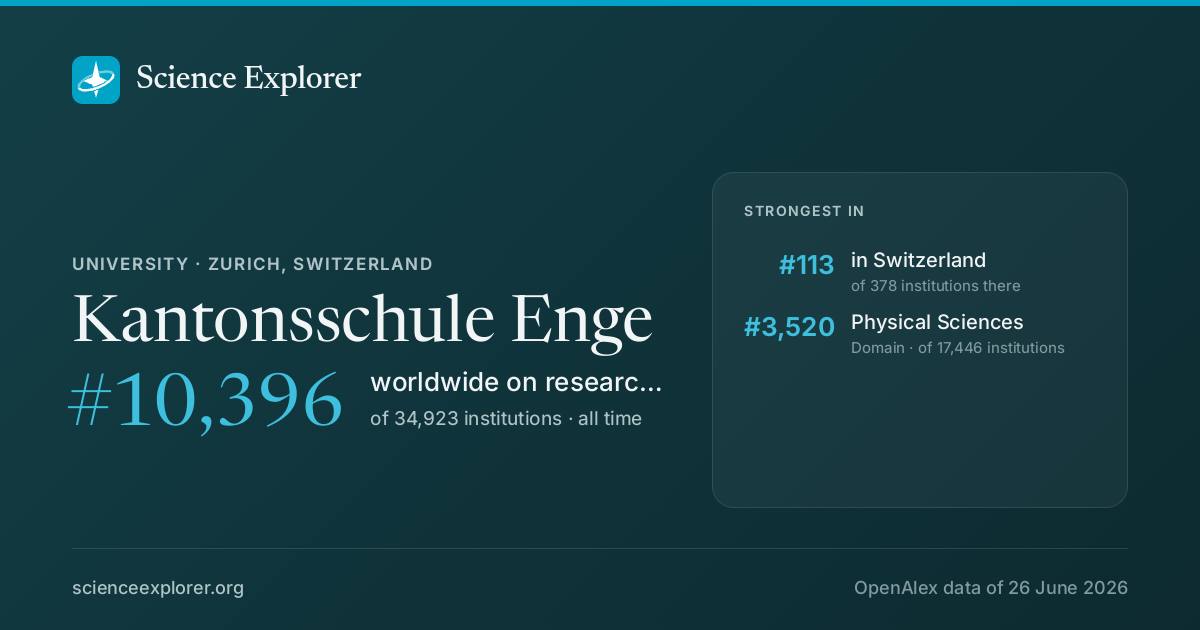
University · Zurich · Switzerland

Kantonsschule Enge

In research, Kantonsschule Enge stands highest in Physical Sciences (#3,520 of 17,446 worldwide), over all time.

World rank, all time
#10,396
of 34,923
Rank in Switzerland
#113
of 378
Research works
265
▲ 54% vs 2018-21
Citations
6k
22.6 per fractional work
Top-10% rate
18.1%
all institutions 10.0%
vs its own fields
1.50×
1.00× is exactly expected
Open access
15%
world 40%
International
16%
world 18%

What is Kantonsschule Enge known for in research?

The fields where it stands highest, over all time, ranked among every institution above the floor in each field.

FieldWorld rankWhere that sitsTop-10% rateWorks
Physical SciencesDomain #3,520 of 17,446 17.9%160

Each strip is that field's whole ranked pool, with the notch where Kantonsschule Enge sits in it, in the colour of the band that rank falls in. The track under the rate is the rate itself: it carries no average mark, because the average differs by field (from about 6% in Dentistry to 21% in Economics).

Which fields of science does Kantonsschule Enge work in?

In all years, 60% of research at Kantonsschule Enge is in Physical Sciences, 15% in Life Sciences. Its largest fields are Chemistry (26%), Engineering (20%), Agricultural and Biological Sciences (9%). It does 1.5× the world's share of Physical Sciences.

Physical Sciences: 160 fractional works · 60.3% of its workChemistry: 70 fractional works · 26.2% of its workSpectroscopy: 52 fractional works · 19.5% of its workAnalytical Chemistry: 11 fractional works · 4.1% of its workOrganic Chemistry: 6 fractional works · 2.2% of its workPhysical and Theoretical Chemistry: 1 fractional works · 0.3% of its workSmaller subfields together: 0 fractional works · 0.2% of its workEngineering: 52 fractional works · 19.7% of its workBiomedical Engineering: 43 fractional works · 16.1% of its workMechanical Engineering: 3 fractional works · 1.2% of its workCivil and Structural Engineering: 2 fractional works · 0.7% of its workElectrical and Electronic Engineering: 1 fractional works · 0.4% of its workControl and Systems Engineering: 1 fractional works · 0.3% of its workAutomotive Engineering: 1 fractional works · 0.3% of its workComputational Mechanics: 1 fractional works · 0.3% of its workSmaller subfields together: 1 fractional works · 0.4% of its workEnvironmental Science: 12 fractional works · 4.4% of its workHealth, Toxicology and Mutagenesis: 4 fractional works · 1.4% of its workEcology: 2 fractional works · 0.7% of its workPollution: 1 fractional works · 0.6% of its workEnvironmental Chemistry: 1 fractional works · 0.5% of its workWater Science and Technology: 1 fractional works · 0.5% of its workGlobal and Planetary Change: 1 fractional works · 0.3% of its workSmaller subfields together: 1 fractional works · 0.5% of its workMaterials Science: 9 fractional works · 3.6% of its workMaterials Chemistry: 6 fractional works · 2.3% of its workBiomaterials: 1 fractional works · 0.5% of its workSurfaces, Coatings and Films: 1 fractional works · 0.4% of its workPolymers and Plastics: 1 fractional works · 0.3% of its workSmaller subfields together: 0 fractional works · 0.1% of its workComputer Science: 5 fractional works · 1.8% of its workSignal Processing: 2 fractional works · 0.6% of its workInformation Systems: 1 fractional works · 0.4% of its workComputer Vision and Pattern Recognition: 1 fractional works · 0.4% of its workSmaller subfields together: 1 fractional works · 0.4% of its workChemical Engineering: 4 fractional works · 1.5% of its workBioengineering: 2 fractional works · 0.8% of its workFiltration and Separation: 1 fractional works · 0.5% of its workSmaller subfields together: 0 fractional works · 0.2% of its workPhysics and Astronomy: 3 fractional works · 1.1% of its workStatistical and Nonlinear Physics: 2 fractional works · 0.8% of its workAtomic and Molecular Physics, and Optics: 1 fractional works · 0.2% of its workSmaller subfields together: 0 fractional works · 0.1% of its workEarth and Planetary Sciences: 3 fractional works · 1.1% of its workEarth-Surface Processes: 1 fractional works · 0.4% of its workGeochemistry and Petrology: 1 fractional works · 0.2% of its workAtmospheric Science: 1 fractional works · 0.2% of its workSmaller subfields together: 0 fractional works · 0.2% of its workMathematics: 2 fractional works · 0.9% of its workGeometry and Topology: 1 fractional works · 0.3% of its workStatistics and Probability: 1 fractional works · 0.2% of its workSmaller subfields together: 1 fractional works · 0.4% of its workEnergy: 0 fractional works · 0.0% of its workLife Sciences: 39 fractional works · 14.9% of its workAgricultural and Biological Sciences: 24 fractional works · 9.1% of its workFood Science: 12 fractional works · 4.4% of its workPlant Science: 6 fractional works · 2.3% of its workAnimal Science and Zoology: 2 fractional works · 0.9% of its workEcology, Evolution, Behavior and Systematics: 1 fractional works · 0.4% of its workAgronomy and Crop Science: 1 fractional works · 0.4% of its workInsect Science: 1 fractional works · 0.4% of its workSmaller subfields together: 1 fractional works · 0.3% of its workBiochemistry, Genetics and Molecular Biology: 12 fractional works · 4.6% of its workMolecular Biology: 6 fractional works · 2.4% of its workBiotechnology: 2 fractional works · 0.6% of its workCancer Research: 1 fractional works · 0.5% of its workEndocrinology: 1 fractional works · 0.3% of its workCell Biology: 1 fractional works · 0.2% of its workSmaller subfields together: 2 fractional works · 0.6% of its workNeuroscience: 2 fractional works · 0.6% of its workCellular and Molecular Neuroscience: 1 fractional works · 0.4% of its workSmaller subfields together: 1 fractional works · 0.3% of its workImmunology and Microbiology: 1 fractional works · 0.4% of its workImmunology: 1 fractional works · 0.4% of its workSmaller subfields together: 0 fractional works · 0.1% of its workPharmacology, Toxicology and Pharmaceutics: 0 fractional works · 0.1% of its workSocial Sciences: 35 fractional works · 13.1% of its workSocial Sciences: 19 fractional works · 7.2% of its workPolitical Science and International Relations: 6 fractional works · 2.1% of its workSociology and Political Science: 5 fractional works · 1.9% of its workEducation: 4 fractional works · 1.5% of its workLaw: 2 fractional works · 0.8% of its workSmaller subfields together: 2 fractional works · 0.9% of its workPsychology: 4 fractional works · 1.6% of its workDevelopmental and Educational Psychology: 2 fractional works · 0.6% of its workClinical Psychology: 1 fractional works · 0.5% of its workSocial Psychology: 1 fractional works · 0.3% of its workExperimental and Cognitive Psychology: 1 fractional works · 0.2% of its workEconomics, Econometrics and Finance: 4 fractional works · 1.5% of its workEconomics and Econometrics: 3 fractional works · 1.2% of its workFinance: 1 fractional works · 0.3% of its workArts and Humanities: 3 fractional works · 1.3% of its workHistory: 1 fractional works · 0.3% of its workHistory and Philosophy of Science: 1 fractional works · 0.3% of its workSmaller subfields together: 2 fractional works · 0.7% of its workBusiness, Management and Accounting: 2 fractional works · 0.9% of its workStrategy and Management: 2 fractional works · 0.7% of its workSmaller subfields together: 1 fractional works · 0.2% of its workDecision Sciences: 1 fractional works · 0.5% of its workInformation Systems and Management: 1 fractional works · 0.2% of its workSmaller subfields together: 1 fractional works · 0.3% of its workHealth Sciences: 31 fractional works · 11.7% of its workMedicine: 18 fractional works · 6.7% of its workEmergency Medicine: 3 fractional works · 1.0% of its workSurgery: 3 fractional works · 1.0% of its workPublic Health, Environmental and Occupational Health: 2 fractional works · 0.6% of its workEndocrinology, Diabetes and Metabolism: 2 fractional works · 0.6% of its workGeriatrics and Gerontology: 1 fractional works · 0.5% of its workPharmacology: 1 fractional works · 0.4% of its workRheumatology: 1 fractional works · 0.4% of its workOncology: 1 fractional works · 0.3% of its workPulmonary and Respiratory Medicine: 1 fractional works · 0.2% of its workSmaller subfields together: 4 fractional works · 1.7% of its workHealth Professions: 9 fractional works · 3.5% of its workGeneral Health Professions: 5 fractional works · 1.9% of its workSpeech and Hearing: 3 fractional works · 1.1% of its workSmaller subfields together: 1 fractional works · 0.4% of its workNursing: 4 fractional works · 1.6% of its workNutrition and Dietetics: 4 fractional works · 1.6% of its workVeterinary: 0 fractional works · 0.0% of its workALL ITS WORKKantonsschuleEnge265fractional works, all years
Life Sciences15%Physical Sciences60%Health Sciences12%Social Sciences13%

Each ring splits the one inside it: the four domains of science, their fields, their subfields. Size is fractional works in all years. Every slice is a page; the interactive view zooms down to single topics and colours each by how much more of it this institution does than the world.

Its 4 domains and 25 fields, with their numbers
    1. Chemistry7026.2%
    2. Engineering5219.7%
    3. Environmental Science124.4%
    4. Materials Science93.6%
    5. Computer Science51.8%
    6. Chemical Engineering41.5%
    7. Physics and Astronomy31.1%
    8. Earth and Planetary Sciences31.1%
    9. Mathematics20.9%
    10. Energy00.0%
    1. Agricultural and Biological Sciences249.1%
    2. Biochemistry, Genetics and Molecular Biology124.6%
    3. Neuroscience20.6%
    4. Immunology and Microbiology10.4%
    5. Pharmacology, Toxicology and Pharmaceutics00.1%
    1. Social Sciences197.2%
    2. Psychology41.6%
    3. Economics, Econometrics and Finance41.5%
    4. Arts and Humanities31.3%
    5. Business, Management and Accounting20.9%
    6. Decision Sciences10.5%
    1. Medicine186.7%
    2. Health Professions93.5%
    3. Nursing41.6%
    4. Veterinary00.0%
All of science, and how each field's share has moved since 1950: the Science domain explorer

Field profile

Location quotient across every field it publishes in: outside the ring is more than an institution of this size would be expected to publish, inside it is less.

Agricultural and Biological Sciences: 0.53× its world share, 0 worksAgricultural and Bio…Biochemistry, Genetics and Molecular Biology: 0.87× its world share, 1 worksBiochemistry, Geneti…Neuroscience: 1.16× its world share, 0 worksNeuroscienceComputer Science: 1.28× its world share, 2 worksComputer ScienceEarth and Planetary Sciences: 0.60× its world share, 0 worksEarth and Planetary …Energy: 0.51× its world share, 0 worksEnergyEngineering: 0.15× its world share, 0 worksEngineeringEnvironmental Science: 2.14× its world share, 2 worksEnvironmental ScienceMaterials Science: 0.27× its world share, 0 worksMaterials ScienceHealth Professions: 0.72× its world share, 0 worksHealth ProfessionsMedicine: 0.60× its world share, 2 worksMedicineArts and Humanities: 1.85× its world share, 1 worksArts and HumanitiesBusiness, Management and Accounting: 0.29× its world share, 0 worksBusiness, Management…Decision Sciences: 5.27× its world share, 1 worksDecision SciencesEconomics, Econometrics and Finance: 1.54× its world share, 1 worksEconomics, Econometr…Psychology: 2.84× its world share, 2 worksPsychologySocial Sciences: 2.30× its world share, 5 worksSocial Sciences1×world share
more than its size predictsabout as predictedless

Rings at 0.5×, 1× and 2×. Widest outward: Decision Sciences, 5.3×. Every wedge is a field page.

All 17 fields, with their numbers
  1. Decision Sciences5.27×1 works
  2. Psychology2.84×2 works
  3. Social Sciences2.30×5 works
  4. Environmental Science2.14×2 works
  5. Arts and Humanities1.85×1 works
  6. Economics, Econometrics and Finance1.54×1 works
  7. Computer Science1.28×2 works
  8. Neuroscience1.16×0 works
  9. Biochemistry, Genetics and Molecular Biology0.87×1 works
  10. Health Professions0.72×0 works
  11. Earth and Planetary Sciences0.60×0 works
  12. Medicine0.60×2 works
  13. Agricultural and Biological Sciences0.53×0 works
  14. Energy0.51×0 works
  15. Business, Management and Accounting0.29×0 works
  16. Materials Science0.27×0 works
  17. Engineering0.15×0 works

Who are the top researchers at Kantonsschule Enge?

Ranked on the quality score, Carlo Mariani, H. P. Neukom and Anna Artho lead among researchers whose main affiliation is Kantonsschule Enge.

  1. 1 Carlo Mariani Switzerland · #2,037,447 worldwide 678 citations · 16 works
  2. 2 H. P. Neukom Switzerland · #2,771,453 worldwide 935 citations · 33 works
  3. 3 Anna Artho Switzerland · #3,506,274 worldwide 503 citations · 24 works
  4. 4 Urs Saxer Switzerland · #4,220,741 worldwide 18 citations · 26 works
  5. 5 Konrad Bernath Switzerland · #4,563,081 worldwide 109 citations · 24 works
  6. 6 Marianne Bronz Switzerland · #4,660,867 worldwide 176 citations · 16 works
  7. 7 Eugen A. Thomas Switzerland · #5,136,950 worldwide 224 citations · 34 works
  8. 8 O Högl Switzerland · #5,274,088 worldwide 33 citations · 44 works
  9. 9 Konrad Grob Switzerland · #7,223,349 worldwide 15k citations · 844 works
All ranked researchers at Kantonsschule Enge

What are the most cited papers from Kantonsschule Enge?

The most cited paper from Kantonsschule Enge is "Deactivation of glass capillary columns by silylation. Part 1: Principles and basic technique" (Konrad Grob, G. Groβ, Konrad Grob, 1979), with 200 citations. Next come "Testing capillary gas chromatographic columns" (194) and "“Band broadening in space” and the “retention gap” in capillary gas chromatography" (163).

Most cited papers
#PaperReleasedCitations
1 Deactivation of glass capillary columns by silylation. Part 1: Principles and basic technique Konrad Grob, G. Groβ, Konrad Grob · Journal of High Resolution Chromatography 1979 200
2 Testing capillary gas chromatographic columns Konrad Grob, G. Groβ, Kurt Grob · Journal of Chromatography A Nov 1981 194
3 “Band broadening in space” and the “retention gap” in capillary gas chromatography Koni Grob · Journal of Chromatography A Mar 1982 163
4 Splitless injection and the solvent effect Konrad Grob, Konrad Grob · Journal of High Resolution Chromatography Jul 1978 158
5 Validation of PCR Methods for Quantitation of Genetically Modified Plants in Food Philipp Hübner, Hans-Ullrich Waiblinger, Klaus Pietsch et al. · Journal of AOAC International Nov 2001 139
All 60 most cited papers, with filters and sorting

Which keywords describe research at Kantonsschule Enge?

By fractional works in all years, weighted toward what it does more of than the world: Liquid Chromatography, Chirality, Chiral Separation, Gas Chromatography, 3D Printing, Lab-on-a-Chip, Poly(dimethylsiloxane) and Mass Spectrometry.

▲ more of its work than of the world's◆ about the world's share▼ less than the world's

Size is fractional works in all years in the topics tagged with each word; colour is the word's share of this institution's work against its share of the world's. The 40 words are chosen for being large and distinctive. Each links to the topic it comes from most.

All 40 words, with their numbers
  1. Liquid Chromatography42▲ 107×2 topics
  2. Chiral Separation39▲ 120×1 topic
  3. Chirality39▲ 97×2 topics
  4. Gas Chromatography39▲ 120×1 topic
  5. 3D Printing18▲ 35×2 topics
  6. Lab-on-a-Chip17▲ 47×1 topic
  7. Poly(dimethylsiloxane)17▲ 133×1 topic
  8. Mass Spectrometry14▲ 25×4 topics
  9. Volatile Organic Compounds13▲ 42×3 topics
  10. Breath Analysis12▲ 33×1 topic
  11. Electronic Nose12▲ 55×1 topic
  12. Antioxidant Activity11▲ 7.6×8 topics
  13. Imaging11▲ 11×3 topics
  14. Health Effects10▲ 6.5×12 topics
  15. Food Safety10▲ 14×8 topics
  16. Proteomics10▲ 33×2 topics
  17. Electrospray10▲ 50×1 topic
  18. Ionization10▲ 50×1 topic
  19. Biomedical Applications8▲ 3.0×4 topics
  20. Droplet Formation7▲ 74×1 topic
  21. Microfluidics7▲ 31×1 topic
  22. Ionic Liquids6▲ 7.2×3 topics
  23. Polyphenols6▲ 15×3 topics
  24. Risk Assessment5▲ 3.3×6 topics
  25. Chronic Diseases5▲ 6.6×4 topics
  26. Green Analytical Chemistry5▲ 20×2 topics
  27. Carbon Nanotubes5▲ 4.9×2 topics
  28. Bioactive Compounds4▲ 8.7×2 topics
  29. Molecularly Imprinted Polymers4▲ 27×1 topic
  30. Solid-Phase Microextraction4▲ 27×1 topic
  31. Counter-Current Chromatography4▲ 82×1 topic
  32. Natural Product Isolation4▲ 82×1 topic
  33. Fatty Acids4▲ 14×3 topics
  34. Fermentation4▲ 9.7×4 topics
  35. Crystallization4▲ 23×2 topics
  36. Vibration Control4▲ 20×2 topics
  37. Germany3▲ 42×1 topic
  38. Health Surveys3▲ 42×1 topic
  39. Phenolic Compounds3▲ 7.9×2 topics
  40. Method Validation3▲ 16×2 topics

Which research topics does Kantonsschule Enge publish most on?

By volume in 2022-now: Impact of Technology on Adolescents, Blockchain Technology Applications and Security, Educational Assessment and Improvement and Art History and Market Analysis.

  1. 1 Impact of Technology on Adolescents Sociology and Political Science 1 works
  2. 2 Blockchain Technology Applications and Security Information Systems 1 works
  3. 3 Educational Assessment and Improvement Information Systems and Management 0 works
  4. 4 Art History and Market Analysis Visual Arts and Performing Arts 0 works
  5. 5 Diverse Scientific and Economic Studies Economics and Econometrics 0 works
  6. 6 Medieval and Early Modern Justice Political Science and International Relations 0 works
  7. 7 Historical Legal Studies and Society Political Science and International Relations 0 works
  8. 8 African studies and sociopolitical issues Sociology and Political Science 0 works
  9. 9 Digital literacy in education Information Systems 0 works
  10. 10 Innovative Teaching and Learning Methods Developmental and Educational Psychology 0 works

How open and international is its research?

Against the world's own shares: the tick on each track. Both are shares of its output, so they sit on one scale and can be read against each other as well as against the world.

openly available15.1%not open84.9%

World: 40% of research is openly available.

with international co-authors16.4%domestic only83.6%

World: 18% is written across borders.

How has Kantonsschule Enge's research output changed?

Output in 2022-2025 was 54% higher than in 2018-2021.

still counting1990200020102020
grewheldshrank

The same series as a ribbon: one cell per year, darker for more. The line above answers how much; this answers when.

Its share of all research

Growing output can still be a shrinking share: all of science grows. This is Kantonsschule Enge as a percentage of every work published that year, 0.000032% in 2024.

still counting0.0010%0.0020%0.0030%Kantonsschule Enge0.00013% in 202519801990200020102020

Fractional works of Kantonsschule Enge over all fractional works that year. How the balance of science has shifted.

Other research institutions in Zurich

All research institutions in Zurich

Share Kantonsschule Enge's ranking

Kantonsschule Enge on Science Explorer

A card with Kantonsschule Enge's standing and the fields it leads in, for a post or a slide. A link to this page previews as the same card.

Download the card

1200 × 630 PNG, sized for social posts, drawn from the latest snapshot.

Badges for a website1Each links back here and updates with every snapshot

Research measures only: rankings here say nothing about teaching, admissions or student experience. Comparable institutions and collaboration partners have tabs of their own, above.

Discussion

Ask a question or share a note about Kantonsschule Enge. Posts are plain text and can be reported.