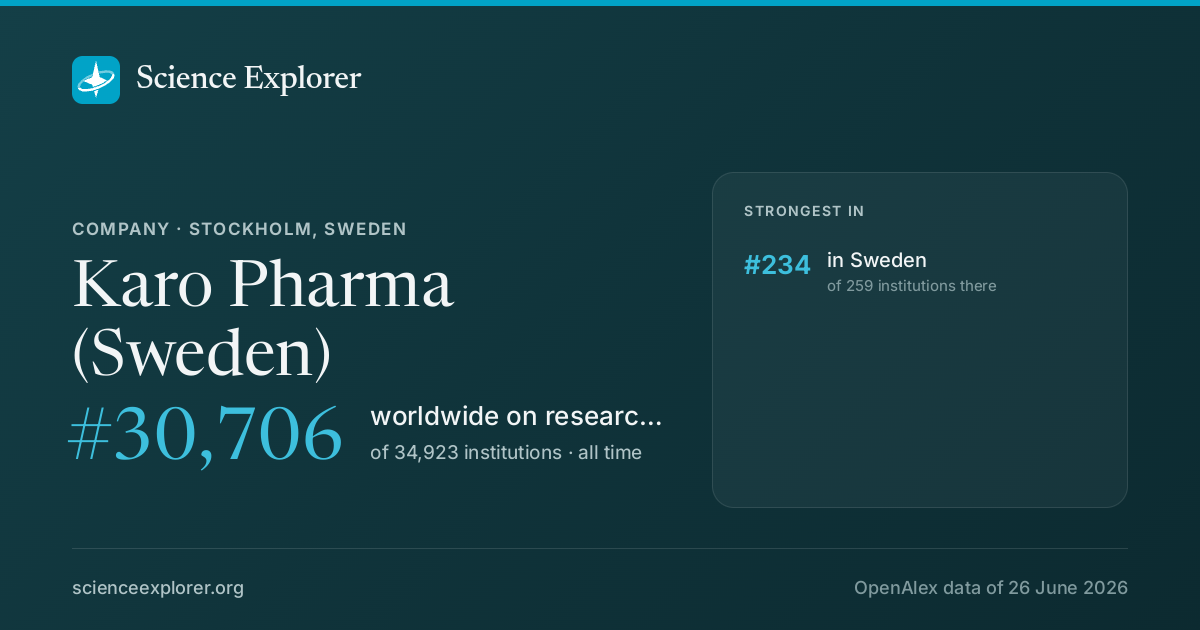
- World rank, all time
- #30,706 of 34,923
- Rank in Sweden
- #234 of 259
- Research works
- 143 ▲ 200% vs 2018-21
- Citations
- 10k 73.1 per fractional work
- Top-10% rate
- 8.2% all institutions 10.0%
- vs its own fields
- 1.16× 1.00× is exactly expected
- Open access
- 40% world 40%
- International
- 32% world 18%
Which fields of science does Karo Pharma (Sweden) work in?
In all years, 45% of research at Karo Pharma (Sweden) is in Life Sciences, 39% in Health Sciences. Its largest fields are Medicine (37%), Biochemistry, Genetics and Molecular Biology (37%), Chemistry (7%). It does 2.7× the world's share of Life Sciences.
Each ring splits the one inside it: the four domains of science, their fields, their subfields. Size is fractional works in all years. Every slice is a page; the interactive view zooms down to single topics and colours each by how much more of it this institution does than the world.
Its 4 domains and 21 fields, with their numbers
- Life Sciences6444.7%
- Health Sciences5538.9%
- Medicine5336.9%
- Nursing11.0%
- Health Professions10.7%
- Dentistry00.2%
- Veterinary00.0%
- Physical Sciences1812.9%
- Chemistry106.7%
- Computer Science32.4%
- Environmental Science21.7%
- Chemical Engineering10.6%
- Engineering10.5%
- Materials Science10.5%
- Physics and Astronomy00.4%
- Earth and Planetary Sciences00.1%
- Social Sciences53.5%
- Psychology32.0%
- Social Sciences21.2%
- Arts and Humanities00.4%
Field profile
Location quotient across every field it publishes in: outside the ring is more than an institution of this size would be expected to publish, inside it is less.
Rings at 0.5×, 1× and 2×. Widest outward: Pharmacology, Toxicology and Pharmaceutics, 21.6×. Every wedge is a field page.
All 12 fields, with their numbers
- Pharmacology, Toxicology and Pharmaceutics21.59×0 works
- Immunology and Microbiology4.54×0 works
- Chemistry3.88×0 works
- Agricultural and Biological Sciences3.20×1 works
- Biochemistry, Genetics and Molecular Biology2.28×0 works
- Social Sciences2.17×1 works
- Environmental Science1.96×0 works
- Earth and Planetary Sciences1.16×0 works
- Health Professions0.69×0 works
- Psychology0.60×0 works
- Medicine0.45×0 works
- Computer Science0.39×0 works
- Pharmacology, Toxicology and Pharmaceutics 21.6×
- Immunology and Microbiology 4.5×
- Chemistry 3.9×
- Agricultural and Biological Sciences 3.2×
- Biochemistry, Genetics and Molecular Biology 2.3×
- Social Sciences 2.2×
- Environmental Science 2.0×
- Earth and Planetary Sciences 1.2×
- Health Professions 0.7×
- Psychology 0.6×
- Medicine 0.5×
- Computer Science 0.4×
Who are the top researchers at Karo Pharma (Sweden)?
Ranked on the quality score, Stefan V. Nilsson, Konrad F. Koehler and Elaine M. Quinet lead among researchers whose main affiliation is Karo Pharma (Sweden).
- 1
Stefan V. Nilsson
 Sweden · #828,453 worldwide
13k citations · 61 works
- 2
Konrad F. Koehler
Sweden · #850,093 worldwide
2.6k citations · 72 works
- 3
Elaine M. Quinet
Sweden · #914,674 worldwide
2.8k citations · 43 works
- 4
Karin Mellström
Sweden · #997,659 worldwide
2k citations · 35 works
- 5
Mathias Färnegårdh
Sweden · #1,844,366 worldwide
1.6k citations · 28 works
- 6
Bo Carlsson
Sweden · #1,892,811 worldwide
9.9k citations · 19 works
- 7
Jan Gustaf Ljunggren
Sweden · #1,992,569 worldwide
862 citations · 18 works
- 8
Johan Malm
Sweden · #2,402,274 worldwide
1.2k citations · 33 works
- 9
Anita R. Halpern
Sweden · #2,497,553 worldwide
572 citations · 18 works
- 10
Lars Öhman
Sweden · #2,727,622 worldwide
4.3k citations · 18 works
Which keywords describe research at Karo Pharma (Sweden)?
By fractional works in all years, weighted toward what it does more of than the world: Nuclear Receptors, Breast Cancer, Transcriptional Regulation, Estrogen, Signaling, G Protein-Coupled Receptor, Glucocorticoids and Receptor.
- SREBP
- LXR
- Hormone Therapy
- Biopharmaceutical Production
- Cardiovascular Events
- Cholesterol
- Glycosylation
- Medicinal Chemistry
- Atherosclerosis
- Pharmacology
- Retinoic Acid
- Metabolic Syndrome
- Thyroid Hormone
- Neurodevelopment
- Cardiovascular Risk
- Cancer
- Receptor
- G Protein-Coupled Receptor
- Estrogen
- Breast Cancer
- Nuclear Receptors
- Transcriptional Regulation
- Signaling
- Glucocorticoids
- Inflammation
- Metabolism
- Pregnancy
- Thyroid Dysfunction
- Cell Signaling
- Acute Promyelocytic Leukemia
- Depression
- Pharmacokinetics
- Metabolic Regulation
- ATP-dependent Transporters
- Multidrug Resistance
- Hypertension
- Monoclonal Antibody
- Macrophage
- Aldosterone
- Primary Aldosteronism
Size is fractional works in all years in the topics tagged with each word; colour is the word's share of this institution's work against its share of the world's. The 40 words are chosen for being large and distinctive. Each links to the topic it comes from most.
All 40 words, with their numbers
- Nuclear Receptors32▲ 123×5 topics
- Breast Cancer26▲ 64×5 topics
- Transcriptional Regulation24▲ 67×5 topics
- Estrogen23▲ 211×2 topics
- Signaling22▲ 132×3 topics
- G Protein-Coupled Receptor20▲ 215×2 topics
- Glucocorticoids20▲ 252×1 topic
- Receptor20▲ 197×1 topic
- Inflammation12▲ 3.5×23 topics
- Cancer11▲ 5.5×16 topics
- Metabolism11▲ 12×12 topics
- Cardiovascular Risk10▲ 20×3 topics
- Pregnancy7▲ 23×4 topics
- Neurodevelopment6▲ 60×2 topics
- Thyroid Dysfunction6▲ 108×1 topic
- Thyroid Hormone6▲ 108×1 topic
- Cell Signaling6▲ 12×5 topics
- Metabolic Syndrome6▲ 4.6×4 topics
- Acute Promyelocytic Leukemia5▲ 125×1 topic
- Retinoic Acid5▲ 125×1 topic
- Depression5▲ 4.7×6 topics
- Pharmacology5▲ 10×4 topics
- Pharmacokinetics5▲ 12×3 topics
- Atherosclerosis4▲ 8.7×5 topics
- Metabolic Regulation4▲ 11×3 topics
- Medicinal Chemistry4▲ 8.0×6 topics
- ATP-dependent Transporters4▲ 56×1 topic
- Glycosylation4▲ 13×3 topics
- Multidrug Resistance4▲ 49×1 topic
- Cholesterol4▲ 16×3 topics
- Hypertension4▲ 8.2×4 topics
- Cardiovascular Events4▲ 17×2 topics
- Monoclonal Antibody4▲ 40×2 topics
- Biopharmaceutical Production4▲ 35×2 topics
- Macrophage4▲ 48×2 topics
- Hormone Therapy4▲ 25×3 topics
- Aldosterone4▲ 58×1 topic
- LXR4▲ 122×1 topic
- Primary Aldosteronism4▲ 58×1 topic
- SREBP4▲ 122×1 topic
Which research topics does Karo Pharma (Sweden) publish most on?
By volume in 2022-now: Education and Character Development, Pancasila Values in Education, Educational Curriculum and Learning Methods and Plant Pathogens and Resistance.
Area is fractional works; colour is the subfield each topic belongs to.
- 1 Education and Character Development Education 0 works
- 2 Pancasila Values in Education Education 0 works
- 3 Educational Curriculum and Learning Methods Education 0 works
- 4 Plant Pathogens and Resistance Plant Science 0 works
- 5 Marine animal studies overview Ecology 0 works
- 6 Pharmacological Effects of Natural Compounds Pharmacology 0 works
- 7 Retinoids in leukemia and cellular processes Molecular Biology 0 works
- 8 Psoriasis: Treatment and Pathogenesis Immunology 0 works
- 9 Pharmacogenetics and Drug Metabolism Pharmacology 0 works
- 10 Cephalopods and Marine Biology Ecology, Evolution, Behavior and Systematics 0 works
How open and international is its research?
Against the world's own shares: the tick on each track. Both are shares of its output, so they sit on one scale and can be read against each other as well as against the world.
World: 40% of research is openly available.
World: 18% is written across borders.
How has Karo Pharma (Sweden)'s research output changed?
Output in 2022-2025 was 200% higher than in 2018-2021.
The same series as a ribbon: one cell per year, darker for more. The line above answers how much; this answers when.
Its share of all research
Growing output can still be a shrinking share: all of science grows. This is Karo Pharma (Sweden) as a percentage of every work published that year, 0.0000093% in 2023.
Fractional works of Karo Pharma (Sweden) over all fractional works that year. How the balance of science has shifted.
Other research institutions in Stockholm
- Karolinska Institutet
- KTH Royal Institute of Technology
- Stockholm University
- Swedish Institute
- Stockholm School of Economics
- Science for Life Laboratory
- Swedish Defence Research Agency
- Stockholm South General Hospital
Share Karo Pharma (Sweden)'s ranking
Badges for a website1Each links back here and updates with every snapshot

Research measures only: rankings here say nothing about teaching, admissions or student experience. Comparable institutions and collaboration partners have tabs of their own, above.
Discussion
Ask a question or share a note about Karo Pharma (Sweden). Keep it to the research: no personal attacks, advertising or links. Any reader can report a post, which collapses it for everyone until it is opened.