Science Explorer Back to mapMap
Discussion
University · Kawagoe · Japan

Kawagoe Technical High School

World rank, all time
#32,613
of 34,923
Rank in Japan
#1,600
of 1,923
Research works
138
▲ 24% vs 2018-21
Citations
3.6k
26.2 per fractional work
Top-10% rate
4.1%
all institutions 10.0%
vs its own fields
0.91×
1.00× is exactly expected
Open access
47%
world 40%
International
14%
world 18%

Which fields of science does Kawagoe Technical High School work in?

In all years, 41% of research at Kawagoe Technical High School is in Health Sciences, 39% in Life Sciences. Its largest fields are Medicine (38%), Biochemistry, Genetics and Molecular Biology (19%), Agricultural and Biological Sciences (11%). It does 2.4× the world's share of Life Sciences.

Health Sciences: 57 fractional works · 41.3% of its workMedicine: 52 fractional works · 38.0% of its workSurgery: 9 fractional works · 6.7% of its workPublic Health, Environmental and Occupational Health: 5 fractional works · 3.6% of its workPhysiology: 3 fractional works · 2.3% of its workEpidemiology: 3 fractional works · 2.2% of its workEndocrinology, Diabetes and Metabolism: 3 fractional works · 2.2% of its workRadiology, Nuclear Medicine and Imaging: 2 fractional works · 1.7% of its workInfectious Diseases: 2 fractional works · 1.6% of its workPulmonary and Respiratory Medicine: 2 fractional works · 1.5% of its workOncology: 2 fractional works · 1.4% of its workRheumatology: 2 fractional works · 1.3% of its workDermatology: 2 fractional works · 1.2% of its workAnesthesiology and Pain Medicine: 1 fractional works · 1.0% of its workPathology and Forensic Medicine: 1 fractional works · 1.0% of its workCardiology and Cardiovascular Medicine: 1 fractional works · 1.0% of its workPediatrics, Perinatology and Child Health: 1 fractional works · 1.0% of its workOphthalmology: 1 fractional works · 0.9% of its workPharmacology: 1 fractional works · 0.8% of its workObstetrics and Gynecology: 1 fractional works · 0.8% of its workNephrology: 1 fractional works · 0.7% of its workOrthopedics and Sports Medicine: 1 fractional works · 0.7% of its workRehabilitation: 1 fractional works · 0.6% of its workPsychiatry and Mental health: 1 fractional works · 0.6% of its workGenetics: 1 fractional works · 0.5% of its workNeurology: 1 fractional works · 0.4% of its workHematology: 0 fractional works · 0.3% of its workOtorhinolaryngology: 0 fractional works · 0.3% of its workImmunology and Allergy: 0 fractional works · 0.3% of its workCritical Care and Intensive Care Medicine: 0 fractional works · 0.3% of its workHepatology: 0 fractional works · 0.2% of its workReproductive Medicine: 0 fractional works · 0.2% of its workComplementary and alternative medicine: 0 fractional works · 0.2% of its workSmaller subfields together: 1 fractional works · 0.4% of its workHealth Professions: 2 fractional works · 1.8% of its workHealth Information Management: 1 fractional works · 0.7% of its workGeneral Health Professions: 1 fractional works · 0.7% of its workSmaller subfields together: 1 fractional works · 0.4% of its workNursing: 2 fractional works · 1.3% of its workNutrition and Dietetics: 2 fractional works · 1.3% of its workVeterinary: 0 fractional works · 0.1% of its workDentistry: 0 fractional works · 0.1% of its workLife Sciences: 54 fractional works · 39.4% of its workBiochemistry, Genetics and Molecular Biology: 26 fractional works · 19.1% of its workMolecular Biology: 14 fractional works · 10.0% of its workGenetics: 4 fractional works · 2.6% of its workMolecular Medicine: 3 fractional works · 2.0% of its workEndocrinology: 2 fractional works · 1.7% of its workClinical Biochemistry: 1 fractional works · 0.7% of its workCancer Research: 1 fractional works · 0.6% of its workCell Biology: 1 fractional works · 0.6% of its workBiophysics: 1 fractional works · 0.5% of its workBiotechnology: 0 fractional works · 0.3% of its workBiochemistry: 0 fractional works · 0.3% of its workAgricultural and Biological Sciences: 15 fractional works · 10.6% of its workEcology, Evolution, Behavior and Systematics: 5 fractional works · 3.6% of its workInsect Science: 4 fractional works · 2.6% of its workPlant Science: 3 fractional works · 2.1% of its workFood Science: 2 fractional works · 1.5% of its workAnimal Science and Zoology: 0 fractional works · 0.3% of its workAgronomy and Crop Science: 0 fractional works · 0.3% of its workSmaller subfields together: 0 fractional works · 0.2% of its workImmunology and Microbiology: 7 fractional works · 5.2% of its workImmunology: 3 fractional works · 2.2% of its workParasitology: 3 fractional works · 2.1% of its workMicrobiology: 1 fractional works · 0.4% of its workApplied Microbiology and Biotechnology: 0 fractional works · 0.3% of its workSmaller subfields together: 0 fractional works · 0.2% of its workNeuroscience: 4 fractional works · 2.9% of its workCellular and Molecular Neuroscience: 1 fractional works · 1.0% of its workCognitive Neuroscience: 1 fractional works · 0.7% of its workNeurology: 1 fractional works · 0.5% of its workSensory Systems: 1 fractional works · 0.4% of its workDevelopmental Neuroscience: 0 fractional works · 0.2% of its workSmaller subfields together: 0 fractional works · 0.0% of its workPharmacology, Toxicology and Pharmaceutics: 2 fractional works · 1.6% of its workPharmacology: 2 fractional works · 1.4% of its workSmaller subfields together: 0 fractional works · 0.2% of its workPhysical Sciences: 22 fractional works · 15.6% of its workEngineering: 5 fractional works · 3.5% of its workBiomedical Engineering: 2 fractional works · 1.7% of its workElectrical and Electronic Engineering: 1 fractional works · 0.7% of its workAerospace Engineering: 0 fractional works · 0.4% of its workMechanics of Materials: 0 fractional works · 0.4% of its workSmaller subfields together: 1 fractional works · 0.4% of its workComputer Science: 4 fractional works · 3.1% of its workInformation Systems: 1 fractional works · 1.0% of its workComputational Theory and Mathematics: 1 fractional works · 0.9% of its workArtificial Intelligence: 1 fractional works · 0.7% of its workComputer Networks and Communications: 1 fractional works · 0.4% of its workSmaller subfields together: 0 fractional works · 0.1% of its workEnvironmental Science: 4 fractional works · 3.0% of its workEcology: 2 fractional works · 1.3% of its workPollution: 1 fractional works · 0.5% of its workEcological Modeling: 0 fractional works · 0.4% of its workManagement, Monitoring, Policy and Law: 0 fractional works · 0.4% of its workNature and Landscape Conservation: 0 fractional works · 0.2% of its workSmaller subfields together: 0 fractional works · 0.3% of its workMaterials Science: 3 fractional works · 2.2% of its workMaterials Chemistry: 1 fractional works · 1.0% of its workBiomaterials: 1 fractional works · 0.6% of its workElectronic, Optical and Magnetic Materials: 0 fractional works · 0.3% of its workPolymers and Plastics: 0 fractional works · 0.2% of its workSmaller subfields together: 0 fractional works · 0.0% of its workPhysics and Astronomy: 2 fractional works · 1.3% of its workAstronomy and Astrophysics: 1 fractional works · 0.4% of its workAtomic and Molecular Physics, and Optics: 1 fractional works · 0.4% of its workRadiation: 0 fractional works · 0.3% of its workSmaller subfields together: 0 fractional works · 0.1% of its workChemistry: 2 fractional works · 1.2% of its workOrganic Chemistry: 1 fractional works · 1.0% of its workSmaller subfields together: 0 fractional works · 0.2% of its workMathematics: 1 fractional works · 0.7% of its workApplied Mathematics: 1 fractional works · 0.4% of its workGeometry and Topology: 0 fractional works · 0.2% of its workSmaller subfields together: 0 fractional works · 0.1% of its workEarth and Planetary Sciences: 0 fractional works · 0.4% of its workEnergy: 0 fractional works · 0.2% of its workRenewable Energy, Sustainability and the Environment: 0 fractional works · 0.2% of its workSocial Sciences: 5 fractional works · 3.6% of its workPsychology: 2 fractional works · 1.2% of its workClinical Psychology: 1 fractional works · 0.7% of its workSocial Psychology: 0 fractional works · 0.3% of its workSmaller subfields together: 0 fractional works · 0.2% of its workSocial Sciences: 2 fractional works · 1.1% of its workSociology and Political Science: 1 fractional works · 0.8% of its workSmaller subfields together: 0 fractional works · 0.3% of its workBusiness, Management and Accounting: 1 fractional works · 1.0% of its workMarketing: 1 fractional works · 0.8% of its workSmaller subfields together: 0 fractional works · 0.2% of its workEconomics, Econometrics and Finance: 0 fractional works · 0.2% of its workArts and Humanities: 0 fractional works · 0.1% of its workDecision Sciences: 0 fractional works · 0.1% of its workALL ITS WORKKawagoe TechnicalHigh School138fractional works, all years
Life Sciences39%Physical Sciences16%Health Sciences41%Social Sciences4%

Each ring splits the one inside it: the four domains of science, their fields, their subfields. Size is fractional works in all years. Every slice is a page; the interactive view zooms down to single topics and colours each by how much more of it this institution does than the world.

Its 4 domains and 25 fields, with their numbers
    1. Medicine5238.0%
    2. Health Professions21.8%
    3. Nursing21.3%
    4. Veterinary00.1%
    5. Dentistry00.1%
    1. Biochemistry, Genetics and Molecular Biology2619.1%
    2. Agricultural and Biological Sciences1510.6%
    3. Immunology and Microbiology75.2%
    4. Neuroscience42.9%
    5. Pharmacology, Toxicology and Pharmaceutics21.6%
    1. Engineering53.5%
    2. Computer Science43.1%
    3. Environmental Science43.0%
    4. Materials Science32.2%
    5. Physics and Astronomy21.3%
    6. Chemistry21.2%
    7. Mathematics10.7%
    8. Earth and Planetary Sciences00.4%
    9. Energy00.2%
    1. Psychology21.2%
    2. Social Sciences21.1%
    3. Business, Management and Accounting11.0%
    4. Economics, Econometrics and Finance00.2%
    5. Arts and Humanities00.1%
    6. Decision Sciences00.1%
All of science, and how each field's share has moved since 1950: the Science domain explorer

Field profile

Location quotient across every field it publishes in: outside the ring is more than an institution of this size would be expected to publish, inside it is less.

Agricultural and Biological Sciences: 0.63× its world share, 1 worksAgricultural and Bio…Biochemistry, Genetics and Molecular Biology: 1.54× its world share, 2 worksBiochemistry, Geneti…Immunology and Microbiology: 3.57× its world share, 1 worksImmunology and Micro…Neuroscience: 3.49× its world share, 1 worksNeuroscienceChemistry: 0.12× its world share, 0 worksChemistryComputer Science: 0.13× its world share, 0 worksComputer ScienceEnergy: 0.93× its world share, 0 worksEnergyEngineering: 0.41× its world share, 1 worksEngineeringEnvironmental Science: 0.92× its world share, 1 worksEnvironmental ScienceMaterials Science: 0.74× its world share, 0 worksMaterials ScienceHealth Professions: 1.03× its world share, 0 worksHealth ProfessionsMedicine: 2.20× its world share, 8 worksMedicineNursing: 2.87× its world share, 0 worksNursingBusiness, Management and Accounting: 1.68× its world share, 1 worksBusiness, Management…Psychology: 1.55× its world share, 1 worksPsychologySocial Sciences: 0.61× its world share, 2 worksSocial Sciences1×world share
more than its size predictsabout as predictedless

Rings at 0.5×, 1× and 2×. Widest outward: Immunology and Microbiology, 3.6×. Every wedge is a field page.

All 16 fields, with their numbers
  1. Immunology and Microbiology3.57×1 works
  2. Neuroscience3.49×1 works
  3. Nursing2.87×0 works
  4. Medicine2.20×8 works
  5. Business, Management and Accounting1.68×1 works
  6. Psychology1.55×1 works
  7. Biochemistry, Genetics and Molecular Biology1.54×2 works
  8. Health Professions1.03×0 works
  9. Energy0.93×0 works
  10. Environmental Science0.92×1 works
  11. Materials Science0.74×0 works
  12. Agricultural and Biological Sciences0.63×1 works
  13. Social Sciences0.61×2 works
  14. Engineering0.41×1 works
  15. Computer Science0.13×0 works
  16. Chemistry0.12×0 works

Who are the top researchers at Kawagoe Technical High School?

Ranked on the quality score, Masahiro Shimojima and Keiko Yanagawa lead among researchers whose main affiliation is Kawagoe Technical High School.

  1. 1 Masahiro Shimojima Japan · #3,182,720 worldwide 1.2k citations · 45 works
  2. 2 Keiko Yanagawa Japan · #3,650,789 worldwide 182 citations · 18 works
All ranked researchers at Kawagoe Technical High School

What are the most cited papers from Kawagoe Technical High School?

The most cited paper from Kawagoe Technical High School is "Broadly Reactive and Highly Sensitive Assay for Norwalk-Like Viruses Based on Real-Time Quantitative Reverse Transcription-PCR" (Tsutomu Kageyama, Shigeyuki Kojima, Michiyo Shinohara et al., 2003), with 1,488 citations. Next come "Selective Expression of a Novel Surface Molecule by Human Th2 Cells In Vivo" (380) and "Memory and flexibility of cytokine gene expression as separable properties of human TH1 and TH2 lymphocytes" (347).

Most cited papers
#PaperReleasedCitations
1 Broadly Reactive and Highly Sensitive Assay for Norwalk-Like Viruses Based on Real-Time Quantitative Reverse Transcription-PCR Tsutomu Kageyama, Shigeyuki Kojima, Michiyo Shinohara et al. · Journal of Clinical Microbiology Open access Apr 2003 1,488
2 Selective Expression of a Novel Surface Molecule by Human Th2 Cells In Vivo Kinya Nagata, Kazuya Tanaka, Kazuyuki Ogawa et al. · The Journal of Immunology Feb 1999 380
3 Memory and flexibility of cytokine gene expression as separable properties of human TH1 and TH2 lymphocytes Mara Messi, Isabella Giacchetto, Kinya Nagata et al. · Nature Immunology 25 Nov 2002 347
4 Neuroprotective Effect of an Antioxidant, Ebselen, in Patients with Delayed Neurological Deficits after Aneurysmal Subarachnoid Hemorrhage Isamu Saito, Takao Asano, Keiji Sano et al. · Neurosurgery Feb 1998 259
5 Ultrastructure and phylogenetic analysis of ‘Candidatus Neoehrlichia mikurensis' in the family Anaplasmataceae, isolated from wild rats and found in Ixodes ovatus ticks Makoto Kawahara, Yasuko Rikihisa, Emiko Isogai et al. · INTERNATIONAL JOURNAL OF SYSTEMATIC AND EVOLUTIONARY MICROBIOLOGY Sep 2004 228
All 60 most cited papers, with filters and sorting

Which keywords describe research at Kawagoe Technical High School?

By fractional works in all years, weighted toward what it does more of than the world: Antibiotic Resistance, Epidemiology, Inflammation, Public Health, Biodiversity, Ecology, Phylogeny and Palliative Care.

▲ more of its work than of the world's◆ about the world's share▼ less than the world's

Size is fractional works in all years in the topics tagged with each word; colour is the word's share of this institution's work against its share of the world's. The 40 words are chosen for being large and distinctive. Each links to the topic it comes from most.

All 40 words, with their numbers
  1. Epidemiology13▲ 2.4×53 topics
  2. Inflammation10▲ 3.1×38 topics
  3. Antibiotic Resistance7▲ 13×8 topics
  4. Public Health7▲ 3.5×13 topics
  5. Biodiversity6▲ 5.2×8 topics
  6. Cancer6▲ 2.8×20 topics
  7. Oxidative Stress5▲ 2.1×20 topics
  8. Metabolic Syndrome5▲ 3.9×15 topics
  9. Ecology4▲ 15×3 topics
  10. Diagnosis4▲ 2.9×19 topics
  11. Pathogenesis4▲ 5.1×12 topics
  12. Treatment4▲ 2.2×17 topics
  13. Palliative Care4▲ 17×3 topics
  14. Phylogeny4▲ 15×3 topics
  15. Biogeography4▲ 7.9×2 topics
  16. Taxonomy4▲ 18×2 topics
  17. Acariformes4▲ 296×1 topic
  18. Mites4▲ 296×1 topic
  19. Neurological Disorders3▲ 3.2×10 topics
  20. Ethical Considerations3▲ 6.4×2 topics
  21. Immune System3▲ 6.3×3 topics
  22. Advance Care Planning3▲ 36×1 topic
  23. ESKAPE Pathogens3▲ 38×1 topic
  24. End-of-Life3▲ 25×1 topic
  25. Genomics3▲ 5.8×7 topics
  26. Multidrug-Resistant Bacteria3▲ 38×1 topic
  27. Consumer Behavior3▲ 5.2×4 topics
  28. Host-Pathogen Interactions2▲ 18×4 topics
  29. Prevention2▲ 4.5×4 topics
  30. Atherosclerosis2▲ 4.8×9 topics
  31. Metabolic Regulation2▲ 5.9×5 topics
  32. DNA Barcoding2▲ 10.0×3 topics
  33. Biofilm Formation2▲ 21×4 topics
  34. Statins2▲ 19×2 topics
  35. Lyme Disease2▲ 48×1 topic
  36. Tick-Borne Diseases2▲ 48×1 topic
  37. Food Authentication2▲ 15×1 topic
  38. Fraud Detection2▲ 18×1 topic
  39. Honey Bees2▲ 19×1 topic
  40. Neonicotinoids2▲ 19×1 topic

Which research topics does Kawagoe Technical High School publish most on?

By volume in 2022-now: Psychosocial Factors Impacting Youth, Lymphadenopathy Diagnosis and Analysis, Sports Dynamics and Biomechanics and Cytomegalovirus and herpesvirus research.

  1. 1 Psychosocial Factors Impacting Youth Sociology and Political Science 1 works
  2. 2 Lymphadenopathy Diagnosis and Analysis Surgery 0 works
  3. 3 Sports Dynamics and Biomechanics Biomedical Engineering 0 works
  4. 4 Cytomegalovirus and herpesvirus research Epidemiology 0 works
  5. 5 Antibiotic Resistance in Bacteria Molecular Medicine 0 works
  6. 6 Infections and bacterial resistance Endocrinology 0 works
  7. 7 Cutaneous lymphoproliferative disorders research Dermatology 0 works
  8. 8 Luminescence Properties of Advanced Materials Materials Chemistry 0 works
  9. 9 Cutaneous Melanoma Detection and Management Oncology 0 works
  10. 10 Consumer Behavior in Brand Consumption and Identification Marketing 0 works

How open and international is its research?

Against the world's own shares: the tick on each track. Both are shares of its output, so they sit on one scale and can be read against each other as well as against the world.

openly available47.0%not open53.0%

World: 40% of research is openly available.

with international co-authors13.6%domestic only86.4%

World: 18% is written across borders.

How has Kawagoe Technical High School's research output changed?

Output in 2022-2025 was 24% higher than in 2018-2021.

still counting1990200020102020
grewheldshrank

The same series as a ribbon: one cell per year, darker for more. The line above answers how much; this answers when.

Its share of all research

Growing output can still be a shrinking share: all of science grows. This is Kawagoe Technical High School as a percentage of every work published that year, 0.00011% in 2024.

still counting0.00050%0.0010%Kawagoe Technical High School0.000073% in 202519801990200020102020

Fractional works of Kawagoe Technical High School over all fractional works that year. How the balance of science has shifted.

Other research institutions in Kawagoe

All research institutions in Kawagoe

Share Kawagoe Technical High School's ranking
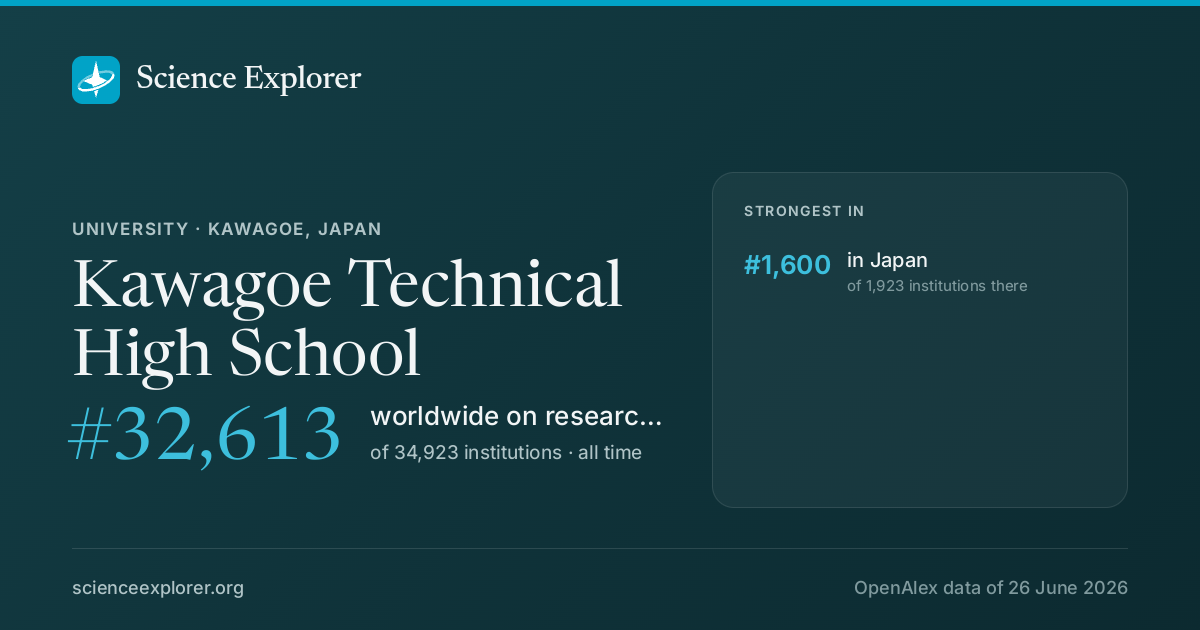
Kawagoe Technical High School on Science Explorer

A card with Kawagoe Technical High School's standing and the fields it leads in, for a post or a slide. A link to this page previews as the same card.

Download the card

1200 × 630 PNG, sized for social posts, drawn from the latest snapshot.

Badges for a website1Each links back here and updates with every snapshot

Research measures only: rankings here say nothing about teaching, admissions or student experience. Comparable institutions and collaboration partners have tabs of their own, above.

Discussion

Ask a question or share a note about Kawagoe Technical High School. Posts are plain text and can be reported.
