Science Explorer Back to mapMap
Hospital / health system · Middletown · United States

Middlesex Hospital

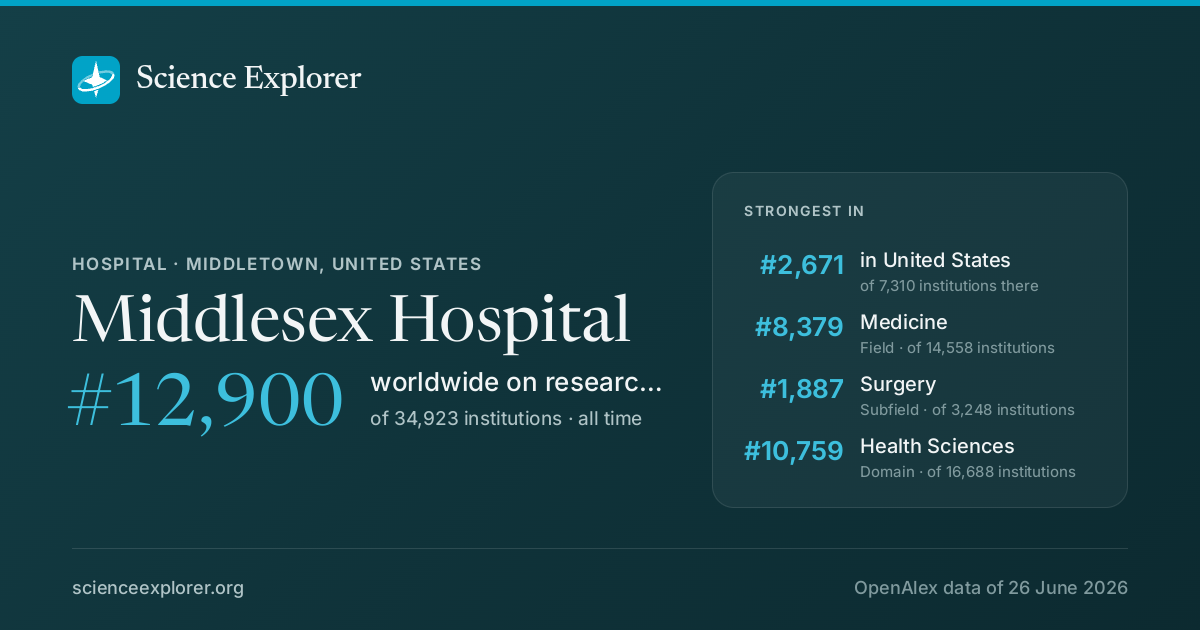
In research, Middlesex Hospital stands highest in Medicine (#8,379 of 14,558 worldwide), Surgery (#1,887 of 3,248 worldwide) and Health Sciences (#10,759 of 16,688 worldwide), over all time.

World rank, all time
#12,900
of 34,923
Rank in United States
#2,671
of 7,310
Research works
5k
▲ 18% vs 2018-21
Citations
158k
31.5 per fractional work
Top-10% rate
5.2%
all institutions 10.0%
vs its own fields
1.14×
1.00× is exactly expected
Open access
31%
world 40%
International
35%
world 18%

What is Middlesex Hospital known for in research?

The fields where it stands highest, over all time, ranked among every institution above the floor in each field.

FieldWorld rankWhere that sitsTop-10% rateWorks
MedicineField #8,379 of 14,558 12.5%3,038
SurgerySubfield #1,887 of 3,248 15.8%446
Health SciencesDomain #10,759 of 16,688 12.3%3,279
Endocrinology, Diabetes and MetabolismSubfield #727 of 959 12.4%223
EpidemiologySubfield #1,512 of 1,970 9.8%224
Pulmonary and Respiratory MedicineSubfield #1,597 of 2,077 10.5%268
PhysiologySubfield #1,123 of 1,334 10.6%168
Biochemistry, Genetics and Molecular BiologyField #4,980 of 5,801 11.1%567
NeuroscienceField #1,886 of 2,157 10.5%167
Immunology and MicrobiologyField #1,404 of 1,587 8.2%181

Each strip is that field's whole ranked pool, with the notch where Middlesex Hospital sits in it, in the colour of the band that rank falls in. The track under the rate is the rate itself: it carries no average mark, because the average differs by field (from about 6% in Dentistry to 21% in Economics).

Which fields of science does Middlesex Hospital work in?

In all years, 65% of research at Middlesex Hospital is in Health Sciences, 21% in Life Sciences. Its largest fields are Medicine (60%), Biochemistry, Genetics and Molecular Biology (11%), Immunology and Microbiology (4%). It does 2.8× the world's share of Health Sciences.

Health Sciences: 3,279 fractional works · 65.2% of its workMedicine: 3,038 fractional works · 60.4% of its workSurgery: 446 fractional works · 8.9% of its workPulmonary and Respiratory Medicine: 268 fractional works · 5.3% of its workEpidemiology: 224 fractional works · 4.5% of its workEndocrinology, Diabetes and Metabolism: 223 fractional works · 4.4% of its workPhysiology: 168 fractional works · 3.3% of its workRadiology, Nuclear Medicine and Imaging: 163 fractional works · 3.2% of its workCardiology and Cardiovascular Medicine: 156 fractional works · 3.1% of its workPublic Health, Environmental and Occupational Health: 124 fractional works · 2.5% of its workRheumatology: 119 fractional works · 2.4% of its workOncology: 110 fractional works · 2.2% of its workPediatrics, Perinatology and Child Health: 88 fractional works · 1.8% of its workNeurology: 86 fractional works · 1.7% of its workPathology and Forensic Medicine: 85 fractional works · 1.7% of its workInfectious Diseases: 63 fractional works · 1.2% of its workReproductive Medicine: 58 fractional works · 1.2% of its workUrology: 53 fractional works · 1.0% of its workDermatology: 51 fractional works · 1.0% of its workNephrology: 48 fractional works · 0.9% of its workGenetics: 48 fractional works · 0.9% of its workEmergency Medicine: 47 fractional works · 0.9% of its workPharmacology: 46 fractional works · 0.9% of its workPsychiatry and Mental health: 46 fractional works · 0.9% of its workObstetrics and Gynecology: 40 fractional works · 0.8% of its workHematology: 36 fractional works · 0.7% of its workGastroenterology: 35 fractional works · 0.7% of its workAnesthesiology and Pain Medicine: 35 fractional works · 0.7% of its workInternal Medicine: 25 fractional works · 0.5% of its workHepatology: 23 fractional works · 0.5% of its workRehabilitation: 21 fractional works · 0.4% of its workCritical Care and Intensive Care Medicine: 18 fractional works · 0.4% of its workImmunology and Allergy: 18 fractional works · 0.4% of its workOrthopedics and Sports Medicine: 13 fractional works · 0.3% of its workComplementary and alternative medicine: 12 fractional works · 0.2% of its workOphthalmology: 12 fractional works · 0.2% of its workSmaller subfields together: 30 fractional works · 0.6% of its workHealth Professions: 167 fractional works · 3.3% of its workGeneral Health Professions: 104 fractional works · 2.1% of its workEmergency Medical Services: 17 fractional works · 0.3% of its workSpeech and Hearing: 13 fractional works · 0.3% of its workSmaller subfields together: 33 fractional works · 0.7% of its workNursing: 43 fractional works · 0.9% of its workNutrition and Dietetics: 37 fractional works · 0.7% of its workSmaller subfields together: 6 fractional works · 0.1% of its workDentistry: 17 fractional works · 0.3% of its workVeterinary: 15 fractional works · 0.3% of its workSmall Animals: 15 fractional works · 0.3% of its workLife Sciences: 1,041 fractional works · 20.7% of its workBiochemistry, Genetics and Molecular Biology: 567 fractional works · 11.3% of its workMolecular Biology: 289 fractional works · 5.7% of its workGenetics: 111 fractional works · 2.2% of its workCell Biology: 45 fractional works · 0.9% of its workCancer Research: 38 fractional works · 0.8% of its workClinical Biochemistry: 25 fractional works · 0.5% of its workBiochemistry: 24 fractional works · 0.5% of its workSmaller subfields together: 35 fractional works · 0.7% of its workImmunology and Microbiology: 181 fractional works · 3.6% of its workImmunology: 123 fractional works · 2.4% of its workMicrobiology: 32 fractional works · 0.6% of its workParasitology: 14 fractional works · 0.3% of its workVirology: 11 fractional works · 0.2% of its workSmaller subfields together: 1 fractional works · 0.0% of its workNeuroscience: 167 fractional works · 3.3% of its workCellular and Molecular Neuroscience: 48 fractional works · 1.0% of its workCognitive Neuroscience: 37 fractional works · 0.7% of its workNeurology: 28 fractional works · 0.6% of its workEndocrine and Autonomic Systems: 22 fractional works · 0.4% of its workDevelopmental Neuroscience: 14 fractional works · 0.3% of its workSmaller subfields together: 18 fractional works · 0.4% of its workAgricultural and Biological Sciences: 92 fractional works · 1.8% of its workPlant Science: 33 fractional works · 0.7% of its workAnimal Science and Zoology: 19 fractional works · 0.4% of its workFood Science: 14 fractional works · 0.3% of its workEcology, Evolution, Behavior and Systematics: 13 fractional works · 0.3% of its workSmaller subfields together: 12 fractional works · 0.2% of its workPharmacology, Toxicology and Pharmaceutics: 34 fractional works · 0.7% of its workPharmacology: 20 fractional works · 0.4% of its workPharmaceutical Science: 12 fractional works · 0.2% of its workSmaller subfields together: 1 fractional works · 0.0% of its workSocial Sciences: 360 fractional works · 7.1% of its workPsychology: 144 fractional works · 2.9% of its workClinical Psychology: 86 fractional works · 1.7% of its workSocial Psychology: 31 fractional works · 0.6% of its workExperimental and Cognitive Psychology: 12 fractional works · 0.2% of its workSmaller subfields together: 16 fractional works · 0.3% of its workSocial Sciences: 94 fractional works · 1.9% of its workSociology and Political Science: 29 fractional works · 0.6% of its workEducation: 16 fractional works · 0.3% of its workPolitical Science and International Relations: 13 fractional works · 0.2% of its workSmaller subfields together: 37 fractional works · 0.7% of its workArts and Humanities: 73 fractional works · 1.5% of its workPhilosophy: 24 fractional works · 0.5% of its workHistory: 19 fractional works · 0.4% of its workHistory and Philosophy of Science: 14 fractional works · 0.3% of its workSmaller subfields together: 17 fractional works · 0.3% of its workEconomics, Econometrics and Finance: 26 fractional works · 0.5% of its workEconomics and Econometrics: 23 fractional works · 0.5% of its workSmaller subfields together: 3 fractional works · 0.1% of its workBusiness, Management and Accounting: 13 fractional works · 0.3% of its workDecision Sciences: 9 fractional works · 0.2% of its workPhysical Sciences: 351 fractional works · 7.0% of its workEngineering: 112 fractional works · 2.2% of its workBiomedical Engineering: 64 fractional works · 1.3% of its workElectrical and Electronic Engineering: 14 fractional works · 0.3% of its workSmaller subfields together: 33 fractional works · 0.7% of its workChemistry: 66 fractional works · 1.3% of its workOrganic Chemistry: 23 fractional works · 0.4% of its workSpectroscopy: 15 fractional works · 0.3% of its workAnalytical Chemistry: 13 fractional works · 0.3% of its workSmaller subfields together: 14 fractional works · 0.3% of its workEnvironmental Science: 47 fractional works · 0.9% of its workHealth, Toxicology and Mutagenesis: 18 fractional works · 0.4% of its workEcology: 13 fractional works · 0.3% of its workSmaller subfields together: 15 fractional works · 0.3% of its workPhysics and Astronomy: 43 fractional works · 0.9% of its workRadiation: 23 fractional works · 0.5% of its workSmaller subfields together: 20 fractional works · 0.4% of its workMaterials Science: 27 fractional works · 0.5% of its workMaterials Chemistry: 14 fractional works · 0.3% of its workSmaller subfields together: 13 fractional works · 0.3% of its workComputer Science: 22 fractional works · 0.4% of its workEarth and Planetary Sciences: 17 fractional works · 0.3% of its workPaleontology: 12 fractional works · 0.2% of its workSmaller subfields together: 5 fractional works · 0.1% of its workMathematics: 9 fractional works · 0.2% of its workChemical Engineering: 8 fractional works · 0.2% of its workEnergy: 1 fractional works · 0.0% of its workALL ITS WORKMiddlesexHospital5,031fractional works, all years
Life Sciences21%Physical Sciences7%Health Sciences65%Social Sciences7%

Each ring splits the one inside it: the four domains of science, their fields, their subfields. Size is fractional works in all years. Every slice is a page; the interactive view zooms down to single topics and colours each by how much more of it this institution does than the world.

Its 4 domains and 26 fields, with their numbers
  1. Health Sciences3,27965.2%
    1. Medicine3,03860.4%
    2. Health Professions1673.3%
    3. Nursing430.9%
    4. Dentistry170.3%
    5. Veterinary150.3%
  2. Life Sciences1,04120.7%
    1. Biochemistry, Genetics and Molecular Biology56711.3%
    2. Immunology and Microbiology1813.6%
    3. Neuroscience1673.3%
    4. Agricultural and Biological Sciences921.8%
    5. Pharmacology, Toxicology and Pharmaceutics340.7%
    1. Psychology1442.9%
    2. Social Sciences941.9%
    3. Arts and Humanities731.5%
    4. Economics, Econometrics and Finance260.5%
    5. Business, Management and Accounting130.3%
    6. Decision Sciences90.2%
    1. Engineering1122.2%
    2. Chemistry661.3%
    3. Environmental Science470.9%
    4. Physics and Astronomy430.9%
    5. Materials Science270.5%
    6. Computer Science220.4%
    7. Earth and Planetary Sciences170.3%
    8. Mathematics90.2%
    9. Chemical Engineering80.2%
    10. Energy10.0%
All of science, and how each field's share has moved since 1950: the Science domain explorer

Field profile

Location quotient across every field it publishes in: outside the ring is more than an institution of this size would be expected to publish, inside it is less.

Biochemistry, Genetics and Molecular Biology: 0.58× its world share, 1 worksBiochemistry, Geneti…Immunology and Microbiology: 1.67× its world share, 0 worksImmunology and Micro…Neuroscience: 0.71× its world share, 0 worksNeuroscienceComputer Science: 0.24× its world share, 0 worksComputer ScienceEngineering: 0.33× its world share, 1 worksEngineeringHealth Professions: 3.31× its world share, 2 worksHealth ProfessionsMedicine: 3.37× its world share, 12 worksMedicineNursing: 5.62× its world share, 0 worksNursingArts and Humanities: 1.27× its world share, 1 worksArts and HumanitiesEconomics, Econometrics and Finance: 0.37× its world share, 0 worksEconomics, Econometr…Psychology: 0.24× its world share, 0 worksPsychologySocial Sciences: 0.45× its world share, 1 worksSocial Sciences1×world share
more than its size predictsabout as predictedless

Rings at 0.5×, 1× and 2×. Widest outward: Nursing, 5.6×. Every wedge is a field page.

All 12 fields, with their numbers
  1. Nursing5.62×0 works
  2. Medicine3.37×12 works
  3. Health Professions3.31×2 works
  4. Immunology and Microbiology1.67×0 works
  5. Arts and Humanities1.27×1 works
  6. Neuroscience0.71×0 works
  7. Biochemistry, Genetics and Molecular Biology0.58×1 works
  8. Social Sciences0.45×1 works
  9. Economics, Econometrics and Finance0.37×0 works
  10. Engineering0.33×1 works
  11. Computer Science0.24×0 works
  12. Psychology0.24×0 works

Who are the top researchers at Middlesex Hospital?

Ranked on the quality score, Rebecca Warren, Deborah Doniach and James Francis Tait lead among researchers whose main affiliation is Middlesex Hospital.

  1. 1 Rebecca Warren United States · #1,418,602 worldwide 2k citations · 45 works
  2. 2 Deborah Doniach United States · #1,578,925 worldwide 16k citations · 257 works
  3. 3 James Francis Tait United States · #1,815,769 worldwide 6k citations · 118 works
  4. 4 I M Roitt United States · #2,200,636 worldwide 9.2k citations · 171 works
  5. 5 A C Thackray United States · #2,240,634 worldwide 2.3k citations · 41 works
  6. 6 Richard T. Turner-Warwick United States · #2,272,852 worldwide 3.6k citations · 93 works
  7. 7 Colin P. McEvedy United States · #2,340,001 worldwide 2.1k citations · 30 works
  8. 8 William W. Slack United States · #2,608,396 worldwide 842 citations · 27 works
  9. 9 Michael W Adler United States · #2,894,496 worldwide 6.1k citations · 225 works
  10. 10 SYLVIA A. SIMPSON United States · #3,012,655 worldwide 1.5k citations · 28 works
All ranked researchers at Middlesex Hospital

What are the most cited papers from Middlesex Hospital?

The most cited paper from Middlesex Hospital is "Positional information and the spatial pattern of cellular differentiation" (Lewis Wolpert, 1969), with 3,149 citations. Next come "A simple and sensitive saturation assay method for the measurement of adenosine 3′:5′-cyclic monophosphate" (1,542) and "Further studies on the properties and assay of glucose 6-phosphate dehydrogenase and 6-phosphogluconate dehydrogenase of rat liver" (1,333).

Most cited papers
#PaperReleasedCitations
1 Positional information and the spatial pattern of cellular differentiation Lewis Wolpert · Journal of Theoretical Biology Oct 1969 3,149
2 A simple and sensitive saturation assay method for the measurement of adenosine 3′:5′-cyclic monophosphate BARRY L. BROWN, J. D. M. Albano, Roger P Ekins et al. · Biochemical Journal Open access Feb 1971 1,542
3 Further studies on the properties and assay of glucose 6-phosphate dehydrogenase and 6-phosphogluconate dehydrogenase of rat liver Gertrude Evelyn Glock, Patricia McLean · Biochemical Journal Open access Oct 1953 1,333
4 ROLE OF ABERRANT HLA-DR EXPRESSION AND ANTIGEN PRESENTATION IN INDUCTION OF ENDOCRINE AUTOIMMUNITY GianFranco Bottazzo, Toshiaki Hanafusa, Ricardo Pujol‐Borrell et al. · The Lancet Nov 1983 1,268
5 Methods in molecular medicine. ROGER K. CRAIG · BMJ Open access 12 Sep 1987 1,060
All 60 most cited papers, with filters and sorting

Which keywords describe research at Middlesex Hospital?

By fractional works in all years, weighted toward what it does more of than the world: Epidemiology, Treatment, Diagnosis, Inflammation, Metabolic Syndrome, Cardiovascular Risk, Cancer and Complications.

▲ more of its work than of the world's◆ about the world's share▼ less than the world's

Size is fractional works in all years in the topics tagged with each word; colour is the word's share of this institution's work against its share of the world's. The 40 words are chosen for being large and distinctive. Each links to the topic it comes from most.

All 40 words, with their numbers
  1. Epidemiology578▲ 2.9×129 topics
  2. Inflammation310▲ 2.6×76 topics
  3. Treatment292▲ 4.5×49 topics
  4. Diagnosis258▲ 5.0×40 topics
  5. Metabolic Syndrome177▲ 4.1×22 topics
  6. Oxidative Stress167▲ 1.81×55 topics
  7. Cancer157▲ 2.2×43 topics
  8. Cardiovascular Disease130▲ 2.3×35 topics
  9. Quality of Life129▲ 1.90×46 topics
  10. Risk Factors120▲ 2.3×33 topics
  11. Management118▲ 3.0×30 topics
  12. Neurological Disorders110▲ 3.2×20 topics
  13. Complications108▲ 4.2×16 topics
  14. Public Health106▲ 1.56×51 topics
  15. Cardiovascular Risk102▲ 5.8×9 topics
  16. Immunotherapy102▲ 3.1×19 topics
  17. Clinical Practice Guidelines100▲ 3.6×14 topics
  18. Chemotherapy100▲ 2.8×25 topics
  19. Genetics100▲ 2.6×24 topics
  20. Immune Response99▲ 3.2×21 topics
  21. Obesity90▲ 2.4×23 topics
  22. Guidelines88▲ 3.7×13 topics
  23. Surgical Management86▲ 3.8×20 topics
  24. Genetic Mutations85▲ 3.3×23 topics
  25. Radiotherapy84▲ 4.4×13 topics
  26. Diabetes80▲ 3.1×19 topics
  27. Metabolism79▲ 2.4×26 topics
  28. Pathogenesis78▲ 2.8×22 topics
  29. Heart Failure77▲ 3.4×13 topics
  30. Autoantibodies76▲ 6.5×8 topics
  31. Antibiotic Resistance73▲ 3.6×13 topics
  32. Insulin Resistance70▲ 3.0×10 topics
  33. Primary Care69▲ 3.3×14 topics
  34. Hypertension66▲ 3.7×14 topics
  35. Vaccine66▲ 3.3×11 topics
  36. Growth Hormone63▲ 15×2 topics
  37. Chronic Kidney Disease57▲ 4.6×9 topics
  38. Ketogenic Diet50▲ 9.2×2 topics
  39. Neuroendocrine Control50▲ 15×2 topics
  40. Weight Loss46▲ 5.8×4 topics

Which research topics does Middlesex Hospital publish most on?

By volume in 2022-now: Injury Epidemiology and Prevention, Pleural and Pulmonary Diseases, Diversity and Career in Medicine and Osteoarthritis Treatment and Mechanisms.

  1. 1 Injury Epidemiology and Prevention Public Health, Environmental and Occupational Health 1 works
  2. 2 Pleural and Pulmonary Diseases Pulmonary and Respiratory Medicine 0 works
  3. 3 Diversity and Career in Medicine Gender Studies 0 works
  4. 4 Osteoarthritis Treatment and Mechanisms Rheumatology 0 works
  5. 5 Knee injuries and reconstruction techniques Surgery 0 works
  6. 6 Total Knee Arthroplasty Outcomes Surgery 0 works
  7. 7 Health and Medical Research Impacts Public Health, Environmental and Occupational Health 0 works
  8. 8 Simulation-Based Education in Healthcare Physiology 0 works
  9. 9 Primary Care and Health Outcomes General Health Professions 0 works
  10. 10 Liver Disease and Transplantation Hepatology 0 works

How open and international is its research?

Against the world's own shares: the tick on each track. Both are shares of its output, so they sit on one scale and can be read against each other as well as against the world.

openly available31.2%not open68.8%

World: 40% of research is openly available.

with international co-authors34.9%domestic only65.1%

World: 18% is written across borders.

How has Middlesex Hospital's research output changed?

Output in 2022-2025 was 18% higher than in 2018-2021.

still counting1990200020102020
grewheldshrank

The same series as a ribbon: one cell per year, darker for more. The line above answers how much; this answers when.

Its share of all research

Growing output can still be a shrinking share: all of science grows. This is Middlesex Hospital as a percentage of every work published that year, 0.000055% in 2024.

still counting0.025%0.050%0.075%Middlesex Hospital0.00010% in 202519801990200020102020

Fractional works of Middlesex Hospital over all fractional works that year. How the balance of science has shifted.

How much of it reaches the world top 10%

Year by year, against all institutions in the same year.

5%10%15%all institutions10.0% in 2009Middlesex Hospital4.6% in 20092000

Of each year's output, the share that reached the world's 10% most cited for its field and year. Peak 13.1% in 1994.

Other research institutions in Middletown

All research institutions in Middletown

Share Middlesex Hospital's ranking

Middlesex Hospital on Science Explorer

A card with Middlesex Hospital's standing and the fields it leads in, for a post or a slide. A link to this page previews as the same card.

Download the card

1200 × 630 PNG, sized for social posts, drawn from the latest snapshot.

Badges for a website1Each links back here and updates with every snapshot

Research measures only: rankings here say nothing about teaching, admissions or student experience. Comparable institutions and collaboration partners have tabs of their own, above.

Discussion

Ask a question or share a note about Middlesex Hospital. Keep it to the research: no personal attacks, advertising or links. Any reader can report a post, which collapses it for everyone until it is opened.