Montgomery County Public Schools
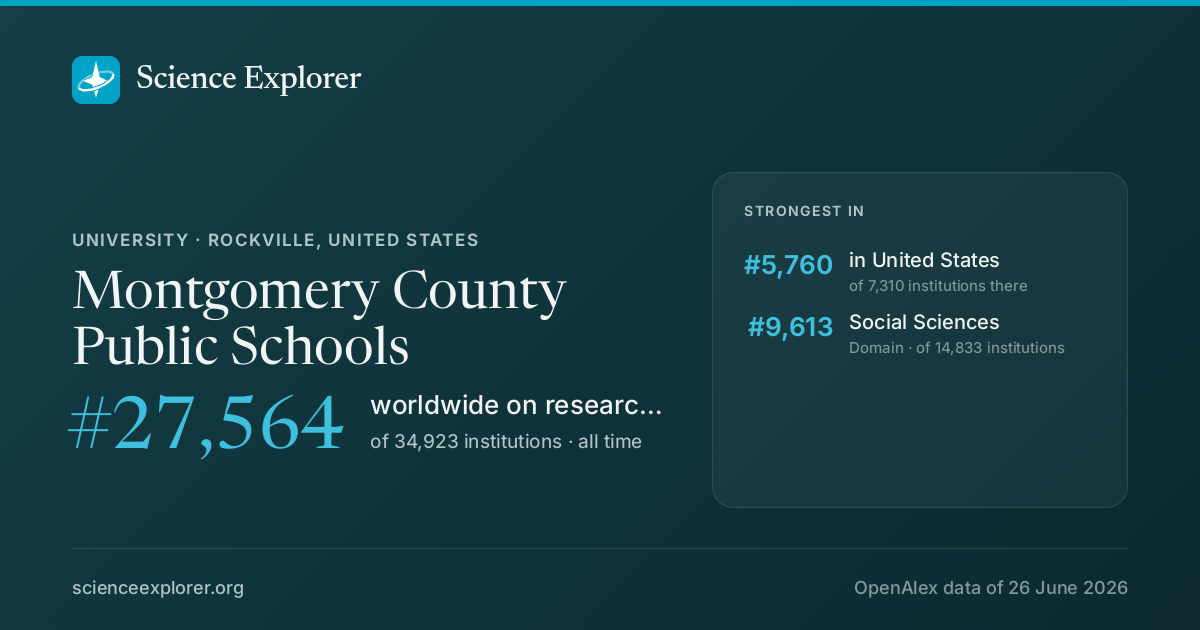
In research, Montgomery County Public Schools stands highest in Social Sciences (#9,613 of 14,833 worldwide), over all time.
- World rank, all time
- #27,564 of 34,923
- Rank in United States
- #5,760 of 7,310
- Research works
- 260 ▼ 55% vs 2018-21
- Citations
- 3.6k 13.8 per fractional work
- Top-10% rate
- 3.6% all institutions 10.0%
- vs its own fields
- 0.84× 1.00× is exactly expected
- Open access
- 9% world 40%
- International
- 2% world 18%
What is Montgomery County Public Schools known for in research?
The fields where it stands highest, over all time, ranked among every institution above the floor in each field.
| Field | World rank | Where that sits | Top-10% rate | Works |
|---|---|---|---|---|
| Social SciencesDomain | #9,613 of 14,833 | 7.5% | 188 |
Each strip is that field's whole ranked pool, with the notch where Montgomery County Public Schools sits in it, in the colour of the band that rank falls in. The track under the rate is the rate itself: it carries no average mark, because the average differs by field (from about 6% in Dentistry to 21% in Economics).
Which fields of science does Montgomery County Public Schools work in?
In all years, 72% of research at Montgomery County Public Schools is in Social Sciences, 13% in Physical Sciences. Its largest fields are Social Sciences (41%), Psychology (20%), Arts and Humanities (6%). It does 3.3× the world's share of Social Sciences.
Each ring splits the one inside it: the four domains of science, their fields, their subfields. Size is fractional works in all years. Every slice is a page; the interactive view zooms down to single topics and colours each by how much more of it this institution does than the world.
Its 4 domains and 24 fields, with their numbers
- Social Sciences18872.2%
- Social Sciences10740.9%
- Psychology5320.3%
- Arts and Humanities166.1%
- Decision Sciences72.9%
- Business, Management and Accounting31.2%
- Economics, Econometrics and Finance20.8%
- Physical Sciences3413.1%
- Computer Science124.7%
- Mathematics72.7%
- Engineering51.9%
- Environmental Science41.4%
- Physics and Astronomy20.8%
- Chemical Engineering10.5%
- Energy10.4%
- Earth and Planetary Sciences10.3%
- Chemistry10.3%
- Materials Science00.1%
- Health Sciences238.7%
- Medicine124.8%
- Health Professions103.8%
- Nursing00.2%
- Life Sciences166.0%
Field profile
Location quotient across every field it publishes in: outside the ring is more than an institution of this size would be expected to publish, inside it is less.
Rings at 0.5×, 1× and 2×. Widest outward: Psychology, 8.9×. Every wedge is a field page.
All 13 fields, with their numbers
- Psychology8.92×4 works
- Mathematics3.08×0 works
- Social Sciences2.72×5 works
- Neuroscience2.23×0 works
- Business, Management and Accounting1.87×1 works
- Health Professions1.30×0 works
- Computer Science1.12×1 works
- Arts and Humanities1.09×0 works
- Nursing0.82×0 works
- Physics and Astronomy0.54×0 works
- Engineering0.48×1 works
- Economics, Econometrics and Finance0.28×0 works
- Agricultural and Biological Sciences0.08×0 works
- Psychology 8.9×
- Mathematics 3.1×
- Social Sciences 2.7×
- Neuroscience 2.2×
- Business, Management and Accounting 1.9×
- Health Professions 1.3×
- Computer Science 1.1×
- Arts and Humanities 1.1×
- Nursing 0.8×
- Physics and Astronomy 0.5×
- Engineering 0.5×
- Economics, Econometrics and Finance 0.3×
- Agricultural and Biological Sciences 0.1×
Who are the top researchers at Montgomery County Public Schools?
Ranked on the quality score, Rich Weinfeld, Sue Jeweler and Alana D. Murray lead among researchers whose main affiliation is Montgomery County Public Schools.
- 1
Rich Weinfeld
 United States · #2,948,088 worldwide
133 citations · 43 works
- 2
Sue Jeweler
United States · #3,155,322 worldwide
139 citations · 50 works
- 3
Alana D. Murray
United States · #3,200,614 worldwide
44 citations · 16 works
- 4
Myriam Met
United States · #3,277,234 worldwide
1k citations · 48 works
- 5
Betty Roffman Shevitz
United States · #3,331,785 worldwide
121 citations · 22 works
- 6
Linda Barnes‐Robinson
United States · #3,488,837 worldwide
122 citations · 24 works
- 7
N. James Myerberg
United States · #4,546,873 worldwide
13 citations · 16 works
- 8
Thomas E. Rowan
United States · #4,835,047 worldwide
56 citations · 31 works
- 9
William M. Richardson
United States · #4,887,245 worldwide
27 citations · 28 works
- 10
Stanley A. Fagen
United States · #5,042,919 worldwide
113 citations · 30 works
Which keywords describe research at Montgomery County Public Schools?
By fractional works in all years, weighted toward what it does more of than the world: Educational Technology, Special Education, Technology Integration, Academic Achievement, Education, Evidence-Based Practice, Teacher Professional Development and Student Achievement.
- Mathematics Education
- Classroom Interaction
- Teacher Preparation
- Language Development
- Higher Education
- Multilingualism
- Child Development
- Reflective Practice
- Family Quality of Life
- Parenting Stress
- Learning Outcomes
- Resilience
- Executive Functioning
- Functional Analysis
- Professional Development
- Student Achievement
- Mental Health
- Evidence-Based Practice
- Technology Integration
- Educational Technology
- Education
- Special Education
- Academic Achievement
- Teacher Professional Development
- Quality of Life
- Student Engagement
- Behavioral Interventions
- Meta-Analysis
- Parental Involvement
- Genetics
- Coping Strategies
- Caregiver Well-Being
- Pedagogy
- Adolescents
- Language Policy
- Teacher Training
- Professional Learning Communities
- Student Perceptions
- Autism Spectrum Disorders
- Interactive Whiteboards
Size is fractional works in all years in the topics tagged with each word; colour is the word's share of this institution's work against its share of the world's. The 40 words are chosen for being large and distinctive. Each links to the topic it comes from most.
All 40 words, with their numbers
- Education16▲ 4.6×21 topics
- Educational Technology15▲ 8.5×10 topics
- Special Education15▲ 70×4 topics
- Technology Integration13▲ 26×5 topics
- Academic Achievement13▲ 33×6 topics
- Evidence-Based Practice11▲ 25×4 topics
- Teacher Professional Development11▲ 40×3 topics
- Mental Health11▲ 3.7×16 topics
- Quality of Life11▲ 3.0×13 topics
- Student Achievement10▲ 45×5 topics
- Student Engagement10▲ 15×8 topics
- Professional Development10▲ 24×4 topics
- Behavioral Interventions10▲ 38×1 topic
- Functional Analysis10▲ 62×1 topic
- Meta-Analysis9▲ 6.2×7 topics
- Executive Functioning9▲ 30×2 topics
- Parental Involvement9▲ 36×2 topics
- Resilience8▲ 8.3×6 topics
- Genetics8▲ 4.1×4 topics
- Learning Outcomes8▲ 13×3 topics
- Coping Strategies8▲ 18×2 topics
- Parenting Stress8▲ 43×2 topics
- Caregiver Well-Being7▲ 60×1 topic
- Family Quality of Life7▲ 60×1 topic
- Pedagogy7▲ 7.9×4 topics
- Reflective Practice7▲ 15×4 topics
- Adolescents7▲ 7.6×6 topics
- Child Development7▲ 9.1×5 topics
- Language Policy7▲ 20×2 topics
- Multilingualism7▲ 19×2 topics
- Teacher Training7▲ 6.6×9 topics
- Higher Education7▲ 6.8×9 topics
- Professional Learning Communities7▲ 55×2 topics
- Language Development7▲ 16×5 topics
- Student Perceptions6▲ 17×5 topics
- Teacher Preparation6▲ 34×4 topics
- Autism Spectrum Disorders6▲ 28×2 topics
- Classroom Interaction6▲ 98×1 topic
- Interactive Whiteboards6▲ 98×1 topic
- Mathematics Education6▲ 40×2 topics
Which research topics does Montgomery County Public Schools publish most on?
By volume in 2022-now: Bullying, Victimization, and Aggression, Academic and Historical Perspectives in Psychology, Education Discipline and Inequality and Neuroscience, Education and Cognitive Function.
Area is fractional works; colour is the subfield each topic belongs to.
- 1 Bullying, Victimization, and Aggression Social Psychology 1 works
- 2 Academic and Historical Perspectives in Psychology General Psychology 1 works
- 3 Education Discipline and Inequality Education 1 works
- 4 Neuroscience, Education and Cognitive Function Cognitive Neuroscience 0 works
- 5 Mathematics Education and Pedagogy Applied Mathematics 0 works
- 6 Digital Economy and Work Transformation Sociology and Political Science 0 works
- 7 Innovative Approaches in Technology and Social Development Management of Technology and Innovation 0 works
- 8 Participatory Visual Research Methods Sociology and Political Science 0 works
- 9 Innovative Teaching and Learning Methods Developmental and Educational Psychology 0 works
- 10 Online Learning and Analytics Computer Science Applications 0 works
How open and international is its research?
Against the world's own shares: the tick on each track. Both are shares of its output, so they sit on one scale and can be read against each other as well as against the world.
World: 40% of research is openly available.
World: 18% is written across borders.
How has Montgomery County Public Schools's research output changed?
Output in 2022-2025 was 55% lower than in 2018-2021.
The same series as a ribbon: one cell per year, darker for more. The line above answers how much; this answers when.
Its share of all research
Growing output can still be a shrinking share: all of science grows. This is Montgomery County Public Schools as a percentage of every work published that year, 0.000045% in 2024.
Fractional works of Montgomery County Public Schools over all fractional works that year. How the balance of science has shifted.
Other research institutions in Rockville
- United States Nuclear Regulatory Commission
- Signal Processing (United States)
- Orthopaedic Center
- Biomedical Research Institute
- Westat (United States)
- Research Applications (United States)
- Kai Research (United States)
- Micro Focus (United States)

Share Montgomery County Public Schools's ranking
Badges for a website1Each links back here and updates with every snapshot

Research measures only: rankings here say nothing about teaching, admissions or student experience. Comparable institutions and collaboration partners have tabs of their own, above.
Discussion
Ask a question or share a note about Montgomery County Public Schools. Posts are plain text and can be reported.