New Frontier
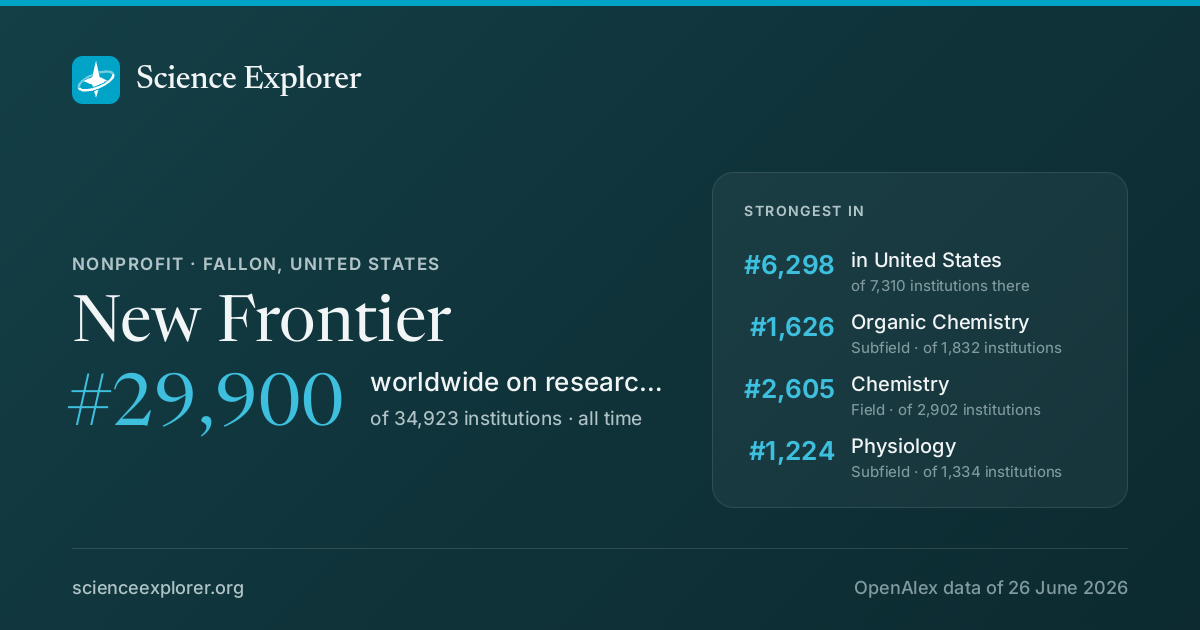
In research, New Frontier stands highest in Organic Chemistry (#1,626 of 1,832 worldwide), Chemistry (#2,605 of 2,902 worldwide) and Physiology (#1,224 of 1,334 worldwide), over all time.
- World rank, all time
- #29,900 of 34,923
- Rank in United States
- #6,298 of 7,310
- Research works
- 3.5k ▼ 38% vs 2018-21
- Citations
- 172k 48.8 per fractional work
- Top-10% rate
- 4.5% all institutions 10.0%
- vs its own fields
- 1.38× 1.00× is exactly expected
- Open access
- 21% world 40%
- International
- 18% world 18%
What is New Frontier known for in research?
The fields where it stands highest, over all time, ranked among every institution above the floor in each field.
| Field | World rank | Where that sits | Top-10% rate | Works |
|---|---|---|---|---|
| Organic ChemistrySubfield | #1,626 of 1,832 | 19.8% | 297 | |
| ChemistryField | #2,605 of 2,902 | 19.0% | 423 | |
| PhysiologySubfield | #1,224 of 1,334 | 8.6% | 167 | |
| NeuroscienceField | #1,982 of 2,157 | 15.3% | 186 | |
| Immunology and MicrobiologyField | #1,512 of 1,587 | 11.6% | 201 | |
| Molecular BiologySubfield | #3,564 of 3,729 | 12.7% | 715 | |
| Biochemistry, Genetics and Molecular BiologyField | #5,574 of 5,801 | 12.4% | 986 | |
| ImmunologySubfield | #1,110 of 1,141 | 11.4% | 147 | |
| OncologySubfield | #1,442 of 1,474 | 11.3% | 121 | |
| MedicineField | #14,304 of 14,558 | 10.2% | 1,222 |
Each strip is that field's whole ranked pool, with the notch where New Frontier sits in it, in the colour of the band that rank falls in. The track under the rate is the rate itself: it carries no average mark, because the average differs by field (from about 6% in Dentistry to 21% in Economics).
Which fields of science does New Frontier work in?
In all years, 43% of research at New Frontier is in Life Sciences, 37% in Health Sciences. Its largest fields are Medicine (35%), Biochemistry, Genetics and Molecular Biology (28%), Chemistry (12%). It does 2.9× the world's share of Life Sciences.
Each ring splits the one inside it: the four domains of science, their fields, their subfields. Size is fractional works in all years. Every slice is a page; the interactive view zooms down to single topics and colours each by how much more of it this institution does than the world.
Its 4 domains and 26 fields, with their numbers
- Life Sciences1,52643.2%
- Health Sciences1,30336.9%
- Medicine1,22234.6%
- Health Professions320.9%
- Nursing260.7%
- Veterinary210.6%
- Dentistry20.1%
- Physical Sciences60217.1%
- Chemistry42312.0%
- Engineering601.7%
- Materials Science320.9%
- Computer Science300.9%
- Environmental Science280.8%
- Mathematics100.3%
- Chemical Engineering80.2%
- Physics and Astronomy60.2%
- Earth and Planetary Sciences20.0%
- Energy20.0%
- Social Sciences992.8%
- Psychology270.8%
- Economics, Econometrics and Finance210.6%
- Social Sciences190.5%
- Business, Management and Accounting130.4%
- Decision Sciences130.4%
- Arts and Humanities50.2%
Field profile
Location quotient across every field it publishes in: outside the ring is more than an institution of this size would be expected to publish, inside it is less.
Rings at 0.5×, 1× and 2×. Widest outward: Economics, Econometrics and Finance, 17.8×. Every wedge is a field page.
All 14 fields, with their numbers
- Economics, Econometrics and Finance17.77×4 works
- Nursing6.75×0 works
- Decision Sciences3.42×0 works
- Chemistry3.11×0 works
- Agricultural and Biological Sciences1.39×1 works
- Biochemistry, Genetics and Molecular Biology1.33×1 works
- Engineering0.88×1 works
- Business, Management and Accounting0.86×0 works
- Computer Science0.57×0 works
- Medicine0.57×1 works
- Environmental Science0.55×0 works
- Materials Science0.47×0 works
- Physics and Astronomy0.23×0 works
- Psychology0.18×0 works
- Economics, Econometrics and Finance 17.8×
- Nursing 6.8×
- Decision Sciences 3.4×
- Chemistry 3.1×
- Agricultural and Biological Sciences 1.4×
- Biochemistry, Genetics and Molecular Biology 1.3×
- Engineering 0.9×
- Business, Management and Accounting 0.9×
- Computer Science 0.6×
- Medicine 0.6×
- Environmental Science 0.6×
- Materials Science 0.5×
- Physics and Astronomy 0.2×
- Psychology 0.2×
Who are the top researchers at New Frontier?
Ranked on the quality score, David G. Tew, Amy Roshak and Jerry L. Adams lead among researchers whose main affiliation is New Frontier.
- 1
David G. Tew
 United States · #543,614 worldwide
5.4k citations · 76 works
- 2
Amy Roshak
United States · #620,576 worldwide
3.9k citations · 47 works
- 3
Jerry L. Adams
United States · #622,554 worldwide
13k citations · 118 works
- 4
Mark F. Bean
United States · #828,878 worldwide
3k citations · 34 works
- 5
Dean E. McNulty
United States · #968,155 worldwide
14k citations · 57 works
- 6
Ruth J. Mayer
United States · #1,004,901 worldwide
5.4k citations · 96 works
- 7
Martin I. Freed
United States · #1,057,273 worldwide
5.5k citations · 55 works
- 8
James D. Winkler
United States · #1,092,508 worldwide
9.4k citations · 123 works
- 9 Timothy K. Hart #1,139,704 worldwide 3.5k citations · 59 works
- 10
Ganesh M. Sathe
United States · #1,457,509 worldwide
4.3k citations · 106 works
Which keywords describe research at New Frontier?
By fractional works in all years, weighted toward what it does more of than the world: Inflammation, Drug Discovery, Cell Signaling, Pharmacology, Oxidative Stress, Cancer, Reactive Oxygen Species and Synthesis.
- Nuclear Receptors
- Protein-Protein Interactions
- Cancer Progression
- Antiretroviral Therapy
- Neuropeptides
- Monoclonal Antibodies
- Nitric Oxide
- Cardiovascular Diseases
- Anticancer Agents
- G-Protein-Coupled Receptors
- Endothelial Dysfunction
- Hypertension
- Angiogenesis
- Medicinal Chemistry
- Atherosclerosis
- Signal Transduction
- Synthesis
- Cell Signaling
- Epidemiology
- Oxidative Stress
- Inflammation
- Drug Discovery
- Cancer
- Pharmacology
- Reactive Oxygen Species
- Immune Response
- Cancer Therapy
- Molecular Mechanisms
- Crystal Structure
- Glycosylation
- Arrestin
- Vascular Function
- Stress
- NAD(P)H Oxidase
- Anxiety
- Transcriptional Regulation
- Therapeutic Antibodies
- Extracellular Matrix
- Immune Modulation
- Calcitonin Gene-Related Peptide
Size is fractional works in all years in the topics tagged with each word; colour is the word's share of this institution's work against its share of the world's. The 40 words are chosen for being large and distinctive. Each links to the topic it comes from most.
All 40 words, with their numbers
- Inflammation485▲ 5.8×75 topics
- Oxidative Stress217▲ 3.4×52 topics
- Drug Discovery215▲ 15×10 topics
- Epidemiology204▲ 1.44×88 topics
- Cancer193▲ 3.9×46 topics
- Cell Signaling175▲ 15×12 topics
- Pharmacology148▲ 13×15 topics
- Synthesis137▲ 6.6×24 topics
- Reactive Oxygen Species136▲ 7.8×12 topics
- Signal Transduction124▲ 14×6 topics
- Immune Response117▲ 5.4×21 topics
- Atherosclerosis112▲ 8.7×12 topics
- Cancer Therapy111▲ 5.0×17 topics
- Medicinal Chemistry111▲ 8.4×12 topics
- Molecular Mechanisms110▲ 17×4 topics
- Angiogenesis107▲ 7.4×15 topics
- Crystal Structure106▲ 12×6 topics
- Hypertension105▲ 8.4×13 topics
- Glycosylation102▲ 13×3 topics
- Endothelial Dysfunction99▲ 9.6×7 topics
- Arrestin99▲ 35×1 topic
- G-Protein-Coupled Receptors99▲ 35×1 topic
- Vascular Function84▲ 17×3 topics
- Anticancer Agents83▲ 9.3×12 topics
- Stress83▲ 5.8×6 topics
- Cardiovascular Diseases82▲ 20×3 topics
- NAD(P)H Oxidase82▲ 43×1 topic
- Nitric Oxide82▲ 43×1 topic
- Anxiety74▲ 5.8×8 topics
- Monoclonal Antibodies73▲ 14×3 topics
- Transcriptional Regulation72▲ 8.2×9 topics
- Neuropeptides72▲ 19×2 topics
- Therapeutic Antibodies68▲ 15×2 topics
- Antiretroviral Therapy68▲ 8.3×6 topics
- Extracellular Matrix62▲ 7.2×6 topics
- Cancer Progression60▲ 7.5×8 topics
- Immune Modulation59▲ 12×3 topics
- Protein-Protein Interactions57▲ 15×3 topics
- Calcitonin Gene-Related Peptide57▲ 19×2 topics
- Nuclear Receptors55▲ 8.4×5 topics
Which research topics does New Frontier publish most on?
By volume in 2022-now: Financial Markets and Investment Strategies, Complex Systems and Time Series Analysis, Housing Market and Economics and Housing, Finance, and Neoliberalism.
Area is fractional works; colour is the subfield each topic belongs to.
- 1 Financial Markets and Investment Strategies Finance 1 works
- 2 Complex Systems and Time Series Analysis Economics and Econometrics 0 works
- 3 Housing Market and Economics Economics and Econometrics 0 works
- 4 Housing, Finance, and Neoliberalism Finance 0 works
- 5 Biochemical Analysis and Sensing Techniques Nutrition and Dietetics 0 works
- 6 Economic theories and models Economics and Econometrics 0 works
- 7 Metabolomics and Mass Spectrometry Studies Molecular Biology 0 works
- 8 Geophysical Methods and Applications Ocean Engineering 0 works
- 9 Big Data and Digital Economy Information Systems 0 works
- 10 Ultrasonics and Acoustic Wave Propagation Mechanics of Materials 0 works
How open and international is its research?
Against the world's own shares: the tick on each track. Both are shares of its output, so they sit on one scale and can be read against each other as well as against the world.
World: 40% of research is openly available.
World: 18% is written across borders.
How has New Frontier's research output changed?
Output in 2022-2025 was 38% lower than in 2018-2021.
The same series as a ribbon: one cell per year, darker for more. The line above answers how much; this answers when.
Its share of all research
Growing output can still be a shrinking share: all of science grows. This is New Frontier as a percentage of every work published that year, 0.000035% in 2024.
Fractional works of New Frontier over all fractional works that year. How the balance of science has shifted.
How much of it reaches the world top 10%
Year by year, against all institutions in the same year.
Of each year's output, the share that reached the world's 10% most cited for its field and year. Peak 15.5% in 2001.
Share New Frontier's ranking
Badges for a website1Each links back here and updates with every snapshot

Research measures only: rankings here say nothing about teaching, admissions or student experience. Comparable institutions and collaboration partners have tabs of their own, above.
Discussion
Ask a question or share a note about New Frontier. Keep it to the research: no personal attacks, advertising or links. Any reader can report a post, which collapses it for everyone until it is opened.