Science Explorer Back to mapMap
Discussion
University · Saitama · Japan

Nihon Pharmaceutical University

In research, Nihon Pharmaceutical University stands highest in Medicine (#13,298 of 14,558 worldwide), Life Sciences (#10,144 of 11,023 worldwide) and Health Sciences (#15,501 of 16,688 worldwide), over all time.

World rank, 2022-now
#21,503
of 22,385 · #33,387 all time
Rank in Japan
#800
of 924
Research works
411
▲ 17% vs 2018-21
Citations
5.4k
13.0 per fractional work
Top-10% rate
5.5%
all institutions 10.0%
vs its own fields
0.90×
1.00× is exactly expected
Open access
59%
world 40%
International
19%
world 18%

What is Nihon Pharmaceutical University known for in research?

The fields where it stands highest, over all time, ranked among every institution above the floor in each field.

FieldWorld rankWhere that sitsTop-10% rateWorks
MedicineField #13,298 of 14,558 4.9%135
Life SciencesDomain #10,144 of 11,023 4.1%157
Health SciencesDomain #15,501 of 16,688 4.9%152

Each strip is that field's whole ranked pool, with the notch where Nihon Pharmaceutical University sits in it, in the colour of the band that rank falls in. The track under the rate is the rate itself: it carries no average mark, because the average differs by field (from about 6% in Dentistry to 21% in Economics).

Which fields of science does Nihon Pharmaceutical University work in?

In 2022-now, 48% of research at Nihon Pharmaceutical University is in Health Sciences, 32% in Life Sciences. Its largest fields are Medicine (43%), Biochemistry, Genetics and Molecular Biology (16%), Pharmacology, Toxicology and Pharmaceutics (7%). It does 2.2× the world's share of Life Sciences.

Health Sciences: 47 fractional works · 48.1% of its workMedicine: 42 fractional works · 42.9% of its workPhysiology: 4 fractional works · 4.1% of its workEndocrinology, Diabetes and Metabolism: 3 fractional works · 3.1% of its workEpidemiology: 3 fractional works · 3.0% of its workComplementary and alternative medicine: 3 fractional works · 2.8% of its workPharmacology: 3 fractional works · 2.8% of its workPublic Health, Environmental and Occupational Health: 3 fractional works · 2.8% of its workSurgery: 3 fractional works · 2.7% of its workPulmonary and Respiratory Medicine: 3 fractional works · 2.6% of its workOncology: 2 fractional works · 2.4% of its workInfectious Diseases: 2 fractional works · 2.1% of its workPediatrics, Perinatology and Child Health: 2 fractional works · 1.7% of its workPathology and Forensic Medicine: 1 fractional works · 1.3% of its workCardiology and Cardiovascular Medicine: 1 fractional works · 1.2% of its workOphthalmology: 1 fractional works · 1.1% of its workDermatology: 1 fractional works · 1.1% of its workNeurology: 1 fractional works · 1.1% of its workEmergency Medicine: 1 fractional works · 1.0% of its workRheumatology: 1 fractional works · 0.9% of its workRadiology, Nuclear Medicine and Imaging: 1 fractional works · 0.8% of its workGeriatrics and Gerontology: 1 fractional works · 0.7% of its workNephrology: 1 fractional works · 0.6% of its workPsychiatry and Mental health: 0 fractional works · 0.5% of its workGenetics: 0 fractional works · 0.3% of its workGastroenterology: 0 fractional works · 0.3% of its workImmunology and Allergy: 0 fractional works · 0.2% of its workHepatology: 0 fractional works · 0.2% of its workSmaller subfields together: 1 fractional works · 1.5% of its workHealth Professions: 3 fractional works · 2.9% of its workOccupational Therapy: 1 fractional works · 0.9% of its workPharmacy: 1 fractional works · 0.7% of its workGeneral Health Professions: 1 fractional works · 0.6% of its workEmergency Medical Services: 0 fractional works · 0.5% of its workSmaller subfields together: 0 fractional works · 0.2% of its workNursing: 2 fractional works · 1.9% of its workNutrition and Dietetics: 2 fractional works · 1.9% of its workSmaller subfields together: 0 fractional works · 0.1% of its workVeterinary: 0 fractional works · 0.3% of its workDentistry: 0 fractional works · 0.1% of its workLife Sciences: 32 fractional works · 32.5% of its workBiochemistry, Genetics and Molecular Biology: 15 fractional works · 15.7% of its workMolecular Biology: 9 fractional works · 8.9% of its workCell Biology: 2 fractional works · 2.0% of its workGenetics: 1 fractional works · 1.0% of its workCancer Research: 1 fractional works · 1.0% of its workPhysiology: 1 fractional works · 0.7% of its workBiochemistry: 1 fractional works · 0.6% of its workBiophysics: 1 fractional works · 0.6% of its workMolecular Medicine: 0 fractional works · 0.4% of its workClinical Biochemistry: 0 fractional works · 0.3% of its workSmaller subfields together: 0 fractional works · 0.1% of its workPharmacology, Toxicology and Pharmaceutics: 6 fractional works · 6.6% of its workPharmacology: 5 fractional works · 5.2% of its workToxicology: 1 fractional works · 1.1% of its workPharmaceutical Science: 0 fractional works · 0.3% of its workNeuroscience: 4 fractional works · 4.4% of its workCognitive Neuroscience: 1 fractional works · 0.9% of its workNeurology: 1 fractional works · 0.7% of its workEndocrine and Autonomic Systems: 1 fractional works · 0.7% of its workSensory Systems: 1 fractional works · 0.7% of its workCellular and Molecular Neuroscience: 1 fractional works · 0.6% of its workBiological Psychiatry: 0 fractional works · 0.5% of its workSmaller subfields together: 0 fractional works · 0.3% of its workAgricultural and Biological Sciences: 3 fractional works · 3.2% of its workPlant Science: 1 fractional works · 1.4% of its workFood Science: 1 fractional works · 0.7% of its workForestry: 0 fractional works · 0.5% of its workAquatic Science: 0 fractional works · 0.3% of its workSmaller subfields together: 0 fractional works · 0.2% of its workImmunology and Microbiology: 2 fractional works · 2.6% of its workImmunology: 1 fractional works · 1.5% of its workMicrobiology: 1 fractional works · 0.5% of its workApplied Microbiology and Biotechnology: 0 fractional works · 0.3% of its workSmaller subfields together: 0 fractional works · 0.2% of its workPhysical Sciences: 14 fractional works · 13.9% of its workChemistry: 6 fractional works · 6.1% of its workOrganic Chemistry: 4 fractional works · 4.4% of its workAnalytical Chemistry: 1 fractional works · 1.0% of its workSpectroscopy: 1 fractional works · 0.7% of its workSmaller subfields together: 0 fractional works · 0.1% of its workEnvironmental Science: 3 fractional works · 3.2% of its workHealth, Toxicology and Mutagenesis: 1 fractional works · 1.3% of its workWater Science and Technology: 1 fractional works · 0.9% of its workPollution: 0 fractional works · 0.4% of its workIndustrial and Manufacturing Engineering: 0 fractional works · 0.3% of its workEcology: 0 fractional works · 0.2% of its workSmaller subfields together: 0 fractional works · 0.1% of its workEngineering: 2 fractional works · 1.7% of its workMechanical Engineering: 1 fractional works · 0.6% of its workAutomotive Engineering: 0 fractional works · 0.3% of its workBiomedical Engineering: 0 fractional works · 0.3% of its workSmaller subfields together: 0 fractional works · 0.4% of its workMaterials Science: 1 fractional works · 1.3% of its workMaterials Chemistry: 1 fractional works · 1.1% of its workSmaller subfields together: 0 fractional works · 0.2% of its workComputer Science: 1 fractional works · 0.9% of its workInformation Systems: 1 fractional works · 0.6% of its workComputational Theory and Mathematics: 0 fractional works · 0.2% of its workSmaller subfields together: 0 fractional works · 0.2% of its workEarth and Planetary Sciences: 0 fractional works · 0.4% of its workAtmospheric Science: 0 fractional works · 0.3% of its workSmaller subfields together: 0 fractional works · 0.1% of its workMathematics: 0 fractional works · 0.3% of its workStatistics and Probability: 0 fractional works · 0.3% of its workSocial Sciences: 5 fractional works · 5.5% of its workPsychology: 2 fractional works · 2.0% of its workSocial Psychology: 1 fractional works · 1.1% of its workClinical Psychology: 0 fractional works · 0.5% of its workExperimental and Cognitive Psychology: 0 fractional works · 0.4% of its workSmaller subfields together: 0 fractional works · 0.0% of its workEconomics, Econometrics and Finance: 1 fractional works · 1.5% of its workEconomics and Econometrics: 1 fractional works · 1.5% of its workSocial Sciences: 1 fractional works · 1.0% of its workSafety Research: 0 fractional works · 0.5% of its workTransportation: 0 fractional works · 0.3% of its workSmaller subfields together: 0 fractional works · 0.2% of its workDecision Sciences: 1 fractional works · 0.7% of its workManagement Science and Operations Research: 0 fractional works · 0.5% of its workSmaller subfields together: 0 fractional works · 0.2% of its workBusiness, Management and Accounting: 0 fractional works · 0.3% of its workMarketing: 0 fractional works · 0.3% of its workALL ITS WORKNihonPharmaceutical…98fractional works, 2022-now
Life Sciences32%Physical Sciences14%Health Sciences48%Social Sciences5%

Each ring splits the one inside it: the four domains of science, their fields, their subfields. Size is fractional works in 2022-now. Every slice is a page; the interactive view zooms down to single topics and colours each by how much more of it this institution does than the world.

Its 4 domains and 22 fields, with their numbers
    1. Medicine4242.9%
    2. Health Professions32.9%
    3. Nursing21.9%
    4. Veterinary00.3%
    5. Dentistry00.1%
    1. Biochemistry, Genetics and Molecular Biology1515.7%
    2. Pharmacology, Toxicology and Pharmaceutics66.6%
    3. Neuroscience44.4%
    4. Agricultural and Biological Sciences33.2%
    5. Immunology and Microbiology22.6%
    1. Chemistry66.1%
    2. Environmental Science33.2%
    3. Engineering21.7%
    4. Materials Science11.3%
    5. Computer Science10.9%
    6. Earth and Planetary Sciences00.4%
    7. Mathematics00.3%
    1. Psychology22.0%
    2. Economics, Econometrics and Finance11.5%
    3. Social Sciences11.0%
    4. Decision Sciences10.7%
    5. Business, Management and Accounting00.3%
All of science, and how each field's share has moved since 1950: the Science domain explorer

Field profile

Location quotient across every field it publishes in: outside the ring is more than an institution of this size would be expected to publish, inside it is less.

Agricultural and Biological Sciences: 0.68× its world share, 3 worksAgricultural and Bio…Biochemistry, Genetics and Molecular Biology: 2.94× its world share, 15 worksBiochemistry, Geneti…Immunology and Microbiology: 2.54× its world share, 2 worksImmunology and Micro…Neuroscience: 2.73× its world share, 4 worksNeurosciencePharmacology, Toxicology and Pharmaceutics: 18.74× its world share, 6 worksPharmacology, Toxico…Chemistry: 3.90× its world share, 6 worksChemistryComputer Science: 0.12× its world share, 1 worksComputer ScienceEarth and Planetary Sciences: 0.27× its world share, 0 worksEarth and Planetary …Engineering: 0.11× its world share, 2 worksEngineeringEnvironmental Science: 0.64× its world share, 3 worksEnvironmental ScienceMaterials Science: 0.37× its world share, 1 worksMaterials ScienceMathematics: 0.24× its world share, 0 worksMathematicsDentistry: 0.26× its world share, 0 worksDentistryHealth Professions: 1.11× its world share, 3 worksHealth ProfessionsMedicine: 2.23× its world share, 42 worksMedicineNursing: 3.93× its world share, 2 worksNursingVeterinary: 2.09× its world share, 0 worksVeterinaryBusiness, Management and Accounting: 0.08× its world share, 0 worksBusiness, Management…Decision Sciences: 0.71× its world share, 1 worksDecision SciencesEconomics, Econometrics and Finance: 0.70× its world share, 2 worksEconomics, Econometr…Psychology: 0.66× its world share, 2 worksPsychologySocial Sciences: 0.08× its world share, 1 worksSocial Sciences1×world share
more than its size predictsabout as predictedless

Rings at 0.5×, 1× and 2×. Widest outward: Pharmacology, Toxicology and Pharmaceutics, 18.7×. Every wedge is a field page.

All 22 fields, with their numbers
  1. Pharmacology, Toxicology and Pharmaceutics18.74×6 works
  2. Nursing3.93×2 works
  3. Chemistry3.90×6 works
  4. Biochemistry, Genetics and Molecular Biology2.94×15 works
  5. Neuroscience2.73×4 works
  6. Immunology and Microbiology2.54×2 works
  7. Medicine2.23×42 works
  8. Veterinary2.09×0 works
  9. Health Professions1.11×3 works
  10. Decision Sciences0.71×1 works
  11. Economics, Econometrics and Finance0.70×2 works
  12. Agricultural and Biological Sciences0.68×3 works
  13. Psychology0.66×2 works
  14. Environmental Science0.64×3 works
  15. Materials Science0.37×1 works
  16. Earth and Planetary Sciences0.27×0 works
  17. Dentistry0.26×0 works
  18. Mathematics0.24×0 works
  19. Computer Science0.12×1 works
  20. Engineering0.11×2 works
  21. Business, Management and Accounting0.08×0 works
  22. Social Sciences0.08×1 works

Who are the top researchers at Nihon Pharmaceutical University?

Ranked on the quality score, Sachiko Ohta, Ken-ichi Sako and Minoru Tsuzuki lead among researchers whose main affiliation is Nihon Pharmaceutical University.

  1. 1 Sachiko Ohta Japan · #3,659,323 worldwide 2.1k citations · 35 works
  2. 2 Ken-ichi Sako Japan · #4,919,701 worldwide 400 citations · 35 works
  3. 3 Minoru Tsuzuki Japan · #5,057,179 worldwide 1.1k citations · 41 works
  4. 4 Naohito Ide Japan · #5,482,203 worldwide 88 citations · 23 works
  5. 5 Kazunori Tsuchida Japan · #5,656,888 worldwide 520 citations · 22 works
  6. 6 Toshiyuki Higuchi Japan · #5,671,948 worldwide 579 citations · 34 works
  7. 7 Tatsuya Wada Japan · #5,756,204 worldwide 111 citations · 26 works
  8. 8 Takuro Kurita Japan · #5,999,641 worldwide 123 citations · 18 works
  9. 9 Atsushi Ishimura Japan · #6,279,225 worldwide 37 citations · 16 works
  10. 10 Takanori Nakajima Japan · #6,377,415 worldwide 1.1k citations · 64 works
All ranked researchers at Nihon Pharmaceutical University

What are the most cited papers from Nihon Pharmaceutical University?

The most cited paper from Nihon Pharmaceutical University is "Guidelines for the use and interpretation of assays for monitoring autophagy (4th edition) 1" (Daniel J. Klionsky et al., 2021), with 2,743 citations. Next come "Nuclear Hormone Receptor Activity of Polybrominated Diphenyl Ethers and Their Hydroxylated and Methoxylated Metabolites in Transactivation Assays Using Chinese Hamster Ovary Cells" (225) and "Profiling of bisphenol A and eight of its analogues on transcriptional activity via human nuclear receptors" (160).

Most cited papers
#PaperReleasedCitations
1 Guidelines for the use and interpretation of assays for monitoring autophagy (4th edition) 1 Daniel J. Klionsky et al. · Autophagy Open access2,930 authors 2 Jan 2021 2,743
2 Nuclear Hormone Receptor Activity of Polybrominated Diphenyl Ethers and Their Hydroxylated and Methoxylated Metabolites in Transactivation Assays Using Chinese Hamster Ovary Cells Hiroyuki Kojima, Shinji Takeuchi, Naoto Uramaru et al. · Environmental Health Perspectives Open access 27 Apr 2009 225
3 Profiling of bisphenol A and eight of its analogues on transcriptional activity via human nuclear receptors Hiroyuki Kojima, Shinji Takeuchi, Seigo Sanoh et al. · Toxicology 21 Dec 2018 160
4 Calorimetric Investigation of the Structural Relaxation of Amorphous Materials: Evaluating Validity of the Methodologies Kohsaku Kawakami, Michael Jon Pikal · Journal of Pharmaceutical Sciences 25 Mar 2005 159
5 Isobavachalcone, a Chalcone Constituent of Angelica keiskei, Induces Apoptosis in Neuroblastoma Reiko Nishimura, Keiichi Tabata, Motoki Arakawa et al. · Biological and Pharmaceutical Bulletin Open access 2007 157
All 60 most cited papers, with filters and sorting

Which keywords describe research at Nihon Pharmaceutical University?

By fractional works in 2022-now, weighted toward what it does more of than the world: Inflammation, Oxidative Stress, Adverse Drug Reactions, Cancer, Metabolism, Alkaloids, Insulin Resistance and Cardiovascular Disease.

▲ more of its work than of the world's◆ about the world's share▼ less than the world's

Size is fractional works in 2022-now in the topics tagged with each word; colour is the word's share of this institution's work against its share of the world's. The 40 words are chosen for being large and distinctive. Each links to the topic it comes from most.

All 40 words, with their numbers
  1. Inflammation10▲ 4.5×40 topics
  2. Oxidative Stress8▲ 4.6×33 topics
  3. Cancer5▲ 4.0×20 topics
  4. Epidemiology5▲ 1.31×28 topics
  5. Adverse Drug Reactions5▲ 89×3 topics
  6. Cardiovascular Disease4▲ 3.4×15 topics
  7. Metabolism3▲ 6.6×14 topics
  8. Antioxidant3▲ 4.6×13 topics
  9. Obesity3▲ 4.1×12 topics
  10. Alkaloids3▲ 63×5 topics
  11. Insulin Resistance3▲ 6.5×7 topics
  12. Aging3▲ 5.3×9 topics
  13. Metabolic Syndrome3▲ 3.4×10 topics
  14. Treatment3▲ 2.3×13 topics
  15. Clinical Trials3▲ 4.0×9 topics
  16. Heart Failure2▲ 5.8×6 topics
  17. Pharmacological Effects2▲ 40×4 topics
  18. Synthesis2▲ 6.7×8 topics
  19. Total Synthesis2▲ 74×3 topics
  20. Clinical Pharmacy2▲ 225×1 topic
  21. Pharmaceutical Care2▲ 225×1 topic
  22. Herbal Medicine2▲ 8.0×4 topics
  23. Clinical Guidelines2▲ 7.2×5 topics
  24. Neurodegeneration2▲ 7.0×7 topics
  25. Prevention2▲ 4.8×6 topics
  26. Antiretroviral Therapy2▲ 11×4 topics
  27. Metabolic Regulation2▲ 11×5 topics
  28. Mitochondrial Dysfunction2▲ 6.2×7 topics
  29. Adverse Effects2▲ 37×2 topics
  30. Anti-inflammatory2▲ 6.0×9 topics
  31. Anticancer2▲ 10×6 topics
  32. Apoptosis2▲ 5.7×8 topics
  33. Pharmacokinetics2▲ 6.5×7 topics
  34. Toxicology2▲ 10×3 topics
  35. Kratom2▲ 188×1 topic
  36. Mitragyna Speciosa2▲ 188×1 topic
  37. Traditional Medicine2▲ 12×2 topics
  38. Type 2 Diabetes2▲ 7.1×3 topics
  39. HIV Infection2▲ 15×2 topics
  40. Nuclear Receptors2▲ 17×3 topics

Which research topics does Nihon Pharmaceutical University publish most on?

By volume in 2022-now: Pharmacy and Medical Practices, Alkaloids: synthesis and pharmacology, Pharmaceutical studies and practices and HIV/AIDS drug development and treatment.

  1. 1 Pharmacy and Medical Practices Pharmacology 2 works
  2. 2 Alkaloids: synthesis and pharmacology Pharmacology 2 works
  3. 3 Pharmaceutical studies and practices Pediatrics, Perinatology and Child Health 1 works
  4. 4 HIV/AIDS drug development and treatment Infectious Diseases 1 works
  5. 5 Pharmacovigilance and Adverse Drug Reactions Toxicology 1 works
  6. 6 Diabetes Treatment and Management Endocrinology, Diabetes and Metabolism 1 works
  7. 7 Complementary and Alternative Medicine Studies Complementary and alternative medicine 1 works
  8. 8 Drug Transport and Resistance Mechanisms Oncology 1 works
  9. 9 Color perception and design Social Psychology 1 works
  10. 10 Inhalation and Respiratory Drug Delivery Pulmonary and Respiratory Medicine 1 works

How open and international is its research?

Against the world's own shares: the tick on each track. Both are shares of its output, so they sit on one scale and can be read against each other as well as against the world.

openly available58.9%not open41.1%

World: 40% of research is openly available.

with international co-authors18.6%domestic only81.4%

World: 18% is written across borders.

How has Nihon Pharmaceutical University's research output changed?

Output in 2022-2025 was 17% higher than in 2018-2021.

still counting1990200020102020
grewheldshrank

The same series as a ribbon: one cell per year, darker for more. The line above answers how much; this answers when.

Its share of all research

Growing output can still be a shrinking share: all of science grows. This is Nihon Pharmaceutical University as a percentage of every work published that year, 0.00046% in 2024.

still counting0.00050%0.0010%Nihon Pharmaceutical University0.00034% in 202519801990200020102020

Fractional works of Nihon Pharmaceutical University over all fractional works that year. How the balance of science has shifted.

How much of it reaches the world top 10%

Year by year, against all institutions in the same year.

5%10%all institutions10.0% in 2024Nihon Pharmaceutical University2.3% in 202420102020

Of each year's output, the share that reached the world's 10% most cited for its field and year. Peak 7.4% in 2007.

Other research institutions in Saitama

All research institutions in Saitama

Share Nihon Pharmaceutical University's ranking
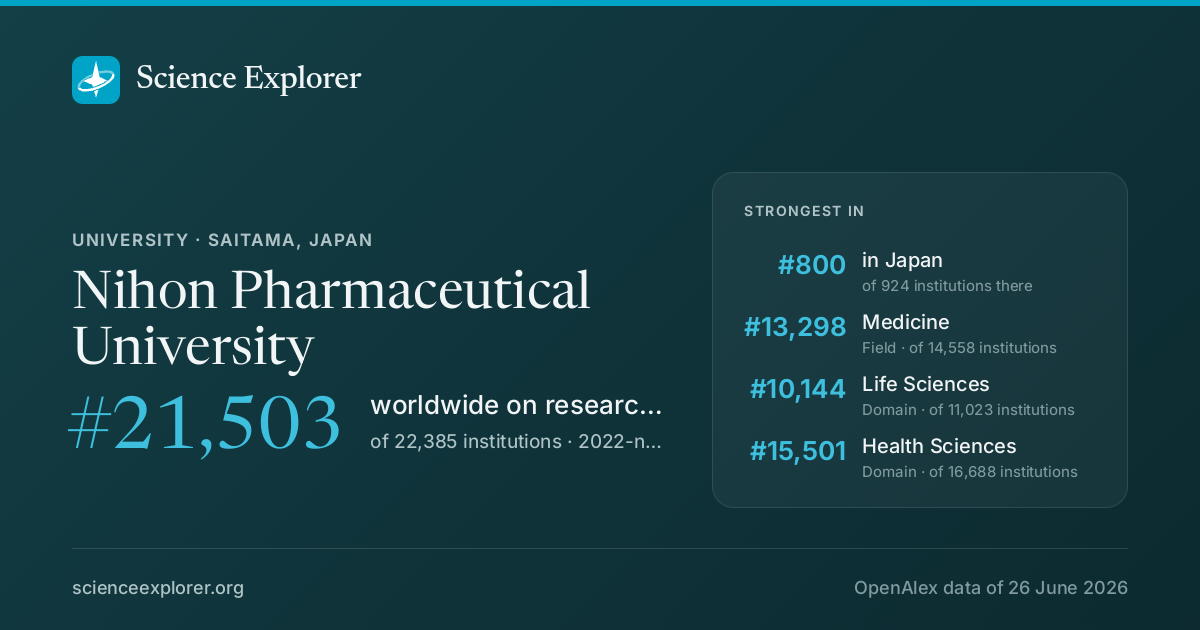
Nihon Pharmaceutical University on Science Explorer

A card with Nihon Pharmaceutical University's standing and the fields it leads in, for a post or a slide. A link to this page previews as the same card.

Download the card

1200 × 630 PNG, sized for social posts, drawn from the latest snapshot.

Badges for a website1Each links back here and updates with every snapshot

Research measures only: rankings here say nothing about teaching, admissions or student experience. Comparable institutions and collaboration partners have tabs of their own, above.

Discussion

Ask a question or share a note about Nihon Pharmaceutical University. Posts are plain text and can be reported.
