SickKids Foundation
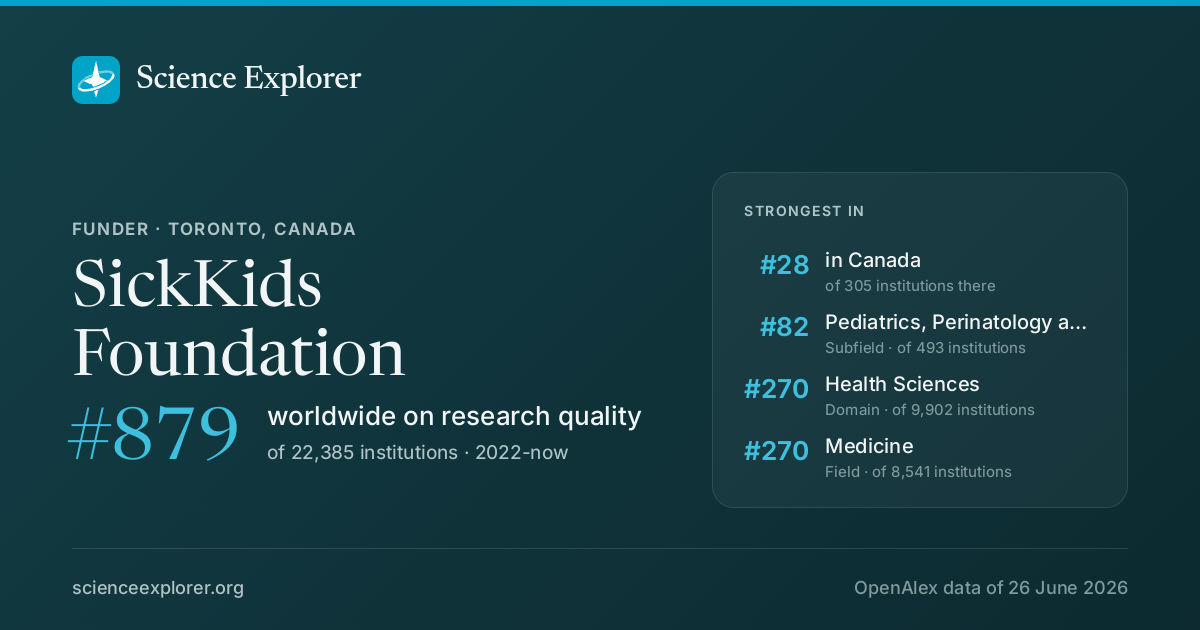
In research, SickKids Foundation stands highest in Health Sciences (#270 of 9,902 worldwide), Medicine (#270 of 8,541 worldwide) and Life Sciences (#520 of 6,403 worldwide), 2022-now. Relative to its size it is most specialised in Pediatrics, Perinatology and Child Health and Genetics (Pediatrics, Perinatology and Child Health is 8.8× its share of world research).
- World rank, 2022-now
- #879 of 22,385 · #735 all time
- Rank in Canada
- #28 of 305
- Research works
- 6.3k ▼ 4% vs 2018-21
- Citations
- 272k 43.1 per fractional work
- Top-10% rate
- 13.9% all institutions 10.0%
- vs its own fields
- 1.26× 1.00× is exactly expected
- Open access
- 38% world 40%
- International
- 38% world 18%
What is SickKids Foundation known for in research?
The fields where it stands highest, 2022-now, ranked among every institution above the floor in each field.
| Field | World rank | Where that sits | Top-10% rate | Works | All time |
|---|---|---|---|---|---|
| Health SciencesDomain | #270 of 9,902 | 15.1% | 611 | #228 | |
| MedicineField | #270 of 8,541 | 15.3% | 535 | #231 | |
| Life SciencesDomain | #520 of 6,403 | 10.4% | 206 | #461 | |
| Biochemistry, Genetics and Molecular BiologyField | #399 of 2,964 | 9.7% | 132 | #419 | |
| SurgerySubfield | #242 of 1,532 | 19.4% | 61 | #187 | |
| Pediatrics, Perinatology and Child HealthSubfield | #82 of 493 | 16.5% | 62 | #65 | |
| Molecular BiologySubfield | #428 of 1,880 | 10.6% | 61 | #447 | |
| Social SciencesDomain | #3,043 of 9,585 | 12.4% | 76 | #1996 |
Each strip is that field's whole ranked pool, with the notch where SickKids Foundation sits in it, in the colour of the band that rank falls in. The track under the rate is the rate itself: it carries no average mark, because the average differs by field (from about 6% in Dentistry to 21% in Economics).
Which of those standings moved
The same fields on both windows: where it stood over the whole record, and where it stands in 2022-now. The distance is the story, and it is the one thing the two rank columns above cannot show.
- Health Sciences#228 #270
- Medicine#231 #270
- Life Sciences#461 #520
- Biochemistry, Genetics and Molecular Biology#419 #399
- Surgery#187 #242
- Pediatrics, Perinatology and Child Health#65 #82
- Molecular Biology#447 #428
- Social Sciences#1,996 #3,043
A dot further right is a better standing. Fields it was not ranked in over the whole record are left out.
Which fields of science does SickKids Foundation work in?
In 2022-now, 65% of research at SickKids Foundation is in Health Sciences, 22% in Life Sciences. Its largest fields are Medicine (57%), Biochemistry, Genetics and Molecular Biology (14%), Health Professions (6%). It does 2.8× the world's share of Health Sciences.
Each ring splits the one inside it: the four domains of science, their fields, their subfields. Size is fractional works in 2022-now. Every slice is a page; the interactive view zooms down to single topics and colours each by how much more of it this institution does than the world.
Its 4 domains and 24 fields, with their numbers
- Health Sciences67965.2%
- Medicine59657.2%
- Health Professions595.6%
- Nursing212.0%
- Dentistry40.3%
- Veterinary00.0%
- Life Sciences23022.1%
- Social Sciences878.4%
- Physical Sciences454.3%
- Engineering171.6%
- Environmental Science70.7%
- Computer Science70.7%
- Mathematics60.6%
- Physics and Astronomy30.3%
- Chemistry20.2%
- Materials Science10.1%
- Earth and Planetary Sciences10.1%
What does SickKids Foundation specialise in?
Where its research is concentrated relative to its size: Pediatrics, Perinatology and Child Health takes 8.8× the share of its output that it takes of world research.
- Pediatrics, Perinatology and Child HealthSubfield · 68.8 works8.8×
- GeneticsSubfield · 50.8 works5.9×
Location quotient, a volume reading rather than an impact one. It surfaces small, lopsided specialities.
Field profile
Location quotient across every field it publishes in: outside the ring is more than an institution of this size would be expected to publish, inside it is less.
Rings at 0.5×, 1× and 2×. Widest outward: Nursing, 4.0×. Every wedge is a field page.
All 24 fields, with their numbers
- Nursing4.03×21 works
- Neuroscience3.05×51 works
- Medicine2.98×596 works
- Biochemistry, Genetics and Molecular Biology2.65×147 works
- Immunology and Microbiology2.30×24 works
- Health Professions2.13×58 works
- Psychology1.30×41 works
- Dentistry0.70×4 works
- Mathematics0.51×6 works
- Pharmacology, Toxicology and Pharmaceutics0.49×2 works
- Economics, Econometrics and Finance0.42×9 works
- Decision Sciences0.36×4 works
- Veterinary0.32×0 works
- Social Sciences0.21×28 works
- Chemistry0.14×2 works
- Environmental Science0.14×7 works
- Physics and Astronomy0.14×3 works
- Agricultural and Biological Sciences0.11×6 works
- Engineering0.11×17 works
- Computer Science0.08×7 works
- Arts and Humanities0.08×2 works
- Business, Management and Accounting0.08×3 works
- Earth and Planetary Sciences0.05×1 works
- Materials Science0.04×2 works
- Nursing 4.0×
- Neuroscience 3.0×
- Medicine 3.0×
- Biochemistry, Genetics and Molecular Biology 2.6×
- Immunology and Microbiology 2.3×
- Health Professions 2.1×
- Psychology 1.3×
- Dentistry 0.7×
- Mathematics 0.5×
- Pharmacology, Toxicology and Pharmaceutics 0.5×
- Economics, Econometrics and Finance 0.4×
- Decision Sciences 0.4×
- Veterinary 0.3×
- Social Sciences 0.2×
- Chemistry 0.1×
- Environmental Science 0.1×
- Physics and Astronomy 0.1×
- Agricultural and Biological Sciences 0.1×
- Engineering 0.1×
- Computer Science 0.1×
- Arts and Humanities 0.1×
- Business, Management and Accounting 0.1×
- Earth and Planetary Sciences 0.1×
- Materials Science 0.0×
Who are the top researchers at SickKids Foundation?
Ranked on the quality score, Tyler Vaivada, Sherri L. Adams and Ellen Go lead among researchers whose main affiliation is SickKids Foundation.
- 1
Tyler Vaivada
 Canada · #419,816 worldwide
1.5k citations · 34 works
- 2
Sherri L. Adams
Canada · #1,396,211 worldwide
680 citations · 47 works
- 3
Ellen Go
Canada · #1,478,240 worldwide
424 citations · 15 works
- 4
Karen M O’Callaghan
Canada · #1,573,094 worldwide
383 citations · 34 works
- 5
Nicholas Carman
Canada · #1,803,305 worldwide
938 citations · 69 works
- 6
Erin Culbert
Canada · #3,132,511 worldwide
129 citations · 19 works
- 7
Leah Bartlett
Canada · #3,236,965 worldwide
140 citations · 25 works
Which keywords describe research at SickKids Foundation?
By fractional works in 2022-now, weighted toward what it does more of than the world: Epidemiology, Inflammation, Genetics, Adolescents, Genetic Mutations, Neurodevelopmental Outcomes, Preterm Infants and Children.
- Temozolomide
- Glioblastoma
- Pediatric Quality of Life Inventory
- Epilepsy
- Cognitive Function
- Psychosocial Outcomes
- Cerebral Palsy
- Autism Spectrum Disorders
- Genetic Variants
- Critical Care
- Prenatal Diagnosis
- Health-related Quality of Life
- Children
- Preterm Infants
- Immunotherapy
- Management
- Cancer
- Treatment
- Genetic Mutations
- Inflammation
- Epidemiology
- Genetics
- Adolescents
- Neurodevelopmental Outcomes
- Quality of Life
- Diagnosis
- Neurological Disorders
- Depression
- Prevalence
- Pulmonary Hypertension
- Executive Functioning
- Congenital Heart Disease
- Mortality Risk
- Neurodevelopmental Disorders
- Respiratory Distress Syndrome
- Cardiac Surgery
- Molecular Classification
- Childhood Cancer Survivor Study
- Adult Congenital Heart Disease
- Pulmonary Valve Replacement
Size is fractional works in 2022-now in the topics tagged with each word; colour is the word's share of this institution's work against its share of the world's. The 40 words are chosen for being large and distinctive. Each links to the topic it comes from most.
All 40 words, with their numbers
- Epidemiology112▲ 2.7×113 topics
- Inflammation60▲ 2.7×71 topics
- Genetics41▲ 5.6×18 topics
- Genetic Mutations34▲ 7.5×23 topics
- Adolescents34▲ 8.9×7 topics
- Treatment34▲ 2.7×47 topics
- Neurodevelopmental Outcomes33▲ 17×6 topics
- Cancer28▲ 2.0×42 topics
- Quality of Life28▲ 1.83×44 topics
- Management27▲ 3.2×27 topics
- Diagnosis27▲ 2.8×35 topics
- Immunotherapy26▲ 3.5×17 topics
- Neurological Disorders26▲ 4.4×20 topics
- Preterm Infants26▲ 20×4 topics
- Depression22▲ 2.4×17 topics
- Children20▲ 8.6×7 topics
- Prevalence19▲ 4.4×14 topics
- Health-related Quality of Life16▲ 6.7×5 topics
- Pulmonary Hypertension16▲ 11×3 topics
- Prenatal Diagnosis16▲ 10×7 topics
- Executive Functioning15▲ 12×3 topics
- Critical Care15▲ 5.9×8 topics
- Congenital Heart Disease14▲ 16×3 topics
- Genetic Variants14▲ 7.5×7 topics
- Mortality Risk14▲ 5.6×6 topics
- Autism Spectrum Disorders14▲ 13×2 topics
- Neurodevelopmental Disorders14▲ 9.8×6 topics
- Cerebral Palsy13▲ 18×2 topics
- Respiratory Distress Syndrome13▲ 15×2 topics
- Psychosocial Outcomes13▲ 19×2 topics
- Cardiac Surgery13▲ 17×2 topics
- Cognitive Function13▲ 6.6×7 topics
- Molecular Classification13▲ 8.0×4 topics
- Epilepsy13▲ 11×4 topics
- Childhood Cancer Survivor Study12▲ 28×1 topic
- Pediatric Quality of Life Inventory12▲ 28×1 topic
- Adult Congenital Heart Disease12▲ 21×1 topic
- Glioblastoma12▲ 17×1 topic
- Pulmonary Valve Replacement12▲ 21×1 topic
- Temozolomide12▲ 17×1 topic
Which research topics does SickKids Foundation publish most on?
By volume in 2022-now: Childhood Cancer Survivors' Quality of Life, Congenital Heart Disease Studies, Glioma Diagnosis and Treatment and Neonatal Respiratory Health Research.
Area is fractional works; colour is the subfield each topic belongs to.
- 1 Childhood Cancer Survivors' Quality of Life Pediatrics, Perinatology and Child Health 12 works
- 2 Congenital Heart Disease Studies Epidemiology 12 works
- 3 Glioma Diagnosis and Treatment Genetics 12 works
- 4 Neonatal Respiratory Health Research Pulmonary and Respiratory Medicine 11 works
- 5 Genomics and Rare Diseases Genetics 10 works
- 6 Neonatal and fetal brain pathology Pediatrics, Perinatology and Child Health 10 works
- 7 Adolescent and Pediatric Healthcare Speech and Hearing 9 works
- 8 Cystic Fibrosis Research Advances Pulmonary and Respiratory Medicine 9 works
- 9 Infant Development and Preterm Care Pediatrics, Perinatology and Child Health 8 works
- 10 Child and Adolescent Psychosocial and Emotional Development Clinical Psychology 8 works
How open and international is its research?
Against the world's own shares: the tick on each track. Both are shares of its output, so they sit on one scale and can be read against each other as well as against the world.
World: 40% of research is openly available.
World: 18% is written across borders.
How has SickKids Foundation's research output changed?
Output in 2022-2025 was 4% lower than in 2018-2021.
The same series as a ribbon: one cell per year, darker for more. The line above answers how much; this answers when.
Its share of all research
Growing output can still be a shrinking share: all of science grows. This is SickKids Foundation as a percentage of every work published that year, 0.0041% in 2024.
Fractional works of SickKids Foundation over all fractional works that year. How the balance of science has shifted.
How much of it reaches the world top 10%
Year by year, against all institutions in the same year.
Of each year's output, the share that reached the world's 10% most cited for its field and year. Peak 21.9% in 1992.
Other research institutions in Toronto
- University of Toronto
- York University
- Toronto Metropolitan University
- Princess Margaret Cancer Centre
- Toronto General Hospital
- Toronto Western Hospital
- Toronto Public Health
- Ontario Institute for Cancer Research

Compare SickKids Foundation with
- vs
 Northeast Forestry University
- vs
 Kyungpook National University
- vs
 Murdoch University
- vs
 École Polytechnique
- vs
 Hamad bin Khalifa University
- vs Hunan University of Science and Technology
Share SickKids Foundation's ranking



Research measures only: rankings here say nothing about teaching, admissions or student experience. Comparable institutions and collaboration partners have tabs of their own, above.
Discussion
Ask a question or share a note about SickKids Foundation. Posts are plain text and can be reported.