Texas Instruments (India)
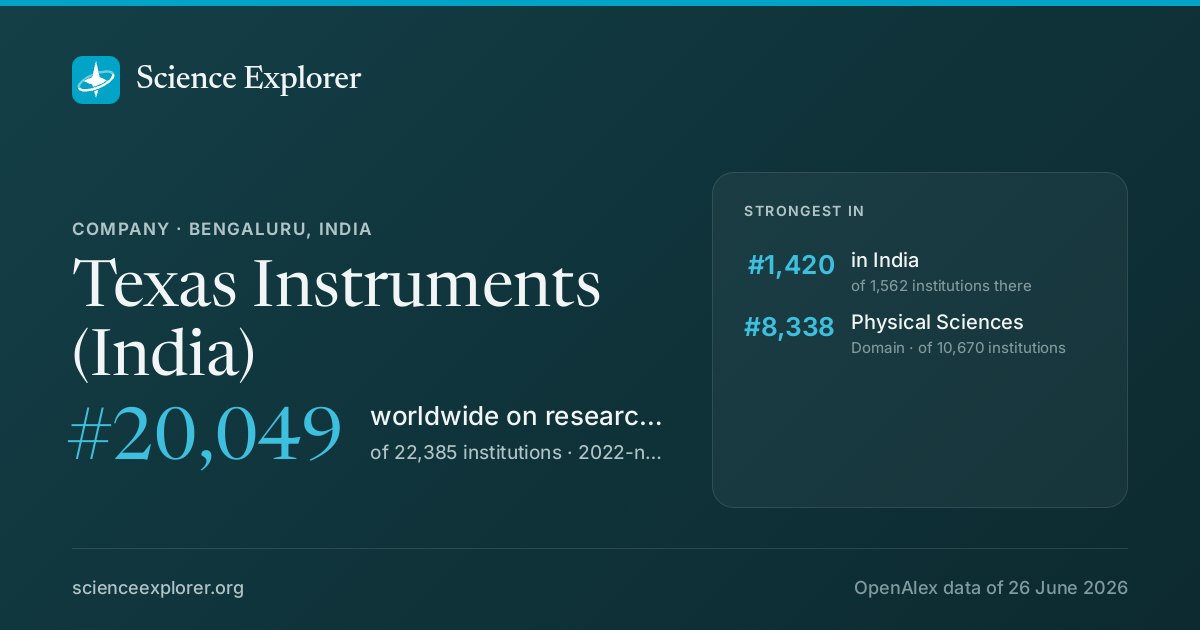
In research, Texas Instruments (India) stands highest in Physical Sciences (#8,338 of 10,670 worldwide), 2022-now. Relative to its size it is most specialised in Electrical and Electronic Engineering (Electrical and Electronic Engineering is 9.1× its share of world research).
- World rank, 2022-now
- #20,049 of 22,385 · #24,964 all time
- Rank in India
- #1,420 of 1,562
- Research works
- 456 ▲ 84% vs 2018-21
- Citations
- 3.5k 7.6 per fractional work
- Top-10% rate
- 4.7% all institutions 10.0%
- vs its own fields
- 0.91× 1.00× is exactly expected
- Open access
- 11% world 40%
- International
- 32% world 18%
What is Texas Instruments (India) known for in research?
The fields where it stands highest, 2022-now, ranked among every institution above the floor in each field.
| Field | World rank | Where that sits | Top-10% rate | Works | All time |
|---|---|---|---|---|---|
| Physical SciencesDomain | #8,338 of 10,670 | 4.1% | 86 | #8189 |
Each strip is that field's whole ranked pool, with the notch where Texas Instruments (India) sits in it, in the colour of the band that rank falls in. The track under the rate is the rate itself: it carries no average mark, because the average differs by field (from about 6% in Dentistry to 21% in Economics).
Which fields of science does Texas Instruments (India) work in?
In 2022-now, 86% of research at Texas Instruments (India) is in Physical Sciences, 7% in Social Sciences. Its largest fields are Engineering (55%), Computer Science (25%), Decision Sciences (3%). It does 2.1× the world's share of Physical Sciences.
Each ring splits the one inside it: the four domains of science, their fields, their subfields. Size is fractional works in 2022-now. Every slice is a page; the interactive view zooms down to single topics and colours each by how much more of it this institution does than the world.
Its 4 domains and 20 fields, with their numbers
- Physical Sciences9586.4%
- Engineering6055.1%
- Computer Science2825.1%
- Materials Science22.1%
- Physics and Astronomy21.7%
- Environmental Science11.0%
- Energy10.7%
- Earth and Planetary Sciences10.5%
- Chemical Engineering00.1%
- Chemistry00.1%
- Social Sciences87.1%
- Life Sciences43.9%
- Health Sciences32.6%
- Medicine32.6%
What does Texas Instruments (India) specialise in?
Where its research is concentrated relative to its size: Electrical and Electronic Engineering takes 9.1× the share of its output that it takes of world research.
- Electrical and Electronic EngineeringSubfield · 35.4 works9.1×
Location quotient, a volume reading rather than an impact one. It surfaces small, lopsided specialities.
Field profile
Location quotient across every field it publishes in: outside the ring is more than an institution of this size would be expected to publish, inside it is less.
Rings at 0.5×, 1× and 2×. Widest outward: Engineering, 3.7×. Every wedge is a field page.
All 20 fields, with their numbers
- Engineering3.68×60 works
- Decision Sciences3.60×4 works
- Computer Science3.23×28 works
- Energy0.77×1 works
- Physics and Astronomy0.74×2 works
- Materials Science0.60×2 works
- Business, Management and Accounting0.57×2 works
- Immunology and Microbiology0.50×1 works
- Neuroscience0.44×1 works
- Earth and Planetary Sciences0.34×1 works
- Agricultural and Biological Sciences0.33×2 works
- Arts and Humanities0.32×1 works
- Chemical Engineering0.29×0 works
- Biochemistry, Genetics and Molecular Biology0.20×1 works
- Environmental Science0.20×1 works
- Medicine0.13×3 works
- Psychology0.13×0 works
- Economics, Econometrics and Finance0.08×0 works
- Chemistry0.05×0 works
- Social Sciences0.02×0 works
- Engineering 3.7×
- Decision Sciences 3.6×
- Computer Science 3.2×
- Energy 0.8×
- Physics and Astronomy 0.7×
- Materials Science 0.6×
- Business, Management and Accounting 0.6×
- Immunology and Microbiology 0.5×
- Neuroscience 0.4×
- Earth and Planetary Sciences 0.3×
- Agricultural and Biological Sciences 0.3×
- Arts and Humanities 0.3×
- Chemical Engineering 0.3×
- Biochemistry, Genetics and Molecular Biology 0.2×
- Environmental Science 0.2×
- Medicine 0.1×
- Psychology 0.1×
- Economics, Econometrics and Finance 0.1×
- Chemistry 0.1×
- Social Sciences 0.0×
Who are the top researchers at Texas Instruments (India)?
Ranked on the quality score, Sandeep Rao, Rohan Sinha and Mahesh M. Mehendale lead among researchers whose main affiliation is Texas Instruments (India).
- 1
Sandeep Rao
 India · #2,309,081 worldwide
322 citations · 28 works
- 2
Rohan Sinha
India · #3,039,010 worldwide
156 citations · 19 works
- 3
Mahesh M. Mehendale
India · #3,580,588 worldwide
734 citations · 80 works
- 4
Vinod Menezes
India · #4,254,918 worldwide
131 citations · 20 works
- 5
Rajesh Kumar Mittal
India · #4,397,540 worldwide
116 citations · 15 works
- 6
Arvind Kumar Jain
India · #4,419,028 worldwide
870 citations · 45 works
- 7
B. Mitra
India · #4,753,614 worldwide
60 citations · 18 works
- 8
Ajoy Mandal
India · #5,018,961 worldwide
43 citations · 17 works
- 9
Lakshmanan Balasubramanian
India · #5,256,481 worldwide
82 citations · 21 works
- 10
V.R. Devanathan
India · #5,296,819 worldwide
271 citations · 37 works
Which keywords describe research at Texas Instruments (India)?
By fractional works in 2022-now, weighted toward what it does more of than the world: Power Electronics, Fault Tolerance, CMOS Technology, Low-Power, Renewable Energy Integration, CMOS, Integrated Circuits and Delta-Sigma Modulator.
- Voltage Source Inverters
- Signal Processing
- Embedded Systems
- Approximate Computing
- Networks on Chip
- Model Predictive Control
- High-Frequency Power Conversion
- Photon Emission Microscopy
- FPGA
- Thermal Management
- Failure Analysis
- Fault Localization
- Process Variation
- ADC
- Embedded Cores
- Integrated Circuits
- CMOS
- Low-Power
- CMOS Technology
- Deep Learning
- Power Electronics
- Machine Learning
- Fault Tolerance
- Renewable Energy Integration
- Neural Networks
- Delta-Sigma Modulator
- Test Data Compression
- Neural Recording
- Optimization
- Power Optimization
- Frequency Synthesizer
- Nanoelectronics
- Laser Voltage Probing
- DC-DC Converters
- Radiation Effects
- Interconnection Networks
- Smart Grid
- VLSI Circuits
- Multilevel Converters
- Taguchi Method
Size is fractional works in 2022-now in the topics tagged with each word; colour is the word's share of this institution's work against its share of the world's. The 40 words are chosen for being large and distinctive. Each links to the topic it comes from most.
All 40 words, with their numbers
- Power Electronics8▲ 23×7 topics
- Deep Learning8▲ 2.0×30 topics
- Machine Learning6▲ 1.74×24 topics
- CMOS Technology6▲ 70×4 topics
- Fault Tolerance6▲ 36×5 topics
- Low-Power6▲ 128×2 topics
- Renewable Energy Integration6▲ 16×4 topics
- CMOS6▲ 103×2 topics
- Neural Networks5▲ 3.1×14 topics
- Integrated Circuits5▲ 32×3 topics
- Delta-Sigma Modulator5▲ 136×2 topics
- Embedded Cores5▲ 281×1 topic
- Test Data Compression5▲ 281×1 topic
- ADC4▲ 159×1 topic
- Neural Recording4▲ 159×1 topic
- Process Variation4▲ 58×2 topics
- Optimization4▲ 7.2×9 topics
- Fault Localization3▲ 44×2 topics
- Power Optimization3▲ 104×2 topics
- Failure Analysis3▲ 30×2 topics
- Frequency Synthesizer3▲ 70×2 topics
- Thermal Management3▲ 8.3×3 topics
- Nanoelectronics3▲ 33×2 topics
- FPGA3▲ 66×3 topics
- Laser Voltage Probing3▲ 98×1 topic
- Photon Emission Microscopy3▲ 98×1 topic
- DC-DC Converters3▲ 45×1 topic
- High-Frequency Power Conversion3▲ 45×1 topic
- Radiation Effects3▲ 60×2 topics
- Model Predictive Control2▲ 9.0×3 topics
- Interconnection Networks2▲ 123×1 topic
- Networks on Chip2▲ 123×1 topic
- Smart Grid2▲ 5.8×5 topics
- Approximate Computing2▲ 96×1 topic
- VLSI Circuits2▲ 96×1 topic
- Embedded Systems2▲ 40×2 topics
- Multilevel Converters2▲ 36×1 topic
- Signal Processing2▲ 13×4 topics
- Taguchi Method2▲ 40×3 topics
- Voltage Source Inverters2▲ 36×1 topic
Which research topics does Texas Instruments (India) publish most on?
By volume in 2022-now: VLSI and Analog Circuit Testing, Analog and Mixed-Signal Circuit Design, Integrated Circuits and Semiconductor Failure Analysis and Advanced DC-DC Converters.
Area is fractional works; colour is the subfield each topic belongs to.
- 1 VLSI and Analog Circuit Testing Hardware and Architecture 5 works
- 2 Analog and Mixed-Signal Circuit Design Biomedical Engineering 4 works
- 3 Integrated Circuits and Semiconductor Failure Analysis Electrical and Electronic Engineering 3 works
- 4 Advanced DC-DC Converters Electrical and Electronic Engineering 3 works
- 5 Interconnection Networks and Systems Computer Networks and Communications 2 works
- 6 Low-power high-performance VLSI design Electrical and Electronic Engineering 2 works
- 7 Multilevel Inverters and Converters Electrical and Electronic Engineering 2 works
- 8 Radio Frequency Integrated Circuit Design Electrical and Electronic Engineering 2 works
- 9 Advancements in Semiconductor Devices and Circuit Design Electrical and Electronic Engineering 2 works
- 10 Embedded Systems Design Techniques Hardware and Architecture 2 works
How open and international is its research?
Against the world's own shares: the tick on each track. Both are shares of its output, so they sit on one scale and can be read against each other as well as against the world.
World: 40% of research is openly available.
World: 18% is written across borders.
How has Texas Instruments (India)'s research output changed?
Output in 2022-2025 was 84% higher than in 2018-2021.
The same series as a ribbon: one cell per year, darker for more. The line above answers how much; this answers when.
Its share of all research
Growing output can still be a shrinking share: all of science grows. This is Texas Instruments (India) as a percentage of every work published that year, 0.00046% in 2024.
Fractional works of Texas Instruments (India) over all fractional works that year. How the balance of science has shifted.
How much of it reaches the world top 10%
Year by year, against all institutions in the same year.
Of each year's output, the share that reached the world's 10% most cited for its field and year. Peak 6.4% in 2022.
Other research institutions in Bengaluru
- Indian Institute of Science Bangalore
- Christ University
- Department of Space
- Jain University
- National Institute of Mental Health and Neurosciences
- Bangalore University
- PES University
- M S Ramaiah University of Applied Sciences
Share Texas Instruments (India)'s ranking
Badges for a website1Each links back here and updates with every snapshot

Research measures only: rankings here say nothing about teaching, admissions or student experience. Comparable institutions and collaboration partners have tabs of their own, above.
Discussion
Ask a question or share a note about Texas Instruments (India). Keep it to the research: no personal attacks, advertising or links. Any reader can report a post, which collapses it for everyone until it is opened.