Science Explorer Back to mapMap
Discussion
Nonprofit · Zurich · Switzerland

The Geneva Association

In research, The Geneva Association stands highest in Health Sciences (#7,271 of 16,688 worldwide) and Social Sciences (#7,116 of 14,833 worldwide), over all time.

World rank, 2022-now
#15,625
of 22,385 · #10,746 all time
Rank in Switzerland
#125
of 186
Research works
463
▲ 25% vs 2018-21
Citations
8.4k
18.1 per fractional work
Top-10% rate
11.9%
all institutions 10.0%
vs its own fields
0.98×
1.00× is exactly expected
Open access
45%
world 40%
International
35%
world 18%

What is The Geneva Association known for in research?

The fields where it stands highest, over all time, ranked among every institution above the floor in each field.

FieldWorld rankWhere that sitsTop-10% rateWorks
Health SciencesDomain #7,271 of 16,688 10.9%139
Social SciencesDomain #7,116 of 14,833 8.9%207

Each strip is that field's whole ranked pool, with the notch where The Geneva Association sits in it, in the colour of the band that rank falls in. The track under the rate is the rate itself: it carries no average mark, because the average differs by field (from about 6% in Dentistry to 21% in Economics).

Which fields of science does The Geneva Association work in?

In 2022-now, 39% of research at The Geneva Association is in Health Sciences, 27% in Social Sciences. Its largest fields are Medicine (30%), Biochemistry, Genetics and Molecular Biology (10%), Psychology (10%). It does 1.6× the world's share of Health Sciences.

Health Sciences: 39 fractional works · 38.7% of its workMedicine: 30 fractional works · 29.8% of its workEpidemiology: 5 fractional works · 4.6% of its workPublic Health, Environmental and Occupational Health: 3 fractional works · 3.2% of its workOncology: 3 fractional works · 2.8% of its workSurgery: 2 fractional works · 2.2% of its workPsychiatry and Mental health: 2 fractional works · 2.2% of its workPulmonary and Respiratory Medicine: 2 fractional works · 1.5% of its workHepatology: 2 fractional works · 1.5% of its workPhysiology: 1 fractional works · 1.5% of its workEndocrinology, Diabetes and Metabolism: 1 fractional works · 1.1% of its workCardiology and Cardiovascular Medicine: 1 fractional works · 1.0% of its workRheumatology: 1 fractional works · 1.0% of its workPediatrics, Perinatology and Child Health: 1 fractional works · 0.9% of its workEmergency Medicine: 1 fractional works · 0.8% of its workRadiology, Nuclear Medicine and Imaging: 1 fractional works · 0.8% of its workOrthopedics and Sports Medicine: 1 fractional works · 0.6% of its workInfectious Diseases: 1 fractional works · 0.6% of its workPathology and Forensic Medicine: 0 fractional works · 0.5% of its workReproductive Medicine: 0 fractional works · 0.4% of its workHematology: 0 fractional works · 0.4% of its workAnesthesiology and Pain Medicine: 0 fractional works · 0.3% of its workRehabilitation: 0 fractional works · 0.3% of its workDermatology: 0 fractional works · 0.3% of its workPharmacology: 0 fractional works · 0.2% of its workHealth Informatics: 0 fractional works · 0.2% of its workSmaller subfields together: 1 fractional works · 0.9% of its workHealth Professions: 8 fractional works · 7.8% of its workGeneral Health Professions: 6 fractional works · 6.2% of its workHealth Information Management: 0 fractional works · 0.5% of its workSpeech and Hearing: 0 fractional works · 0.5% of its workEmergency Medical Services: 0 fractional works · 0.3% of its workSmaller subfields together: 0 fractional works · 0.3% of its workNursing: 1 fractional works · 0.7% of its workNutrition and Dietetics: 1 fractional works · 0.7% of its workVeterinary: 0 fractional works · 0.3% of its workSmall Animals: 0 fractional works · 0.3% of its workSocial Sciences: 27 fractional works · 26.9% of its workPsychology: 10 fractional works · 10.2% of its workClinical Psychology: 5 fractional works · 4.8% of its workSocial Psychology: 3 fractional works · 3.0% of its workExperimental and Cognitive Psychology: 1 fractional works · 0.9% of its workApplied Psychology: 1 fractional works · 0.8% of its workDevelopmental and Educational Psychology: 1 fractional works · 0.6% of its workSmaller subfields together: 0 fractional works · 0.1% of its workSocial Sciences: 9 fractional works · 8.6% of its workSociology and Political Science: 2 fractional works · 1.8% of its workCommunication: 1 fractional works · 1.4% of its workGender Studies: 1 fractional works · 1.1% of its workHealth: 1 fractional works · 0.9% of its workDemography: 1 fractional works · 0.8% of its workSafety Research: 1 fractional works · 0.8% of its workEducation: 1 fractional works · 0.7% of its workPolitical Science and International Relations: 0 fractional works · 0.5% of its workUrban Studies: 0 fractional works · 0.4% of its workSmaller subfields together: 0 fractional works · 0.2% of its workEconomics, Econometrics and Finance: 3 fractional works · 3.3% of its workEconomics and Econometrics: 3 fractional works · 2.8% of its workFinance: 0 fractional works · 0.4% of its workBusiness, Management and Accounting: 2 fractional works · 2.2% of its workStrategy and Management: 1 fractional works · 0.7% of its workManagement of Technology and Innovation: 1 fractional works · 0.6% of its workAccounting: 1 fractional works · 0.6% of its workSmaller subfields together: 0 fractional works · 0.3% of its workArts and Humanities: 2 fractional works · 2.0% of its workHistory and Philosophy of Science: 1 fractional works · 0.6% of its workHistory: 0 fractional works · 0.5% of its workPhilosophy: 0 fractional works · 0.4% of its workConservation: 0 fractional works · 0.2% of its workSmaller subfields together: 0 fractional works · 0.2% of its workDecision Sciences: 1 fractional works · 0.7% of its workInformation Systems and Management: 1 fractional works · 0.7% of its workLife Sciences: 18 fractional works · 17.7% of its workBiochemistry, Genetics and Molecular Biology: 10 fractional works · 10.4% of its workMolecular Biology: 6 fractional works · 6.3% of its workGenetics: 2 fractional works · 1.6% of its workCancer Research: 1 fractional works · 0.8% of its workBiotechnology: 1 fractional works · 0.5% of its workBiophysics: 0 fractional works · 0.5% of its workClinical Biochemistry: 0 fractional works · 0.3% of its workSmaller subfields together: 0 fractional works · 0.4% of its workAgricultural and Biological Sciences: 4 fractional works · 3.7% of its workPlant Science: 1 fractional works · 1.5% of its workSoil Science: 1 fractional works · 1.0% of its workAgronomy and Crop Science: 0 fractional works · 0.4% of its workEcology, Evolution, Behavior and Systematics: 0 fractional works · 0.4% of its workInsect Science: 0 fractional works · 0.3% of its workSmaller subfields together: 0 fractional works · 0.3% of its workNeuroscience: 2 fractional works · 1.9% of its workCognitive Neuroscience: 1 fractional works · 1.5% of its workEndocrine and Autonomic Systems: 0 fractional works · 0.2% of its workSmaller subfields together: 0 fractional works · 0.1% of its workImmunology and Microbiology: 2 fractional works · 1.5% of its workParasitology: 1 fractional works · 1.0% of its workImmunology: 0 fractional works · 0.3% of its workSmaller subfields together: 0 fractional works · 0.2% of its workPharmacology, Toxicology and Pharmaceutics: 0 fractional works · 0.3% of its workPhysical Sciences: 17 fractional works · 16.7% of its workEnvironmental Science: 6 fractional works · 5.7% of its workHealth, Toxicology and Mutagenesis: 2 fractional works · 1.6% of its workEcology: 1 fractional works · 1.2% of its workGlobal and Planetary Change: 1 fractional works · 1.1% of its workManagement, Monitoring, Policy and Law: 1 fractional works · 0.8% of its workEnvironmental Engineering: 0 fractional works · 0.4% of its workNature and Landscape Conservation: 0 fractional works · 0.4% of its workSmaller subfields together: 0 fractional works · 0.3% of its workComputer Science: 5 fractional works · 5.4% of its workArtificial Intelligence: 1 fractional works · 1.4% of its workInformation Systems: 1 fractional works · 1.0% of its workHardware and Architecture: 1 fractional works · 0.8% of its workComputer Networks and Communications: 1 fractional works · 0.6% of its workComputer Science Applications: 0 fractional works · 0.5% of its workComputer Vision and Pattern Recognition: 0 fractional works · 0.5% of its workHuman-Computer Interaction: 0 fractional works · 0.3% of its workSmaller subfields together: 0 fractional works · 0.2% of its workEngineering: 4 fractional works · 4.2% of its workBiomedical Engineering: 2 fractional works · 1.9% of its workElectrical and Electronic Engineering: 1 fractional works · 0.8% of its workAerospace Engineering: 0 fractional works · 0.5% of its workMedia Technology: 0 fractional works · 0.3% of its workCivil and Structural Engineering: 0 fractional works · 0.2% of its workSmaller subfields together: 1 fractional works · 0.5% of its workPhysics and Astronomy: 0 fractional works · 0.4% of its workRadiation: 0 fractional works · 0.4% of its workSmaller subfields together: 0 fractional works · 0.0% of its workEarth and Planetary Sciences: 0 fractional works · 0.3% of its workAtmospheric Science: 0 fractional works · 0.3% of its workMaterials Science: 0 fractional works · 0.2% of its workChemistry: 0 fractional works · 0.2% of its workMathematics: 0 fractional works · 0.2% of its workChemical Engineering: 0 fractional works · 0.1% of its workALL ITS WORKThe GenevaAssociation100fractional works, 2022-now
Life Sciences18%Physical Sciences17%Health Sciences39%Social Sciences27%

Each ring splits the one inside it: the four domains of science, their fields, their subfields. Size is fractional works in 2022-now. Every slice is a page; the interactive view zooms down to single topics and colours each by how much more of it this institution does than the world.

Its 4 domains and 24 fields, with their numbers
    1. Medicine3029.8%
    2. Health Professions87.8%
    3. Nursing10.7%
    4. Veterinary00.3%
    1. Psychology1010.2%
    2. Social Sciences98.6%
    3. Economics, Econometrics and Finance33.3%
    4. Business, Management and Accounting22.2%
    5. Arts and Humanities22.0%
    6. Decision Sciences10.7%
    1. Biochemistry, Genetics and Molecular Biology1010.4%
    2. Agricultural and Biological Sciences43.7%
    3. Neuroscience21.9%
    4. Immunology and Microbiology21.5%
    5. Pharmacology, Toxicology and Pharmaceutics00.3%
    1. Environmental Science65.7%
    2. Computer Science55.4%
    3. Engineering44.2%
    4. Physics and Astronomy00.4%
    5. Earth and Planetary Sciences00.3%
    6. Materials Science00.2%
    7. Chemistry00.2%
    8. Mathematics00.2%
    9. Chemical Engineering00.1%
All of science, and how each field's share has moved since 1950: the Science domain explorer

Field profile

Location quotient across every field it publishes in: outside the ring is more than an institution of this size would be expected to publish, inside it is less.

Agricultural and Biological Sciences: 0.79× its world share, 4 worksAgricultural and Bio…Biochemistry, Genetics and Molecular Biology: 1.94× its world share, 10 worksBiochemistry, Geneti…Immunology and Microbiology: 1.49× its world share, 2 worksImmunology and Micro…Neuroscience: 1.14× its world share, 2 worksNeurosciencePharmacology, Toxicology and Pharmaceutics: 0.79× its world share, 0 worksPharmacology, Toxico…Chemical Engineering: 0.23× its world share, 0 worksChemical EngineeringChemistry: 0.14× its world share, 0 worksChemistryComputer Science: 0.69× its world share, 5 worksComputer ScienceEarth and Planetary Sciences: 0.19× its world share, 0 worksEarth and Planetary …Engineering: 0.28× its world share, 4 worksEngineeringEnvironmental Science: 1.15× its world share, 6 worksEnvironmental ScienceMaterials Science: 0.07× its world share, 0 worksMaterials ScienceMathematics: 0.19× its world share, 0 worksMathematicsPhysics and Astronomy: 0.18× its world share, 0 worksPhysics and AstronomyHealth Professions: 2.98× its world share, 8 worksHealth ProfessionsMedicine: 1.55× its world share, 30 worksMedicineNursing: 1.44× its world share, 1 worksNursingVeterinary: 1.90× its world share, 0 worksVeterinaryArts and Humanities: 0.69× its world share, 2 worksArts and HumanitiesBusiness, Management and Accounting: 0.68× its world share, 2 worksBusiness, Management…Decision Sciences: 0.72× its world share, 1 worksDecision SciencesEconomics, Econometrics and Finance: 1.53× its world share, 3 worksEconomics, Econometr…Psychology: 3.35× its world share, 10 worksPsychologySocial Sciences: 0.68× its world share, 9 worksSocial Sciences1×world share
more than its size predictsabout as predictedless

Rings at 0.5×, 1× and 2×. Widest outward: Psychology, 3.4×. Every wedge is a field page.

All 24 fields, with their numbers
  1. Psychology3.35×10 works
  2. Health Professions2.98×8 works
  3. Biochemistry, Genetics and Molecular Biology1.94×10 works
  4. Veterinary1.90×0 works
  5. Medicine1.55×30 works
  6. Economics, Econometrics and Finance1.53×3 works
  7. Immunology and Microbiology1.49×2 works
  8. Nursing1.44×1 works
  9. Environmental Science1.15×6 works
  10. Neuroscience1.14×2 works
  11. Agricultural and Biological Sciences0.79×4 works
  12. Pharmacology, Toxicology and Pharmaceutics0.79×0 works
  13. Decision Sciences0.72×1 works
  14. Computer Science0.69×5 works
  15. Arts and Humanities0.69×2 works
  16. Business, Management and Accounting0.68×2 works
  17. Social Sciences0.68×9 works
  18. Engineering0.28×4 works
  19. Chemical Engineering0.23×0 works
  20. Earth and Planetary Sciences0.19×0 works
  21. Mathematics0.19×0 works
  22. Physics and Astronomy0.18×0 works
  23. Chemistry0.14×0 works
  24. Materials Science0.07×0 works

Who are the top researchers at The Geneva Association?

Ranked on the quality score, Norman Sartorius, Afzal Javed and Norman Sartorius lead among researchers whose main affiliation is The Geneva Association.

  1. 1 Norman Sartorius Switzerland · #168,123 worldwide 37k citations · 829 works
  2. 2 Afzal Javed Switzerland · #217,876 worldwide 4.7k citations · 218 works
  3. 3 Norman Sartorius Switzerland · #720,264 worldwide 3.5k citations · 197 works
  4. 4 Ernest Merian Switzerland · #1,179,475 worldwide 4.7k citations · 131 works
  5. 5 Walter R. Stahel Switzerland · #1,216,831 worldwide 4.2k citations · 107 works
  6. 6 Christophe Courbage Switzerland · #1,557,994 worldwide 1.3k citations · 118 works
  7. 7 Peter A. Wuffli Switzerland · #2,959,399 worldwide 52 citations · 20 works
  8. 8 Patrick M. Liedtke Switzerland · #3,474,425 worldwide 199 citations · 35 works
  9. 9 Andi J. Tanra Switzerland · #3,720,951 worldwide 217 citations · 22 works
  10. 10 Geneviève Reday-Mulvey Switzerland · #3,755,590 worldwide 195 citations · 35 works
All ranked researchers at The Geneva Association

What are the most cited papers from The Geneva Association?

The most cited paper from The Geneva Association is "EULAR recommendations for the management of rheumatoid arthritis with synthetic and biological disease-modifying antirheumatic drugs: 2022 update" (Josef S Smolen et al., 2022), with 1,921 citations. Next come "Toward a new definition of mental health" (959) and "The Lancet Commission on ending stigma and discrimination in mental health" (734).

Most cited papers
#PaperReleasedCitations
1 EULAR recommendations for the management of rheumatoid arthritis with synthetic and biological disease-modifying antirheumatic drugs: 2022 update Josef S Smolen et al. · Annals of the Rheumatic Diseases Open access 10 Nov 2022 1,921
2 Toward a new definition of mental health Silvana Galderisi, Andreas Heinz, Marianne Carisius Kastrup et al. · World Psychiatry Open access Jun 2015 959
3 The Lancet Commission on ending stigma and discrimination in mental health Graham Thornicroft et al. · The Lancet Open access Oct 2022 734
4 Self-stigma, empowerment and perceived discrimination among people with schizophrenia in 14 European countries: The GAMIAN-Europe study Elaine Brohan, Rodney Elgie, Norman Sartorius et al. · Schizophrenia Research 27 Mar 2010 541
5 Global pattern of experienced and anticipated discrimination reported by people with major depressive disorder: a cross-sectional survey Antonio Lasalvia, Silvia Zoppei, Tine Van Bortel et al. · The Lancet 18 Oct 2012 451
All 60 most cited papers, with filters and sorting

Which keywords describe research at The Geneva Association?

By fractional works in 2022-now, weighted toward what it does more of than the world: Primary Care, Epidemiology, Public Health, Health Services, Depression, Liver Transplantation, Comorbidity and Healthcare Utilization.

▲ more of its work than of the world's◆ about the world's share▼ less than the world's

Size is fractional works in 2022-now in the topics tagged with each word; colour is the word's share of this institution's work against its share of the world's. The 40 words are chosen for being large and distinctive. Each links to the topic it comes from most.

All 40 words, with their numbers
  1. Epidemiology9▲ 2.2×33 topics
  2. Public Health6▲ 4.1×23 topics
  3. Primary Care6▲ 15×10 topics
  4. Depression4▲ 5.0×11 topics
  5. Quality of Life4▲ 2.8×9 topics
  6. Health Services4▲ 40×2 topics
  7. Mental Health4▲ 2.5×19 topics
  8. Liver Transplantation3▲ 25×3 topics
  9. Comorbidity3▲ 24×4 topics
  10. Prevalence3▲ 6.8×9 topics
  11. Ethical Considerations3▲ 7.8×11 topics
  12. Healthcare Utilization3▲ 33×2 topics
  13. Health Equity3▲ 9.0×5 topics
  14. Chronic Conditions2▲ 36×2 topics
  15. Clinical Practice Guidelines2▲ 4.3×2 topics
  16. Multimorbidity2▲ 53×1 topic
  17. Patient Complexity2▲ 53×1 topic
  18. Anxiety2▲ 4.5×8 topics
  19. Community Health2▲ 13×3 topics
  20. Psychological Distress2▲ 8.9×4 topics
  21. Global Burden2▲ 3.8×2 topics
  22. Insurance2▲ 28×2 topics
  23. Risk Management2▲ 4.5×2 topics
  24. Social Determinants2▲ 10×2 topics
  25. Training2▲ 9.7×2 topics
  26. Vitamin B122▲ 61×2 topics
  27. Medical Education2▲ 7.2×9 topics
  28. Stakeholder Engagement2▲ 21×2 topics
  29. Advocacy2▲ 67×1 topic
  30. Mental Disorders2▲ 15×2 topics
  31. Mobile Health2▲ 12×3 topics
  32. Pediatrics2▲ 67×1 topic
  33. Genomic Analysis2▲ 6.3×2 topics
  34. Heme Biosynthesis2▲ 231×1 topic
  35. Porphyrias2▲ 231×1 topic
  36. Disaster Management2▲ 9.7×2 topics
  37. Patient Engagement2▲ 12×4 topics
  38. Vulnerability2▲ 6.4×3 topics
  39. Epithelial-Mesenchymal Transition1▲ 14×2 topics
  40. Stigma1▲ 10×2 topics

Which research topics does The Geneva Association publish most on?

By volume in 2022-now: Chronic Disease Management Strategies, Child and Adolescent Health, Porphyrin Metabolism and Disorders and Child Nutrition and Feeding Issues.

  1. 1 Chronic Disease Management Strategies Epidemiology 2 works
  2. 2 Child and Adolescent Health General Health Professions 2 works
  3. 3 Porphyrin Metabolism and Disorders Molecular Biology 2 works
  4. 4 Child Nutrition and Feeding Issues Psychiatry and Mental health 1 works
  5. 5 Mental Health Treatment and Access Social Psychology 1 works
  6. 6 Public Relations and Crisis Communication Communication 1 works
  7. 7 Insurance and Financial Risk Management Economics and Econometrics 1 works
  8. 8 Agricultural risk and resilience Soil Science 1 works
  9. 9 3D Printing in Biomedical Research Biomedical Engineering 1 works
  10. 10 Cancer Cells and Metastasis Oncology 1 works

How open and international is its research?

Against the world's own shares: the tick on each track. Both are shares of its output, so they sit on one scale and can be read against each other as well as against the world.

openly available44.8%not open55.2%

World: 40% of research is openly available.

with international co-authors35.4%domestic only64.6%

World: 18% is written across borders.

How has The Geneva Association's research output changed?

Output in 2022-2025 was 25% higher than in 2018-2021.

still counting1990200020102020
grewheldshrank

The same series as a ribbon: one cell per year, darker for more. The line above answers how much; this answers when.

Its share of all research

Growing output can still be a shrinking share: all of science grows. This is The Geneva Association as a percentage of every work published that year, 0.00031% in 2024.

still counting0.0010%0.0020%The Geneva Association0.00046% in 202519801990200020102020

Fractional works of The Geneva Association over all fractional works that year. How the balance of science has shifted.

How much of it reaches the world top 10%

Year by year, against all institutions in the same year.

still counting10%20%The Geneva Association12.4% in 2025all institutions10.0% in 202520102020

Of each year's output, the share that reached the world's 10% most cited for its field and year. Peak 15.3% in 2015.

Other research institutions in Zurich

All research institutions in Zurich

Share The Geneva Association's ranking
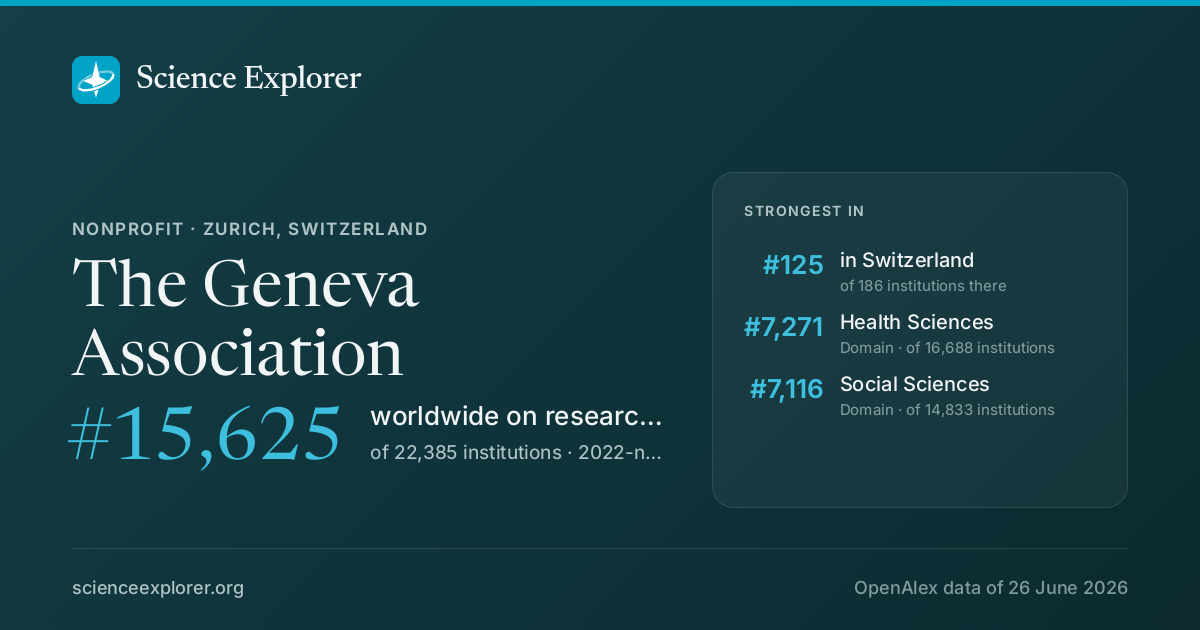
The Geneva Association on Science Explorer

A card with The Geneva Association's standing and the fields it leads in, for a post or a slide. A link to this page previews as the same card.

Download the card

1200 × 630 PNG, sized for social posts, drawn from the latest snapshot.

Badges for a website1Each links back here and updates with every snapshot

Research measures only: rankings here say nothing about teaching, admissions or student experience. Comparable institutions and collaboration partners have tabs of their own, above.

Discussion

Ask a question or share a note about The Geneva Association. Posts are plain text and can be reported.