Science Explorer Back to mapMap
Discussion
Research facility · El Segundo · United States

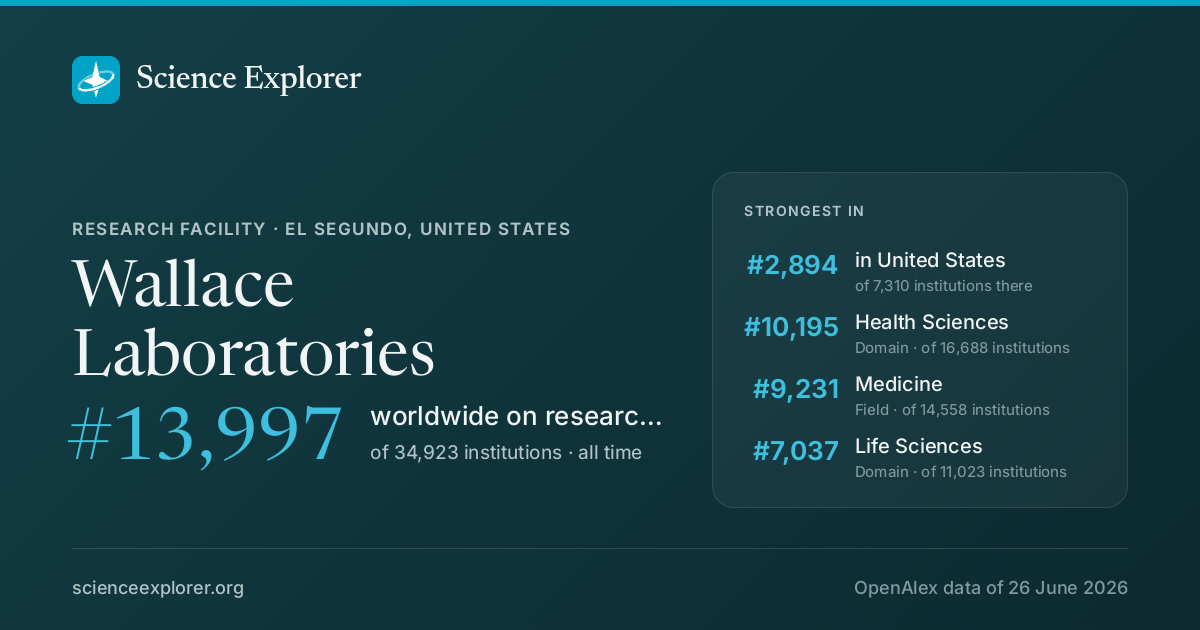
Wallace Laboratories

In research, Wallace Laboratories stands highest in Health Sciences (#10,195 of 16,688 worldwide), Medicine (#9,231 of 14,558 worldwide) and Life Sciences (#7,037 of 11,023 worldwide), over all time.

World rank, all time
#13,997
of 34,923
Rank in United States
#2,894
of 7,310
Research works
572
▲ 6% vs 2018-21
Citations
9.6k
16.7 per fractional work
Top-10% rate
8.4%
all institutions 10.0%
vs its own fields
0.92×
1.00× is exactly expected
Open access
20%
world 40%
International
8%
world 18%

What is Wallace Laboratories known for in research?

The fields where it stands highest, over all time, ranked among every institution above the floor in each field.

FieldWorld rankWhere that sitsTop-10% rateWorks
Health SciencesDomain #10,195 of 16,688 9.6%176
MedicineField #9,231 of 14,558 9.9%152
Life SciencesDomain #7,037 of 11,023 5.7%171
Physical SciencesDomain #13,971 of 17,446 4.4%136

Each strip is that field's whole ranked pool, with the notch where Wallace Laboratories sits in it, in the colour of the band that rank falls in. The track under the rate is the rate itself: it carries no average mark, because the average differs by field (from about 6% in Dentistry to 21% in Economics).

Which fields of science does Wallace Laboratories work in?

In all years, 31% of research at Wallace Laboratories is in Health Sciences, 30% in Life Sciences. Its largest fields are Medicine (27%), Agricultural and Biological Sciences (11%), Biochemistry, Genetics and Molecular Biology (9%). It does 2.0× the world's share of Life Sciences.

Health Sciences: 176 fractional works · 30.8% of its workMedicine: 152 fractional works · 26.6% of its workPhysiology: 22 fractional works · 3.9% of its workPharmacology: 14 fractional works · 2.5% of its workPsychiatry and Mental health: 12 fractional works · 2.0% of its workSurgery: 11 fractional works · 1.9% of its workCardiology and Cardiovascular Medicine: 10 fractional works · 1.8% of its workPulmonary and Respiratory Medicine: 10 fractional works · 1.7% of its workPediatrics, Perinatology and Child Health: 9 fractional works · 1.6% of its workOncology: 8 fractional works · 1.4% of its workEpidemiology: 8 fractional works · 1.3% of its workImmunology and Allergy: 5 fractional works · 0.9% of its workRheumatology: 4 fractional works · 0.8% of its workInfectious Diseases: 4 fractional works · 0.7% of its workNeurology: 4 fractional works · 0.7% of its workPublic Health, Environmental and Occupational Health: 4 fractional works · 0.7% of its workRadiology, Nuclear Medicine and Imaging: 4 fractional works · 0.6% of its workDermatology: 3 fractional works · 0.6% of its workComplementary and alternative medicine: 3 fractional works · 0.5% of its workGenetics: 3 fractional works · 0.4% of its workEndocrinology, Diabetes and Metabolism: 3 fractional works · 0.4% of its workPathology and Forensic Medicine: 2 fractional works · 0.4% of its workEmergency Medicine: 1 fractional works · 0.3% of its workSmaller subfields together: 9 fractional works · 1.6% of its workVeterinary: 9 fractional works · 1.5% of its workSmall Animals: 9 fractional works · 1.5% of its workNursing: 8 fractional works · 1.4% of its workNutrition and Dietetics: 8 fractional works · 1.4% of its workSmaller subfields together: 0 fractional works · 0.0% of its workHealth Professions: 7 fractional works · 1.2% of its workGeneral Health Professions: 4 fractional works · 0.7% of its workSmaller subfields together: 3 fractional works · 0.6% of its workDentistry: 0 fractional works · 0.0% of its workLife Sciences: 171 fractional works · 29.9% of its workAgricultural and Biological Sciences: 62 fractional works · 10.9% of its workPlant Science: 13 fractional works · 2.3% of its workInsect Science: 10 fractional works · 1.7% of its workAnimal Science and Zoology: 8 fractional works · 1.4% of its workAgronomy and Crop Science: 8 fractional works · 1.4% of its workEcology, Evolution, Behavior and Systematics: 7 fractional works · 1.3% of its workFood Science: 6 fractional works · 1.1% of its workSoil Science: 5 fractional works · 0.8% of its workGeneral Agricultural and Biological Sciences: 3 fractional works · 0.5% of its workSmaller subfields together: 2 fractional works · 0.3% of its workBiochemistry, Genetics and Molecular Biology: 49 fractional works · 8.6% of its workMolecular Biology: 27 fractional works · 4.8% of its workGenetics: 11 fractional works · 1.9% of its workBiochemistry: 5 fractional works · 0.9% of its workClinical Biochemistry: 2 fractional works · 0.3% of its workCell Biology: 1 fractional works · 0.3% of its workCancer Research: 1 fractional works · 0.2% of its workSmaller subfields together: 2 fractional works · 0.3% of its workNeuroscience: 26 fractional works · 4.5% of its workCellular and Molecular Neuroscience: 18 fractional works · 3.1% of its workNeurology: 4 fractional works · 0.7% of its workCognitive Neuroscience: 2 fractional works · 0.4% of its workEndocrine and Autonomic Systems: 1 fractional works · 0.2% of its workSmaller subfields together: 1 fractional works · 0.1% of its workPharmacology, Toxicology and Pharmaceutics: 17 fractional works · 3.1% of its workPharmacology: 12 fractional works · 2.0% of its workToxicology: 3 fractional works · 0.6% of its workPharmaceutical Science: 2 fractional works · 0.3% of its workSmaller subfields together: 0 fractional works · 0.1% of its workImmunology and Microbiology: 16 fractional works · 2.9% of its workImmunology: 10 fractional works · 1.7% of its workParasitology: 4 fractional works · 0.7% of its workMicrobiology: 2 fractional works · 0.4% of its workSmaller subfields together: 0 fractional works · 0.1% of its workPhysical Sciences: 136 fractional works · 23.8% of its workChemistry: 43 fractional works · 7.5% of its workOrganic Chemistry: 24 fractional works · 4.3% of its workSpectroscopy: 7 fractional works · 1.3% of its workAnalytical Chemistry: 7 fractional works · 1.2% of its workPhysical and Theoretical Chemistry: 2 fractional works · 0.3% of its workInorganic Chemistry: 1 fractional works · 0.3% of its workSmaller subfields together: 1 fractional works · 0.1% of its workEngineering: 36 fractional works · 6.4% of its workMechanical Engineering: 7 fractional works · 1.2% of its workAerospace Engineering: 6 fractional works · 1.0% of its workBiomedical Engineering: 6 fractional works · 1.0% of its workControl and Systems Engineering: 3 fractional works · 0.6% of its workMechanics of Materials: 3 fractional works · 0.5% of its workOcean Engineering: 3 fractional works · 0.5% of its workElectrical and Electronic Engineering: 2 fractional works · 0.4% of its workAutomotive Engineering: 2 fractional works · 0.4% of its workCivil and Structural Engineering: 2 fractional works · 0.3% of its workIndustrial and Manufacturing Engineering: 2 fractional works · 0.3% of its workSmaller subfields together: 1 fractional works · 0.2% of its workEnvironmental Science: 31 fractional works · 5.4% of its workEcology: 8 fractional works · 1.4% of its workHealth, Toxicology and Mutagenesis: 6 fractional works · 1.1% of its workIndustrial and Manufacturing Engineering: 3 fractional works · 0.5% of its workNature and Landscape Conservation: 3 fractional works · 0.5% of its workPollution: 2 fractional works · 0.4% of its workManagement, Monitoring, Policy and Law: 2 fractional works · 0.4% of its workWater Science and Technology: 2 fractional works · 0.4% of its workGlobal and Planetary Change: 2 fractional works · 0.3% of its workEnvironmental Engineering: 1 fractional works · 0.2% of its workSmaller subfields together: 1 fractional works · 0.2% of its workMaterials Science: 10 fractional works · 1.8% of its workMaterials Chemistry: 3 fractional works · 0.6% of its workBiomaterials: 3 fractional works · 0.5% of its workPolymers and Plastics: 3 fractional works · 0.4% of its workGeneral Materials Science: 2 fractional works · 0.3% of its workComputer Science: 4 fractional works · 0.7% of its workComputational Theory and Mathematics: 2 fractional works · 0.3% of its workArtificial Intelligence: 1 fractional works · 0.2% of its workSmaller subfields together: 1 fractional works · 0.1% of its workEarth and Planetary Sciences: 3 fractional works · 0.5% of its workPhysics and Astronomy: 3 fractional works · 0.5% of its workAstronomy and Astrophysics: 1 fractional works · 0.2% of its workSmaller subfields together: 2 fractional works · 0.3% of its workChemical Engineering: 2 fractional works · 0.4% of its workMathematics: 2 fractional works · 0.3% of its workEnergy: 1 fractional works · 0.2% of its workSocial Sciences: 89 fractional works · 15.5% of its workArts and Humanities: 33 fractional works · 5.7% of its workVisual Arts and Performing Arts: 5 fractional works · 0.9% of its workLiterature and Literary Theory: 5 fractional works · 0.9% of its workArcheology: 5 fractional works · 0.9% of its workHistory: 5 fractional works · 0.8% of its workHistory and Philosophy of Science: 4 fractional works · 0.7% of its workMuseology: 3 fractional works · 0.6% of its workPhilosophy: 2 fractional works · 0.3% of its workConservation: 1 fractional works · 0.2% of its workSmaller subfields together: 2 fractional works · 0.4% of its workSocial Sciences: 24 fractional works · 4.2% of its workSociology and Political Science: 8 fractional works · 1.4% of its workPolitical Science and International Relations: 4 fractional works · 0.7% of its workAnthropology: 2 fractional works · 0.4% of its workGeography, Planning and Development: 2 fractional works · 0.4% of its workEducation: 2 fractional works · 0.3% of its workSmaller subfields together: 5 fractional works · 0.9% of its workBusiness, Management and Accounting: 14 fractional works · 2.5% of its workStrategy and Management: 4 fractional works · 0.8% of its workManagement Information Systems: 4 fractional works · 0.7% of its workAccounting: 3 fractional works · 0.6% of its workOrganizational Behavior and Human Resource Management: 1 fractional works · 0.2% of its workSmaller subfields together: 1 fractional works · 0.2% of its workPsychology: 10 fractional works · 1.7% of its workClinical Psychology: 5 fractional works · 0.8% of its workSocial Psychology: 2 fractional works · 0.3% of its workApplied Psychology: 2 fractional works · 0.3% of its workSmaller subfields together: 2 fractional works · 0.3% of its workEconomics, Econometrics and Finance: 6 fractional works · 1.0% of its workEconomics and Econometrics: 5 fractional works · 0.8% of its workFinance: 1 fractional works · 0.2% of its workDecision Sciences: 3 fractional works · 0.5% of its workStatistics, Probability and Uncertainty: 2 fractional works · 0.3% of its workSmaller subfields together: 1 fractional works · 0.1% of its workALL ITS WORKWallaceLaboratories572fractional works, all years
Life Sciences30%Physical Sciences24%Health Sciences31%Social Sciences16%

Each ring splits the one inside it: the four domains of science, their fields, their subfields. Size is fractional works in all years. Every slice is a page; the interactive view zooms down to single topics and colours each by how much more of it this institution does than the world.

Its 4 domains and 26 fields, with their numbers
    1. Medicine15226.6%
    2. Veterinary91.5%
    3. Nursing81.4%
    4. Health Professions71.2%
    5. Dentistry00.0%
    1. Agricultural and Biological Sciences6210.9%
    2. Biochemistry, Genetics and Molecular Biology498.6%
    3. Neuroscience264.5%
    4. Pharmacology, Toxicology and Pharmaceutics173.1%
    5. Immunology and Microbiology162.9%
    1. Chemistry437.5%
    2. Engineering366.4%
    3. Environmental Science315.4%
    4. Materials Science101.8%
    5. Computer Science40.7%
    6. Earth and Planetary Sciences30.5%
    7. Physics and Astronomy30.5%
    8. Chemical Engineering20.4%
    9. Mathematics20.3%
    10. Energy10.2%
    1. Arts and Humanities335.7%
    2. Social Sciences244.2%
    3. Business, Management and Accounting142.5%
    4. Psychology101.7%
    5. Economics, Econometrics and Finance61.0%
    6. Decision Sciences30.5%
All of science, and how each field's share has moved since 1950: the Science domain explorer

Field profile

Location quotient across every field it publishes in: outside the ring is more than an institution of this size would be expected to publish, inside it is less.

Biochemistry, Genetics and Molecular Biology: 1.03× its world share, 1 worksBiochemistry, Geneti…Immunology and Microbiology: 2.22× its world share, 0 worksImmunology and Micro…Computer Science: 0.29× its world share, 0 worksComputer ScienceEnergy: 1.62× its world share, 0 worksEnergyEngineering: 0.46× its world share, 1 worksEngineeringEnvironmental Science: 1.28× its world share, 1 worksEnvironmental ScienceMaterials Science: 2.32× its world share, 1 worksMaterials SciencePhysics and Astronomy: 1.01× its world share, 0 worksPhysics and AstronomyHealth Professions: 3.50× its world share, 1 worksHealth ProfessionsMedicine: 1.35× its world share, 4 worksMedicineArts and Humanities: 6.98× its world share, 3 worksArts and HumanitiesBusiness, Management and Accounting: 0.12× its world share, 0 worksBusiness, Management…Economics, Econometrics and Finance: 1.09× its world share, 0 worksEconomics, Econometr…Social Sciences: 0.54× its world share, 1 worksSocial Sciences1×world share
more than its size predictsabout as predictedless

Rings at 0.5×, 1× and 2×. Widest outward: Arts and Humanities, 7.0×. Every wedge is a field page.

All 14 fields, with their numbers
  1. Arts and Humanities6.98×3 works
  2. Health Professions3.50×1 works
  3. Materials Science2.32×1 works
  4. Immunology and Microbiology2.22×0 works
  5. Energy1.62×0 works
  6. Medicine1.35×4 works
  7. Environmental Science1.28×1 works
  8. Economics, Econometrics and Finance1.09×0 works
  9. Biochemistry, Genetics and Molecular Biology1.03×1 works
  10. Physics and Astronomy1.01×0 works
  11. Social Sciences0.54×1 works
  12. Engineering0.46×1 works
  13. Computer Science0.29×0 works
  14. Business, Management and Accounting0.12×0 works

Who are the top researchers at Wallace Laboratories?

Ranked on the quality score, J Yang, James L. Perhach and Naresh Chand lead among researchers whose main affiliation is Wallace Laboratories.

  1. 1 J Yang United States · #1,508,754 worldwide 957 citations · 33 works
  2. 2 James L. Perhach United States · #1,971,881 worldwide 1.8k citations · 55 works
  3. 3 Naresh Chand United States · #2,539,272 worldwide 1.1k citations · 42 works
  4. 4 Franz C. Schmelkes United States · #3,257,769 worldwide 208 citations · 28 works
  5. 5 Attmore E. Griffin United States · #3,329,138 worldwide 143 citations · 19 works
  6. 6 F. B. Strandskov United States · #3,518,463 worldwide 216 citations · 18 works
  7. 7 Dudley A. Gill United States · #3,708,545 worldwide 160 citations · 28 works
  8. 8 S. W. Lee United States · #3,738,948 worldwide 104 citations · 15 works
  9. 9 G. C. Chandlee United States · #3,856,885 worldwide 193 citations · 18 works
  10. 10 C. S. M. Hopkirk United States · #3,861,722 worldwide 85 citations · 37 works
All ranked researchers at Wallace Laboratories

What are the most cited papers from Wallace Laboratories?

The most cited paper from Wallace Laboratories is "Cardiovascular mortality and noncontraceptive use of estrogen in women: results from the Lipid Research Clinics Program Follow-up Study." (Trudy L. Bush, E L Barrett-Connor, Linda D. Cowan et al., 1987), with 1,366 citations. Next come "The role of the exercise test in the evaluation of patients for ischemic heart disease." (499) and "Wolff-Parkinson-White syndrome. The problem, evaluation, and surgical correction." (392).

Most cited papers
#PaperReleasedCitations
1 Cardiovascular mortality and noncontraceptive use of estrogen in women: results from the Lipid Research Clinics Program Follow-up Study. Trudy L. Bush, E L Barrett-Connor, Linda D. Cowan et al. · Circulation Jun 1987 1,366
2 The role of the exercise test in the evaluation of patients for ischemic heart disease. J F McNeer, James R. Margolis, K L Lee et al. · Circulation 1978 499
3 Wolff-Parkinson-White syndrome. The problem, evaluation, and surgical correction. John J. Gallagher, MARCEL R. GILBERT, Robert H. Svenson et al. · Circulation May 1975 392
4 DEVELOPING A PROTOTYPE FOR EVALUATING ALCOHOL TREATMENT EFFECTIVENESS Mark B. Sobell, Ashley M. Cooper, Stephen A. Maisto et al. · Elsevier eBooks Book chapter 1980 245
5 Age-related changes in sleep in depressed and normal subjects John Christian Gillin, Wallace C. Duncan, Dennis L. Murphy et al. · Psychiatry Research Feb 1981 225
All 60 most cited papers, with filters and sorting

Which keywords describe research at Wallace Laboratories?

By fractional works in all years, weighted toward what it does more of than the world: Inflammation, Neurological Disorders, Genetics, Epidemiology, Oxidative Stress, Asthma, Synthesis and Treatment.

▲ more of its work than of the world's◆ about the world's share▼ less than the world's

Size is fractional works in all years in the topics tagged with each word; colour is the word's share of this institution's work against its share of the world's. The 40 words are chosen for being large and distinctive. Each links to the topic it comes from most.

All 40 words, with their numbers
  1. Inflammation48▲ 3.6×38 topics
  2. Epidemiology45▲ 1.95×56 topics
  3. Oxidative Stress30▲ 2.8×32 topics
  4. Neurological Disorders28▲ 7.3×9 topics
  5. Genetics28▲ 6.4×12 topics
  6. Climate Change26▲ 1.71×29 topics
  7. Treatment25▲ 3.3×19 topics
  8. Synthesis20▲ 5.9×12 topics
  9. Asthma18▲ 24×2 topics
  10. Antioxidant15▲ 3.9×16 topics
  11. Neuroprotection14▲ 6.4×8 topics
  12. Antiepileptic Drugs14▲ 24×2 topics
  13. Allergic Diseases13▲ 29×1 topic
  14. Eosinophils13▲ 29×1 topic
  15. Drug Resistance13▲ 7.1×6 topics
  16. Neurobiology12▲ 6.2×6 topics
  17. Toxicity12▲ 4.7×8 topics
  18. Method Validation12▲ 26×3 topics
  19. Synaptic Plasticity12▲ 6.5×2 topics
  20. GABAergic12▲ 15×1 topic
  21. Neurotransmission12▲ 15×1 topic
  22. Medicinal Chemistry11▲ 5.1×7 topics
  23. Metabolism11▲ 2.9×11 topics
  24. Pharmacokinetics10▲ 6.5×6 topics
  25. Genetic Variation10▲ 5.5×5 topics
  26. Liquid Chromatography10▲ 11×2 topics
  27. Epilepsy9▲ 13×2 topics
  28. Metabolic Disorders9▲ 8.9×4 topics
  29. Classification9▲ 4.4×4 topics
  30. Surgery9▲ 4.7×3 topics
  31. Seizures9▲ 20×1 topic
  32. Status Epilepticus9▲ 27×1 topic
  33. Catalyst9▲ 14×3 topics
  34. Antimicrobial Activity8▲ 7.6×6 topics
  35. Heterocyclic Compounds8▲ 8.9×4 topics
  36. Anticancer Agents8▲ 5.5×6 topics
  37. Anticancer8▲ 6.8×5 topics
  38. Cytochrome P4507▲ 17×2 topics
  39. Chiral Separation7▲ 9.6×1 topic
  40. Gas Chromatography7▲ 9.6×1 topic

Which research topics does Wallace Laboratories publish most on?

By volume in 2022-now: History of Science and Natural History, Philosophy and History of Science, Evolution and Science Education and Palliative Care and End-of-Life Issues.

  1. 1 History of Science and Natural History History and Philosophy of Science 1 works
  2. 2 Philosophy and History of Science History and Philosophy of Science 1 works
  3. 3 Evolution and Science Education History and Philosophy of Science 1 works
  4. 4 Palliative Care and End-of-Life Issues Public Health, Environmental and Occupational Health 1 works
  5. 5 Healthcare Systems and Challenges General Health Professions 0 works
  6. 6 Primary Care and Health Outcomes General Health Professions 0 works
  7. 7 Water resources management and optimization Ocean Engineering 0 works
  8. 8 Urticaria and Related Conditions Rheumatology 0 works
  9. 9 Multicultural Socio-Legal Studies Sociology and Political Science 0 works
  10. 10 Mast cells and histamine Immunology 0 works

How open and international is its research?

Against the world's own shares: the tick on each track. Both are shares of its output, so they sit on one scale and can be read against each other as well as against the world.

openly available19.9%not open80.1%

World: 40% of research is openly available.

with international co-authors7.7%domestic only92.3%

World: 18% is written across borders.

How has Wallace Laboratories's research output changed?

Output in 2022-2025 was 6% higher than in 2018-2021.

still counting1990200020102020
grewheldshrank

The same series as a ribbon: one cell per year, darker for more. The line above answers how much; this answers when.

Its share of all research

Growing output can still be a shrinking share: all of science grows. This is Wallace Laboratories as a percentage of every work published that year, 0.000053% in 2024.

still counting0.0020%0.0040%0.0060%Wallace Laboratories0.000080% in 202519801990200020102020

Fractional works of Wallace Laboratories over all fractional works that year. How the balance of science has shifted.

Other research institutions in El Segundo

All research institutions in El Segundo

Share Wallace Laboratories's ranking

Wallace Laboratories on Science Explorer

A card with Wallace Laboratories's standing and the fields it leads in, for a post or a slide. A link to this page previews as the same card.

Download the card

1200 × 630 PNG, sized for social posts, drawn from the latest snapshot.

Badges for a website1Each links back here and updates with every snapshot

Research measures only: rankings here say nothing about teaching, admissions or student experience. Comparable institutions and collaboration partners have tabs of their own, above.

Discussion

Ask a question or share a note about Wallace Laboratories. Keep it to the research: no personal attacks, advertising or links. Any reader can report a post, which collapses it for everyone until it is opened.