Yahoo (Spain)
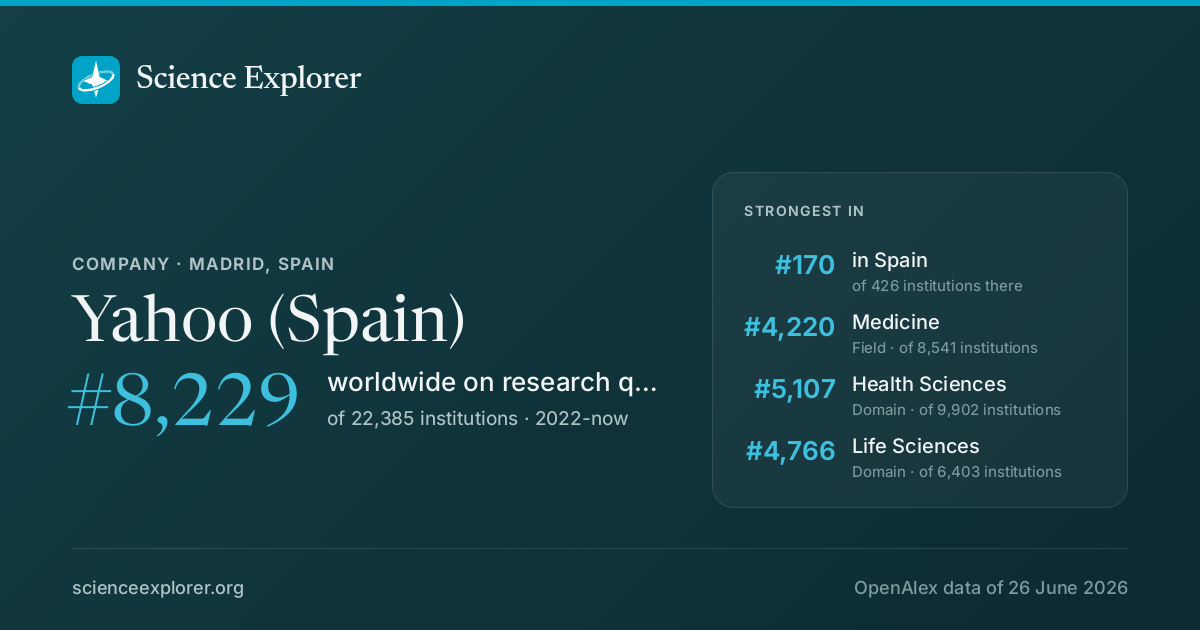
In research, Yahoo (Spain) stands highest in Medicine (#4,220 of 8,541 worldwide), Health Sciences (#5,107 of 9,902 worldwide) and Life Sciences (#4,766 of 6,403 worldwide), 2022-now.
- World rank, 2022-now
- #8,229 of 22,385 · #7,887 all time
- Rank in Spain
- #170 of 426
- Research works
- 3.2k ▼ 15% vs 2018-21
- Citations
- 66k 20.6 per fractional work
- Top-10% rate
- 8.9% all institutions 10.0%
- vs its own fields
- 0.93× 1.00× is exactly expected
- Open access
- 40% world 40%
- International
- 65% world 18%
What is Yahoo (Spain) known for in research?
The fields where it stands highest, 2022-now, ranked among every institution above the floor in each field.
| Field | World rank | Where that sits | Top-10% rate | Works | All time |
|---|---|---|---|---|---|
| MedicineField | #4,220 of 8,541 | 9.6% | 196 | #7082 | |
| Health SciencesDomain | #5,107 of 9,902 | 9.9% | 221 | #8538 | |
| Life SciencesDomain | #4,766 of 6,403 | 7.2% | 79 | #7156 | |
| Social SciencesDomain | #7,628 of 9,585 | 8.0% | 87 | #9116 |
Each strip is that field's whole ranked pool, with the notch where Yahoo (Spain) sits in it, in the colour of the band that rank falls in. The track under the rate is the rate itself: it carries no average mark, because the average differs by field (from about 6% in Dentistry to 21% in Economics).
Which of those standings moved
The same fields on both windows: where it stood over the whole record, and where it stands in 2022-now. The distance is the story, and it is the one thing the two rank columns above cannot show.
- Medicine#7,082 #4,220
- Health Sciences#8,538 #5,107
- Life Sciences#7,156 #4,766
- Social Sciences#9,116 #7,628
A dot further right is a better standing. Fields it was not ranked in over the whole record are left out.
Which fields of science does Yahoo (Spain) work in?
In 2022-now, 49% of research at Yahoo (Spain) is in Health Sciences, 21% in Social Sciences. Its largest fields are Medicine (43%), Social Sciences (12%), Biochemistry, Genetics and Molecular Biology (7%). It does 2.1× the world's share of Health Sciences.
Each ring splits the one inside it: the four domains of science, their fields, their subfields. Size is fractional works in 2022-now. Every slice is a page; the interactive view zooms down to single topics and colours each by how much more of it this institution does than the world.
Its 4 domains and 26 fields, with their numbers
- Health Sciences26349.2%
- Medicine23243.4%
- Health Professions173.2%
- Dentistry81.5%
- Nursing30.6%
- Veterinary20.4%
- Social Sciences11321.1%
- Social Sciences6311.7%
- Psychology173.2%
- Arts and Humanities142.6%
- Economics, Econometrics and Finance91.7%
- Business, Management and Accounting81.5%
- Decision Sciences20.3%
- Life Sciences9618.0%
- Physical Sciences6311.8%
- Computer Science163.0%
- Engineering162.9%
- Environmental Science132.4%
- Materials Science51.0%
- Chemistry50.9%
- Earth and Planetary Sciences40.7%
- Physics and Astronomy30.5%
- Energy10.2%
- Mathematics10.2%
- Chemical Engineering00.0%
Field profile
Location quotient across every field it publishes in: outside the ring is more than an institution of this size would be expected to publish, inside it is less.
Rings at 0.5×, 1× and 2×. Widest outward: Veterinary, 3.2×. Every wedge is a field page.
All 26 fields, with their numbers
- Veterinary3.20×2 works
- Dentistry3.18×8 works
- Medicine2.26×232 works
- Neuroscience2.07×18 works
- Biochemistry, Genetics and Molecular Biology1.41×40 works
- Nursing1.32×4 works
- Pharmacology, Toxicology and Pharmaceutics1.27×2 works
- Health Professions1.21×17 works
- Agricultural and Biological Sciences1.16×30 works
- Immunology and Microbiology1.16×6 works
- Psychology1.06×17 works
- Social Sciences0.93×63 works
- Arts and Humanities0.89×14 works
- Economics, Econometrics and Finance0.79×9 works
- Chemistry0.54×5 works
- Environmental Science0.48×13 works
- Business, Management and Accounting0.48×8 works
- Earth and Planetary Sciences0.45×4 works
- Computer Science0.38×16 works
- Decision Sciences0.30×2 works
- Materials Science0.27×5 works
- Energy0.25×1 works
- Physics and Astronomy0.24×3 works
- Engineering0.19×16 works
- Mathematics0.13×1 works
- Chemical Engineering0.12×0 works
- Veterinary 3.2×
- Dentistry 3.2×
- Medicine 2.3×
- Neuroscience 2.1×
- Biochemistry, Genetics and Molecular Biology 1.4×
- Nursing 1.3×
- Pharmacology, Toxicology and Pharmaceutics 1.3×
- Health Professions 1.2×
- Agricultural and Biological Sciences 1.2×
- Immunology and Microbiology 1.2×
- Psychology 1.1×
- Social Sciences 0.9×
- Arts and Humanities 0.9×
- Economics, Econometrics and Finance 0.8×
- Chemistry 0.5×
- Environmental Science 0.5×
- Business, Management and Accounting 0.5×
- Earth and Planetary Sciences 0.5×
- Computer Science 0.4×
- Decision Sciences 0.3×
- Materials Science 0.3×
- Energy 0.2×
- Physics and Astronomy 0.2×
- Engineering 0.2×
- Mathematics 0.1×
- Chemical Engineering 0.1×
Who are the top researchers at Yahoo (Spain)?
Ranked on the quality score, Flavio Junqueira, Peter Mika and Hugo Zaragoza lead among researchers whose main affiliation is Yahoo (Spain).
- 1
Flavio Junqueira
 Spain · #666,950 worldwide
3.8k citations · 79 works
- 2
Peter Mika
Spain · #874,300 worldwide
5.3k citations · 118 works
- 3
Hugo Zaragoza
Spain · #966,192 worldwide
6.6k citations · 90 works
- 4
Vanessa Murdock
Spain · #978,167 worldwide
2.8k citations · 107 works
- 5
Debora Donato
Spain · #1,009,049 worldwide
3.9k citations · 58 works
- 6
Berkant Barla Cambazoglu
Spain · #1,110,070 worldwide
2.9k citations · 112 works
- 7
Vassilis Plachouras
Spain · #1,170,208 worldwide
2.1k citations · 85 works
- 8
Alejandro Jaimes
Spain · #1,375,581 worldwide
3.8k citations · 121 works
- 9
Roi Blanco
Spain · #1,494,058 worldwide
2.5k citations · 118 works
- 10
Amin Mantrach
Spain · #1,798,912 worldwide
948 citations · 50 works
Which keywords describe research at Yahoo (Spain)?
By fractional works in 2022-now, weighted toward what it does more of than the world: Epidemiology, Inflammation, Neurological Disorders, Treatment, Quality of Life, Evolution, Taxonomy and Phylogeny.
- beetles
- Post-acute COVID-19 Syndrome
- Central Nervous System Involvement
- Pain Management
- Innovation Economics
- Investment
- Anatomy
- Biogeography
- Cognitive Impairment
- Teaching Methods
- Educational Technologies
- Language Teaching
- Complications
- Phylogeny
- Evolution
- Diagnosis
- Globalization
- Neurological Disorders
- Treatment
- Inflammation
- Epidemiology
- Quality of Life
- Oxidative Stress
- Cardiovascular Disease
- Risk Factors
- Management
- Pedagogy
- Taxonomy
- DNA Barcoding
- Critical Thinking
- Student Competencies
- Mitochondrial Dysfunction
- Parkinson's Disease
- Entrepreneurship
- Robotic Surgery
- Industrial Enterprises
- Morphology
- Coleoptera
- Neurologic Manifestations
- Speciation
Size is fractional works in 2022-now in the topics tagged with each word; colour is the word's share of this institution's work against its share of the world's. The 40 words are chosen for being large and distinctive. Each links to the topic it comes from most.
All 40 words, with their numbers
- Epidemiology48▲ 2.2×112 topics
- Inflammation25▲ 2.2×66 topics
- Quality of Life19▲ 2.5×48 topics
- Treatment19▲ 2.9×42 topics
- Oxidative Stress17▲ 1.94×50 topics
- Neurological Disorders15▲ 5.0×18 topics
- Cardiovascular Disease13▲ 2.2×34 topics
- Globalization13▲ 1.23×28 topics
- Risk Factors13▲ 2.2×24 topics
- Diagnosis12▲ 2.4×33 topics
- Management12▲ 2.7×22 topics
- Evolution11▲ 7.6×9 topics
- Pedagogy10▲ 3.6×6 topics
- Phylogeny9▲ 10×8 topics
- Taxonomy9▲ 12×7 topics
- Complications9▲ 3.5×17 topics
- DNA Barcoding9▲ 10.0×7 topics
- Language Teaching9▲ 6.3×2 topics
- Critical Thinking9▲ 14×3 topics
- Educational Technologies9▲ 18×2 topics
- Student Competencies9▲ 25×1 topic
- Teaching Methods9▲ 10.0×1 topic
- Mitochondrial Dysfunction8▲ 4.9×12 topics
- Cognitive Impairment8▲ 5.7×8 topics
- Parkinson's Disease7▲ 5.2×8 topics
- Biogeography7▲ 4.5×10 topics
- Entrepreneurship7▲ 3.2×2 topics
- Anatomy7▲ 17×5 topics
- Robotic Surgery6▲ 7.7×5 topics
- Investment6▲ 9.9×2 topics
- Industrial Enterprises6▲ 33×1 topic
- Innovation Economics6▲ 33×1 topic
- Morphology6▲ 6.2×4 topics
- Pain Management6▲ 4.7×8 topics
- Coleoptera5▲ 34×2 topics
- Central Nervous System Involvement5▲ 12×2 topics
- Neurologic Manifestations4▲ 12×1 topic
- Post-acute COVID-19 Syndrome4▲ 12×1 topic
- Speciation4▲ 19×3 topics
- beetles4▲ 49×1 topic
Which research topics does Yahoo (Spain) publish most on?
By volume in 2022-now: Education, Innovation and Language Studies, Economic and Industrial Development, Long-Term Effects of COVID-19 and Coleoptera Taxonomy and Distribution.
Area is fractional works; colour is the subfield each topic belongs to.
- 1 Education, Innovation and Language Studies Education 9 works
- 2 Economic and Industrial Development Economics and Econometrics 6 works
- 3 Long-Term Effects of COVID-19 Neurology 4 works
- 4 Coleoptera Taxonomy and Distribution Ecology, Evolution, Behavior and Systematics 4 works
- 5 Lepidoptera: Biology and Taxonomy Genetics 4 works
- 6 Medical, Sociocultural, and Biopolitical Studies Political Science and International Relations 4 works
- 7 Engineering and Agricultural Innovations Aquatic Science 3 works
- 8 Pediatric Urology and Nephrology Studies Pediatrics, Perinatology and Child Health 3 works
- 9 Peripheral Neuropathies and Disorders Neurology 3 works
- 10 Kidney Stones and Urolithiasis Treatments Pulmonary and Respiratory Medicine 3 works
How open and international is its research?
Against the world's own shares: the tick on each track. Both are shares of its output, so they sit on one scale and can be read against each other as well as against the world.
World: 40% of research is openly available.
World: 18% is written across borders.
How has Yahoo (Spain)'s research output changed?
Output in 2022-2025 was 15% lower than in 2018-2021.
The same series as a ribbon: one cell per year, darker for more. The line above answers how much; this answers when.
Its share of all research
Growing output can still be a shrinking share: all of science grows. This is Yahoo (Spain) as a percentage of every work published that year, 0.0020% in 2024.
Fractional works of Yahoo (Spain) over all fractional works that year. How the balance of science has shifted.
How much of it reaches the world top 10%
Year by year, against all institutions in the same year.
Of each year's output, the share that reached the world's 10% most cited for its field and year. Peak 14.5% in 2007.
Other research institutions in Madrid
- Consejo Superior de Investigaciones Científicas
- Universidad Complutense de Madrid
- Universidad Autónoma de Madrid
- Universidad Politécnica de Madrid
- Instituto de Salud Carlos III
- Universidad Carlos III de Madrid
- Universidad Rey Juan Carlos
- Universidad Nacional de Educación a Distancia





Share Yahoo (Spain)'s ranking
Badges for a website1Each links back here and updates with every snapshot

Research measures only: rankings here say nothing about teaching, admissions or student experience. Comparable institutions and collaboration partners have tabs of their own, above.
Discussion
Ask a question or share a note about Yahoo (Spain). Posts are plain text and can be reported.