 Science in Mongolia
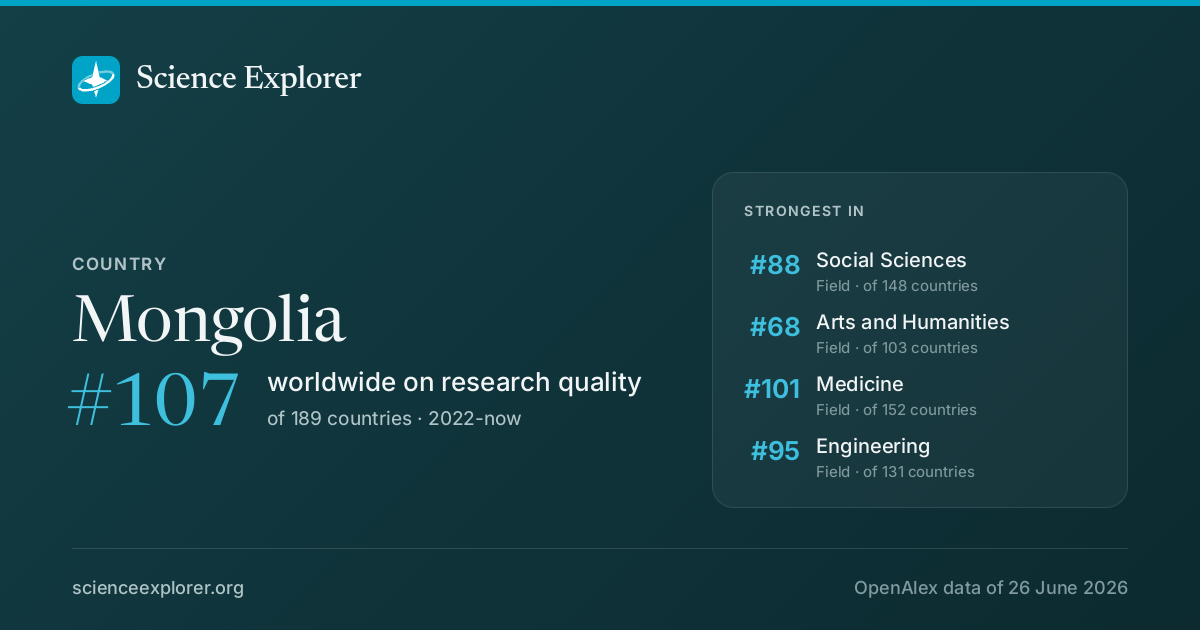
Mongolia ranks #107 of 189 countries on research quality in 2022-now (#119 all time), with 6.4k research works and 5.0% of them in the world's top 10%.
- World rank, 2022-now
- #107 of 189 · #119 all time
- Works, 2022-now
- 6.4k ▲ 58% vs 2018-21
- Citations
- 110k 4.7 per fractional work, all time
- Top-10% rate
- 5.0% all institutions 10.0%
- vs its own fields
- 0.52× 1.00× is exactly expected
- In the world top 100
- 0 0 in the top 1,000
- Open access
- 55% world 40%
- International
- 39% world 18%
MongoliaWhat is Mongolia strongest at in science?
On research quality in 2022-now, Mongolia ranks highest in Social Sciences (#88 of 148), Arts and Humanities (#68 of 103) and Medicine (#101 of 152). Relative to its size it is most specialised in Fuel Technology, Computer Graphics and Computer-Aided Design and Music.
| Field | World rank | Where that sits | Top-10% rate | Works | All time | Institutions |
|---|---|---|---|---|---|---|
| Social SciencesField | #88 of 148 | 6.1% | 1,238 | #93 | Institutions | |
| Arts and HumanitiesField | #68 of 103 | 6.3% | 485 | #66 | Institutions | |
| MedicineField | #101 of 152 | 5.2% | 742 | #115 | Institutions | |
| EngineeringField | #95 of 131 | 3.3% | 603 | #114 | Institutions | |
| Sociology and Political ScienceSubfield | #91 of 119 | 5.2% | 342 | #102 | Institutions | |
| PsychologyField | #84 of 106 | 4.8% | 202 | #96 | Institutions | |
| Environmental ScienceField | #98 of 122 | 4.3% | 556 | #101 | Institutions | |
| Earth and Planetary SciencesField | #63 of 78 | 3.3% | 216 | #81 | Institutions | |
| Computer ScienceField | #105 of 128 | 3.9% | 513 | #111 | Institutions | |
| Biochemistry, Genetics and Molecular BiologyField | #88 of 105 | 4.5% | 209 | #109 | ||
| Economics, Econometrics and FinanceField | #91 of 107 | 7.0% | 246 | #100 | Institutions | |
| Agricultural and Biological SciencesField | #107 of 124 | 5.0% | 358 | #122 | Institutions |
Where its research is concentrated
Location quotient: how much more (or less) of each node it does than its size predicts. Drawn around 1×, where "twice the world share" and "half of it" are the same distance apart in opposite directions. A volume reading, which on a country axis is largely population and industrial structure.
- Fuel TechnologySubfield · 14.4 works · #12 of 113 active here24×
- Computer Graphics and Computer-Aided DesignSubfield · 60.6 works · #37 of 159 active here9.8×
- MusicSubfield · 50.0 works · #50 of 174 active here8.2×
- ArcheologySubfield · 6.5 works · #63 of 158 active here5.7×
- Language and LinguisticsSubfield · 174.1 works · #72 of 213 active here5.3×
- Library and Information SciencesSubfield · 7.1 works · #59 of 146 active here5.0×
- Management, Monitoring, Policy and LawSubfield · 215.2 works · #67 of 223 active here4.9×
- AnthropologySubfield · 95.3 works · #70 of 213 active here4.5×
The whole field profile
All 26 fields at once. A specialist and a generalist produce the same ranked list and a completely different shape.
Rings at 0.5×, 1× and 2×. Widest outward: Arts and Humanities, 2.5×. Every wedge is a field page.
All 26 fields, with their numbers
- Arts and Humanities2.49×535 works
- Earth and Planetary Sciences2.02×236 works
- Economics, Econometrics and Finance1.91×305 works
- Environmental Science1.72×635 works
- Social Sciences1.47×1,382 works
- Business, Management and Accounting1.35×324 works
- Agricultural and Biological Sciences1.21×428 works
- Decision Sciences1.21×87 works
- Veterinary1.11×11 works
- Psychology1.06×240 works
- Computer Science1.05×606 works
- Pharmacology, Toxicology and Pharmaceutics1.01×27 works
- Energy0.90×61 works
- Chemical Engineering0.84×22 works
- Health Professions0.83×164 works
- Mathematics0.77×67 works
- Dentistry0.75×27 works
- Nursing0.65×24 works
- Physics and Astronomy0.64×106 works
- Biochemistry, Genetics and Molecular Biology0.63×252 works
- Medicine0.63×897 works
- Engineering0.62×692 works
- Immunology and Microbiology0.59×45 works
- Materials Science0.59×154 works
- Neuroscience0.52×63 works
- Chemistry0.52×61 works
Which fields of science does Mongolia work in?
In 2022-now, 39% of research in Mongolia is in Social Sciences, 35% in Physical Sciences. Its largest fields are Social Sciences (19%), Medicine (12%), Engineering (9%). It does 1.6× the world's share of Social Sciences.
Each ring splits the one inside it: the four domains of science, their fields, their subfields. Size is fractional works in 2022-now. Every slice is a page; the interactive view zooms down to single topics and colours each by how much more of it this country does than the world.
Its 4 domains and 26 fields, with their numbers
- Social Sciences2,87338.6%
- Social Sciences1,38218.5%
- Arts and Humanities5357.2%
- Business, Management and Accounting3244.4%
- Economics, Econometrics and Finance3054.1%
- Psychology2403.2%
- Decision Sciences871.2%
- Physical Sciences2,64035.4%
- Engineering6929.3%
- Environmental Science6358.5%
- Computer Science6058.1%
- Earth and Planetary Sciences2363.2%
- Materials Science1542.1%
- Physics and Astronomy1061.4%
- Mathematics670.9%
- Energy610.8%
- Chemistry610.8%
- Chemical Engineering220.3%
- Health Sciences1,12315.1%
- Medicine89712.0%
- Health Professions1642.2%
- Dentistry270.4%
- Nursing240.3%
- Veterinary110.2%
- Life Sciences81410.9%
Which keywords describe research in Mongolia?
By fractional works in 2022-now, weighted toward what it does more of than the world: Climate Change, Sustainability, Ecological Knowledge, Adaptation, Globalization, Artificial Intelligence, Livelihoods and Land Management.
- Visual Communication Design
- Graphic Design
- Eurasian Exchange
- Financial Security
- Economic Security
- Central Asia
- Turkic
- Virtual Reality
- Morphology
- Etymology
- History
- Economic Growth
- Pastoralists
- Livelihoods
- Innovation
- Adaptation
- Deep Learning
- Sustainable Development
- Artificial Intelligence
- Sustainability
- Climate Change
- Globalization
- Machine Learning
- Epidemiology
- Education
- Ecological Knowledge
- Economic Development
- Land Management
- Rangeland Degradation
- Linguistics
- Biodiversity
- Historical Phonology
- Language Contact
- Syntax
- oral epics
- Multimedia Technology
- Arctic
- Human-Computer Interaction
- Silk Roads
- Digital Media Technology
Size is fractional works in 2022-now in the topics tagged with each word; colour is the word's share of this country's work against its share of the world's. The 40 words are chosen for being large and distinctive. Each links to the topic it comes from most.
All 40 words, with their numbers
- Climate Change527▲ 2.6×10⁵ topics
- Sustainability358▲ 1.97×10⁶ topics
- Globalization307▲ 2.1×132 topics
- Artificial Intelligence271▲ 2.5×62 topics
- Machine Learning257◆ 1.04×88 topics
- Sustainable Development249▲ 2.1×83 topics
- Epidemiology227▼ 0.76×130 topics
- Deep Learning220▼ 0.86×81 topics
- Education190▲ 1.49×115 topics
- Adaptation165▲ 7.4×14 topics
- Ecological Knowledge164▲ 52×2 topics
- Innovation162▲ 2.1×71 topics
- Economic Development157▲ 2.6×41 topics
- Livelihoods149▲ 58×2 topics
- Land Management148▲ 57×2 topics
- Pastoralists147▲ 78×1 topic
- Rangeland Degradation147▲ 78×1 topic
- Economic Growth132▲ 2.2×33 topics
- Linguistics127▲ 11×9 topics
- History126▲ 2.4×45 topics
- Biodiversity114▲ 2.0×35 topics
- Etymology112▲ 32×2 topics
- Historical Phonology112▲ 32×2 topics
- Morphology111▲ 8.3×11 topics
- Language Contact104▲ 15×5 topics
- Virtual Reality103▲ 2.8×19 topics
- Syntax100▲ 19×3 topics
- Turkic94▲ 48×1 topic
- oral epics94▲ 48×1 topic
- Central Asia90▲ 17×4 topics
- Multimedia Technology83▲ 18×2 topics
- Economic Security80▲ 5.1×7 topics
- Arctic75▲ 9.1×4 topics
- Financial Security73▲ 9.2×3 topics
- Human-Computer Interaction70▲ 5.2×7 topics
- Eurasian Exchange61▲ 40×1 topic
- Silk Roads61▲ 40×1 topic
- Graphic Design59▲ 20×2 topics
- Digital Media Technology59▲ 21×1 topic
- Visual Communication Design59▲ 21×1 topic
Which research topics does Mongolia publish the most in?
Its largest topics in 2022-now are Rangeland Management and Livestock Ecology, Linguistics and Cultural Studies, Eurasian Exchange Networks.
Area is fractional works in 2022-now; colour is the subfield each topic belongs to. Every tile is a topic page.
- 1 Rangeland Management and Livestock Ecology Management, Monitoring, Policy and Law 147 works
- 2 Linguistics and Cultural Studies Language and Linguistics 94 works
- 3 Eurasian Exchange Networks Anthropology 61 works
- 4 Digital Media and Visual Art Computer Graphics and Computer-Aided Design 59 works
- 5 Linguistic, Cultural, and Literary Studies Sociology and Political Science 36 works
- 6 Geological Studies and Exploration Geology 34 works
- 7 Economic Issues in Ukraine General Economics, Econometrics and Finance 32 works
- 8 Legal and Regulatory Analysis Transportation 31 works
- 9 Water Resources and Management Ecology 31 works
- 10 Educational Reforms and Innovations Health, Toxicology and Mutagenesis 30 works
- 11 Military Technology and Strategies Aerospace Engineering 29 works
- 12 Diverse Musicological Studies Music 28 works
Which universities in Mongolia lead research?
National University of Mongolia, University of Finance and Economics and University of the Humanities rank highest in Mongolia on research quality in 2022-now.
One dot per institution in the list below. The upper left is the interesting corner.
- 1National University of MongoliaUniversity · Ulaanbaatar · #3,535 worldwide4.4% top 10% · 1.2k works
- 2University of Finance and EconomicsUniversity · Ulaanbaatar · #4,745 worldwide4.8% top 10% · 561 works
- 3University of the HumanitiesUniversity · Ulaanbaatar · #5,002 worldwide9.3% top 10% · 603 works
- 4Mongolian Academy of SciencesGovernment institution · Ulaanbaatar · #7,058 worldwide2.2% top 10% · 827 works
- 5National Academy of GovernanceUniversity · Ulaanbaatar · #7,290 worldwide8.6% top 10% · 375 works
- 6Ider UniversityUniversity · Ulaanbaatar · #7,940 worldwide5.8% top 10% · 187 works
- 7Mongolian University of Life SciencesUniversity · Ulaanbaatar · #8,666 worldwide4.5% top 10% · 284 works
- 8Mongolian National UniversityUniversity · Ulaanbaatar · #8,944 worldwide5.4% top 10% · 291 works
- 9Mongolian National University of EducationUniversity · Ulaanbaatar · #11,261 worldwide3.9% top 10% · 232 works
- 10Mongolian University of Science and TechnologyUniversity · Ulaanbaatar · #11,449 worldwide3.5% top 10% · 721 works
- 11Mongolian National University of Medical SciencesUniversity · Ulaanbaatar · #11,904 worldwide5.2% top 10% · 301 works
- 12Ministry of HealthGovernment institution · Ulaanbaatar · #15,885 worldwide5.2% top 10% · 172 works
- 13National Center for Communicable DiseasesGovernment institution · Ulaanbaatar · #15,888 worldwide5.5% top 10% · 113 works
- 14Research Institute of Animal HusbandryGovernment institution · Ulaanbaatar · #16,862 worldwide4.3% top 10% · 152 works
- 15National Influenza CenterGovernment institution · Ulaanbaatar · #17,372 worldwide13.8% top 10% · 63 works
The track on each row is its top-10% rate; the tick is the average of all institutions, 10.0% (how it is set): teal above it, red below.
All ranked institutions in MongoliaWho are the top researchers in Mongolia?
Munkhtuya Tumurkhuu, Yanjinlkham Munkhsaikhan and Ryenchindorj Erkhembayar rank highest among researchers based in Mongolia.
- 1 Munkhtuya Tumurkhuu #26,249 worldwide 24k citations · 79 works
- 2 Yanjinlkham Munkhsaikhan #149,169 worldwide 3.7k citations · 25 works
- 3 Ryenchindorj Erkhembayar #171,998 worldwide 17k citations · 37 works
- 4 Болормаа Норов #173,089 worldwide 2.7k citations · 45 works
- 5 Jamsranjav Bayarsaikhan #177,653 worldwide 2.4k citations · 82 works
- 6 Bazartseren Boldgiv #227,349 worldwide 9.9k citations · 148 works
- 7 Gombosuren Badarch #235,555 worldwide 8.6k citations · 57 works
- 8 Chimedsuren Оchir #430,901 worldwide 11k citations · 84 works
- 9 Pagbajabyn Nymadawa #455,943 worldwide 7.8k citations · 87 works
- 10 Bayarbaatar Buuveibaatar #637,388 worldwide 2.1k citations · 89 works
Which cities in Mongolia are research hubs?
- 1
UlaanbaatarMongolia
23k works
How open and international is Mongolia's research?
55% of its research is openly available (world: 40%), and 39% is written with international co-authors (world: 18%).
World: 40% of research is openly available.
World: 18% is written across borders.
In 2022-now, 79% of its research is openly available (world 63%) and 40% is written with co-authors abroad (world 22%). Against what its own mix of topics predicts, that is 1.17× the expected open access and 1.89× the expected international share, which puts it #24 of 173 countries on openness.
How has Mongolia's research grown?
Output in 2022-2025 was 58% higher than in 2018-2021.
The same series as a ribbon: one cell per year, darker for more. The line above answers how much; this answers when.
Its share of all research
Growing output can still be a shrinking share: all of science grows. This is Mongolia as a percentage of every work published that year, 0.029% in 2024.
Fractional works of Mongolia over all fractional works that year. How the balance of science has shifted.
How much of it reaches the world top 10%
Over the whole record, 5.0% of its 23k works since 1951 reached the world top 10% for their field and year.
Of each year's output, the share that reached the world's 10% most cited for its field and year. Peak 11.7% in 1992.
Which countries have research most like Mongolia's?
Slovenia is Mongolia's closest research twin: of all countries, its research is spread across the fields most like Mongolia's, with both strong in Arts and Humanities.
- 1
 SloveniaBoth strong in Arts and Humanities, Economics, Econometrics and Finance, Social Sciences
0.70 Compare
- 2
 BahamasBoth strong in Earth and Planetary Sciences, Economics, Econometrics and Finance, Environmental Science
0.69 Compare
- 3
 NicaraguaBoth strong in Economics, Econometrics and Finance, Arts and Humanities, Social Sciences
0.68 Compare
- 4
 Costa RicaBoth strong in Arts and Humanities, Environmental Science, Social Sciences
0.67 Compare
- 5
 AlbaniaBoth strong in Arts and Humanities, Economics, Econometrics and Finance, Social Sciences
0.67 Compare
Similarity is the correlation of each side's location quotients across every field it publishes in, on a log scale: 1 is the same shape of research, 0 is unrelated. It ignores size. How it is measured.
Compare Mongolia with
 Afghanistan
 Saint Kitts and Nevis
 Yemen
 Nepal
 Kuwait
 Sudan
Share Mongolia's ranking
Badges for a website1Each links back here and updates with every snapshot

Research fields in Mongolia
- Social Sciences
- Social Sciences
- Health Sciences
- Arts and Humanities
- Physical Sciences
- Medicine
- Engineering
- Sociology and Political Science
- Psychology
- Life Sciences
- Environmental Science
- Earth and Planetary Sciences
- Computer Science
- Economics, Econometrics and Finance
- Agricultural and Biological Sciences
- Business, Management and Accounting
Discussion
Ask a question or share a note about Mongolia. Posts are plain text and can be reported.