 Science in Serbia
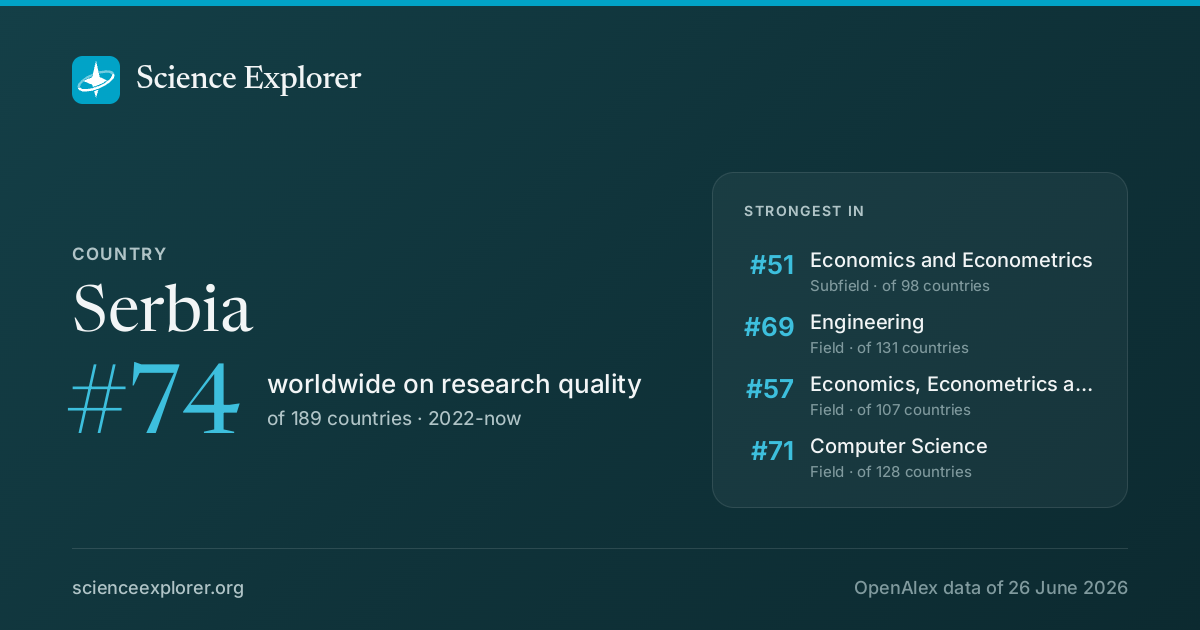
Serbia ranks #74 of 189 countries on research quality in 2022-now (#80 all time), with 39k research works and 7.4% of them in the world's top 10%.
- World rank, 2022-now
- #74 of 189 · #80 all time
- Works, 2022-now
- 39k ▲ 3% vs 2018-21
- Citations
- 1.7M 9.7 per fractional work, all time
- Top-10% rate
- 7.4% all institutions 10.0%
- vs its own fields
- 0.71× 1.00× is exactly expected
- In the world top 100
- 0 0 in the top 1,000
- Open access
- 59% world 40%
- International
- 23% world 18%
SerbiaWhat is Serbia strongest at in science?
On research quality in 2022-now, Serbia ranks highest in Economics and Econometrics (#51 of 98), Engineering (#69 of 131) and Economics, Econometrics and Finance (#57 of 107). Relative to its size it is most specialised in Biochemistry, Filtration and Separation and Tourism, Leisure and Hospitality Management.
| Field | World rank | Where that sits | Top-10% rate | Works | All time | Institutions |
|---|---|---|---|---|---|---|
| Economics and EconometricsSubfield | #51 of 98 | 12.0% | 1,735 | #53 | Institutions | |
| EngineeringField | #69 of 131 | 5.6% | 5,387 | #60 | Institutions | |
| Economics, Econometrics and FinanceField | #57 of 107 | 11.4% | 2,037 | #59 | Institutions | |
| Computer ScienceField | #71 of 128 | 8.0% | 2,541 | #69 | Institutions | |
| Social SciencesField | #83 of 148 | 8.0% | 4,651 | #85 | Institutions | |
| Agricultural and Biological SciencesField | #70 of 124 | 8.7% | 2,864 | #83 | Institutions | |
| MedicineField | #87 of 152 | 6.8% | 6,856 | #102 | Institutions | |
| MathematicsField | #46 of 80 | 11.2% | 733 | #45 | Institutions | |
| Business, Management and AccountingField | #67 of 110 | 9.0% | 1,623 | #72 | Institutions | |
| Environmental ScienceField | #79 of 122 | 6.2% | 2,117 | #74 | Institutions | |
| Arts and HumanitiesField | #67 of 103 | 6.8% | 1,330 | #74 | Institutions | |
| Biochemistry, Genetics and Molecular BiologyField | #69 of 105 | 6.7% | 1,651 | #80 | Institutions |
Where its research is concentrated
Location quotient: how much more (or less) of each node it does than its size predicts. Drawn around 1×, where "twice the world share" and "half of it" are the same distance apart in opposite directions. A volume reading, which on a country axis is largely population and industrial structure.
- BiochemistrySubfield · 214.8 works · #30 of 198 active here4.0×
- Filtration and SeparationSubfield · 16.5 works · #28 of 134 active here3.4×
- Tourism, Leisure and Hospitality ManagementSubfield · 34.1 works · #39 of 165 active here3.4×
- General EnergySubfield · 38.0 works · #40 of 167 active here3.2×
- ArchitectureSubfield · 50.7 works · #33 of 166 active here3.0×
- Economics and EconometricsSubfield · 1,895.8 works · #37 of 220 active here2.7×
- Geometry and TopologySubfield · 189.1 works · #40 of 186 active here2.6×
- Industrial relationsSubfield · 3.5 works · #22 of 95 active here2.6×
The whole field profile
All 26 fields at once. A specialist and a generalist produce the same ranked list and a completely different shape.
Rings at 0.5×, 1× and 2×. Widest outward: Economics, Econometrics and Finance, 2.4×. Every wedge is a field page.
All 26 fields, with their numbers
- Economics, Econometrics and Finance2.38×2,229 works
- Mathematics1.58×814 works
- Agricultural and Biological Sciences1.55×3,228 works
- Decision Sciences1.33×562 works
- Dentistry1.30×277 works
- Veterinary1.26×75 works
- Business, Management and Accounting1.25×1,772 works
- Nursing1.24×266 works
- Pharmacology, Toxicology and Pharmaceutics1.20×185 works
- Arts and Humanities1.16×1,472 works
- Environmental Science1.12×2,443 works
- Chemistry1.07×737 works
- Psychology1.02×1,357 works
- Social Sciences0.95×5,261 works
- Medicine0.92×7,726 works
- Engineering0.91×5,966 works
- Physics and Astronomy0.89×869 works
- Energy0.87×351 works
- Computer Science0.84×2,847 works
- Biochemistry, Genetics and Molecular Biology0.80×1,869 works
- Chemical Engineering0.80×122 works
- Immunology and Microbiology0.78×344 works
- Neuroscience0.78×552 works
- Earth and Planetary Sciences0.78×536 works
- Materials Science0.74×1,132 works
- Health Professions0.72×828 works
Which fields of science does Serbia work in?
In 2022-now, 36% of research in Serbia is in Physical Sciences, 29% in Social Sciences. Its largest fields are Medicine (18%), Engineering (14%), Social Sciences (12%).
Each ring splits the one inside it: the four domains of science, their fields, their subfields. Size is fractional works in 2022-now. Every slice is a page; the interactive view zooms down to single topics and colours each by how much more of it this country does than the world.
Its 4 domains and 26 fields, with their numbers
- Physical Sciences16k36.1%
- Engineering5,96613.6%
- Computer Science2,8476.5%
- Environmental Science2,4435.6%
- Materials Science1,1322.6%
- Physics and Astronomy8692.0%
- Mathematics8141.9%
- Chemistry7371.7%
- Earth and Planetary Sciences5361.2%
- Energy3510.8%
- Chemical Engineering1220.3%
- Social Sciences13k28.9%
- Social Sciences5,26112.0%
- Economics, Econometrics and Finance2,2295.1%
- Business, Management and Accounting1,7724.0%
- Arts and Humanities1,4723.4%
- Psychology1,3573.1%
- Decision Sciences5621.3%
- Health Sciences9,17320.9%
- Medicine7,72617.6%
- Health Professions8281.9%
- Dentistry2770.6%
- Nursing2660.6%
- Veterinary750.2%
- Life Sciences6,17814.1%
Which keywords describe research in Serbia?
By fractional works in 2022-now, weighted toward what it does more of than the world: Sustainable Development, Economic Growth, Regional Development, Innovation Management, Agricultural Sustainability, Small and Medium Enterprises, Rural Tourism and Leadership Emergence.
- Yugoslavia
- Eastern Europe
- Conflict
- Commercial Diplomacy
- Flavonoids
- Sovereign Debt Crises
- Legal Regulation
- Religion
- International Relations
- Ethnicity
- Renewable Energy
- Rural Tourism
- Globalization
- Agricultural Sustainability
- Organizational Culture
- Environmental Impact
- Regional Development
- Climate Change
- Economic Growth
- Epidemiology
- Sustainable Development
- Sustainability
- Machine Learning
- Oxidative Stress
- Financial Performance
- Inflammation
- Innovation Management
- Small and Medium Enterprises
- Artificial Intelligence
- Leadership Emergence
- Antioxidant
- Identity
- Antioxidant Activity
- International Trade
- Foreign Policy
- Nation-Building
- Negotiation
- Economic Diplomacy
- Balkans
- Post-war
Size is fractional works in 2022-now in the topics tagged with each word; colour is the word's share of this country's work against its share of the world's. The 40 words are chosen for being large and distinctive. Each links to the topic it comes from most.
All 40 words, with their numbers
- Sustainable Development1,762▲ 2.6×10³ topics
- Epidemiology1,436▼ 0.82×138 topics
- Sustainability1,361▲ 1.27×126 topics
- Economic Growth1,315▲ 3.7×36 topics
- Machine Learning1,287◆ 0.88×95 topics
- Climate Change1,224◆ 1.03×125 topics
- Oxidative Stress969▲ 1.34×63 topics
- Regional Development957▲ 6.4×19 topics
- Financial Performance950▲ 3.9×16 topics
- Environmental Impact911▲ 1.22×72 topics
- Inflammation888◆ 0.95×83 topics
- Organizational Culture887▲ 5.2×15 topics
- Innovation Management834▲ 12×10 topics
- Agricultural Sustainability824▲ 17×6 topics
- Small and Medium Enterprises822▲ 11×10 topics
- Globalization815◆ 0.95×163 topics
- Artificial Intelligence811▲ 1.30×62 topics
- Rural Tourism780▲ 57×2 topics
- Leadership Emergence780▲ 130×1 topic
- Renewable Energy736▲ 1.16×61 topics
- Antioxidant610▲ 2.0×51 topics
- Ethnicity558▲ 3.4×21 topics
- Identity558▲ 1.76×72 topics
- International Relations547▲ 5.2×29 topics
- Antioxidant Activity510▲ 1.87×32 topics
- Religion449▲ 2.2×40 topics
- International Trade429▲ 7.0×11 topics
- Legal Regulation412▲ 4.2×8 topics
- Foreign Policy403▲ 24×4 topics
- Sovereign Debt Crises397▲ 22×2 topics
- Nation-Building395▲ 17×4 topics
- Flavonoids371▲ 3.3×12 topics
- Negotiation368▲ 24×3 topics
- Commercial Diplomacy359▲ 70×1 topic
- Economic Diplomacy359▲ 70×1 topic
- Conflict313▲ 4.4×11 topics
- Balkans284▲ 28×2 topics
- Eastern Europe264▲ 12×3 topics
- Post-war244▲ 48×1 topic
- Yugoslavia244▲ 48×1 topic
Which research topics does Serbia publish the most in?
Its largest topics in 2022-now are Regional Development and Management Studies, Balkan and Eastern European Studies, Balkans: History, Politics, Society.
Area is fractional works in 2022-now; colour is the subfield each topic belongs to. Every tile is a topic page.
- 1 Regional Development and Management Studies Economics and Econometrics 780 works
- 2 Balkan and Eastern European Studies Economics and Econometrics 359 works
- 3 Balkans: History, Politics, Society Cultural Studies 244 works
- 4 Military Technology and Strategies Aerospace Engineering 236 works
- 5 Legal and Regulatory Analysis Transportation 235 works
- 6 Linguistic, Cultural, and Literary Studies Sociology and Political Science 234 works
- 7 Phytochemicals and Antioxidant Activities Biochemistry 175 works
- 8 Essential Oils and Antimicrobial Activity Food Science 149 works
- 9 Diverse Aspects of Tourism Research Sociology and Political Science 142 works
- 10 Environmental Science and Water Management Water Science and Technology 132 works
- 11 Education, Law, and Society Political Science and International Relations 120 works
- 12 Global Trade and Competitiveness Strategy and Management 117 works
Which universities in Serbia lead research?
University of Belgrade, Singidunum University and University of Novi Sad rank highest in Serbia on research quality in 2022-now.
One dot per institution in the list below. The upper left is the interesting corner.
- 1University of BelgradeUniversity · Belgrade · #1,084 worldwide7.3% top 10% · 14k works
- 2Singidunum UniversityUniversity · Belgrade · #2,074 worldwide11.5% top 10% · 725 works
- 3University of Novi SadUniversity · Novi Sad · #3,665 worldwide7.5% top 10% · 6.6k works
- 4Univerzitet Union Nikola TeslaUniversity · Belgrade · #4,037 worldwide7.6% top 10% · 504 works
- 5Gulf UniversityUniversity · Sanad · #5,048 worldwide15.9% top 10% · 417 works
- 6University of KragujevacUniversity · Kragujevac · #5,616 worldwide8.7% top 10% · 2.4k works
- 7Metropolitan UniversityUniversity · Belgrade · #5,646 worldwide7.4% top 10% · 359 works
- 8Serbian Academy of Sciences and ArtsGovernment institution · Belgrade · #6,683 worldwide9.2% top 10% · 630 works
- 9University of NisUniversity · Niš · #7,076 worldwide5.6% top 10% · 3.4k works
- 10University of DefenceUniversity · Belgrade · #7,510 worldwide12.6% top 10% · 291 works
- 11University of Arts in BelgradeUniversity · Belgrade · #7,590 worldwide4.8% top 10% · 309 works
- 12Center for Health, Exercise and Sport SciencesInstitution · Belgrade · #8,156 worldwide7.2% top 10% · 396 works
- 13Arheološki InstitutArchive · Belgrade · #8,410 worldwide6.3% top 10% · 262 works
- 14Zdravstveni centarHospital / health system · Senta · #8,527 worldwide3.9% top 10% · 252 works
- 15Development Agency of SerbiaGovernment institution · Belgrade · #9,223 worldwide3.9% top 10% · 212 works

The track on each row is its top-10% rate; the tick is the average of all institutions, 10.0% (how it is set): teal above it, red below.
All ranked institutions in SerbiaWho are the top researchers in Serbia?
Dragan Stevan Pamucar, Mihajlo Jakovljević and Petar M Seferovic rank highest among researchers based in Serbia.
- 1 Dragan Stevan Pamucar #1,015 worldwide 30k citations · 791 works
- 2 Mihajlo Jakovljević #2,006 worldwide 151k citations · 290 works
- 3 Petar M Seferovic #2,543 worldwide 70k citations · 423 works
- 4 Irena Ilić #6,030 worldwide 99k citations · 203 works
- 5 Vladimir Šimić #6,734 worldwide 7.5k citations · 346 works
- 6 K. Bristow #7,835 worldwide 17k citations · 195 works
- 7 Milena Ilić #10,549 worldwide 124k citations · 270 works
- 8 T. Velz #13,330 worldwide 14k citations · 154 works
- 9 Milena M Santric-Milicevic #14,772 worldwide 181k citations · 307 works
- 10 C. Hengler #17,298 worldwide 15k citations · 187 works
Which cities in Serbia are research hubs?
How open and international is Serbia's research?
59% of its research is openly available (world: 40%), and 23% is written with international co-authors (world: 18%).
World: 40% of research is openly available.
World: 18% is written across borders.
In 2022-now, 75% of its research is openly available (world 63%) and 27% is written with co-authors abroad (world 22%). Against what its own mix of topics predicts, that is 1.18× the expected open access and 1.23× the expected international share, which puts it #62 of 173 countries on openness.
How has Serbia's research grown?
Output in 2022-2025 was 3% higher than in 2018-2021.
The same series as a ribbon: one cell per year, darker for more. The line above answers how much; this answers when.
Its share of all research
Growing output can still be a shrinking share: all of science grows. This is Serbia as a percentage of every work published that year, 0.17% in 2024.
Fractional works of Serbia over all fractional works that year. How the balance of science has shifted.
How much of it reaches the world top 10%
Over the whole record, 6.3% of its 180k works since 1950 reached the world top 10% for their field and year.
Of each year's output, the share that reached the world's 10% most cited for its field and year. Peak 7.7% in 2025.
Which countries have research most like Serbia's?
Bosnia and Herzegovina is Serbia's closest research twin: of all countries, its research is spread across the fields most like Serbia's, with both strong in Economics, Econometrics and Finance.
- 1
 Bosnia and HerzegovinaBoth strong in Economics, Econometrics and Finance, Dentistry, Veterinary
0.76 Compare
- 2
 North MacedoniaBoth strong in Economics, Econometrics and Finance, Decision Sciences, Dentistry
0.71 Compare
- 3
 CroatiaBoth strong in Economics, Econometrics and Finance, Dentistry, Nursing
0.68 Compare
- 4
 RomaniaBoth strong in Economics, Econometrics and Finance, Mathematics, Dentistry
0.65 Compare
- 5
 AfghanistanBoth strong in Economics, Econometrics and Finance, Agricultural and Biological Sciences, Dentistry
0.64 Compare
Similarity is the correlation of each side's location quotients across every field it publishes in, on a log scale: 1 is the same shape of research, 0 is unrelated. It ignores size. How it is measured.
Compare Serbia with
 Lithuania
 Zimbabwe
 Pakistan
 Lebanon
 Latvia
 Bulgaria
Share Serbia's ranking
Badges for a website1Each links back here and updates with every snapshot

Research fields in Serbia
- Physical Sciences
- Economics and Econometrics
- Engineering
- Economics, Econometrics and Finance
- Social Sciences
- Computer Science
- Health Sciences
- Social Sciences
- Agricultural and Biological Sciences
- Medicine
- Mathematics
- Life Sciences
- Business, Management and Accounting
- Environmental Science
- Arts and Humanities
- Biochemistry, Genetics and Molecular Biology
- Physics and Astronomy
- Sociology and Political Science
- Transportation
- Surgery
- Plant Science
- Political Science and International Relations
- Materials Science
- Cardiology and Cardiovascular Medicine
- Strategy and Management
- Management Science and Operations Research
- Food Science
- Artificial Intelligence
- Decision Sciences
- Pulmonary and Respiratory Medicine
- Psychology
- Control and Systems Engineering
- Radiology, Nuclear Medicine and Imaging
- Biomedical Engineering
- Health Professions
- Molecular Biology
- Industrial and Manufacturing Engineering
- Applied Mathematics
- Chemistry
- Computational Theory and Mathematics
- Endocrinology, Diabetes and Metabolism
- Dentistry
- Electrical and Electronic Engineering
- Epidemiology
- Organic Chemistry
- Information Systems
- Genetics
- Aerospace Engineering
- Materials Chemistry
- Energy
- Pathology and Forensic Medicine
- Social Psychology
- Infectious Diseases
- Education
- Public Health, Environmental and Occupational Health
- Water Science and Technology
- Physiology
- Mechanical Engineering
- Ecology, Evolution, Behavior and Systematics
- Insect Science
Discussion
Ask a question or share a note about Serbia. Posts are plain text and can be reported.