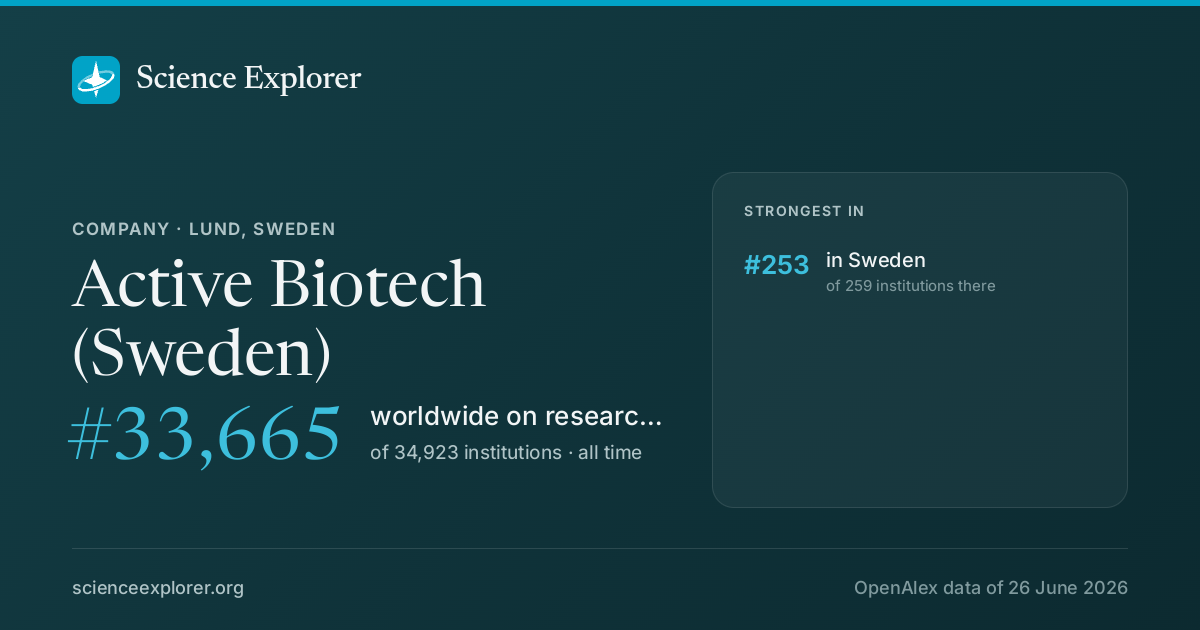
- World rank, all time
- #33,665 of 34,923
- Rank in Sweden
- #253 of 259
- Research works
- 176 ▲ 23% vs 2018-21
- Citations
- 5.7k 32.4 per fractional work
- Top-10% rate
- 7.3% all institutions 10.0%
- vs its own fields
- 0.99× 1.00× is exactly expected
- Open access
- 28% world 40%
- International
- 34% world 18%
Which fields of science does Active Biotech (Sweden) work in?
In all years, 48% of research at Active Biotech (Sweden) is in Life Sciences, 31% in Health Sciences. Its largest fields are Medicine (29%), Biochemistry, Genetics and Molecular Biology (24%), Immunology and Microbiology (18%). It does 3.0× the world's share of Life Sciences.
Each ring splits the one inside it: the four domains of science, their fields, their subfields. Size is fractional works in all years. Every slice is a page; the interactive view zooms down to single topics and colours each by how much more of it this institution does than the world.
Its 4 domains and 21 fields, with their numbers
- Life Sciences8548.2%
- Health Sciences5430.7%
- Medicine5129.0%
- Nursing20.9%
- Health Professions10.5%
- Dentistry00.2%
- Veterinary00.1%
- Physical Sciences3620.6%
- Chemistry179.6%
- Engineering105.7%
- Environmental Science42.2%
- Materials Science42.1%
- Chemical Engineering10.5%
- Physics and Astronomy00.2%
- Earth and Planetary Sciences00.1%
- Computer Science00.0%
- Energy00.0%
- Social Sciences10.5%
- Social Sciences10.3%
- Arts and Humanities00.2%
Field profile
Location quotient across every field it publishes in: outside the ring is more than an institution of this size would be expected to publish, inside it is less.
Rings at 0.5×, 1× and 2×. Widest outward: Immunology and Microbiology, 14.1×. Every wedge is a field page.
All 11 fields, with their numbers
- Immunology and Microbiology14.13×3 works
- Biochemistry, Genetics and Molecular Biology4.01×4 works
- Dentistry3.54×0 works
- Chemistry2.41×1 works
- Materials Science2.19×2 works
- Medicine1.80×7 works
- Agricultural and Biological Sciences1.26×1 works
- Engineering0.49×1 works
- Neuroscience0.20×0 works
- Social Sciences0.20×0 works
- Health Professions0.19×0 works
Who are the top researchers at Active Biotech (Sweden)?
Ranked on the quality score, Helén Tuvesson, Helena Eriksson and Örjan Nordle lead among researchers whose main affiliation is Active Biotech (Sweden).
- 1
Helén Tuvesson
 Sweden · #1,568,527 worldwide
523 citations · 21 works
- 2
Helena Eriksson
Sweden · #1,720,060 worldwide
846 citations · 73 works
- 3
Örjan Nordle
Sweden · #2,120,199 worldwide
1.5k citations · 50 works
- 4
Poul Sørensen
Sweden · #2,893,976 worldwide
655 citations · 19 works
- 5
Per Björk
Sweden · #3,711,062 worldwide
2.2k citations · 80 works
- 6
Göran Forsberg
Sweden · #4,371,092 worldwide
2.7k citations · 108 works
- 7
Marie Törngren
Sweden · #5,556,521 worldwide
463 citations · 77 works
- 8
Leif Svensson
Sweden · #5,693,062 worldwide
199 citations · 31 works
- 9
P. O. Gunnarsson
Sweden · #5,751,806 worldwide
425 citations · 25 works
Which keywords describe research at Active Biotech (Sweden)?
By fractional works in all years, weighted toward what it does more of than the world: Monoclonal Antibodies, Therapeutic Antibodies, Inflammation, Cancer Immunotherapy, Innate Immunity, Glycosylation, Immunity and Cancer.
- Lab-on-a-Chip
- Innate Antiviral Responses
- Cytokine-Mediated Link
- Angiogenesis
- Foxp3
- Pattern Recognition Receptors
- Toll-like Receptors
- Tumor Microenvironment
- Natural Killer Cells
- Cancer Therapy
- Recombinant Proteins
- Autoimmunity
- Biopharmaceuticals
- Antibody Engineering
- Tumor Antigen
- Antigen Presentation
- Immunity
- Cancer
- Cancer Immunotherapy
- Monoclonal Antibodies
- Inflammation
- Therapeutic Antibodies
- Innate Immunity
- Glycosylation
- Immunotherapy
- Dendritic Cells
- Vaccine Adjuvants
- Fc Receptors
- Immunogenicity
- Protein Aggregation
- Stability
- NK Cell Recognition
- Tumor Regression
- TGF-ß
- Pathogen Recognition
- CD4+CD25+
- Liquid Chromatography
- Chiral Separation
- Gas Chromatography
- Metastasis
Size is fractional works in all years in the topics tagged with each word; colour is the word's share of this institution's work against its share of the world's. The 40 words are chosen for being large and distinctive. Each links to the topic it comes from most.
All 40 words, with their numbers
- Inflammation18▲ 4.3×33 topics
- Monoclonal Antibodies14▲ 56×3 topics
- Therapeutic Antibodies14▲ 61×2 topics
- Cancer Immunotherapy12▲ 49×2 topics
- Innate Immunity12▲ 19×8 topics
- Cancer12▲ 4.8×26 topics
- Glycosylation12▲ 30×3 topics
- Immunity10▲ 17×4 topics
- Immunotherapy9▲ 7.9×11 topics
- Antigen Presentation8▲ 48×2 topics
- Dendritic Cells8▲ 41×2 topics
- Tumor Antigen8▲ 57×1 topic
- Vaccine Adjuvants8▲ 57×1 topic
- Antibody Engineering8▲ 43×1 topic
- Fc Receptors8▲ 43×1 topic
- Biopharmaceuticals7▲ 57×3 topics
- Immunogenicity7▲ 74×2 topics
- Autoimmunity6▲ 18×4 topics
- Protein Aggregation6▲ 46×1 topic
- Recombinant Proteins6▲ 68×2 topics
- Stability6▲ 19×1 topic
- Cancer Therapy6▲ 5.7×13 topics
- NK Cell Recognition6▲ 31×1 topic
- Natural Killer Cells6▲ 31×1 topic
- Tumor Regression5▲ 35×2 topics
- Tumor Microenvironment5▲ 8.5×7 topics
- TGF-ß5▲ 17×4 topics
- Toll-like Receptors5▲ 17×4 topics
- Pathogen Recognition5▲ 32×2 topics
- Pattern Recognition Receptors5▲ 19×3 topics
- CD4+CD25+5▲ 36×1 topic
- Foxp35▲ 36×1 topic
- Liquid Chromatography5▲ 18×2 topics
- Angiogenesis5▲ 6.3×9 topics
- Chiral Separation5▲ 21×1 topic
- Cytokine-Mediated Link5▲ 38×1 topic
- Gas Chromatography5▲ 21×1 topic
- Innate Antiviral Responses5▲ 38×1 topic
- Metastasis4▲ 7.1×8 topics
- Lab-on-a-Chip4▲ 16×3 topics
Which research topics does Active Biotech (Sweden) publish most on?
By volume in 2022-now: Muon and positron interactions and applications, Galectins and Cancer Biology, Monoclonal and Polyclonal Antibodies Research and S100 Proteins and Annexins.
Area is fractional works; colour is the subfield each topic belongs to.
- 1 Muon and positron interactions and applications Mechanics of Materials 1 works
- 2 Galectins and Cancer Biology Immunology 1 works
- 3 Monoclonal and Polyclonal Antibodies Research Radiology, Nuclear Medicine and Imaging 1 works
- 4 S100 Proteins and Annexins Molecular Biology 1 works
- 5 Glycosylation and Glycoproteins Research Molecular Biology 1 works
- 6 Neonatal Respiratory Health Research Pulmonary and Respiratory Medicine 1 works
- 7 biodegradable polymer synthesis and properties Biomaterials 0 works
- 8 Legal Systems and Judicial Processes Political Science and International Relations 0 works
- 9 Toxin Mechanisms and Immunotoxins Immunology 0 works
- 10 Multiple Myeloma Research and Treatments Hematology 0 works
How open and international is its research?
Against the world's own shares: the tick on each track. Both are shares of its output, so they sit on one scale and can be read against each other as well as against the world.
World: 40% of research is openly available.
World: 18% is written across borders.
How has Active Biotech (Sweden)'s research output changed?
Output in 2022-2025 was 23% higher than in 2018-2021.
The same series as a ribbon: one cell per year, darker for more. The line above answers how much; this answers when.
Its share of all research
Growing output can still be a shrinking share: all of science grows. This is Active Biotech (Sweden) as a percentage of every work published that year, 0.000044% in 2024.
Fractional works of Active Biotech (Sweden) over all fractional works that year. How the balance of science has shifted.
Other research institutions in Lund
- Lund University
- Skåne University Hospital
- MAX IV Laboratory
- European Spallation Source
- Lund Science (Sweden)
- Informa (Sweden)
- Swedish Institute for Health Economics
- Ideon Science Park
Share Active Biotech (Sweden)'s ranking
Badges for a website1Each links back here and updates with every snapshot

Research measures only: rankings here say nothing about teaching, admissions or student experience. Comparable institutions and collaboration partners have tabs of their own, above.
Discussion
Ask a question or share a note about Active Biotech (Sweden). Posts are plain text and can be reported.