Science Explorer Back to mapMap
Research facility · Brisbane · Australia

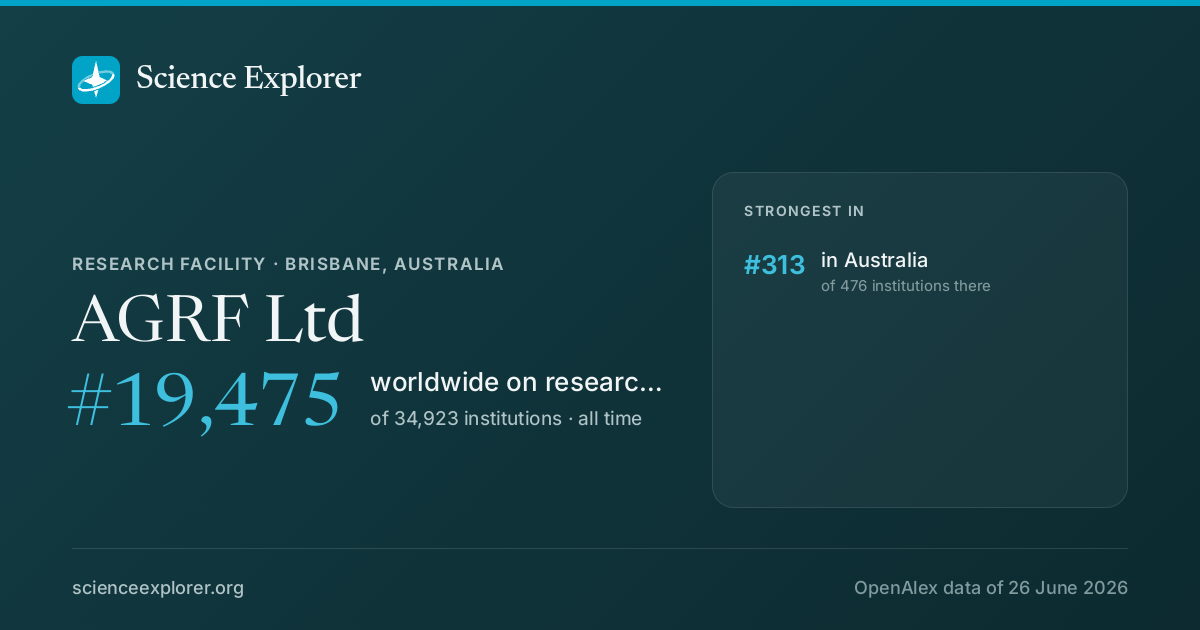
AGRF Ltd

World rank, all time
#19,475
of 34,923
Rank in Australia
#313
of 476
Research works
200
▼ 37% vs 2018-21
Citations
8.9k
44.4 per fractional work
Top-10% rate
14.2%
all institutions 10.0%
vs its own fields
1.12×
1.00× is exactly expected
Open access
52%
world 40%
International
35%
world 18%

Which fields of science does AGRF Ltd work in?

In 2022-now, 60% of research at AGRF Ltd is in Life Sciences, 25% in Health Sciences. Its largest fields are Biochemistry, Genetics and Molecular Biology (39%), Medicine (23%), Agricultural and Biological Sciences (12%). It does 3.1× the world's share of Life Sciences.

Life Sciences: 19 fractional works · 60.4% of its workBiochemistry, Genetics and Molecular Biology: 12 fractional works · 39.3% of its workMolecular Biology: 7 fractional works · 24.0% of its workGenetics: 3 fractional works · 9.0% of its workCancer Research: 1 fractional works · 3.6% of its workCell Biology: 1 fractional works · 1.9% of its workBiotechnology: 0 fractional works · 0.6% of its workSmaller subfields together: 0 fractional works · 0.2% of its workAgricultural and Biological Sciences: 4 fractional works · 12.1% of its workPlant Science: 2 fractional works · 7.3% of its workAgronomy and Crop Science: 0 fractional works · 1.4% of its workAnimal Science and Zoology: 0 fractional works · 1.2% of its workAquatic Science: 0 fractional works · 0.6% of its workInsect Science: 0 fractional works · 0.6% of its workSoil Science: 0 fractional works · 0.6% of its workEcology, Evolution, Behavior and Systematics: 0 fractional works · 0.3% of its workFood Science: 0 fractional works · 0.2% of its workNeuroscience: 1 fractional works · 4.7% of its workCellular and Molecular Neuroscience: 0 fractional works · 1.4% of its workBiological Psychiatry: 0 fractional works · 1.4% of its workCognitive Neuroscience: 0 fractional works · 0.7% of its workNeurology: 0 fractional works · 0.7% of its workEndocrine and Autonomic Systems: 0 fractional works · 0.4% of its workSmaller subfields together: 0 fractional works · 0.1% of its workImmunology and Microbiology: 1 fractional works · 4.1% of its workImmunology: 1 fractional works · 2.4% of its workMicrobiology: 0 fractional works · 1.4% of its workVirology: 0 fractional works · 0.3% of its workSmaller subfields together: 0 fractional works · 0.1% of its workPharmacology, Toxicology and Pharmaceutics: 0 fractional works · 0.2% of its workHealth Sciences: 8 fractional works · 25.2% of its workMedicine: 7 fractional works · 23.3% of its workOncology: 1 fractional works · 4.2% of its workPulmonary and Respiratory Medicine: 1 fractional works · 3.7% of its workPhysiology: 1 fractional works · 2.6% of its workSurgery: 0 fractional works · 1.4% of its workPsychiatry and Mental health: 0 fractional works · 1.3% of its workCardiology and Cardiovascular Medicine: 0 fractional works · 1.1% of its workRadiology, Nuclear Medicine and Imaging: 0 fractional works · 1.0% of its workEpidemiology: 0 fractional works · 1.0% of its workPathology and Forensic Medicine: 0 fractional works · 1.0% of its workPediatrics, Perinatology and Child Health: 0 fractional works · 0.9% of its workInfectious Diseases: 0 fractional works · 0.8% of its workNeurology: 0 fractional works · 0.6% of its workNephrology: 0 fractional works · 0.6% of its workGenetics: 0 fractional works · 0.5% of its workOtorhinolaryngology: 0 fractional works · 0.4% of its workOphthalmology: 0 fractional works · 0.4% of its workObstetrics and Gynecology: 0 fractional works · 0.3% of its workUrology: 0 fractional works · 0.3% of its workPublic Health, Environmental and Occupational Health: 0 fractional works · 0.2% of its workSmaller subfields together: 0 fractional works · 1.0% of its workDentistry: 0 fractional works · 1.1% of its workPeriodontics: 0 fractional works · 1.1% of its workHealth Professions: 0 fractional works · 0.5% of its workHealth Information Management: 0 fractional works · 0.2% of its workSmaller subfields together: 0 fractional works · 0.2% of its workVeterinary: 0 fractional works · 0.5% of its workSmall Animals: 0 fractional works · 0.5% of its workPhysical Sciences: 4 fractional works · 12.2% of its workChemistry: 2 fractional works · 4.9% of its workSpectroscopy: 1 fractional works · 3.8% of its workOrganic Chemistry: 0 fractional works · 1.1% of its workComputer Science: 0 fractional works · 1.5% of its workInformation Systems: 0 fractional works · 1.1% of its workComputational Theory and Mathematics: 0 fractional works · 0.4% of its workSmaller subfields together: 0 fractional works · 0.1% of its workMaterials Science: 0 fractional works · 1.4% of its workMaterials Chemistry: 0 fractional works · 0.6% of its workBiomaterials: 0 fractional works · 0.4% of its workElectronic, Optical and Magnetic Materials: 0 fractional works · 0.3% of its workSmaller subfields together: 0 fractional works · 0.0% of its workEngineering: 0 fractional works · 1.3% of its workComputational Mechanics: 0 fractional works · 0.5% of its workBuilding and Construction: 0 fractional works · 0.4% of its workBiomedical Engineering: 0 fractional works · 0.3% of its workSmaller subfields together: 0 fractional works · 0.1% of its workEarth and Planetary Sciences: 0 fractional works · 1.2% of its workGeology: 0 fractional works · 1.1% of its workSmaller subfields together: 0 fractional works · 0.1% of its workEnvironmental Science: 0 fractional works · 1.1% of its workEcology: 0 fractional works · 0.8% of its workSmaller subfields together: 0 fractional works · 0.3% of its workPhysics and Astronomy: 0 fractional works · 0.5% of its workAstronomy and Astrophysics: 0 fractional works · 0.5% of its workChemical Engineering: 0 fractional works · 0.4% of its workProcess Chemistry and Technology: 0 fractional works · 0.4% of its workSocial Sciences: 1 fractional works · 2.2% of its workDecision Sciences: 0 fractional works · 1.1% of its workInformation Systems and Management: 0 fractional works · 1.1% of its workSocial Sciences: 0 fractional works · 0.6% of its workEducation: 0 fractional works · 0.6% of its workPsychology: 0 fractional works · 0.3% of its workClinical Psychology: 0 fractional works · 0.3% of its workEconomics, Econometrics and Finance: 0 fractional works · 0.2% of its workEconomics and Econometrics: 0 fractional works · 0.2% of its workALL ITS WORKAGRF Ltd31fractional works, 2022-now
Life Sciences60%Physical Sciences12%Health Sciences25%Social Sciences2%

Each ring splits the one inside it: the four domains of science, their fields, their subfields. Size is fractional works in 2022-now. Every slice is a page; the interactive view zooms down to single topics and colours each by how much more of it this institution does than the world.

Its 4 domains and 21 fields, with their numbers
    1. Biochemistry, Genetics and Molecular Biology1239.3%
    2. Agricultural and Biological Sciences412.1%
    3. Neuroscience14.7%
    4. Immunology and Microbiology14.1%
    5. Pharmacology, Toxicology and Pharmaceutics00.2%
    1. Medicine723.3%
    2. Dentistry01.1%
    3. Health Professions00.5%
    4. Veterinary00.5%
    1. Chemistry24.9%
    2. Computer Science01.5%
    3. Materials Science01.4%
    4. Engineering01.3%
    5. Earth and Planetary Sciences01.2%
    6. Environmental Science01.1%
    7. Physics and Astronomy00.5%
    8. Chemical Engineering00.4%
    1. Decision Sciences01.1%
    2. Social Sciences00.6%
    3. Psychology00.3%
    4. Economics, Econometrics and Finance00.2%
All of science, and how each field's share has moved since 1950: the Science domain explorer

Field profile

Location quotient across every field it publishes in: outside the ring is more than an institution of this size would be expected to publish, inside it is less.

Agricultural and Biological Sciences: 2.54× its world share, 4 worksAgricultural and Bio…Biochemistry, Genetics and Molecular Biology: 7.38× its world share, 12 worksBiochemistry, Geneti…Immunology and Microbiology: 4.12× its world share, 1 worksImmunology and Micro…Neuroscience: 2.88× its world share, 1 worksNeurosciencePharmacology, Toxicology and Pharmaceutics: 0.51× its world share, 0 worksPharmacology, Toxico…Chemical Engineering: 1.03× its world share, 0 worksChemical EngineeringChemistry: 3.10× its world share, 2 worksChemistryComputer Science: 0.20× its world share, 0 worksComputer ScienceEarth and Planetary Sciences: 0.77× its world share, 0 worksEarth and Planetary …Engineering: 0.09× its world share, 0 worksEngineeringEnvironmental Science: 0.22× its world share, 0 worksEnvironmental ScienceMaterials Science: 0.39× its world share, 0 worksMaterials SciencePhysics and Astronomy: 0.22× its world share, 0 worksPhysics and AstronomyDentistry: 2.22× its world share, 0 worksDentistryHealth Professions: 0.17× its world share, 0 worksHealth ProfessionsMedicine: 1.21× its world share, 7 worksMedicineVeterinary: 3.35× its world share, 0 worksVeterinaryDecision Sciences: 1.12× its world share, 0 worksDecision SciencesEconomics, Econometrics and Finance: 0.10× its world share, 0 worksEconomics, Econometr…Psychology: 0.10× its world share, 0 worksPsychologySocial Sciences: 0.04× its world share, 0 worksSocial Sciences1×world share
more than its size predictsabout as predictedless

Rings at 0.5×, 1× and 2×. Widest outward: Biochemistry, Genetics and Molecular Biology, 7.4×. Every wedge is a field page.

All 21 fields, with their numbers
  1. Biochemistry, Genetics and Molecular Biology7.38×12 works
  2. Immunology and Microbiology4.12×1 works
  3. Veterinary3.35×0 works
  4. Chemistry3.10×2 works
  5. Neuroscience2.88×1 works
  6. Agricultural and Biological Sciences2.54×4 works
  7. Dentistry2.22×0 works
  8. Medicine1.21×7 works
  9. Decision Sciences1.12×0 works
  10. Chemical Engineering1.03×0 works
  11. Earth and Planetary Sciences0.77×0 works
  12. Pharmacology, Toxicology and Pharmaceutics0.51×0 works
  13. Materials Science0.39×0 works
  14. Environmental Science0.22×0 works
  15. Physics and Astronomy0.22×0 works
  16. Computer Science0.20×0 works
  17. Health Professions0.17×0 works
  18. Economics, Econometrics and Finance0.10×0 works
  19. Psychology0.10×0 works
  20. Engineering0.09×0 works
  21. Social Sciences0.04×0 works

Who are the top researchers at AGRF Ltd?

Ranked on the quality score, Matthew Tinning, Xianzhong Lau and Lesley-Ann Gray lead among researchers whose main affiliation is AGRF Ltd.

  1. 1 Matthew Tinning Australia · #1,021,052 worldwide 1.5k citations · 22 works
  2. 2 Xianzhong Lau Australia · #1,386,603 worldwide 270 citations · 27 works
  3. 3 Lesley-Ann Gray Australia · #1,917,420 worldwide 276 citations · 16 works
  4. 4 Kelly R. Ewen Australia · #3,012,917 worldwide 619 citations · 16 works
All ranked researchers at AGRF Ltd

What are the most cited papers from AGRF Ltd?

The most cited paper from AGRF Ltd is "Protein Identification and Analysis Tools in the ExPASy Server" (Marc Ronald Wilkins, Elisabeth Gasteiger, Amos Bairoch et al., 2003), with 6,262 citations. Next come "Genome-wide association study identifies novel breast cancer susceptibility loci" (2,342) and "Amyloid-β and tau synergistically impair the oxidative phosphorylation system in triple transgenic Alzheimer's disease mice" (662).

Most cited papers
#PaperReleasedCitations
1 Protein Identification and Analysis Tools in the ExPASy Server Marc Ronald Wilkins, Elisabeth Gasteiger, Amos Bairoch et al. · Humana Press eBooks Book chapterOpen access 14 Nov 2003 6,262
2 Genome-wide association study identifies novel breast cancer susceptibility loci Douglas F. Easton et al. · Nature Open access239 authors 27 May 2007 2,342
3 Amyloid-β and tau synergistically impair the oxidative phosphorylation system in triple transgenic Alzheimer's disease mice Virginie F. Rhein, Xiaomin Song, Andreas Wiesner et al. · Proceedings of the National Academy of Sciences Open access 6 Nov 2009 662
4 Multi-laboratory assessment of reproducibility, qualitative and quantitative performance of SWATH-mass spectrometry Ben C. Collins et al. · Nature Communications Open access 10 Aug 2017 628
5 The concordance between RNA-seq and microarray data depends on chemical treatment and transcript abundance Charles Wang et al. · Nature Biotechnology Open access 21 Aug 2014 554
All 59 most cited papers, with filters and sorting

Which keywords describe research at AGRF Ltd?

By fractional works in 2022-now, weighted toward what it does more of than the world: Gene Expression, Oxidative Stress, Innate Immunity, Cancer, Proteomics, Mass Spectrometry, Epidemiology and Inflammation.

▲ more of its work than of the world's◆ about the world's share▼ less than the world's

Size is fractional works in 2022-now in the topics tagged with each word; colour is the word's share of this institution's work against its share of the world's. The 8 words are chosen for being large and distinctive. Each links to the topic it comes from most.

All 8 words, with their numbers
  1. Oxidative Stress2▲ 3.7×13 topics
  2. Gene Expression2▲ 8.7×13 topics
  3. Cancer2▲ 3.9×16 topics
  4. Epidemiology1▲ 1.17×25 topics
  5. Innate Immunity1▲ 12×8 topics
  6. Mass Spectrometry1▲ 23×3 topics
  7. Proteomics1▲ 57×3 topics
  8. Inflammation1▲ 1.57×16 topics

Which research topics does AGRF Ltd publish most on?

By volume in 2022-now: Genomics and Rare Diseases, GABA and Rice Research, Advanced Proteomics Techniques and Applications and Genomics and Phylogenetic Studies.

  1. 1 Genomics and Rare Diseases Genetics 1 works
  2. 2 GABA and Rice Research Plant Science 0 works
  3. 3 Advanced Proteomics Techniques and Applications Spectroscopy 0 works
  4. 4 Genomics and Phylogenetic Studies Molecular Biology 0 works
  5. 5 Mass Spectrometry Techniques and Applications Spectroscopy 0 works
  6. 6 Epigenetics and DNA Methylation Molecular Biology 0 works
  7. 7 BRCA gene mutations in cancer Genetics 0 works
  8. 8 Tryptophan and brain disorders Biological Psychiatry 0 works
  9. 9 Cancer Genomics and Diagnostics Cancer Research 0 works
  10. 10 CRISPR and Genetic Engineering Molecular Biology 0 works

How open and international is its research?

Against the world's own shares: the tick on each track. Both are shares of its output, so they sit on one scale and can be read against each other as well as against the world.

openly available52.2%not open47.8%

World: 40% of research is openly available.

with international co-authors35.0%domestic only65.0%

World: 18% is written across borders.

How has AGRF Ltd's research output changed?

Output in 2022-2025 was 37% lower than in 2018-2021.

still counting200020102020
grewheldshrank

The same series as a ribbon: one cell per year, darker for more. The line above answers how much; this answers when.

Its share of all research

Growing output can still be a shrinking share: all of science grows. This is AGRF Ltd as a percentage of every work published that year, 0.00015% in 2024.

still counting0.00025%0.00050%0.00075%AGRF Ltd0.00011% in 2025200020102020

Fractional works of AGRF Ltd over all fractional works that year. How the balance of science has shifted.

Other research institutions in Brisbane

All research institutions in Brisbane

Share AGRF Ltd's ranking

AGRF Ltd on Science Explorer

A card with AGRF Ltd's standing and the fields it leads in, for a post or a slide. A link to this page previews as the same card.

Download the card

1200 × 630 PNG, sized for social posts, drawn from the latest snapshot.

Badges for a website1Each links back here and updates with every snapshot

Research measures only: rankings here say nothing about teaching, admissions or student experience. Comparable institutions and collaboration partners have tabs of their own, above.

Discussion

Ask a question or share a note about AGRF Ltd. Keep it to the research: no personal attacks, advertising or links. Any reader can report a post, which collapses it for everyone until it is opened.