Science Explorer Back to mapMap
Hospital / health system · Florence · United States

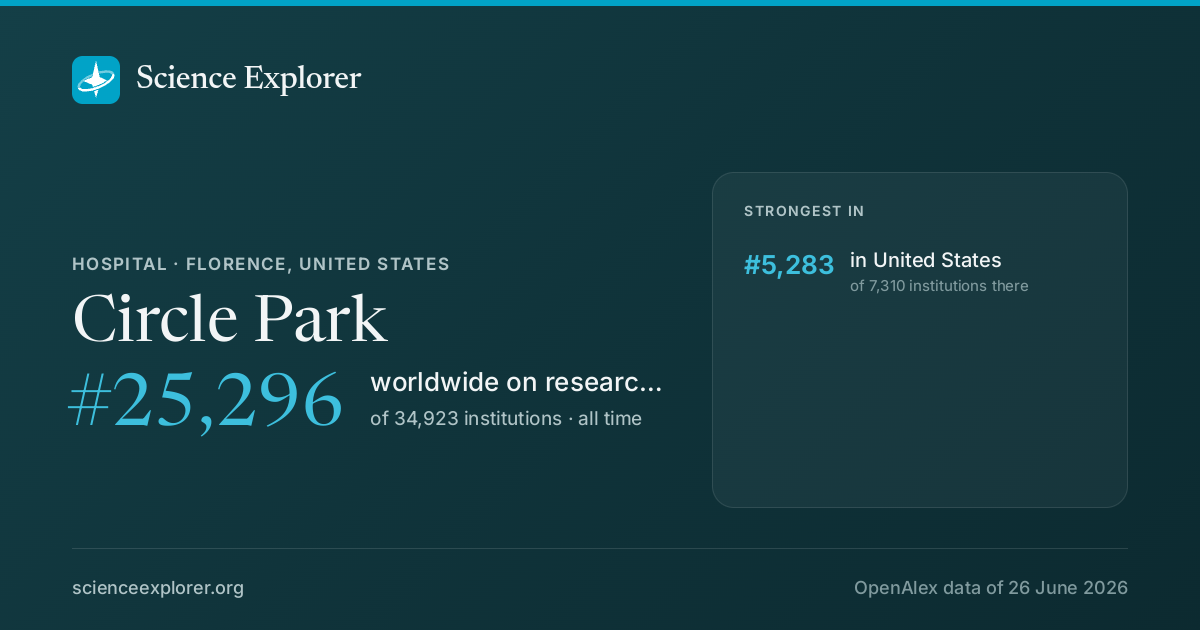
Circle Park

World rank, all time
#25,296
of 34,923
Rank in United States
#5,283
of 7,310
Research works
139
▼ 40% vs 2018-21
Citations
4k
28.7 per fractional work
Top-10% rate
13.1%
all institutions 10.0%
vs its own fields
0.97×
1.00× is exactly expected
Open access
36%
world 40%
International
15%
world 18%

Which fields of science does Circle Park work in?

In all years, 42% of research at Circle Park is in Physical Sciences, 40% in Social Sciences. Its largest fields are Social Sciences (22%), Computer Science (12%), Engineering (8%). It does 1.8× the world's share of Social Sciences.

Physical Sciences: 59 fractional works · 42.5% of its workComputer Science: 17 fractional works · 12.1% of its workInformation Systems: 9 fractional works · 6.5% of its workArtificial Intelligence: 2 fractional works · 1.6% of its workComputer Networks and Communications: 1 fractional works · 0.8% of its workHuman-Computer Interaction: 1 fractional works · 0.7% of its workComputer Vision and Pattern Recognition: 1 fractional works · 0.7% of its workComputer Science Applications: 1 fractional works · 0.6% of its workComputational Theory and Mathematics: 1 fractional works · 0.6% of its workSoftware: 0 fractional works · 0.4% of its workSmaller subfields together: 0 fractional works · 0.2% of its workEngineering: 12 fractional works · 8.5% of its workMechanical Engineering: 3 fractional works · 2.5% of its workBiomedical Engineering: 1 fractional works · 1.0% of its workCivil and Structural Engineering: 1 fractional works · 1.0% of its workMechanics of Materials: 1 fractional works · 1.0% of its workElectrical and Electronic Engineering: 1 fractional works · 0.9% of its workAerospace Engineering: 1 fractional works · 0.6% of its workControl and Systems Engineering: 0 fractional works · 0.4% of its workAutomotive Engineering: 0 fractional works · 0.3% of its workMedia Technology: 0 fractional works · 0.3% of its workComputational Mechanics: 0 fractional works · 0.2% of its workSmaller subfields together: 0 fractional works · 0.3% of its workEnvironmental Science: 10 fractional works · 6.9% of its workEcology: 2 fractional works · 1.5% of its workIndustrial and Manufacturing Engineering: 2 fractional works · 1.1% of its workHealth, Toxicology and Mutagenesis: 1 fractional works · 1.0% of its workGlobal and Planetary Change: 1 fractional works · 0.9% of its workNature and Landscape Conservation: 1 fractional works · 0.7% of its workEnvironmental Engineering: 1 fractional works · 0.5% of its workEcological Modeling: 1 fractional works · 0.4% of its workEnvironmental Chemistry: 0 fractional works · 0.3% of its workPollution: 0 fractional works · 0.2% of its workSmaller subfields together: 0 fractional works · 0.2% of its workPhysics and Astronomy: 6 fractional works · 4.7% of its workNuclear and High Energy Physics: 4 fractional works · 2.9% of its workAstronomy and Astrophysics: 1 fractional works · 0.6% of its workAtomic and Molecular Physics, and Optics: 1 fractional works · 0.5% of its workRadiation: 0 fractional works · 0.4% of its workStatistical and Nonlinear Physics: 0 fractional works · 0.2% of its workSmaller subfields together: 0 fractional works · 0.0% of its workMaterials Science: 4 fractional works · 3.0% of its workMaterials Chemistry: 2 fractional works · 1.6% of its workBiomaterials: 1 fractional works · 0.6% of its workElectronic, Optical and Magnetic Materials: 1 fractional works · 0.4% of its workPolymers and Plastics: 0 fractional works · 0.2% of its workSmaller subfields together: 0 fractional works · 0.2% of its workChemistry: 4 fractional works · 2.6% of its workOrganic Chemistry: 2 fractional works · 1.2% of its workInorganic Chemistry: 1 fractional works · 0.8% of its workAnalytical Chemistry: 0 fractional works · 0.3% of its workSpectroscopy: 0 fractional works · 0.2% of its workSmaller subfields together: 0 fractional works · 0.0% of its workEarth and Planetary Sciences: 3 fractional works · 2.3% of its workEarth-Surface Processes: 1 fractional works · 0.7% of its workAtmospheric Science: 1 fractional works · 0.6% of its workPaleontology: 1 fractional works · 0.5% of its workSmaller subfields together: 1 fractional works · 0.4% of its workMathematics: 3 fractional works · 2.0% of its workGeometry and Topology: 1 fractional works · 0.6% of its workStatistics and Probability: 1 fractional works · 0.4% of its workMathematical Physics: 1 fractional works · 0.4% of its workNumerical Analysis: 0 fractional works · 0.2% of its workSmaller subfields together: 1 fractional works · 0.4% of its workEnergy: 0 fractional works · 0.3% of its workRenewable Energy, Sustainability and the Environment: 0 fractional works · 0.3% of its workChemical Engineering: 0 fractional works · 0.2% of its workProcess Chemistry and Technology: 0 fractional works · 0.2% of its workSocial Sciences: 55 fractional works · 39.8% of its workSocial Sciences: 31 fractional works · 22.1% of its workCommunication: 9 fractional works · 6.5% of its workSociology and Political Science: 8 fractional works · 6.0% of its workEducation: 3 fractional works · 2.1% of its workPolitical Science and International Relations: 3 fractional works · 2.0% of its workLibrary and Information Sciences: 2 fractional works · 1.8% of its workAnthropology: 1 fractional works · 0.9% of its workGender Studies: 1 fractional works · 0.5% of its workGeneral Social Sciences: 1 fractional works · 0.5% of its workGeography, Planning and Development: 1 fractional works · 0.5% of its workHealth: 1 fractional works · 0.4% of its workDemography: 0 fractional works · 0.3% of its workSmaller subfields together: 1 fractional works · 0.6% of its workDecision Sciences: 7 fractional works · 4.9% of its workInformation Systems and Management: 3 fractional works · 1.9% of its workStatistics, Probability and Uncertainty: 3 fractional works · 1.8% of its workManagement Science and Operations Research: 2 fractional works · 1.2% of its workPsychology: 6 fractional works · 4.1% of its workClinical Psychology: 2 fractional works · 1.2% of its workSocial Psychology: 2 fractional works · 1.1% of its workDevelopmental and Educational Psychology: 1 fractional works · 1.0% of its workExperimental and Cognitive Psychology: 1 fractional works · 0.4% of its workApplied Psychology: 0 fractional works · 0.2% of its workSmaller subfields together: 0 fractional works · 0.1% of its workBusiness, Management and Accounting: 5 fractional works · 3.7% of its workMarketing: 2 fractional works · 1.4% of its workStrategy and Management: 1 fractional works · 1.0% of its workOrganizational Behavior and Human Resource Management: 1 fractional works · 0.6% of its workManagement Information Systems: 1 fractional works · 0.4% of its workSmaller subfields together: 0 fractional works · 0.2% of its workArts and Humanities: 5 fractional works · 3.5% of its workLiterature and Literary Theory: 1 fractional works · 0.7% of its workHistory and Philosophy of Science: 1 fractional works · 0.7% of its workConservation: 1 fractional works · 0.6% of its workHistory: 1 fractional works · 0.4% of its workClassics: 0 fractional works · 0.3% of its workPhilosophy: 0 fractional works · 0.2% of its workSmaller subfields together: 1 fractional works · 0.4% of its workEconomics, Econometrics and Finance: 2 fractional works · 1.5% of its workEconomics and Econometrics: 2 fractional works · 1.4% of its workSmaller subfields together: 0 fractional works · 0.1% of its workLife Sciences: 18 fractional works · 13.1% of its workAgricultural and Biological Sciences: 9 fractional works · 6.6% of its workPlant Science: 2 fractional works · 1.8% of its workEcology, Evolution, Behavior and Systematics: 1 fractional works · 1.0% of its workFood Science: 1 fractional works · 1.0% of its workAgronomy and Crop Science: 1 fractional works · 0.9% of its workSoil Science: 1 fractional works · 0.8% of its workGeneral Agricultural and Biological Sciences: 1 fractional works · 0.4% of its workInsect Science: 1 fractional works · 0.4% of its workAnimal Science and Zoology: 0 fractional works · 0.2% of its workSmaller subfields together: 0 fractional works · 0.1% of its workBiochemistry, Genetics and Molecular Biology: 7 fractional works · 5.3% of its workMolecular Biology: 5 fractional works · 3.8% of its workGenetics: 1 fractional works · 0.7% of its workBiophysics: 1 fractional works · 0.4% of its workSmaller subfields together: 1 fractional works · 0.4% of its workNeuroscience: 1 fractional works · 0.5% of its workCognitive Neuroscience: 0 fractional works · 0.4% of its workSmaller subfields together: 0 fractional works · 0.1% of its workPharmacology, Toxicology and Pharmaceutics: 1 fractional works · 0.4% of its workPharmacology: 0 fractional works · 0.4% of its workSmaller subfields together: 0 fractional works · 0.1% of its workImmunology and Microbiology: 0 fractional works · 0.2% of its workHealth Sciences: 6 fractional works · 4.6% of its workMedicine: 4 fractional works · 2.9% of its workPublic Health, Environmental and Occupational Health: 1 fractional works · 0.8% of its workEpidemiology: 1 fractional works · 0.6% of its workRadiology, Nuclear Medicine and Imaging: 1 fractional works · 0.5% of its workSmaller subfields together: 1 fractional works · 1.0% of its workHealth Professions: 2 fractional works · 1.5% of its workGeneral Health Professions: 2 fractional works · 1.1% of its workSmaller subfields together: 0 fractional works · 0.4% of its workNursing: 0 fractional works · 0.3% of its workALL ITS WORKCircle Park139fractional works, all years
Life Sciences13%Physical Sciences42%Health Sciences5%Social Sciences40%

Each ring splits the one inside it: the four domains of science, their fields, their subfields. Size is fractional works in all years. Every slice is a page; the interactive view zooms down to single topics and colours each by how much more of it this institution does than the world.

Its 4 domains and 24 fields, with their numbers
    1. Computer Science1712.1%
    2. Engineering128.5%
    3. Environmental Science106.9%
    4. Physics and Astronomy64.7%
    5. Materials Science43.0%
    6. Chemistry42.6%
    7. Earth and Planetary Sciences32.3%
    8. Mathematics32.0%
    9. Energy00.3%
    10. Chemical Engineering00.2%
    1. Social Sciences3122.1%
    2. Decision Sciences74.9%
    3. Psychology64.1%
    4. Business, Management and Accounting53.7%
    5. Arts and Humanities53.5%
    6. Economics, Econometrics and Finance21.5%
    1. Agricultural and Biological Sciences96.6%
    2. Biochemistry, Genetics and Molecular Biology75.3%
    3. Neuroscience10.5%
    4. Pharmacology, Toxicology and Pharmaceutics10.4%
    5. Immunology and Microbiology00.2%
    1. Medicine42.9%
    2. Health Professions21.5%
    3. Nursing00.3%
All of science, and how each field's share has moved since 1950: the Science domain explorer

Field profile

Location quotient across every field it publishes in: outside the ring is more than an institution of this size would be expected to publish, inside it is less.

Agricultural and Biological Sciences: 1.95× its world share, 2 worksAgricultural and Bio…Biochemistry, Genetics and Molecular Biology: 2.01× its world share, 2 worksBiochemistry, Geneti…Neuroscience: 0.78× its world share, 0 worksNeuroscienceChemistry: 0.81× its world share, 0 worksChemistryComputer Science: 0.54× its world share, 1 worksComputer ScienceEarth and Planetary Sciences: 1.14× its world share, 0 worksEarth and Planetary …Energy: 0.92× its world share, 0 worksEnergyEngineering: 0.53× its world share, 2 worksEngineeringEnvironmental Science: 0.85× its world share, 1 worksEnvironmental ScienceMaterials Science: 1.59× its world share, 1 worksMaterials ScienceMathematics: 5.41× its world share, 1 worksMathematicsPhysics and Astronomy: 2.47× its world share, 1 worksPhysics and AstronomyHealth Professions: 0.91× its world share, 0 worksHealth ProfessionsMedicine: 0.49× its world share, 2 worksMedicineNursing: 1.35× its world share, 0 worksNursingArts and Humanities: 1.32× its world share, 1 worksArts and HumanitiesBusiness, Management and Accounting: 1.25× its world share, 1 worksBusiness, Management…Decision Sciences: 3.76× its world share, 1 worksDecision SciencesPsychology: 2.41× its world share, 2 worksPsychologySocial Sciences: 0.77× its world share, 2 worksSocial Sciences1×world share
more than its size predictsabout as predictedless

Rings at 0.5×, 1× and 2×. Widest outward: Mathematics, 5.4×. Every wedge is a field page.

All 20 fields, with their numbers
  1. Mathematics5.41×1 works
  2. Decision Sciences3.76×1 works
  3. Physics and Astronomy2.47×1 works
  4. Psychology2.41×2 works
  5. Biochemistry, Genetics and Molecular Biology2.01×2 works
  6. Agricultural and Biological Sciences1.95×2 works
  7. Materials Science1.59×1 works
  8. Nursing1.35×0 works
  9. Arts and Humanities1.32×1 works
  10. Business, Management and Accounting1.25×1 works
  11. Earth and Planetary Sciences1.14×0 works
  12. Energy0.92×0 works
  13. Health Professions0.91×0 works
  14. Environmental Science0.85×1 works
  15. Chemistry0.81×0 works
  16. Neuroscience0.78×0 works
  17. Social Sciences0.77×2 works
  18. Computer Science0.54×1 works
  19. Engineering0.53×2 works
  20. Medicine0.49×2 works

What are the most cited papers from Circle Park?

The most cited paper from Circle Park is "Culture’s consequences: Economic barriers to owning mobile phones experienced by women in India" (Devendra Dilip Potnis, 2015), with 1,403 citations. Next come "Succession of Hydrocarbon-Degrading Bacteria in the Aftermath of the Deepwater Horizon Oil Spill in the Gulf of Mexico" (370) and "The Segment Anything Model (SAM) for remote sensing applications: From zero to one shot" (337).

Most cited papers
#PaperReleasedCitations
1 Culture’s consequences: Economic barriers to owning mobile phones experienced by women in India Devendra Dilip Potnis · Telematics and Informatics 11 Sep 2015 1,403
2 Succession of Hydrocarbon-Degrading Bacteria in the Aftermath of the Deepwater Horizon Oil Spill in the Gulf of Mexico Eric A. Dubinsky, Mark E. Conrad, Romy Chakraborty et al. · Environmental Science & Technology 12 Aug 2013 370
3 The Segment Anything Model (SAM) for remote sensing applications: From zero to one shot Lucas Prado Osco, Qiusheng Wu, Eduardo Lopes de Lemos et al. · International Journal of Applied Earth Observation and Geoinformation Open access Nov 2023 337
4 Hashtag activism and message frames among social movement organizations: Semantic network analysis and thematic analysis of Twitter during the #MeToo movement Ying Xiong, Moonhee Cho, Brandon Boatwright · Public Relations Review 14 Nov 2018 322
5 EVOLUTION MODEL OF PEDOGENESIS Donald Lee Johnson, Donna Watson-Stegner · Soil Science May 1987 310
All 62 most cited papers, with filters and sorting

Which keywords describe research at Circle Park?

By fractional works in all years, weighted toward what it does more of than the world: Social Media, Digital Divide, Trust, Social Capital, Online Communication, Academic Libraries, Community Engagement and Stakeholder Engagement.

▲ more of its work than of the world's◆ about the world's share▼ less than the world's

Size is fractional works in all years in the topics tagged with each word; colour is the word's share of this institution's work against its share of the world's. The 40 words are chosen for being large and distinctive. Each links to the topic it comes from most.

All 40 words, with their numbers
  1. Social Media12▲ 11×13 topics
  2. Digital Divide5▲ 18×6 topics
  3. Trust4▲ 12×7 topics
  4. Social Capital4▲ 7.2×9 topics
  5. Academic Libraries3▲ 47×3 topics
  6. Community Engagement3▲ 7.5×4 topics
  7. Online Communication3▲ 21×3 topics
  8. Invasive Species3▲ 3.7×6 topics
  9. Stakeholder Engagement3▲ 30×2 topics
  10. Crisis Communication3▲ 86×1 topic
  11. Public Relations3▲ 109×1 topic
  12. Information Retrieval3▲ 13×3 topics
  13. Digital Literacy2▲ 6.1×3 topics
  14. Civic Engagement2▲ 17×3 topics
  15. Digital Repositories2▲ 65×2 topics
  16. Information Technology2▲ 5.4×2 topics
  17. Interdisciplinary Research2▲ 21×2 topics
  18. Political Participation2▲ 20×2 topics
  19. Accountability2▲ 24×2 topics
  20. Bibliometric Analysis2▲ 35×1 topic
  21. Deliberative Democracy2▲ 24×1 topic
  22. Knowledge Sharing2▲ 9.5×3 topics
  23. Media Use2▲ 34×1 topic
  24. Motivation2▲ 5.5×3 topics
  25. Research Evaluation2▲ 75×1 topic
  26. Ecology2▲ 7.3×2 topics
  27. Data Integration2▲ 6.0×4 topics
  28. Dark Matter2▲ 7.1×2 topics
  29. Data Sharing2▲ 69×1 topic
  30. Information Quality2▲ 28×2 topics
  31. Particle Physics2▲ 11×2 topics
  32. Scientific Data Management2▲ 88×1 topic
  33. Search Engines2▲ 161×1 topic
  34. User Behavior2▲ 161×1 topic
  35. Collaboration2▲ 19×3 topics
  36. Cultural Competence2▲ 10×3 topics
  37. Diversity2▲ 7.2×3 topics
  38. Semantic Web2▲ 8.8×4 topics
  39. User-Centered Design2▲ 35×3 topics
  40. Virtual Communities2▲ 33×2 topics

Which research topics does Circle Park publish most on?

By volume in 2022-now: RNA Interference and Gene Delivery, Supramolecular Self-Assembly in Materials, Advanced biosensing and bioanalysis techniques and Digital and Traditional Archives Management.

  1. 1 RNA Interference and Gene Delivery Molecular Biology 1 works
  2. 2 Supramolecular Self-Assembly in Materials Biomaterials 0 works
  3. 3 Advanced biosensing and bioanalysis techniques Molecular Biology 0 works
  4. 4 Digital and Traditional Archives Management Conservation 0 works
  5. 5 scientometrics and bibliometrics research Statistics, Probability and Uncertainty 0 works
  6. 6 Nanoplatforms for cancer theranostics Biomedical Engineering 0 works
  7. 7 Agricultural Innovations and Practices General Agricultural and Biological Sciences 0 works
  8. 8 Particle Detector Development and Performance Nuclear and High Energy Physics 0 works
  9. 9 Particle physics theoretical and experimental studies Nuclear and High Energy Physics 0 works
  10. 10 Neuroendocrine regulation and behavior Social Psychology 0 works

How open and international is its research?

Against the world's own shares: the tick on each track. Both are shares of its output, so they sit on one scale and can be read against each other as well as against the world.

openly available36.1%not open63.9%

World: 40% of research is openly available.

with international co-authors15.3%domestic only84.7%

World: 18% is written across borders.

How has Circle Park's research output changed?

Output in 2022-2025 was 40% lower than in 2018-2021.

still counting1990200020102020
grewheldshrank

The same series as a ribbon: one cell per year, darker for more. The line above answers how much; this answers when.

Its share of all research

Growing output can still be a shrinking share: all of science grows. This is Circle Park as a percentage of every work published that year, 0.000068% in 2024.

still counting0.00025%0.00050%0.00075%Circle Park0.000088% in 202519801990200020102020

Fractional works of Circle Park over all fractional works that year. How the balance of science has shifted.

Other research institutions in Florence

All research institutions in Florence

Share Circle Park's ranking

Circle Park on Science Explorer

A card with Circle Park's standing and the fields it leads in, for a post or a slide. A link to this page previews as the same card.

Download the card

1200 × 630 PNG, sized for social posts, drawn from the latest snapshot.

Badges for a website1Each links back here and updates with every snapshot

Research measures only: rankings here say nothing about teaching, admissions or student experience. Comparable institutions and collaboration partners have tabs of their own, above.

Discussion

Ask a question or share a note about Circle Park. Keep it to the research: no personal attacks, advertising or links. Any reader can report a post, which collapses it for everyone until it is opened.