Science Explorer Back to mapMap
Discussion

Data Sciences International (United States)

World rank, all time
#25,593
of 34,923
Rank in United States
#5,355
of 7,310
Research works
152
▲ 12% vs 2018-21
Citations
4.2k
27.9 per fractional work
Top-10% rate
7.1%
all institutions 10.0%
vs its own fields
0.99×
1.00× is exactly expected
Open access
26%
world 40%
International
23%
world 18%
Data Sciences International (United States)

Which fields of science does Data Sciences International (United States) work in?

In 2022-now, 35% of research at Data Sciences International (United States) is in Health Sciences, 26% in Physical Sciences. Its largest fields are Medicine (30%), Social Sciences (11%), Computer Science (9%). It does 1.3× the world's share of Health Sciences.

Health Sciences: 8 fractional works · 35.4% of its workMedicine: 7 fractional works · 29.9% of its workCardiology and Cardiovascular Medicine: 1 fractional works · 3.3% of its workSurgery: 1 fractional works · 3.3% of its workPediatrics, Perinatology and Child Health: 1 fractional works · 2.7% of its workPulmonary and Respiratory Medicine: 1 fractional works · 2.2% of its workEpidemiology: 1 fractional works · 2.2% of its workPharmacology: 0 fractional works · 2.1% of its workCritical Care and Intensive Care Medicine: 0 fractional works · 1.8% of its workEndocrinology, Diabetes and Metabolism: 0 fractional works · 1.7% of its workPublic Health, Environmental and Occupational Health: 0 fractional works · 1.7% of its workHematology: 0 fractional works · 1.5% of its workOncology: 0 fractional works · 1.2% of its workBiochemistry: 0 fractional works · 1.1% of its workPhysiology: 0 fractional works · 0.8% of its workRadiology, Nuclear Medicine and Imaging: 0 fractional works · 0.8% of its workRehabilitation: 0 fractional works · 0.7% of its workEmergency Medicine: 0 fractional works · 0.5% of its workHealth Informatics: 0 fractional works · 0.5% of its workOrthopedics and Sports Medicine: 0 fractional works · 0.3% of its workFamily Practice: 0 fractional works · 0.3% of its workHepatology: 0 fractional works · 0.3% of its workNephrology: 0 fractional works · 0.3% of its workPsychiatry and Mental health: 0 fractional works · 0.3% of its workInternal Medicine: 0 fractional works · 0.2% of its workHealth Professions: 1 fractional works · 4.8% of its workGeneral Health Professions: 1 fractional works · 4.2% of its workEmergency Medical Services: 0 fractional works · 0.4% of its workSmaller subfields together: 0 fractional works · 0.2% of its workNursing: 0 fractional works · 0.7% of its workResearch and Theory: 0 fractional works · 0.7% of its workPhysical Sciences: 6 fractional works · 25.8% of its workComputer Science: 2 fractional works · 9.1% of its workArtificial Intelligence: 1 fractional works · 4.8% of its workInformation Systems: 1 fractional works · 4.3% of its workMathematics: 2 fractional works · 7.9% of its workStatistics and Probability: 2 fractional works · 7.9% of its workEngineering: 1 fractional works · 5.7% of its workMedia Technology: 0 fractional works · 2.0% of its workBiomedical Engineering: 0 fractional works · 1.1% of its workIndustrial and Manufacturing Engineering: 0 fractional works · 0.9% of its workAutomotive Engineering: 0 fractional works · 0.7% of its workControl and Systems Engineering: 0 fractional works · 0.7% of its workArchitecture: 0 fractional works · 0.3% of its workEnvironmental Science: 0 fractional works · 1.2% of its workHealth, Toxicology and Mutagenesis: 0 fractional works · 1.2% of its workMaterials Science: 0 fractional works · 0.8% of its workMaterials Chemistry: 0 fractional works · 0.5% of its workBiomaterials: 0 fractional works · 0.3% of its workPhysics and Astronomy: 0 fractional works · 0.6% of its workCondensed Matter Physics: 0 fractional works · 0.5% of its workSmaller subfields together: 0 fractional works · 0.2% of its workEarth and Planetary Sciences: 0 fractional works · 0.5% of its workAtmospheric Science: 0 fractional works · 0.5% of its workSocial Sciences: 5 fractional works · 21.2% of its workSocial Sciences: 2 fractional works · 10.7% of its workEducation: 1 fractional works · 4.3% of its workSociology and Political Science: 0 fractional works · 2.1% of its workTransportation: 0 fractional works · 2.1% of its workPolitical Science and International Relations: 0 fractional works · 0.7% of its workSafety Research: 0 fractional works · 0.7% of its workHealth: 0 fractional works · 0.4% of its workGender Studies: 0 fractional works · 0.3% of its workEconomics, Econometrics and Finance: 1 fractional works · 4.0% of its workEconomics and Econometrics: 1 fractional works · 4.0% of its workDecision Sciences: 1 fractional works · 2.4% of its workManagement Science and Operations Research: 0 fractional works · 1.8% of its workStatistics, Probability and Uncertainty: 0 fractional works · 0.5% of its workSmaller subfields together: 0 fractional works · 0.0% of its workBusiness, Management and Accounting: 0 fractional works · 1.7% of its workManagement of Technology and Innovation: 0 fractional works · 1.4% of its workManagement Information Systems: 0 fractional works · 0.3% of its workPsychology: 0 fractional works · 1.3% of its workClinical Psychology: 0 fractional works · 0.6% of its workSocial Psychology: 0 fractional works · 0.5% of its workDevelopmental and Educational Psychology: 0 fractional works · 0.3% of its workArts and Humanities: 0 fractional works · 1.1% of its workLiterature and Literary Theory: 0 fractional works · 1.1% of its workLife Sciences: 4 fractional works · 17.6% of its workBiochemistry, Genetics and Molecular Biology: 2 fractional works · 7.2% of its workMolecular Biology: 1 fractional works · 3.3% of its workGenetics: 0 fractional works · 2.0% of its workCancer Research: 0 fractional works · 0.9% of its workCell Biology: 0 fractional works · 0.6% of its workClinical Biochemistry: 0 fractional works · 0.3% of its workSmaller subfields together: 0 fractional works · 0.0% of its workNeuroscience: 1 fractional works · 4.5% of its workSensory Systems: 0 fractional works · 1.4% of its workEndocrine and Autonomic Systems: 0 fractional works · 1.1% of its workCognitive Neuroscience: 0 fractional works · 1.0% of its workNeurology: 0 fractional works · 0.7% of its workBehavioral Neuroscience: 0 fractional works · 0.3% of its workAgricultural and Biological Sciences: 1 fractional works · 3.9% of its workEcology, Evolution, Behavior and Systematics: 0 fractional works · 1.4% of its workInsect Science: 0 fractional works · 0.9% of its workPlant Science: 0 fractional works · 0.8% of its workSoil Science: 0 fractional works · 0.7% of its workImmunology and Microbiology: 0 fractional works · 1.5% of its workImmunology: 0 fractional works · 1.2% of its workVirology: 0 fractional works · 0.2% of its workPharmacology, Toxicology and Pharmaceutics: 0 fractional works · 0.6% of its workPharmaceutical Science: 0 fractional works · 0.5% of its workSmaller subfields together: 0 fractional works · 0.1% of its workALL ITS WORKData SciencesInternational…23fractional works, 2022-now
Life Sciences18%Physical Sciences26%Health Sciences35%Social Sciences21%

Each ring splits the one inside it: the four domains of science, their fields, their subfields. Size is fractional works in 2022-now. Every slice is a page; the interactive view zooms down to single topics and colours each by how much more of it this institution does than the world.

Its 4 domains and 21 fields, with their numbers
    1. Medicine729.9%
    2. Health Professions14.8%
    3. Nursing00.7%
    1. Computer Science29.1%
    2. Mathematics27.9%
    3. Engineering15.7%
    4. Environmental Science01.2%
    5. Materials Science00.8%
    6. Physics and Astronomy00.6%
    7. Earth and Planetary Sciences00.5%
    1. Social Sciences210.7%
    2. Economics, Econometrics and Finance14.0%
    3. Decision Sciences12.4%
    4. Business, Management and Accounting01.7%
    5. Psychology01.3%
    6. Arts and Humanities01.1%
    1. Biochemistry, Genetics and Molecular Biology27.2%
    2. Neuroscience14.5%
    3. Agricultural and Biological Sciences13.9%
    4. Immunology and Microbiology01.5%
    5. Pharmacology, Toxicology and Pharmaceutics00.6%
All of science, and how each field's share has moved since 1950: the Science domain explorer

Field profile

Location quotient across every field it publishes in: outside the ring is more than an institution of this size would be expected to publish, inside it is less.

Agricultural and Biological Sciences: 0.81× its world share, 1 worksAgricultural and Bio…Biochemistry, Genetics and Molecular Biology: 1.35× its world share, 2 worksBiochemistry, Geneti…Immunology and Microbiology: 1.44× its world share, 0 worksImmunology and Micro…Neuroscience: 2.79× its world share, 1 worksNeurosciencePharmacology, Toxicology and Pharmaceutics: 1.64× its world share, 0 worksPharmacology, Toxico…Computer Science: 1.17× its world share, 2 worksComputer ScienceEarth and Planetary Sciences: 0.30× its world share, 0 worksEarth and Planetary …Engineering: 0.38× its world share, 1 worksEngineeringEnvironmental Science: 0.25× its world share, 0 worksEnvironmental ScienceMaterials Science: 0.24× its world share, 0 worksMaterials ScienceMathematics: 6.73× its world share, 2 worksMathematicsPhysics and Astronomy: 0.29× its world share, 0 worksPhysics and AstronomyHealth Professions: 1.81× its world share, 1 worksHealth ProfessionsMedicine: 1.56× its world share, 7 worksMedicineNursing: 1.46× its world share, 0 worksNursingArts and Humanities: 0.37× its world share, 0 worksArts and HumanitiesBusiness, Management and Accounting: 0.52× its world share, 0 worksBusiness, Management…Decision Sciences: 2.43× its world share, 0 worksDecision SciencesEconomics, Econometrics and Finance: 1.87× its world share, 1 worksEconomics, Econometr…Psychology: 0.44× its world share, 0 worksPsychologySocial Sciences: 0.85× its world share, 2 worksSocial Sciences1×world share
more than its size predictsabout as predictedless

Rings at 0.5×, 1× and 2×. Widest outward: Mathematics, 6.7×. Every wedge is a field page.

All 21 fields, with their numbers
  1. Mathematics6.73×2 works
  2. Neuroscience2.79×1 works
  3. Decision Sciences2.43×0 works
  4. Economics, Econometrics and Finance1.87×1 works
  5. Health Professions1.81×1 works
  6. Pharmacology, Toxicology and Pharmaceutics1.64×0 works
  7. Medicine1.56×7 works
  8. Nursing1.46×0 works
  9. Immunology and Microbiology1.44×0 works
  10. Biochemistry, Genetics and Molecular Biology1.35×2 works
  11. Computer Science1.17×2 works
  12. Social Sciences0.85×2 works
  13. Agricultural and Biological Sciences0.81×1 works
  14. Business, Management and Accounting0.52×0 works
  15. Psychology0.44×0 works
  16. Engineering0.38×1 works
  17. Arts and Humanities0.37×0 works
  18. Earth and Planetary Sciences0.30×0 works
  19. Physics and Astronomy0.29×0 works
  20. Environmental Science0.25×0 works
  21. Materials Science0.24×0 works

Who are the top researchers at Data Sciences International (United States)?

Ranked on the quality score, Perry A. Mills, Boyce Moon and R. Dustan Sarazan lead among researchers whose main affiliation is Data Sciences International (United States).

  1. 1 Perry A. Mills United States · #1,879,019 worldwide 700 citations · 17 works
  2. 2 Boyce Moon United States · #2,604,094 worldwide 58 citations · 15 works
  3. 3 R. Dustan Sarazan United States · #3,720,653 worldwide 993 citations · 49 works
  4. 4 Jennifer Doyle United States · #3,971,793 worldwide 1.1k citations · 44 works
  5. 5 Heather Bogie United States · #4,802,952 worldwide 92 citations · 16 works
  6. 6 Christophe Bory United States · #4,835,695 worldwide 35 citations · 21 works
  7. 7 Dennis A. Tribble United States · #4,881,310 worldwide 143 citations · 33 works
  8. 8 Philippe Legé United States · #4,883,853 worldwide 6 citations · 20 works
  9. 9 Estelle Chalencon United States · #4,914,547 worldwide 6 citations · 19 works
  10. 10 Olivier B. Boucheix United States · #5,235,503 worldwide 39 citations · 21 works
All ranked researchers at Data Sciences International (United States)

What are the most cited papers from Data Sciences International (United States)?

The most cited paper from Data Sciences International (United States) is "Tumor-Infiltrating Lymphocyte Therapy or Ipilimumab in Advanced Melanoma" (Maartje W. Rohaan et al., 2022), with 577 citations. Next come "Subchronic Toxicity Studies on Perfluorooctanesulfonate Potassium Salt in Cynomolgus Monkeys" (566) and "Key components of shared decision making models: a systematic review" (559).

Most cited papers
#PaperReleasedCitations
1 Tumor-Infiltrating Lymphocyte Therapy or Ipilimumab in Advanced Melanoma Maartje W. Rohaan et al. · New England Journal of Medicine Open access 7 Dec 2022 577
2 Subchronic Toxicity Studies on Perfluorooctanesulfonate Potassium Salt in Cynomolgus Monkeys Andrew M. Seacat · Toxicological Sciences Jul 2002 566
3 Key components of shared decision making models: a systematic review Hanna Bomhof‐Roordink, Fania R. Gärtner, Anne Margarethe Stiggelbout et al. · BMJ Open ReviewOpen access Dec 2019 559
4 A New Method for Continuous Chronic Measurement and Recording of Blood Pressure, Heart Rate and Activity in the Rat Via Radio-telemetry Brian P. Brockway, Perry A. Mills, Silvia H. Azar · Clinical and Experimental Hypertension 1991 249
5 A new method for measurement of blood pressure, heart rate, and activity in the mouse by radiotelemetry Perry A. Mills, Daniel A. Huetteman, Brian P. Brockway et al. · Journal of Applied Physiology May 2000 173
All 57 most cited papers, with filters and sorting

Which keywords describe research at Data Sciences International (United States)?

By fractional works in 2022-now, weighted toward what it does more of than the world: Education, Technology, Social Impact, Innovation, Clinical Trials, Distance Learning, Gender Bias and Digitalization.

▲ more of its work than of the world's◆ about the world's share▼ less than the world's

Size is fractional works in 2022-now in the topics tagged with each word; colour is the word's share of this institution's work against its share of the world's. The 14 words are chosen for being large and distinctive. Each links to the topic it comes from most.

All 14 words, with their numbers
  1. Education2▲ 5.8×3 topics
  2. Technology2▲ 16×2 topics
  3. Innovation1▲ 5.5×2 topics
  4. Social Impact1▲ 15×2 topics
  5. Clinical Trials1▲ 7.2×5 topics
  6. Distance Learning1▲ 13×2 topics
  7. Gender Bias1▲ 52×2 topics
  8. Biomarkers1▲ 6.2×6 topics
  9. Digital Literacy1▲ 7.5×1 topic
  10. Digitalization1▲ 21×1 topic
  11. Pedagogy1▲ 8.5×1 topic
  12. Quantum Computation1▲ 78×1 topic
  13. Quantum Information1▲ 37×1 topic
  14. TICs1▲ 744×1 topic

Which research topics does Data Sciences International (United States) publish most on?

By volume in 2022-now: Technology in Education and Healthcare, Educational Methods and Teacher Development, Quantum Computing Algorithms and Architecture and Statistical Methods in Clinical Trials.

  1. 1 Technology in Education and Healthcare Education 1 works
  2. 2 Educational Methods and Teacher Development Information Systems 1 works
  3. 3 Quantum Computing Algorithms and Architecture Artificial Intelligence 1 works
  4. 4 Statistical Methods in Clinical Trials Statistics and Probability 1 works
  5. 5 Benford’s Law and Fraud Detection Statistics and Probability 1 works
  6. 6 Pharmaceutical studies and practices Pediatrics, Perinatology and Child Health 0 works
  7. 7 Bariatric Surgery and Outcomes Surgery 0 works
  8. 8 Innovative Approaches in Technology and Social Development Management of Technology and Innovation 0 works
  9. 9 Human Mobility and Location-Based Analysis Transportation 0 works
  10. 10 Pharmacology and Obesity Treatment Pharmacology 0 works

How open and international is its research?

Against the world's own shares: the tick on each track. Both are shares of its output, so they sit on one scale and can be read against each other as well as against the world.

openly available25.7%not open74.3%

World: 40% of research is openly available.

with international co-authors23.0%domestic only77.0%

World: 18% is written across borders.

How has Data Sciences International (United States)'s research output changed?

Output in 2022-2025 was 12% higher than in 2018-2021.

still counting1990200020102020
grewheldshrank

The same series as a ribbon: one cell per year, darker for more. The line above answers how much; this answers when.

Its share of all research

Growing output can still be a shrinking share: all of science grows. This is Data Sciences International (United States) as a percentage of every work published that year, 0.000097% in 2024.

still counting0.00025%0.00050%0.00075%Data Sciences International (United States)0.000089% in 202519801990200020102020

Fractional works of Data Sciences International (United States) over all fractional works that year. How the balance of science has shifted.

Other research institutions in Saint Paul

All research institutions in Saint Paul

Share Data Sciences International (United States)'s ranking
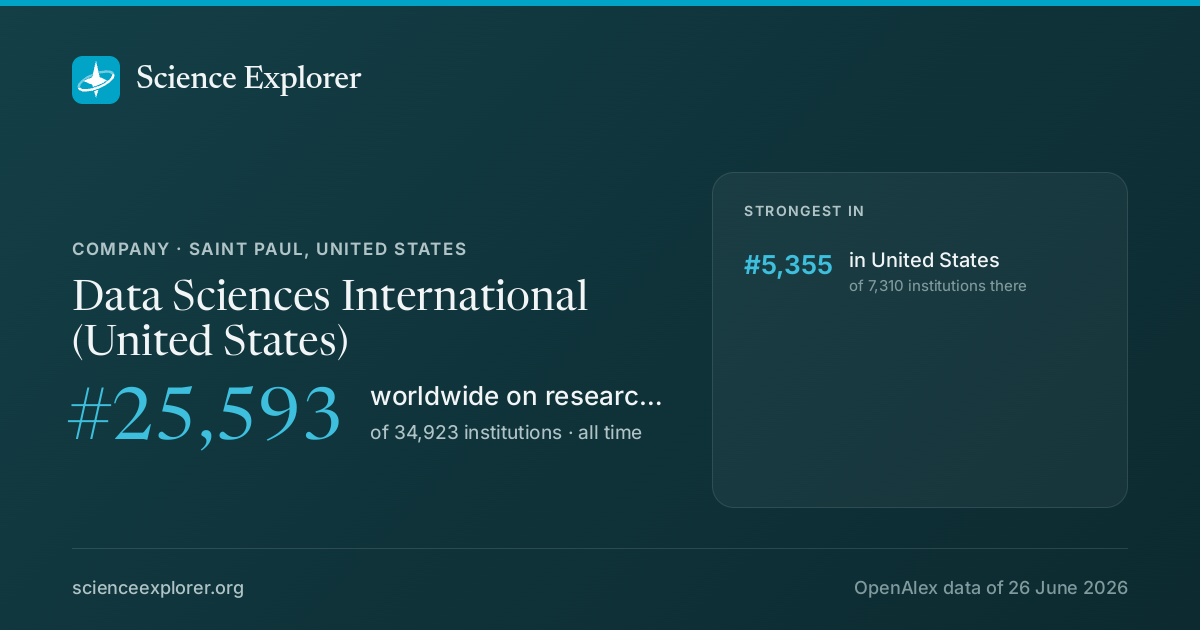
Data Sciences International (United States) on Science Explorer

A card with Data Sciences International (United States)'s standing and the fields it leads in, for a post or a slide. A link to this page previews as the same card.

Download the card

1200 × 630 PNG, sized for social posts, drawn from the latest snapshot.

Badges for a website1Each links back here and updates with every snapshot

Research measures only: rankings here say nothing about teaching, admissions or student experience. Comparable institutions and collaboration partners have tabs of their own, above.

Discussion

Ask a question or share a note about Data Sciences International (United States). Keep it to the research: no personal attacks, advertising or links. Any reader can report a post, which collapses it for everyone until it is opened.