- World rank, all time
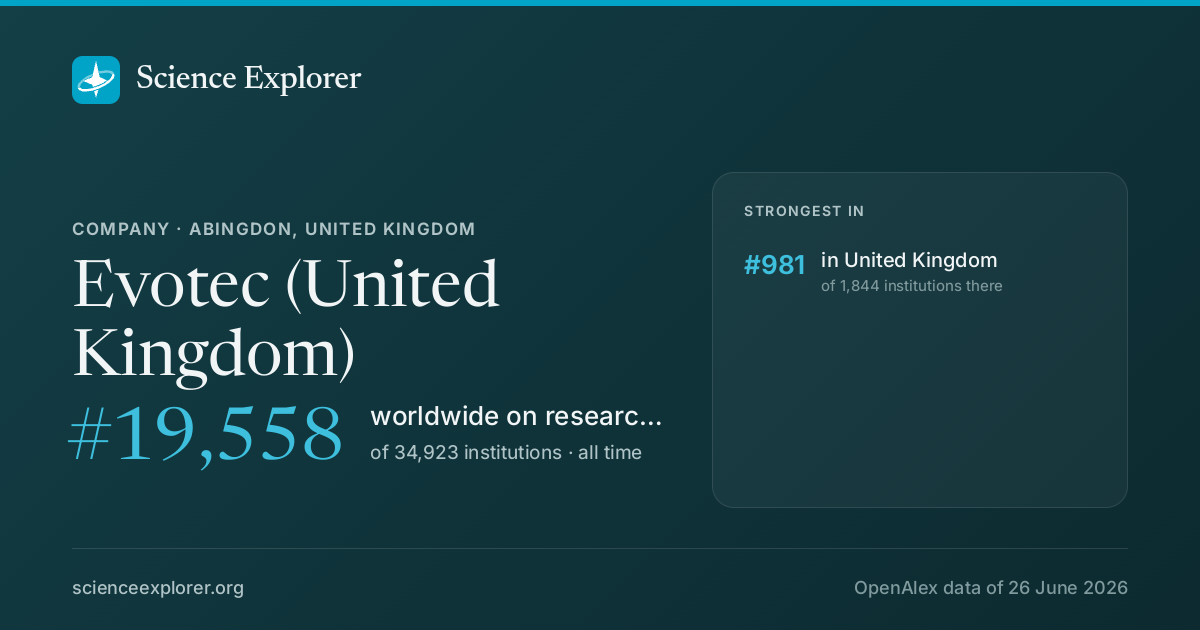
- #19,558 of 34,923
- Rank in United Kingdom
- #981 of 1,844
- Research works
- 228 ▼ 9% vs 2018-21
- Citations
- 8.9k 39.0 per fractional work
- Top-10% rate
- 16.8% all institutions 10.0%
- vs its own fields
- 1.23× 1.00× is exactly expected
- Open access
- 37% world 40%
- International
- 39% world 18%
Which fields of science does Evotec (United Kingdom) work in?
In 2022-now, 45% of research at Evotec (United Kingdom) is in Life Sciences, 32% in Health Sciences. Its largest fields are Medicine (32%), Biochemistry, Genetics and Molecular Biology (32%), Chemistry (10%). It does 2.6× the world's share of Life Sciences.
Each ring splits the one inside it: the four domains of science, their fields, their subfields. Size is fractional works in 2022-now. Every slice is a page; the interactive view zooms down to single topics and colours each by how much more of it this institution does than the world.
Its 4 domains and 15 fields, with their numbers
- Life Sciences2244.9%
- Health Sciences1632.2%
- Medicine1631.9%
- Veterinary00.2%
- Health Professions00.1%
- Physical Sciences1122.2%
- Chemistry59.9%
- Computer Science47.2%
- Materials Science23.7%
- Physics and Astronomy00.9%
- Engineering00.6%
- Social Sciences00.7%
Field profile
Location quotient across every field it publishes in: outside the ring is more than an institution of this size would be expected to publish, inside it is less.
Rings at 0.5×, 1× and 2×. Widest outward: Pharmacology, Toxicology and Pharmaceutics, 19.0×. Every wedge is a field page.
All 15 fields, with their numbers
- Pharmacology, Toxicology and Pharmaceutics18.96×3 works
- Chemistry6.28×5 works
- Biochemistry, Genetics and Molecular Biology5.93×16 works
- Immunology and Microbiology5.43×3 works
- Medicine1.66×16 works
- Veterinary1.25×0 works
- Materials Science1.05×2 works
- Computer Science0.92×4 works
- Neuroscience0.55×0 works
- Decision Sciences0.49×0 works
- Physics and Astronomy0.39×0 works
- Economics, Econometrics and Finance0.13×0 works
- Agricultural and Biological Sciences0.05×0 works
- Engineering0.04×0 works
- Health Professions0.02×0 works
- Pharmacology, Toxicology and Pharmaceutics 19.0×
- Chemistry 6.3×
- Biochemistry, Genetics and Molecular Biology 5.9×
- Immunology and Microbiology 5.4×
- Medicine 1.7×
- Veterinary 1.2×
- Materials Science 1.1×
- Computer Science 0.9×
- Neuroscience 0.6×
- Decision Sciences 0.5×
- Physics and Astronomy 0.4×
- Economics, Econometrics and Finance 0.1×
- Agricultural and Biological Sciences 0.1×
- Engineering 0.0×
- Health Professions 0.0×
Who are the top researchers at Evotec (United Kingdom)?
Ranked on the quality score, Alexander Heifetz, Michael J. Bodkin and Oliver Barker lead among researchers whose main affiliation is Evotec (United Kingdom).
- 1
Alexander Heifetz
 United Kingdom · #886,401 worldwide
2.2k citations · 63 works
- 2
Michael J. Bodkin
United Kingdom · #1,081,207 worldwide
6.9k citations · 42 works
- 3
Oliver Barker
United Kingdom · #1,266,438 worldwide
847 citations · 26 works
- 4
Loren S. Ward
United Kingdom · #1,276,595 worldwide
1.2k citations · 25 works
- 5
John J. Barker
United Kingdom · #1,360,945 worldwide
2.2k citations · 55 works
- 6
Iñaki Morao
United Kingdom · #1,608,955 worldwide
1.5k citations · 41 works
- 7
Mark A. Whittaker
United Kingdom · #1,672,958 worldwide
5.5k citations · 203 works
- 8
Mike J. Bodkin
United Kingdom · #1,700,709 worldwide
628 citations · 25 works
- 9
Michael P. Mazanetz
United Kingdom · #1,744,624 worldwide
1k citations · 24 works
- 10
Stephen M. Courtney
United Kingdom · #1,894,043 worldwide
892 citations · 22 works
Which keywords describe research at Evotec (United Kingdom)?
By fractional works in 2022-now, weighted toward what it does more of than the world: Pharmacokinetics, Molecular Docking, Oxidative Stress, Medicinal Chemistry, Metabolic Regulation, Drug Target Identification, Virtual Screening and Machine Learning.
- Metabolic Disorders
- Glycosylation
- Tumor Microenvironment
- Therapeutic Antibodies
- Mitochondrial Dysfunction
- Crystal Structure
- Pharmacology
- Transcriptional Regulation
- Cancer Therapy
- Cell Signaling
- Inflammation
- Prenatal Exposure
- Antiepileptic Drugs
- Drug Discovery
- ATP-dependent Transporters
- Virtual Screening
- Drug Target Identification
- Molecular Docking
- Machine Learning
- Pharmacokinetics
- Oxidative Stress
- Medicinal Chemistry
- Metabolic Regulation
- Cancer
- Multidrug Resistance
- Cognitive Function
- Drug Metabolism
- Cytochrome P450
- Pharmacogenetics
- Epidemiology
- Molecular Dynamics
- Immunity
- Antibiotic Resistance
- G-Protein-Coupled Receptors
- Monoclonal Antibodies
- Treatment
- Cancer Immunotherapy
- Mass Spectrometry
Size is fractional works in 2022-now in the topics tagged with each word; colour is the word's share of this institution's work against its share of the world's. The 38 words are chosen for being large and distinctive. Each links to the topic it comes from most.
All 38 words, with their numbers
- Pharmacokinetics5▲ 38×3 topics
- Machine Learning4▲ 2.8×8 topics
- Oxidative Stress4▲ 5.1×12 topics
- Molecular Docking4▲ 58×3 topics
- Medicinal Chemistry3▲ 26×4 topics
- Drug Target Identification3▲ 64×1 topic
- Metabolic Regulation3▲ 36×3 topics
- Virtual Screening3▲ 64×1 topic
- Cancer3▲ 4.0×13 topics
- ATP-dependent Transporters3▲ 218×1 topic
- Multidrug Resistance3▲ 159×1 topic
- Drug Discovery2▲ 23×5 topics
- Cognitive Function2▲ 25×2 topics
- Antiepileptic Drugs2▲ 58×1 topic
- Drug Metabolism2▲ 162×2 topics
- Prenatal Exposure2▲ 153×1 topic
- Cytochrome P4502▲ 124×1 topic
- Inflammation2▲ 1.89×10 topics
- Pharmacogenetics2▲ 202×1 topic
- Cell Signaling2▲ 23×5 topics
- Epidemiology2◆ 0.92×11 topics
- Cancer Therapy2▲ 6.3×8 topics
- Molecular Dynamics2▲ 19×2 topics
- Transcriptional Regulation2▲ 18×5 topics
- Immunity1▲ 6.5×4 topics
- Pharmacology1▲ 10×2 topics
- Antibiotic Resistance1▲ 6.1×3 topics
- Crystal Structure1▲ 18×1 topic
- G-Protein-Coupled Receptors1▲ 96×1 topic
- Mitochondrial Dysfunction1▲ 8.4×5 topics
- Monoclonal Antibodies1▲ 28×2 topics
- Therapeutic Antibodies1▲ 35×2 topics
- Treatment1▲ 2.1×4 topics
- Tumor Microenvironment1▲ 5.4×5 topics
- Cancer Immunotherapy1▲ 14×3 topics
- Glycosylation1▲ 20×3 topics
- Mass Spectrometry1▲ 14×3 topics
- Metabolic Disorders1▲ 18×2 topics
Which research topics does Evotec (United Kingdom) publish most on?
By volume in 2022-now: Computational Drug Discovery Methods, Drug Transport and Resistance Mechanisms, Pharmacological Effects and Toxicity Studies and Pharmacogenetics and Drug Metabolism.
Area is fractional works; colour is the subfield each topic belongs to.
- 1 Computational Drug Discovery Methods Computational Theory and Mathematics 3 works
- 2 Drug Transport and Resistance Mechanisms Oncology 3 works
- 3 Pharmacological Effects and Toxicity Studies Pediatrics, Perinatology and Child Health 2 works
- 4 Pharmacogenetics and Drug Metabolism Pharmacology 2 works
- 5 Receptor Mechanisms and Signaling Molecular Biology 1 works
- 6 Protein Degradation and Inhibitors Molecular Biology 1 works
- 7 Machine Learning in Materials Science Materials Chemistry 1 works
- 8 Monoclonal and Polyclonal Antibodies Research Radiology, Nuclear Medicine and Imaging 1 works
- 9 Biomedical Text Mining and Ontologies Molecular Biology 1 works
- 10 Bioinformatics and Genomic Networks Molecular Biology 1 works
How open and international is its research?
Against the world's own shares: the tick on each track. Both are shares of its output, so they sit on one scale and can be read against each other as well as against the world.
World: 40% of research is openly available.
World: 18% is written across borders.
How has Evotec (United Kingdom)'s research output changed?
Output in 2022-2025 was 9% lower than in 2018-2021.
The same series as a ribbon: one cell per year, darker for more. The line above answers how much; this answers when.
Its share of all research
Growing output can still be a shrinking share: all of science grows. This is Evotec (United Kingdom) as a percentage of every work published that year, 0.00015% in 2024.
Fractional works of Evotec (United Kingdom) over all fractional works that year. How the balance of science has shifted.
Other research institutions in Abingdon
- United Kingdom Atomic Energy Authority
- Culham Science Centre
- Oxford Instruments (United Kingdom)
- Summit (United Kingdom)
- Immunocore (United Kingdom)
- Tokamak Energy (United Kingdom)
- Adaptimmune (United Kingdom)
- Infineum (United Kingdom)

Share Evotec (United Kingdom)'s ranking
Badges for a website1Each links back here and updates with every snapshot

Research measures only: rankings here say nothing about teaching, admissions or student experience. Comparable institutions and collaboration partners have tabs of their own, above.
Discussion
Ask a question or share a note about Evotec (United Kingdom). Posts are plain text and can be reported.