Fondation Jean Dausset-CEPH
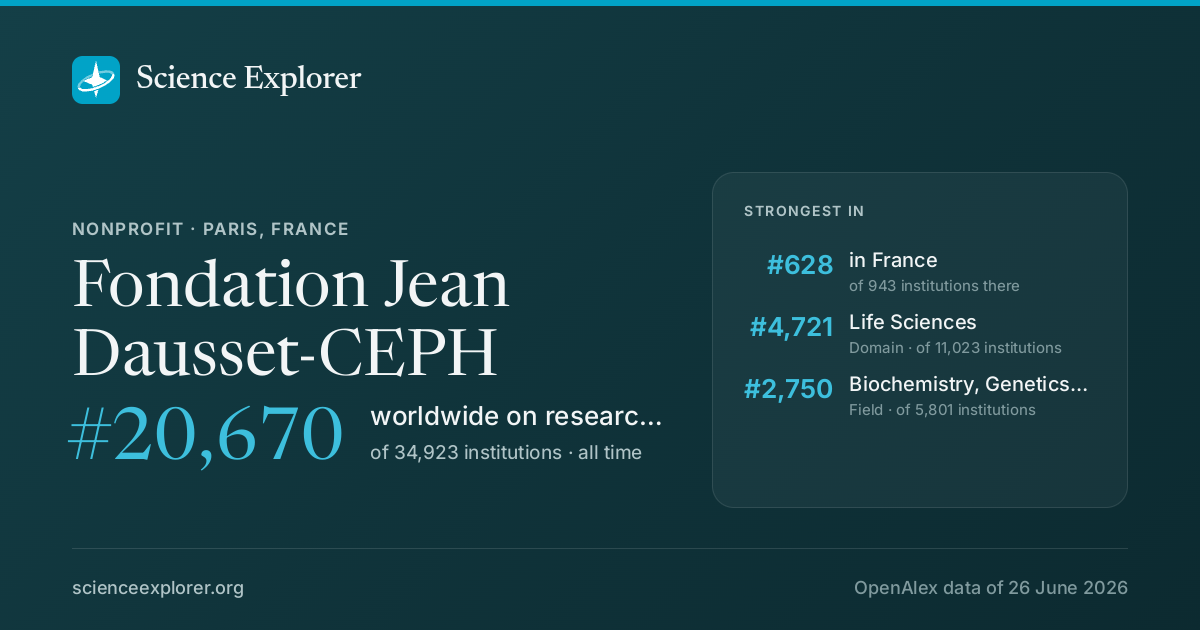
In research, Fondation Jean Dausset-CEPH stands highest in Life Sciences (#4,721 of 11,023 worldwide) and Biochemistry, Genetics and Molecular Biology (#2,750 of 5,801 worldwide), over all time.
- World rank, all time
- #20,670 of 34,923
- Rank in France
- #628 of 943
- Research works
- 366 ▲ 14% vs 2018-21
- Citations
- 28k 77.1 per fractional work
- Top-10% rate
- 8.1% all institutions 10.0%
- vs its own fields
- 1.20× 1.00× is exactly expected
- Open access
- 39% world 40%
- International
- 33% world 18%
What is Fondation Jean Dausset-CEPH known for in research?
The fields where it stands highest, over all time, ranked among every institution above the floor in each field.
| Field | World rank | Where that sits | Top-10% rate | Works |
|---|---|---|---|---|
| Life SciencesDomain | #4,721 of 11,023 | 16.1% | 219 | |
| Biochemistry, Genetics and Molecular BiologyField | #2,750 of 5,801 | 16.0% | 150 |
Each strip is that field's whole ranked pool, with the notch where Fondation Jean Dausset-CEPH sits in it, in the colour of the band that rank falls in. The track under the rate is the rate itself: it carries no average mark, because the average differs by field (from about 6% in Dentistry to 21% in Economics).
Which fields of science does Fondation Jean Dausset-CEPH work in?
In all years, 60% of research at Fondation Jean Dausset-CEPH is in Life Sciences, 30% in Health Sciences. Its largest fields are Biochemistry, Genetics and Molecular Biology (41%), Medicine (29%), Immunology and Microbiology (9%). It does 3.8× the world's share of Life Sciences.
Each ring splits the one inside it: the four domains of science, their fields, their subfields. Size is fractional works in all years. Every slice is a page; the interactive view zooms down to single topics and colours each by how much more of it this institution does than the world.
Its 4 domains and 23 fields, with their numbers
- Life Sciences21959.9%
- Health Sciences11130.3%
- Medicine10629.1%
- Health Professions20.6%
- Nursing20.5%
- Veterinary00.1%
- Dentistry00.1%
- Physical Sciences236.3%
- Environmental Science51.4%
- Computer Science51.3%
- Engineering41.1%
- Mathematics41.0%
- Chemistry30.8%
- Materials Science20.4%
- Earth and Planetary Sciences10.2%
- Energy00.0%
- Social Sciences133.5%
Field profile
Location quotient across every field it publishes in: outside the ring is more than an institution of this size would be expected to publish, inside it is less.
Rings at 0.5×, 1× and 2×. Widest outward: Biochemistry, Genetics and Molecular Biology, 7.6×. Every wedge is a field page.
All 21 fields, with their numbers
- Biochemistry, Genetics and Molecular Biology7.62×8 works
- Mathematics4.51×1 works
- Agricultural and Biological Sciences3.10×3 works
- Immunology and Microbiology2.80×0 works
- Chemistry2.20×1 works
- Economics, Econometrics and Finance1.31×0 works
- Medicine0.94×4 works
- Business, Management and Accounting0.80×0 works
- Veterinary0.64×0 works
- Earth and Planetary Sciences0.44×0 works
- Arts and Humanities0.37×0 works
- Psychology0.36×0 works
- Computer Science0.30×0 works
- Environmental Science0.26×0 works
- Dentistry0.24×0 works
- Materials Science0.16×0 works
- Neuroscience0.15×0 works
- Engineering0.11×0 works
- Health Professions0.11×0 works
- Energy0.08×0 works
- Social Sciences0.02×0 works
- Biochemistry, Genetics and Molecular Biology 7.6×
- Mathematics 4.5×
- Agricultural and Biological Sciences 3.1×
- Immunology and Microbiology 2.8×
- Chemistry 2.2×
- Economics, Econometrics and Finance 1.3×
- Medicine 0.9×
- Business, Management and Accounting 0.8×
- Veterinary 0.6×
- Earth and Planetary Sciences 0.4×
- Arts and Humanities 0.4×
- Psychology 0.4×
- Computer Science 0.3×
- Environmental Science 0.3×
- Dentistry 0.2×
- Materials Science 0.2×
- Neuroscience 0.1×
- Engineering 0.1×
- Health Professions 0.1×
- Energy 0.1×
- Social Sciences 0.0×
Who are the top researchers at Fondation Jean Dausset-CEPH?
Ranked on the quality score, Hélène Blanché, Denis Le Paslier and Daniel Cohen lead among researchers whose main affiliation is Fondation Jean Dausset-CEPH.
- 1
Hélène Blanché
 France · #66,439 worldwide
23k citations · 192 works
- 2
Denis Le Paslier
France · #143,752 worldwide
50k citations · 181 works
- 3
Daniel Cohen
France · #225,452 worldwide
25k citations · 265 works
- 4
Hadi Abderrahim
France · #291,663 worldwide
7.4k citations · 31 works
- 5
Alain Billault
France · #395,287 worldwide
9.1k citations · 48 works
- 6
Emmanuel Tubacher
France · #551,705 worldwide
2.3k citations · 19 works
- 7
Hung Bui
France · #782,599 worldwide
1.8k citations · 22 works
- 8
Habib Zouali
France · #805,433 worldwide
12k citations · 64 works
- 9
François Schächter
France · #837,060 worldwide
4.5k citations · 40 works
- 10
Howard M. Cann
France · #849,443 worldwide
19k citations · 175 works
Which keywords describe research at Fondation Jean Dausset-CEPH?
By fractional works in all years, weighted toward what it does more of than the world: Gene Expression, Oxidative Stress, Genetic Diversity, Epidemiology, Genetic Variation, Cancer, Genetic Mutations and Population Genetics.
- Quantitative Trait Loci
- Foxp3
- ß-Cell Dysfunction
- Genomic Instability
- Genetic Mapping
- Genome Evolution
- Decidual NK Cells
- Marker-Assisted Selection
- Small RNAs
- RNA methylation
- Gene Expression Regulation
- Stem Cells
- Aging
- Mitochondrial Dysfunction
- Genetics
- Epigenetic Regulation
- Genetic Variation
- Genetic Diversity
- Gene Expression
- Oxidative Stress
- Epidemiology
- Cancer
- Inflammation
- Genetic Mutations
- Population Genetics
- Autoimmunity
- Cancer Progression
- Regulatory T Cells
- Genomics
- Cancer Risk
- Immune Regulation
- m6A-seq
- QTL Mapping
- Chromatin
- Fetal-Maternal Interface
- TGF-ß
- Diabetes Mellitus
- Pancreatic Islets
- CD4+CD25+
- Polyploidy
Size is fractional works in all years in the topics tagged with each word; colour is the word's share of this institution's work against its share of the world's. The 40 words are chosen for being large and distinctive. Each links to the topic it comes from most.
All 40 words, with their numbers
- Epidemiology28▲ 1.94×68 topics
- Oxidative Stress23▲ 3.5×38 topics
- Cancer19▲ 3.7×34 topics
- Gene Expression18▲ 8.0×18 topics
- Inflammation16▲ 1.86×49 topics
- Genetic Diversity14▲ 7.8×12 topics
- Genetic Mutations14▲ 7.2×22 topics
- Genetic Variation13▲ 12×8 topics
- Population Genetics11▲ 19×5 topics
- Epigenetic Regulation11▲ 14×6 topics
- Autoimmunity11▲ 14×5 topics
- Genetics10▲ 3.6×19 topics
- Cancer Progression10▲ 11×6 topics
- Mitochondrial Dysfunction9▲ 7.1×8 topics
- Regulatory T Cells9▲ 23×4 topics
- Aging9▲ 4.9×13 topics
- Genomics9▲ 7.2×10 topics
- Stem Cells9▲ 8.0×11 topics
- Cancer Risk8▲ 8.9×7 topics
- Gene Expression Regulation8▲ 20×2 topics
- Immune Regulation8▲ 17×4 topics
- RNA methylation8▲ 29×1 topic
- m6A-seq8▲ 29×1 topic
- Small RNAs8▲ 27×2 topics
- QTL Mapping8▲ 18×5 topics
- Marker-Assisted Selection8▲ 21×2 topics
- Chromatin7▲ 22×2 topics
- Decidual NK Cells7▲ 44×1 topic
- Fetal-Maternal Interface7▲ 44×1 topic
- Genome Evolution7▲ 36×2 topics
- TGF-ß7▲ 11×4 topics
- Genetic Mapping7▲ 19×3 topics
- Diabetes Mellitus7▲ 8.3×3 topics
- Genomic Instability7▲ 15×3 topics
- Pancreatic Islets7▲ 28×1 topic
- ß-Cell Dysfunction7▲ 28×1 topic
- CD4+CD25+7▲ 25×1 topic
- Foxp37▲ 25×1 topic
- Polyploidy7▲ 26×2 topics
- Quantitative Trait Loci7▲ 24×2 topics
Which research topics does Fondation Jean Dausset-CEPH publish most on?
By volume in 2022-now: Cancer Genomics and Diagnostics, Advances in Cucurbitaceae Research, Plant Virus Research Studies and Photosynthetic Processes and Mechanisms.
Area is fractional works; colour is the subfield each topic belongs to.
- 1 Cancer Genomics and Diagnostics Cancer Research 1 works
- 2 Advances in Cucurbitaceae Research Genetics 1 works
- 3 Plant Virus Research Studies Plant Science 1 works
- 4 Photosynthetic Processes and Mechanisms Molecular Biology 1 works
- 5 Proteins in Food Systems Food Science 1 works
- 6 Coconut Research and Applications Inorganic Chemistry 1 works
- 7 Genetic factors in colorectal cancer Pathology and Forensic Medicine 1 works
- 8 Intellectual Property and Patents Management of Technology and Innovation 0 works
- 9 Innovation Policy and R&D Economics and Econometrics 0 works
- 10 Epigenetics and DNA Methylation Molecular Biology 0 works
How open and international is its research?
Against the world's own shares: the tick on each track. Both are shares of its output, so they sit on one scale and can be read against each other as well as against the world.
World: 40% of research is openly available.
World: 18% is written across borders.
How has Fondation Jean Dausset-CEPH's research output changed?
Output in 2022-2025 was 14% higher than in 2018-2021.
The same series as a ribbon: one cell per year, darker for more. The line above answers how much; this answers when.
Its share of all research
Growing output can still be a shrinking share: all of science grows. This is Fondation Jean Dausset-CEPH as a percentage of every work published that year, 0.000060% in 2024.
Fractional works of Fondation Jean Dausset-CEPH over all fractional works that year. How the balance of science has shifted.
Other research institutions in Paris
- Centre National de la Recherche Scientifique
- Inserm
- Université Paris Cité
- Sorbonne Université
- Commissariat à l'Énergie Atomique et aux Énergies Alternatives
- Institut National de Recherche pour l'Agriculture, l'Alimentation et l'Environnement
- Université Paris Sciences et Lettres
- Assistance Publique – Hôpitaux de Paris





Share Fondation Jean Dausset-CEPH's ranking
Badges for a website1Each links back here and updates with every snapshot

Research measures only: rankings here say nothing about teaching, admissions or student experience. Comparable institutions and collaboration partners have tabs of their own, above.
Discussion
Ask a question or share a note about Fondation Jean Dausset-CEPH. Keep it to the research: no personal attacks, advertising or links. Any reader can report a post, which collapses it for everyone until it is opened.